

 by Tom Gurney
Tom Gurney BSc (Hons) is an art history expert with over 20 years experience
Published on June 19, 2020 / Updated on August 21, 2026
Email: tomgurney1@gmail.com / Phone: +44 7429 011000
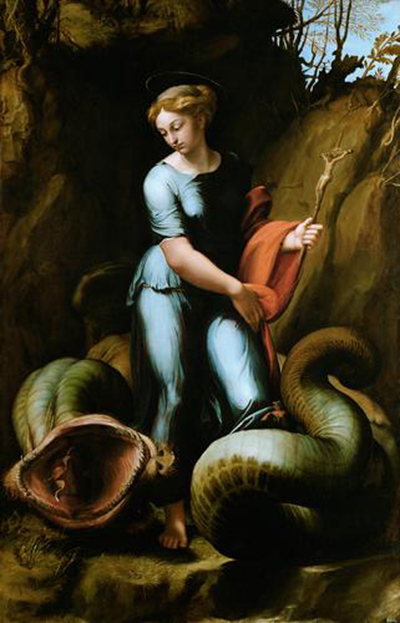
The Louvre Saint Margaret makes a martyr's victory look almost effortless. A young woman in blue and red steps across a dragon's opened wing. She carries a long palm, turns her face toward the spectator and remains serenely upright while the monster's inverted head gapes at one side and its tail curls at the other.[1][2]
Made in 1518, the work was a gift from Pope Leo X to François I of France. French national records say it was probably intended for the king's sister, Marguerite of Angoulême, whose name gave the saint a personal diplomatic relevance.[1][2]
The Louvre now catalogues both Raphael and Giulio Romano. The French Ministry of Culture describes the invention as Raphael's and the execution as Giulio's.[2] That division makes the painting an especially revealing product of Raphael's late studio: the design belongs to the master's artistic language, while the surface brings a leading collaborator into the attribution itself.
At a Glance
- ArtistsRaphael and Giulio Romano
- Louvre titleSainte Marguerite
- English titleSaint Margaret
- Date1518
- Medium/supportoil originally on wood, later transferred to canvas
- Current Louvre dimensions185 × 117 cm
- SubjectSaint Margaret of Antioch victorious over a dragon
- Principal attributepalm of martyrdom
- Commissioner/giverPope Leo X
- RecipientFrançois I; probably conceived for his sister Marguerite of Angoulême
- AuthorshipRaphael's invention with execution substantially assigned to Giulio Romano
- First collectionFrench Crown in 1518
- Holding institutionLouvre, Department of Paintings, Paris
- Museum numbersINV 607; B 2599
- Display when checkedRoom 710, Denon wing
Contents
- Margaret, the demon and the dragon
- The palm of martyrdom
- One bare foot on a wing
- The dragon's inverted face
- A frontal heroine
- Blue, red and the opening of light
- An antique victory remade
- A probable address to Marguerite of Angoulême
- Leo X and gifts to France
- Raphael's invention, Giulio Romano's execution
Margaret, the demon and the dragon
Margaret of Antioch belongs to Christian legend rather than securely documented ancient history. Medieval accounts present her as a virgin who rejected the demands of the pagan prefect Olybrius, endured torture and was imprisoned for her faith.
In the Golden Legend, she asks to see her spiritual enemy. A dragon appears and attempts to devour her. One telling says the sign of the cross makes it vanish; another says the monster swallows her and then splits open so that she emerges unharmed.[3]
The text itself calls the swallowing episode apocryphal, but that reservation did little to reduce its visual power. Dragon and saint became Margaret's most recognisable combination.
The story continues after the beast. Margaret throws a demon in human form to the ground and places her foot on his neck. She is later beheaded, completing her martyrdom.[3]
Raphael's composition fuses those stages. The monster belongs to the prison ordeal; the foot records victory; the palm announces the death and heavenly reward still to come.
The palm of martyrdom
Margaret holds a long palm branch in her right hand. In Christian imagery, the palm signifies victory through martyrdom, recalling both triumphal processions and the reward of those who die for faith.[2]
Its presence gives the painting a broad temporal reach. The dragon lies defeated now, but the palm knows that Margaret will face execution afterward.
The branch also extends her figure upward. Its narrow line rises above the body and counters the low curves of tail and wing.
Unlike a sword or spear, it cannot be mistaken for the means by which she physically conquered the beast. The victory remains spiritual.
This is the clearest distinction from Raphael's Vienna version, where Margaret holds a cross. Vienna stresses the sign that defeats the dragon; the Louvre stresses the martyr's ultimate triumph.
One bare foot on a wing
Margaret places a bare foot upon the dragon's spread wing. The contact is light, almost tender, yet it fixes the monster to the ground.
Raphael avoids the heavy downward force seen in many images of warrior saints. Margaret does not need armour, a horse or a violent blow.
The foot makes bodily what the palm makes symbolic: she has passed through danger without being deformed by it.
Its exposed skin also intensifies contrast. Soft human vulnerability rests directly upon the rough anatomy of a demonic beast.
The gesture transforms an antique pose of triumph into Christian paradox. The apparently weaker body commands the terrifying creature because spiritual constancy reverses ordinary measures of power.
The dragon's inverted face
The creature's head appears low at the left, its mouth opened into a cavernous, nearly upside-down shape. Teeth, tongue and staring eyes turn the legendary threat into a disturbing presence.
Raphael does not give the dragon the coherent anatomy of a real animal. Its head, wing and tail feel partly disconnected, as if monstrosity meant a failure of natural order.
The open mouth recalls swallowing but can no longer act. Margaret has moved above and beyond it.
At the other side, the tail coils across the ground and helps contain the saint's feet. The beast therefore frames her from both directions even in defeat.
Its fragmentation makes her body seem exceptionally complete. Blue dress, red cloth, head and palm form one continuous ascending movement against the scattered parts of evil.
A frontal heroine
The Louvre Margaret advances more directly toward the spectator than the saint in Vienna. Her torso opens to the front, and her face engages the world beyond the picture.
This orientation makes the victory public. She does not remain absorbed in a private exchange with the monster.
Her movement resembles a figure arriving after ordeal, emerging from darkness with the calm of an apparition.
The body is neither rigid nor dramatically twisting. One leg advances, the hips shift, and cloth follows, but the overall silhouette remains stable.
That union of motion and composure belongs to Raphael's mature art. Action is made intelligible by being organised around a figure whose emotional centre does not break.
Blue, red and the opening of light
The saint's blue garment and red cloth distinguish her from the brown, wooded enclosure. Light concentrates on her flesh and clothing, while the dragon and rocks remain lower and darker.
The colour does not merely beautify the heroine. It declares that she belongs to a different order from the creature beneath her.
The blue follows her long body; red catches the turning arm and gives warmth near the palm. Together the colours prevent the central figure from dissolving into the surrounding shadows.
Small openings in the rocky or wooded setting suggest a world beyond the ordeal. Margaret does not remain sealed inside the place of temptation.
Her emergence can therefore be read spatially as well as spiritually. She moves from the monster's dark domain toward the viewer and the light.
An antique victory remade
The pose has often been related to ancient images of Victory. The advancing stance, flowing cloth and untroubled supremacy translate the Christian martyr into a classical triumphal form.
Raphael's Rome offered sustained access to ancient sculpture and reliefs. He did not copy antiquity as neutral ornament; he used its bodily authority to answer new subjects.
Margaret is especially striking because a female saint assumes a posture associated with conquest while remaining unarmed.
The palm mediates between the traditions. It belonged to Roman victory ceremony and became a Christian sign of martyrdom.
In the painting, ancient and Christian meanings do not compete. The historical language of triumph helps viewers understand a victory defined by endurance rather than domination.
A probable address to Marguerite of Angoulême
The French Ministry of Culture says the painting was probably intended for Marguerite of Angoulême, sister of François I.[2] The namesake relationship would have made the subject flattering and personal.
Marguerite was Duchess of Alençon in 1518 and later Queen of Navarre. She was an important political, literary and religious figure at the French court.
The painting need not be a portrait to address her. A patron saint could offer a model of steadfastness, learning and victory while honouring the recipient through her name.
The word “probably” remains important. The Louvre's concise object history securely records Leo X's gift to François I in 1518; the more specific destination to Marguerite is a documented institutional hypothesis rather than a surviving personal dedication.[1][2]
This distinction allows the diplomatic context to remain rich without turning probability into certainty.
Leo X and gifts to France
The Saint Margaret arrived during a concentrated exchange of Raphael paintings between papal Rome and the French court. The Great Saint Michael and the Great Holy Family also belong to the 1518 group associated with François I and his family.
Pope Leo X used celebrated art to give political rapprochement visible form. A work from Raphael's studio carried the cultural prestige of Rome and the Medici papacy.
Each subject could address a recipient differently. Michael corresponded to the king's chivalric order; a Holy Family suited Queen Claude; Margaret's saintly namesake could honour the king's sister.
The works were not generic luxury cargo. Iconography made diplomacy personal.
The Louvre's record of Crown ownership beginning in 1518 confirms that Saint Margaret reached France as intended.[1]
Raphael's invention, Giulio Romano's execution
The Louvre names Raphael and Giulio Romano together.[1] The national Joconde record makes the proposed division explicit: the invention is Raphael's, the execution Giulio's.[2]
Giulio was no minor copyist. He was Raphael's most forceful painterly collaborator and later developed a major independent career in Mantua.
The attribution formula recognises two kinds of agency. Raphael determined the governing conception—the antique triumphant figure, the surrounding monster and the balance of grace and horror. Giulio translated much or most of that conception into paint.
This does not reduce the object to a design detached from its surface. The painting viewers see is precisely the product of translation between artists.
Nor should every attractive passage automatically be returned to Raphael and every awkward one assigned to Giulio. The joint museum record is more responsible than an imaginary map of hands unsupported by technical evidence.
What a Raphael studio painting meant
In 1518 Raphael directed many projects at once. His reputation and papal responsibilities exceeded the amount one person could execute alone.
The studio allowed inventions to become paintings, frescoes, textiles, prints and architectural decoration. Drawings and cartoons preserved a compositional idea while skilled collaborators carried it through later stages.
Royal gifts demanded speed as well as distinction. A leading assistant could make production possible without erasing Raphael's responsibility for what left the studio under his name.
The Saint Margaret makes that system unusually visible because modern catalogues retain both names rather than hiding the collaboration beneath a single master.
Its authorship is therefore not a defect to explain away. It is evidence for how the most successful artistic enterprise in early sixteenth-century Rome worked.
A drawing after a lost study
The Royal Collection preserves a drawing thought to copy a lost Raphael study for the Louvre composition. Its record describes the painting's execution as generally assigned to Giulio Romano after Raphael's designs.[4]
A copy after a lost sheet cannot show Raphael's hand directly. It can, however, preserve information about a preparatory stage that no longer survives.
Such objects remind us that design histories are often reconstructed from fragments, copies and later repetitions rather than a complete chain of original drawings.
They also explain why “invention” can be more than a stylistic intuition. Raphael's ideas circulated on paper in forms assistants and later copyists could use.
The relationship must remain carefully worded: the Royal Collection sheet is not the original cartoon and not proof of the painted hand.
Wood transferred to canvas
The Louvre's live record describes oil on canvas and immediately qualifies the support as wood transferred to canvas.[1]
Raphael and Giulio's studio painted on a wooden panel. At a later date, the paint-bearing layers were removed from that support and attached to fabric.
The French national record confirms a transfer but displays a truncated date, so the year should not be guessed.[2]
This physical change explains why different sources may call the same object a panel painting or a canvas. The first describes its original making; the second describes its present support.
Transfer could preserve an image thought to be endangered, but it also transformed the object's material identity. The surface now belongs to both sixteenth-century creation and later intervention.
Two published measurements
The Louvre's current record gives 185 by 117 centimetres.[1] The Joconde record lists 178 by 122 centimetres.[2]
Such variations may result from different measuring campaigns, the handling of edges after transfer or older catalogue conventions. They do not create two objects.
For current identification, the holding museum's live dimensions should lead. Historical measurements remain useful evidence for the object's changing documentation.
The discrepancy is another reason inventory number matters more than a bare title. INV 607 identifies the Louvre picture despite shifts in measurement and support wording.
Frame-inclusive figures should also be kept separate: the Louvre lists a height of 211 centimetres with its accessory and a width of 150.5 centimetres.[1]
From François I to the Louvre
The painting entered the French royal collection in 1518 and remained part of the Crown holdings.[1][2]
Its history is therefore unusually direct. It did not pass through modern dealers before entering a national museum.
The Louvre assigns it principal number INV 607 and alternate number B 2599. When checked, it was displayed in Room 710 of the Denon wing.[1]
Later reproductive engravings spread the composition beyond palace and museum. A British Museum print made around 1729–40 shows Margaret with the dead dragon and identifies the design after Raphael and Giulio Romano.[5]
Reproduction helped stabilise the painting's fame even as attribution changed. The image could remain “Raphael's Saint Margaret” in cultural memory while catalogues became more precise about Giulio.
How the Vienna version differs
Vienna Gemäldegalerie 171 is a separate poplar panel, slightly taller and wider than the Louvre's current painted field.
Its Margaret turns sideways toward the dragon and holds a cross. The monster's mouth and tail encircle her more directly.
The Louvre saint advances frontally with the palm, lightly pinning an open wing beneath her foot.
The first histories do not overlap. Vienna was painted for the abbot of San Benedetto in Venice and entered Venetian collections before travelling through Hamilton to Archduke Leopold Wilhelm. Paris was a papal gift to François I.
Attribution also differs in museum wording. Vienna catalogues Raphael while discussing assistants. The Louvre names Raphael and Giulio Romano jointly and specifies their proposed roles.[1][2]
How to look at the Louvre Saint Margaret
Start with the palm, then follow its long line downward through Margaret's body to her bare foot.
Find the dragon's open wing beneath that foot before searching for the inverted head at the left.
Trace the tail across the opposite side. The monster becomes a broken frame around the continuous human figure.
Compare the blue-red clarity of her clothing with the brown enclosure, then look for the openings of sky and forest.
Finally, imagine the composition on its original wooden panel. The present canvas carries an image whose physical foundation has changed.
Why the painting matters
The Louvre Saint Margaret is a rare case in which diplomatic meaning, namesake devotion and workshop authorship can all be seen in one commanding figure.
Its palm turns victory over a dragon into a prophecy of martyrdom. The saint defeats fear now and death later.
The probable address to Marguerite of Angoulême shows how religious subject and court identity could be joined without portraiture.
The joint attribution corrects the old desire to make Raphael's fame depend upon solitary execution. Design and painting were distributed through a studio whose collaborators had recognisable authority.
And the comparison with Vienna proves that a repeated subject is not a duplicate. Change the attribute, gaze, monster and recipient, and the entire meaning of triumph changes.
Artist Up Close
Look first for the tiny pressure of Margaret's bare foot on the dragon's much larger wing.
Follow the palm upward and treat it as a second vertical body, a sign of future martyrdom beside present victory.
Notice that the dragon is easiest to understand in parts—head, wing, tail—while Margaret reads whole.
Then compare the polished conception with the joint Raphael–Giulio attribution. The picture's unity was produced through more than one artist's labour.
Frequently Asked Questions
Discussion
What detail most changes how you read Raphael and Giulio Romano's Saint Margaret: The Louvre Version?
Reader Insights
Which source detail gives the page its strongest anchor?
Which visual or historical distinction should readers keep in mind?
How does this page change the wider picture of Raphael's career?
Join the Conversation
Share your reading below.
References
- Musée du Louvre, “Sainte Marguerite,” INV 607. View source.
- Ministère de la Culture, POP: Plateforme ouverte du patrimoine, “Sainte Marguerite,” Joconde 000PE026981. View source.
- Jacobus de Voragine, “The Life of St. Margaret,” The Golden Legend, translated by William Caxton and edited by F. S. Ellis, Fordham University Internet Medieval Sourcebook. View source.
- Royal Collection Trust, “St Margaret,” RCIN 851502, a drawing after a lost Raphael study. View source.
- British Museum, “St Margaret,” etching and engraving after Raphael and Giulio Romano, V,5.119. View source.