

 by Tom Gurney
Tom Gurney BSc (Hons) is an art history expert with over 20 years experience
Published on June 19, 2020 / Updated on August 21, 2026
Email: tomgurney1@gmail.com / Phone: +44 7429 011000
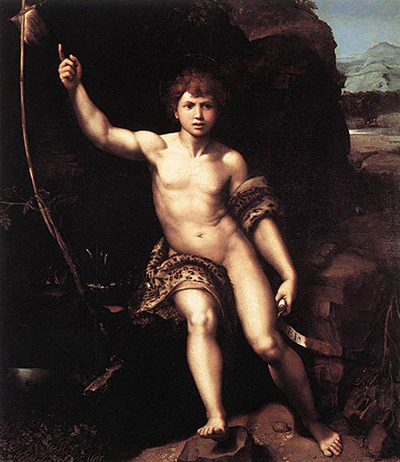
Raphael's Saint John the Baptist as a Boy presents a solitary adolescent in a wilderness that seems to wait for his voice. John sits on a rock, his pale, muscular body emerging from warm light against a dark crag. One hand holds a scroll whose surviving word is DEI; the other points toward a radiant cross fastened to an oak. Water gathers at the left, while a lake, forest and mountains open far into the distance at the right.[1][2]
The Uffizi dates the painting to about 1517–18. Its current title emphasises John's youth, while the familiar title Saint John the Baptist in the Desert emphasises the setting and later hagiographical story.[1]
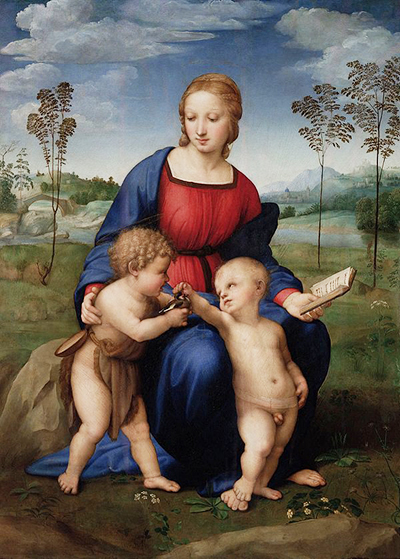
This is not the child who joins the Virgin and Christ in Raphael's Florentine Madonnas, nor the small preacher addressing a crowd in the Ansidei predella. Here John is alone, almost nude and already conscious of his mission. Gesture turns solitude into proclamation: the viewer follows his finger toward Christ's future cross.
At a Glance
- ArtistRaphael
- Uffizi titleSt John the Baptist as a Boy
- Familiar titleSaint John the Baptist in the Desert
- Dateabout 1517–18
- Medium/supportoil on canvas
- Dimensions163 × 147 cm
- Subjectthe young John in a rocky wilderness
- Attributesleopard skin,
DEIscroll, radiant cross, spring and pool - Principal visual sources named by the UffiziLeonardo's Saint John the Baptist, the Laocoön and the Ciampolini Zeus
- CommissionerCardinal Pompeo Colonna
- Early recipients/ownersJacopo Berengario da Carpi and Francesco Benintendi
- Attribution historydebate over Raphael, Giulio Romano and Giovan Francesco Penni
- Present museumUffizi Galleries, Florence
- Inventory1890 no. 1446
- Gallery when checkedA38, Raphael and Michelangelo
Contents
- What the Gospels say about John's youth
- A young body with an adult mission
- The surviving word DEI
- The hand that redirects attention
- The radiant cross on the oak
- Water before the baptism
- A lake, forest and mountain distance
- Leopard skin, not camel hair
- The Laocoön in John's limbs
- The Ciampolini Zeus and the forward foot
What the Gospels say about John's youth
Luke describes John's miraculous birth to the priest Zechariah and Elizabeth, then says only that the child grew, became strong in spirit and remained in the wilderness until his public appearance before Israel.[4]
The canonical text does not provide episodes of a five-year-old hermit wandering alone. Later Lives of John and medieval sacred stories expanded the brief verse into a childhood already shaped by solitude and prophecy.[1][2]
Raphael's painting belongs to that expanded tradition. The figure is adolescent rather than a tiny boy, yet his youth makes vocation appear innate.
He has not reached the crowded riverbank of his adult preaching and baptism. He already possesses its symbols: water, cross and the phrase by which he will identify Christ.
The distinction between Gospel and later story enriches the image. Raphael shows not a documented childhood event but a devotional meditation on how early the forerunner understood his task.
A young body with an adult mission
John's limbs are long and increasingly muscular, but his face and smooth flesh retain youth. The body occupies the centre with a self-assurance that feels older than the sitter's apparent age.[1][2]
This tension makes the subject compelling. Physical adolescence becomes the threshold between hidden childhood and public prophecy.
He does not play with his attributes. The scroll is held with purpose, and the pointing arm controls the viewer's attention.
The near nudity removes signs of ordinary social identity. Rank, wealth and urban life disappear, leaving body, animal skin, rock and sacred signs.
Yet Raphael avoids emaciation. John is not weakened by fasting. His healthy, ideal form presents desert discipline as spiritual strength.
The surviving word DEI
The scroll in John's right hand displays DEI, the closing word of Ecce Agnus Dei—“Behold the Lamb of God.” The Gospel of John gives this proclamation to the adult Baptist when he recognises Jesus.[1][4]
Raphael lets a fragment evoke the full phrase. Viewers familiar with John's iconography could complete the missing words mentally.
The abbreviation also prevents text from dominating the body. A few letters identify speaker, prophecy and future encounter without converting the canvas into a written page.
Because the young John has not yet publicly met Christ in this imagined chronology, the scroll functions prophetically. His future words are already present in the wilderness.
The painting thus makes time fold inward. Childhood, adult proclamation, baptism and Christ's sacrifice coexist through attributes rather than narrative sequence.
The hand that redirects attention
John raises his left arm and points away from himself toward the cross. The Uffizi compares the emotional force of this gesture with Leonardo da Vinci's Saint John the Baptist, now in the Louvre.[1]
Leonardo's half-length saint emerges from darkness and points upward with an enigmatic smile. Raphael broadens the body, clarifies the destination and places the gesture inside a landscape.[3]
The relationship is one of creative assimilation, not duplication. Raphael turns Leonardesque mystery into explicit Christian direction.
John's finger also makes the viewer an active participant. We first meet the illuminated body and face, then are told not to stop there.
The saint's charisma is therefore self-effacing. His beauty attracts attention in order to send it toward another figure who is not physically present.
The radiant cross on the oak
A tall cross is tied to the trunk of an oak. Light around it gives the simple wooden form supernatural visibility.[1][2]
The cross refers to Golgotha and Christ's future sacrifice. It also belongs to John's established role as forerunner, the person who announces what the world has not yet recognised.
Fastening it to a living tree joins two kinds of wood: natural growth and the instrument of execution. The cross appears both made and rooted.
The oak's strength supports the symbol, while surrounding darkness makes the radiance legible.
John does not touch the cross. The interval between finger and object is essential. Gesture, rather than possession, creates the theological connection.
Water before the baptism
At the left, a spring emerges and feeds a clear pool. The Uffizi relates it to purity and to the baptism Christ will receive from John in the Jordan.[1][2]
Water is both an actual desert necessity and a sacramental sign. It keeps the landscape believable while opening a future event.
The pool's reflective brightness answers the light around the cross. One attribute belongs to Christ's baptism; the other to his death.
Together they summarise John's mission. He will prepare through water and identify the person whose path leads to sacrifice.
The spring also prevents the wilderness from feeling dead. Solitude contains a source, a visual form of spiritual renewal.
A lake, forest and mountain distance
The right side moves from rocky foreground toward a lake bounded by trees and distant peaks.[1]
This openness contrasts with the crag behind John's body. Near space is enclosed and shadowed; far space is cool, gentle and expansive.
Landscape makes his withdrawal voluntary. A larger inhabited or inhabitable world exists beyond the rocks, but John occupies the threshold of solitude.
The lake extends the water theme from spring to horizon. Baptismal meaning is not confined to one little pool; it echoes across the country.
Atmospheric distance also gives the large body a believable world. John dominates the canvas but does not become a figure pasted before darkness.
Leopard skin, not camel hair
The Gospels describe the adult John wearing camel hair with a leather belt. Raphael instead wraps the young saint in a precious leopard skin.[2][4]
The Uffizi calls attention to this freedom. The spotted pelt is more luxurious and visually animated than a rough ascetic tunic.[2]
It also brings the sacred youth close to antique figures associated with wild nature. A leopard skin could recall Bacchic imagery, though the Christian signs redirect any pagan association.
Raphael had already used such a garment for the young John in the Madonna dell'Impannata.[2] Repetition made it part of his late visual vocabulary.
The substitution shows that iconographic truth did not require literal costume. The animal skin signals wilderness and separation while colour and pattern serve the body's movement.
The Laocoön in John's limbs
The Uffizi compares the positioning of John's limbs with the ancient Laocoön group.[1][2] Discovered in Rome in 1506, the sculpture became an essential test of how artists understood bodily torsion, strain and classical form.
Raphael does not copy Laocoön's agony. He extracts the organisation of limbs and converts it into composed seated movement.
That transformation is important. A priest and his sons struggling against serpents becomes a youthful prophet whose body is emotionally open and controlled.
Antique study supplies complexity without importing the original tragedy.
John's bent legs and turn prevent the broad canvas from settling into static symmetry. The body creates a chain of angled joints that leads back toward the pointing arm.
The Ciampolini Zeus and the forward foot
The slightly projecting leg and foot recall the antique statue known as the Ciampolini Zeus, according to the Uffizi.[1][2]
Raphael's Roman work repeatedly translated the stance of gods and heroes into Christian bodies. Here the classical reference gives a desert saint physical amplitude.
The forward foot enters the viewer's space and strengthens the impression of a living presence seated just beyond the frame.
At the same time, the relaxed placement keeps the figure from appearing to pose as a conqueror. John's authority comes through invitation and prophecy.
Combining Zeus and Laocoön was not an antiquarian puzzle for viewers to solve. It was a way to make the ancient body newly familiar within Christian feeling.[2]
Warm light against dark rock
The Uffizi emphasises the contrast between John's pale flesh and the crag behind him, relating the warm colour and chiaroscuro to Leonardo.[1]
Darkness allows the body to emerge gradually rather than through a hard cutout. Shoulders, chest and limbs seem modelled by surrounding air.
Warmth makes the wilderness feel inhabited despite its solitude. The saint's flesh carries life into the rock.
The chiaroscuro also differs from the clear daylight of Raphael's earlier Florentine Madonnas. Late Rome deepened his interest in figures that seem to press out of shadow.
Yet the painting remains more spatially explicit than Leonardo's Saint John. Landscape, water and cross turn the mysterious encounter into a readable sacred environment.
Leonardo remembered in Rome
Leonardo began his Louvre Saint John in early sixteenth-century Florence. The work's dark emergence, smile and upward-pointing hand became an unforgettable solution to the saint's role as witness.[3]
Raphael had studied Leonardo closely during his Florentine years. More than a decade later, he could recall that example without simply returning to an earlier style.
The Uffizi picture replaces the tight half-length format with a nearly square, full-bodied wilderness scene. The gesture points sideways toward a visible cross rather than upward beyond the painted field.
Raphael also gives John a scroll and baptismal water, multiplying the signs around the body.
The comparison shows mature independence. Leonardo's psychological invitation becomes one strand inside a larger synthesis of antique pose, hagiographical youth and landscape prophecy.
Cardinal Pompeo Colonna's commission
The Uffizi identifies this as the painting Vasari described in both editions of his Lives. Cardinal Pompeo Colonna commissioned it and gave it to his physician, Jacopo Berengario da Carpi.[1]
Colonna received the cardinal's hat in 1517, one reason the work is dated to 1517 or 1518.[1]
Berengario was a celebrated anatomist and surgeon as well as a physician. A painting centred on an idealised human body was an exceptionally distinguished gift to such a recipient, although no source says anatomy determined the subject.
The act of giving matters. Raphael's late religious pictures could circulate as personal rewards and instruments of learned patronage, not only as church furnishings.
The cardinal's commission also locates the picture within the networks of Leo X's Rome, where ecclesiastical office, medicine, antiquity and artistic prestige met.
Berengario da Carpi and Francesco Benintendi
After receiving the painting, Berengario passed it to or was followed in ownership by the Florentine Francesco Benintendi.[1]
The concise record does not explain every transaction, so it is safest to preserve the named sequence without inventing motives.
The move toward Florence had particular resonance because John the Baptist was the city's patron saint. The image joined a culture already saturated with his feast, baptistery and civic symbolism.[2]
By 1589, the painting was displayed in the Uffizi gallery.[1] That early grand-ducal presentation secured its place within one of Europe's most celebrated collections.
Its Roman invention, Florentine saint and Medici destination give the work a double geography. It belongs to Raphael's late Rome and to Florence's visual identity.
Raphael, Giulio Romano and Penni
The painting has prompted extensive debate. Some scholars have regarded it as wholly Raphael's; others detect the participation of Giulio Romano or Giovan Francesco Penni.[1]
Both assistants were capable of turning Raphael's designs into large finished pictures. Around 1518 such collaboration was normal within his studio.
The Uffizi retains Raphael as the catalogue attribution while making the controversy visible.[1] That is the appropriate balance for a public account.
No secure evidence allows individual body parts to be labelled by hand. A confident division of face, torso or landscape would exceed the museum's statement.
What can be seen is an exceptionally integrated conception. Antique pose, Leonardesque shadow, Christian symbols and landscape all serve John's redirecting gesture, whether Raphael painted every passage or supervised skilled participation.
Not the Ansidei predella preacher
Raphael's Saint John the Baptist Preaching in the National Gallery, London, dates from about 1505 and formed part of the predella below the Ansidei Madonna.
That small horizontal panel shows an adult prophet addressing a crowd. Its function belongs to an altarpiece narrative sequence.
The Uffizi work is much later, measures 163 by 147 centimetres and presents one adolescent body in a nearly square field.[1]
The early picture owns public speech and gathered listeners. The late picture turns prophecy into silent gesture directed at the viewer.
Shared saint and desert do not make them versions. Date, format, age, action, patron and collection all differ.
How to look at the painting
Start with John's eyes and raised hand. Follow the finger until the radiant cross comes into focus.
Return to the scroll and complete DEI mentally as part of the Baptist's future proclamation.
Find the small spring and pool at the left, then allow the water motif to expand toward the distant lake.
Inspect the spotted skin and compare its luxury with the scriptural description of camel hair.
Finally, trace the bent legs and forward foot. Antique bodily knowledge has been converted into a young saint's invitation.
Why the painting matters
The Uffizi Saint John gives a figure known for harsh desert preaching an unusual combination of beauty, youth and emotional warmth.
Its symbols turn a still pose into a complete sacred chronology. Water anticipates baptism, DEI anticipates recognition, and the cross anticipates the Passion.
Raphael's visual learning is equally compressed. Leonardo guides the relation between shadow and pointing; ancient sculpture organises the limbs; later sacred stories make childhood carry adult vocation.
The provenance from Colonna through Berengario and Benintendi shows the painting moving through ecclesiastical, medical and Florentine circles before entering the Uffizi display by 1589.
Most of all, the work defines John through redirection. The luminous body attracts the eye, then refuses to remain its destination.
Artist Up Close
Read the one visible word on the scroll before following the other hand.
Notice how the cross is attached to an oak rather than floating as a free emblem.
Compare three forms of illumination: warm flesh, radiant cross and reflective water.
Then look at the foot projecting over the rock. Classical presence and Christian invitation occupy the same gesture.
Frequently Asked Questions
DEI mean?Discussion
What detail most changes how you read Saint John the Baptist in the Desert?
Reader Insights
Which source detail gives the page its strongest anchor?
Which visual or historical distinction should readers keep in mind?
How does this page change the wider picture of Raphael's career?
Join the Conversation
Share your reading below.
References
- Uffizi Galleries, “St John the Baptist as a Boy,” inventory 1890 no. 1446. View source.
- Anna Bisceglia and Uffizi Galleries, “The Saint Who Baptized Christ,” online exhibition, entries on Raphael's St John the Baptist. View source.
- Musée du Louvre, “Musée du Louvre loans Saint John the Baptist by Leonardo da Vinci,” 2022. View source.
- The Bible, Luke 1:80; Matthew 3:4; John 1:29.