

 by Tom Gurney
Tom Gurney BSc (Hons) is an art history expert with over 20 years experience
Published on June 19, 2020 / Updated on August 21, 2026
Email: tomgurney1@gmail.com / Phone: +44 7429 011000
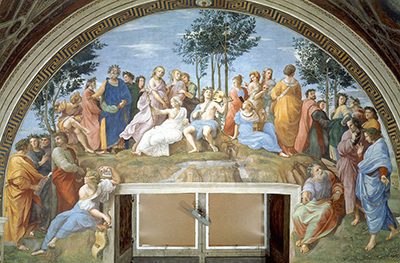
Raphael's Parnassus imagines poetry as a gathering held in music. Apollo plays at the centre beneath a small clearing of sky. The Muses turn around him, while poets from antiquity and the Christian era occupy the slopes of an invented mountain. Homer lifts his blind eyes as if receiving words from beyond sight; Virgil and Dante stand behind him; Sappho sits at the lower edge with her name written on a scroll.
The assembly is learned, but it is not static. Bodies lean, listen, recite and answer one another. Drapery and laurel move across the wall in long rhythms. Raphael has painted a canon of poets, yet the image resists becoming a list. Poetry exists here as performance, memory, inspiration and social exchange—and as a visual art capable of making imagined sound fill a papal room.
At a Glance
- ArtistRaphael, with workshop assistance
- TitleParnassus
- Dateapproximately 1510–1511
- LocationPoetry wall, Stanza della Segnatura, Vatican Palace, Vatican City
- MediumFresco
- PatronPope Julius II
- ProgrammePoetry, beneath the ceiling personification of Poetry
- Central figureApollo playing a bowed lira da braccio
- AssemblyThe nine Muses and ancient and modern poets
- Securely recognisable poetsHomer, Virgil, Dante and Sappho[1][2][3]
Contents
- Poetry in Julius II's Library
- Mount Parnassus in Rome
- Apollo and the Sound at the Centre
- The Nine Muses
- Homer, Virgil and Dante
- Sappho at the Threshold
- Ancient and Modern Poets
- Painting Around a Real Window
- Drawings, Revisions and a Changed Design
- Fresco and the Rhythm of Making
Poetry in Julius II's Library
The Stanza della Segnatura was the first Vatican room decorated by Raphael for Julius II. It probably served as the pope's private library and study before later becoming associated with the tribunal from which its modern name derives. The four great wall subjects correspond to the ceiling personifications of Theology, Philosophy, Poetry and Justice.[2][3]
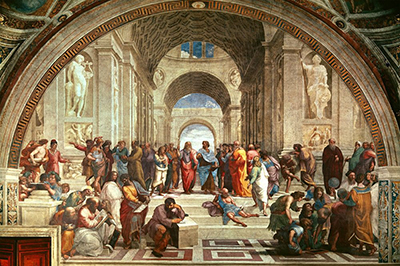
Parnassus occupies the wall beneath Poetry. The School of Athens presents philosophy through ancient thinkers in an ideal architecture; the Disputation of the Holy Sacrament presents theology through the Church in heaven and on earth; the wall of Virtues and Law addresses justice. Poetry is given neither a building nor a Christian heaven. Raphael places it in a sacred landscape from classical mythology.
This choice does not remove poetry from the papal setting. Apollo, the Muses and pagan poets appear within a programme made for the head of the Catholic Church. Dante and other modern writers join the ancients. The wall turns classical myth into a language through which Renaissance literary culture can imagine its own ancestry.
Books probably stood below these images. A reader in the room could move from written texts to painted authors and from one faculty to another. Poetry was not treated as ornament added after more serious disciplines. It received one of the room's principal walls and a governing place on the ceiling.[2][3]
The fresco's relation to a library helps explain its crowd. A library contains voices that never met: different languages, periods and genres coexist through books. Raphael gives that coexistence bodies. The mountain becomes a living collection, organised by affinities without pretending to a historical event.
Its painted gathering also makes reading social. A solitary book can carry a distant voice, but Parnassus restores imagined speakers, listeners, rivals and heirs around it.
Mount Parnassus in Rome
In Greek mythology, Mount Parnassus was associated with Apollo and the Muses, and therefore with music, poetry, prophecy and inspired knowledge. Raphael does not paint a topographical view of the real mountain in central Greece. His Parnassus is a gently rising, laurel-filled stage adapted to the architecture of the Vatican room.[1]
The mountain is suggested rather than described. Ground rises behind the foreground groups; trees and sky establish an outdoor setting; figures occupy terraces of different height. The central summit is low enough for Apollo to remain intimately connected with the poets around him.
Laurel is both plant and sign. Sacred to Apollo and used to crown poets, it links the landscape to literary honour. Wreaths distinguish several figures, while living branches make poetic fame appear to grow from the mountain itself.
The trees do more than identify the place. Their trunks create vertical accents in a composition otherwise governed by slopes and turning bodies. Leaves break the pale sky into irregular patches, softening the wall's architectural boundary. The central foliage shelters Apollo without forming a rigid throne or halo.
This natural canopy helps explain the fresco's intimacy. Apollo is a god, yet he sits among performers rather than above them. Branches gather the centre while leaving the flanks open to the poets. The mountain's authority is environmental: laurel, elevation and music establish sacred ground without a temple.
Raphael also uses the green landscape to mediate between strong garment colours and the light wall. Reds and blues can remain vivid because foliage and earth provide a quieter field. What first appears to be background is therefore essential to the rhythm and legibility of the assembly.
The landscape differs sharply from the School of Athens. There, stone architecture creates a rational, humanly constructed order. Here, the order seems organic. Groups follow the slope; bodies overlap like branches; the sky opens irregularly through foliage. Poetry requires structure, but its structure does not look engineered.
Raphael still controls the wall with great precision. Apollo occupies the centre, and the Muses distribute around him. Major poet groups balance the lower left and right. The hill's apparent naturalness is a compositional achievement.
The Roman setting adds another paradox. A Greek sacred mountain has been relocated inside a Christian palace. Renaissance Rome imagined itself as heir to ancient culture, and Julius II's patronage made that claim monumental. Raphael's fresco does not reconstruct pagan worship. It converts Parnassus into an academy of poetic excellence.
Apollo and the Sound at the Centre
Apollo sits beneath the central tree and plays a bowed stringed instrument. The Vatican's English record calls it a lyre, following the god's traditional attribute, but the instrument Raphael paints is closer to a contemporary lira da braccio. It is held at the shoulder and played with a bow rather than plucked like the ancient lyre usually imagined from classical art.[1][13][15]
This modernisation is deliberate and meaningful. Apollo is ancient, but his music enters the sound world of Raphael's Rome. The god does not display an archaeological reconstruction. He performs on an instrument that contemporary viewers could understand as capable of sustained melodic sound.
Institutional musical-instrument research has explored the distinction between ancient lyra and Renaissance lira. The names are similar, but the technologies and playing methods differ. Raphael uses visual tradition freely: the god remains Apollo because of the poetic setting and laurel, while the bowed instrument makes inspiration sensorially immediate.[15]
Apollo's posture is absorbed. He does not command the assembly with an orator's gesture. His eyes lower toward the strings, and his arms form a compact field of controlled movement. The god at the centre is working.
The bowed instrument lets Raphael suggest duration. A plucked note begins and fades; a bow can sustain a tone. The fresco cannot produce sound, but the continuous movement of cloth and bodies around Apollo seems to extend the music across the wall.
Preparatory studies associated with Apollo show Raphael testing the arms, instrument and seated balance. Royal Collection material preserves the history of a Lille drawing connected with the figure. Such evidence returns the god's apparently effortless music to the labour of design.[13]
The number of strings and exact construction have generated specialist discussion, but the larger visual point is secure. Raphael places living Renaissance musical practice at the heart of an ancient poetic world. Inspiration is transmitted by adaptation, not by perfect antiquarian recovery.
The Nine Muses
Apollo is surrounded by the nine Muses, protectors of the arts and branches of poetic or learned activity. Their presence establishes the mountain's divine community. Yet assigning every Muse a secure individual name is difficult.[1]
Classical and later traditions supplied attributes for Calliope, Clio, Erato, Euterpe, Melpomene, Polyhymnia, Terpsichore, Thalia and Urania, but Raphael does not turn the wall into a simple iconographic chart. Instruments, gestures and positions support some proposals more strongly than others. Later engravings and identification keys helped stabilise names that the fresco itself may leave open.[17]
The uncertainty is worth preserving because the Muses operate first as a group. They listen, turn and inhabit the music around Apollo. Their draperies create a circular motion that distinguishes the divine centre from the more conversational poet groups below.
Raphael gives them different temperaments. One reclines, another turns sharply, another stands with sculptural calm. The variety prevents divine inspiration from becoming a repeated female type. It also gives the wall a substantial community of women even though the named literary canon is overwhelmingly male.
A celebrated study for a reclining Muse, often identified as Euterpe, draws upon the ancient sculpture now known as the Sleeping Ariadne. The Metropolitan Museum's record describes Raphael's transformation of the antique pose and a related drapery study. The borrowing is not literal. A sleeping or abandoned body becomes an alert participant in poetic assembly.[8]
That transformation exemplifies Raphael's relationship with antiquity. He studies an ancient form, detaches it from its original story and gives it a new psychological and compositional function. The Muse belongs to Parnassus precisely because the source has been changed.
Homer, Virgil and Dante
Behind Apollo, three poets form the fresco's most authoritative human group. Homer, blind and laurel-crowned, raises his face and appears to recite. A youthful attendant records his words. Virgil turns toward him, while Dante stands in profile with his unmistakable hood and laurel.[1][6]
The Vatican identifies all three clearly. They form a genealogy of epic and visionary poetry: the Greek poet credited with the Iliad and Odyssey; the Roman author of the Aeneid; and the Florentine author of the Divine Comedy.
Homer's blindness is made expressive rather than merely descriptive. His unseeing eyes rise beyond the visible scene, suggesting inspired memory and oral recitation. The writing youth beside him converts performance into text. Poetry moves from voice to record within one small group.
Virgil provides the bridge between Homer and Dante. The Aeneid reworked Greek epic for Rome, while Virgil becomes Dante's guide through Hell and Purgatory. Raphael's arrangement turns literary influence into bodily proximity.
Dante's presence brings the chain into Christian and Italian modernity. The Vatican's research into his portrait tradition explains the recognisable profile, cap and laurel through which artists made the poet an icon.[6] He also appears on the Disputation wall, where his theological authority places him behind Sixtus IV. In the Stanza, Dante belongs to more than one faculty.
A surviving study of the three poet heads records Raphael's search for their relation. The Metropolitan Museum's Royal Collection loan record identifies Homer, Dante and an unidentified poet associated with the final group. The sheet shows heads tested as an expressive sequence before they became part of the wall.[7]
The group is not a neutral history. It elevates epic and the Comedy as a central line of poetic authority. Other genres and languages occupy the wider assembly, but these three receive exceptional placement behind the god.
Sappho at the Threshold
Sappho sits at the lower left, holding a scroll on which her name is written. The inscription makes her one of the fresco's most securely identified poets. She looks outward from the mountain's edge, physically close to the architecture of the real window below.[1]
Her placement is both prominent and marginal. She is large, near the viewer and clearly named, yet she sits below the main group and near the boundary of the composition. Raphael uses that threshold position to connect the ideal gathering with the room.
Sappho's survival in fragments made her Renaissance reception different from the continuous textual authority of Homer or Virgil. Her fame as a lyric poet endured even where direct access to her work was partial. Writing her name into the fresco acknowledges both canonical status and the need for identification.
She holds an instrument as well as a scroll, linking lyric poetry to music. In ancient culture, lyric verse was not simply silent text. Sappho's attributes answer Apollo's performance and the instruments of the Muses.
Her directness also matters within a male-dominated poet assembly. The Muses are divine women; Sappho is a historical woman credited with authorship. She is not absorbed into an anonymous feminine allegory.
The lower-left position invites a modern viewer to read Sappho as excluded from the centre, but the composition is more complex. The real window prevents a conventional continuous foreground, and Raphael uses the available edges for major seated figures. Her scale, inscription and outward presence give her unusual visibility even as the hierarchy of the canon remains unmistakable.
Ancient and Modern Poets
Around the secure figures stretches a much larger assembly of poets. Traditional identification keys name writers including Horace, Ovid, Petrarch, Ariosto and others, but the confidence of these proposals varies. Later prints sometimes supply names more decisively than the fresco itself.[5][17]
Raphael's larger idea does not depend on resolving every face. Ancient and modern poets share one mountain. Literary excellence can cross pagan and Christian eras, Latin and vernacular traditions, epic, lyric and other genres.
The writers gather in small conversational units rather than one ranked queue. Some listen to Apollo or Homer; others turn toward peers. Inspiration may descend from a god, but poetry also develops through reading and exchange among poets.
Laurel crowns make status visible while also creating repetition across the wall. Yet not every head bears the same wreath, and not every body occupies the same height. The canon has order without becoming a strict numbered hierarchy.
The inclusion of modern poets is an argument about the present. Raphael's contemporaries did not see antiquity as an unsurpassable world sealed in the past. Modern writers could enter Parnassus by transforming inherited forms. The fresco itself performs the same operation in painting.
This is why uncertain names should not be filled through enthusiasm. A complete cast list makes the work seem like a solved puzzle. Leaving some poets unnamed restores the experience Raphael actually offers: a crowd in which fame, type, attribute and later scholarship produce different degrees of recognition.
Painting Around a Real Window
Parnassus is not painted on a blank rectangular wall. A large window interrupts the lower centre. Raphael had to organise his mountain and assembly around an opening that belonged to the room's architecture.
The solution is so natural that the difficulty can disappear. The hill rises above the window; poets occupy the lateral zones; Apollo sits high enough to command the wall without floating disconnected from the foreground. The real opening becomes the base of an invented landscape.
Raphael uses the window's arch and recess as part of the composition's threshold. Sappho and figures on the right sit near its edges, seeming to mediate between painted Parnassus and the physical room. The viewer's world enters the fiction through architecture.
The wall's asymmetries required constant adjustment. A centred god does not guarantee balanced groups when the lower centre is unavailable. Raphael distributes mass through opposing seated figures, standing clusters and foliage. The result feels organic because the architecture has been absorbed rather than concealed.
Light from the real window would once have changed the surrounding fresco through the day. Painted sky and actual illumination met on the same wall. Even in modern museum conditions, the opening reminds viewers that the fresco belongs to a room used by living people.
Drawings, Revisions and a Changed Design
Surviving drawings show that Parnassus emerged through revision. Studies for heads, drapery, standing poets, Apollo and individual Muses isolate problems later coordinated across the wall.[7][8][10][11][13]
The British Museum holds sheets connected with groups of figures and with the drapery of a poet traditionally identified as Horace. Attribution histories around such drawings can be complex: some were once given to Raphael, others reassigned to pupils or copies, and scholarship continues to examine their function.[10][11]
This complexity is useful. A drawing related to a fresco is not automatically an autograph first thought. It may record workshop practice, copying, transfer or later study. Object-specific museum records provide a firmer basis than a generic label such as “Raphael sketch.”
Raphael's design appears to have changed substantially from earlier ideas. The final emphasis on Apollo, Homer and the broad poet assembly was not inevitable. Drawings let us glimpse abandoned groupings and the search for a composition capable of accommodating the window.
The study of the reclining Muse demonstrates the depth of transformation from antique source to final figure. The Apollo studies show the practical problem of fitting instrument, bow, arms and seated body into the centre. Head studies show expression developed separately from full-body placement.[7][8][13]
Drawing is therefore the hidden movement beneath the fresco's visible music. Revisions, transfers and workshop coordination made spontaneity possible.
Fresco and the Rhythm of Making
Painting into fresh plaster divides a large wall into daily working sections. Raphael and his workshop had to transfer designs, prepare pigment and complete passages while the surface remained receptive. The mountain's continuous rhythm was made through discontinuous labour.[4]
Colour helps hide those practical divisions. Drapery passes from one figure to the next in linked reds, blues, greens and golds. Laurel foliage breaks edges into small repeated forms. Sky and landscape create atmospheric continuity behind the groups.
Workshop participation belongs to the material history of the room. Raphael controlled the invention and final order, while assistants supported transfer and execution. Conservation research considers plaster, pigment and style to understand how responsibility was distributed.[4]
The fresco has also passed through later restoration and environmental change. What looks like a single Renaissance surface contains a history of ageing, repair and conservation. Technical study allows the poetic fiction to be understood as a vulnerable wall painting rather than an untouchable image.
This material perspective suits the subject. Poetry in the fresco moves between inspired voice and written record; the fresco itself moves between imaginative unity and the practical sequence of making.
Eloquence in the Body
Poetry cannot be read directly from a fresco, so Raphael gives language a physical form. The open mouth of Homer, the lifted chin of a listener, Sappho's scroll and Apollo's bow all stand for kinds of utterance. Even figures whose identities remain uncertain contribute through posture. They become the syntax of the wall.
Raphael's drawings clarify how deliberately this bodily eloquence was made. Studies may concentrate on the turn of a neck, the relation of three heads or the fall of cloth across a standing leg. Thomas and Whistler's study of eloquence in Raphael's drawings connects such searching to Renaissance ideas about persuasive gesture: bodies communicate before a viewer has decoded every attribute.[16]
This does not mean that each pose translates into one fixed verbal message. A hand can invite attention, keep rhythm or respond to a neighbouring figure at once. Raphael's achievement lies in coordinating ambiguous local gestures into a clear collective atmosphere.
Homer provides the strongest example. His head rises, mouth opens and unseen eyes turn upward. The pose makes inspiration visible without representing a god whispering into his ear. The writing youth gives the gesture a practical consequence: words heard or remembered become text.
Sappho communicates differently. Her seated body is relatively still, and her name-bearing scroll faces the room. Authorship is attached to an object that can outlast the voice. Apollo joins both modes. The bowed instrument requires physical performance but produces an invisible continuity like spoken verse.
Drapery extends these actions. Sleeves follow arms; mantles open around turns; folds descend from poised bodies into the slope of the hill. Where the School of Athens uses architecture to relate separate groups, Parnassus often uses fabric and foliage. Lines do not terminate at the edge of a person; they pass rhythm onward.
Faces vary between absorption and exchange. Some poets seem to listen inwardly, others converse, and a few acknowledge the space outside the fresco. The mountain therefore contains private composition, oral performance and public reception at the same time.
The wall's eloquence is ultimately painterly. Raphael cannot supply Homer's verses or Apollo's melody, but he can organise the expectation of sound. The silent fresco becomes persuasive because it makes viewers imagine what its bodies are doing beyond vision.
Prints and the Portable Parnassus
Engravings carried Raphael's composition beyond the Vatican. Marcantonio Raimondi produced a print after the design, and later printmakers returned to the subject. Museum records preserve variants in which the wall's colour and scale become line, tonal pattern and portable paper.[9][12][14][17]
Prints could preserve or alter identifications. They might add lettering, keys or inscriptions that encouraged viewers to treat the gathering as a definitive cast list. They also reversed, compressed or reframed the composition according to process and publication.
The Metropolitan Museum's record for Marcantonio's engraving shows the close relation between Raphael's inventions and a reproductive network that helped establish his European fame.[9] Royal Collection and Ashmolean records document later forms of this afterlife.[14][17]
On paper, the real window disappears as an architectural fact and becomes a shape within the image. The print viewer no longer stands in Julius's library. What remains is the ideal mountain and its assembly.
This mobility helped Parnassus become a reference point for later literary and artistic canons. It also makes returning to the fresco essential. The wall's relation to light, room, ceiling and neighbouring faculties cannot be fully carried by an engraving.
Poetry Among Theology, Philosophy and Justice
The Stanza's programme does not ask poetry to imitate the other faculties. Theology is vertically ordered around the Eucharist. Philosophy inhabits architecture and perspective. Justice combines personified virtues and legal histories. Poetry takes the form of music and mountain gathering.
Yet connections cross the walls. Dante belongs to theology and poetry. Pythagorean harmony in the School of Athens anticipates musical order here. Apollo appears as a statue in the philosophical hall and as a living performer on Parnassus. Books, memory, divine inspiration and human craft circulate through the room.
Raphael's image therefore resists the idea that poetry is irrational decoration. Its inspiration has structure; its canon has history; its music requires technique; its community depends on transmission. At the same time, the fresco refuses to reduce poetry to rules. Apollo plays, Homer recites and the Muses listen.
The room's physical arrangement keeps these faculties distinct but mutually visible. A viewer turns from wall to wall, carrying comparisons. Poetry becomes one way of knowing among others—not subordinate, not identical.
Why Parnassus Still Matters
The fresco offers an extraordinarily generous image of influence. Ancient and modern writers do not form a chain in which the present merely copies the past. Virgil transforms Homer; Dante transforms Virgil; Raphael transforms antique bodies and Renaissance music into a new Parnassus.
Each inheritance becomes an act of renewal.
Its canon is historically limited and its identities partly uncertain, but those facts deepen rather than destroy the work. They reveal how cultural memory is built: through selection, repetition, naming, loss and rediscovery.
The wall also makes a strong claim for painting. A silent art represents music, recitation and literary time. Pigment gives bodies to authors known through words. Architecture becomes landscape. A real window becomes the base of a mythic mountain.
Raphael's achievement is not that he solved poetry into one definition. He lets several accounts coexist. Poetry is divine gift, bodily performance, learned tradition, written text, social exchange and individual voice.
Artist Up Close
Start with Apollo's bow. Follow its short diagonal across the instrument, then look for other diagonals in arms, scrolls and turning heads. The music seems to spread because Raphael repeats directional movement rather than painting visible sound.
Next, find Sappho's name. Most figures require attributes or later scholarship; her scroll identifies her within the fresco. The written name turns a poet into a reader of her own reception.
Finally, look at Homer. His raised face and open mouth make poetry feel oral, while the youth beside him writes. In a few inches of fresco, Raphael joins inspiration, memory, voice and text.
Frequently Asked Questions
Discussion
What detail most changes how you read Parnassus?
Reader Insights
Which source detail gives the page its strongest anchor?
Which visual or historical distinction should readers keep in mind?
How does this page change the wider picture of Raphael's career?
Join the Conversation
Share your reading below.
References
- Vatican Museums, “Parnassus,” official object page. View source.
- Vatican Museums, “Room of the Segnatura,” official room and programme record. View source.
- Vatican Museums, “Ceiling,” official account of the four faculties and corresponding walls. View source.
- Barbara Agosti and Silvia Ginzburg, foreword to Raphael in Rome: Style, Technique, Conservation, Edizioni Musei Vaticani. View source.
- National Gallery, London, Raphael: From Urbino to Rome, exhibition catalogue, figure 38. View source.
- Vatican Museums, Dante in Effigy: Images of the Poet in the Vatican. View source.
- Metropolitan Museum of Art, “Studies of the Heads of the Three Poets (Homer, Unidentified Poet, and Dante) in the Parnassus,” official collection record. View source.
- Metropolitan Museum of Art, “Study for the Reclining Muse Euterpe in the Parnassus; Drapery of a Muse Seen from the Rear,” official collection record. View source.
- Metropolitan Museum of Art, “Apollo sitting on Parnassus surrounded by the muses and famous poets,” Marcantonio Raimondi after Raphael. View source.
- British Museum, “Eight figures in the Parnassus,” official collection record. View source.
- British Museum, “A man standing slightly to left; drapery of ‘Horace’ and three hands,” official collection record. View source.
- British Museum, “Apollo and the Muses on Parnassus with famous poets,” Jacob Matham after Raphael. View source.
- Royal Collection Trust, “Studies for Apollo playing the ‘viola da braccio’,” Raphael Collection. View source.
- Ashmolean Museum, “Engraving of Raphael's Fresco of ‘Parnassus’ in the Stanza della Segnatura.” View source.
- Staatliches Institut für Musikforschung, Musikinstrumenten-Museum, “Lyra oder Lira?” View source.
- Ben Thomas and Catherine Whistler, “Eloquence in Raphael Drawings,” Artibus et Historiae 74 (2016), pp. 25–36. View source.
- Royal Collection Trust, “The Parnassus,” Raphael Collection record for Giovanni Volpato's reproductive print and identification key. View source.