

 by Tom Gurney
Tom Gurney BSc (Hons) is an art history expert with over 20 years experience
Published on June 19, 2020 / Updated on August 21, 2026
Email: tomgurney1@gmail.com / Phone: +44 7429 011000
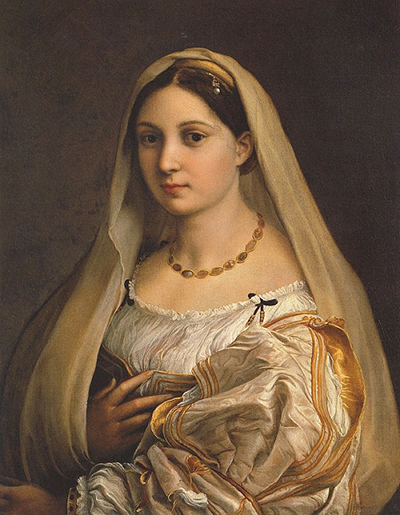
Raphael's La Velata, or Woman with a Veil, is a portrait in which fabric carries almost as much meaning as the face. A young woman turns in three-quarter view, one hand at her breast and the other arm extended toward the spectator. Light moves across an immense pale silk sleeve before receding toward her watchful eyes.[1]
The veil over her hair indicates married status, but it does not identify her. Giorgio Vasari connected the portrait with a woman Raphael loved until his death, later tradition named Margherita Luti, and facial similarities encouraged comparison with La Fornarina. The Uffizi keeps the question open, noting that the costly dress and jewellery are more consistent with a commissioned portrait of a young noblewoman.[1]
Uncertainty does not diminish the work. It redirects attention from romantic biography to what the painting can actually show: marriage, status, touch, light and an extraordinary negotiation between sumptuous public display and private interiority.
At a Glance
- ArtistRaphael
- Museum titleWoman with a Veil
- Common Italian titlesLa Velata or La Donna Velata
- Dateabout 1512–15
- CollectionPalatine Gallery, Pitti Palace, Florence
- LocationJupiter Room
- Inventory1912 no. 245
- Mediumoil on canvas
- Dimensions82 × 60.5 cm
- Sitterunknown
- Traditional identityMargherita Luti, called La Fornarina, Raphael's alleged beloved
- Veilperiod sign of a married woman
- Early provenanceseen by Vasari in the Florentine house of merchant Matteo Botti
Contents
- The title and the veil
- Veiling and marriage
- Annotated Details
- An unknown sitter
- Vasari's testimony
- Matteo Botti's collection
- From Botti to Medici
- Several early viewers
- A merchant collection and social display
- Date and Roman context
- Three-quarter pose
The title and the veil
The modern name comes from the fabric laid over the woman's hair.
Velata means veiled. Unlike a personal name, it describes a visible feature and the social information that feature conveyed.
The Uffizi identifies the veil as a sign that the sitter was married.[1]
That fact sets an important boundary: whoever she was, Raphael presented her within the visual conventions of respectable marital status.
Veiling and marriage
A married woman's veil could communicate honour, modesty and household position.
It covered and framed the hair without concealing the face. Material, placement and accompanying jewels distinguished elite fashion from penitential or monastic covering.
In this portrait, the veil is translucent and luxurious rather than severe.
It makes social virtue visible through costly beauty.
Annotated Details from La Velata
The annotated view keeps the whole work in sight while isolating six details that reward close looking: expression, gesture, fabric, setting and the way Raphael moves attention through the image.
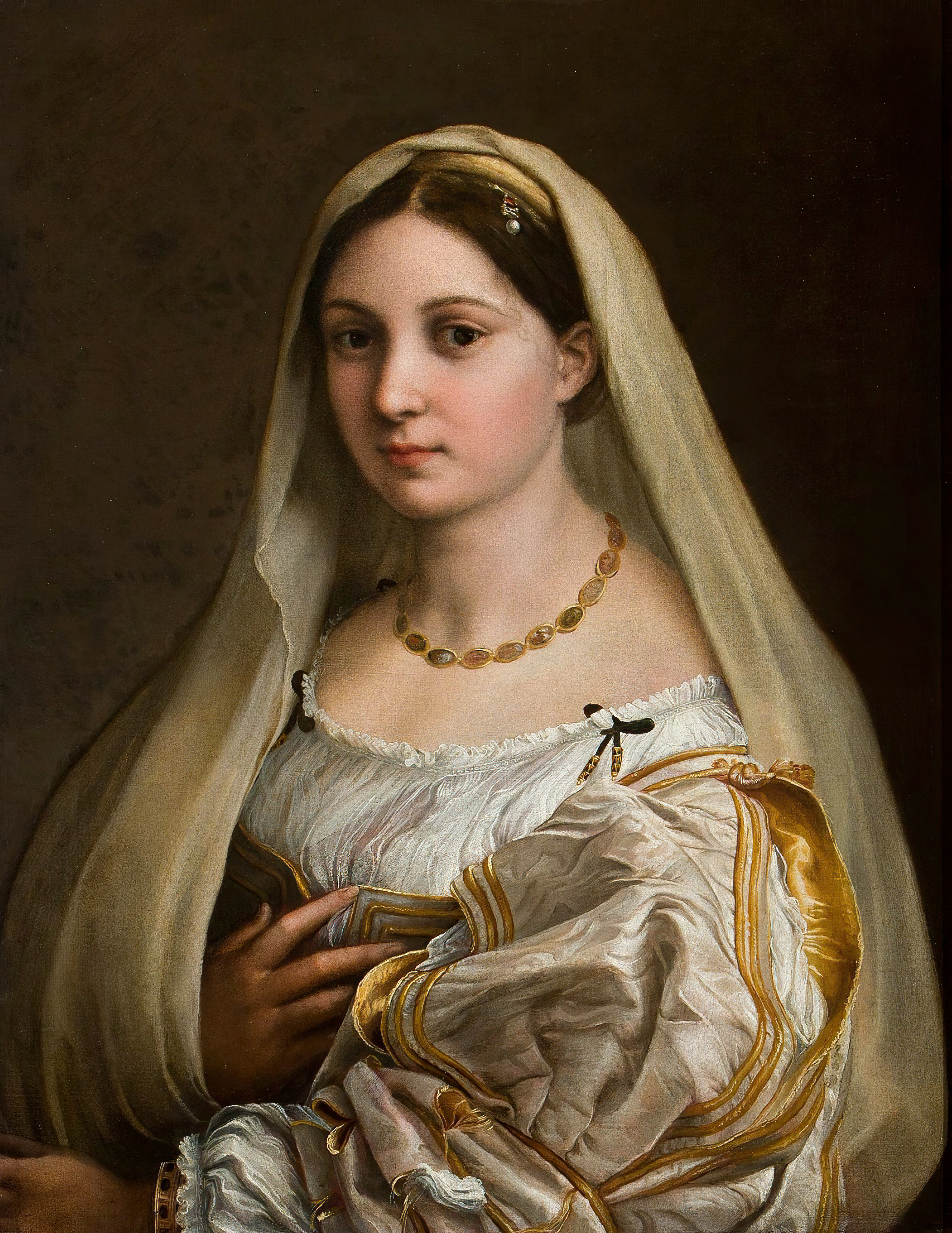
Details from LA VELATA
Close looking highlights visible details in the work while keeping image-source and rights notes with the page evidence.
Face and veil
The face is framed by the veil so that softness of fabric and alertness of gaze work together.
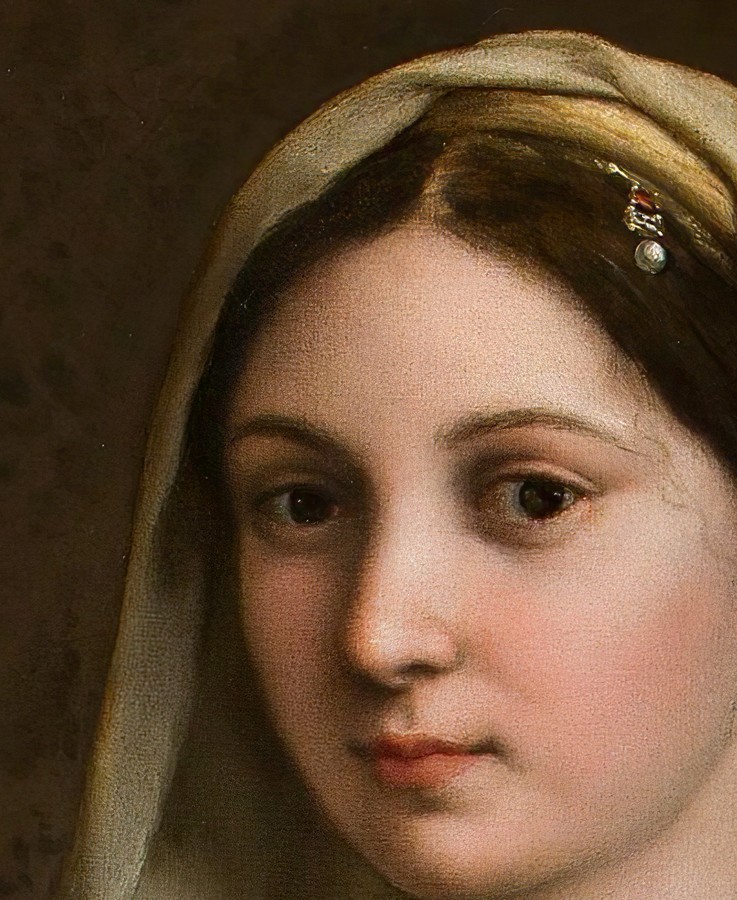
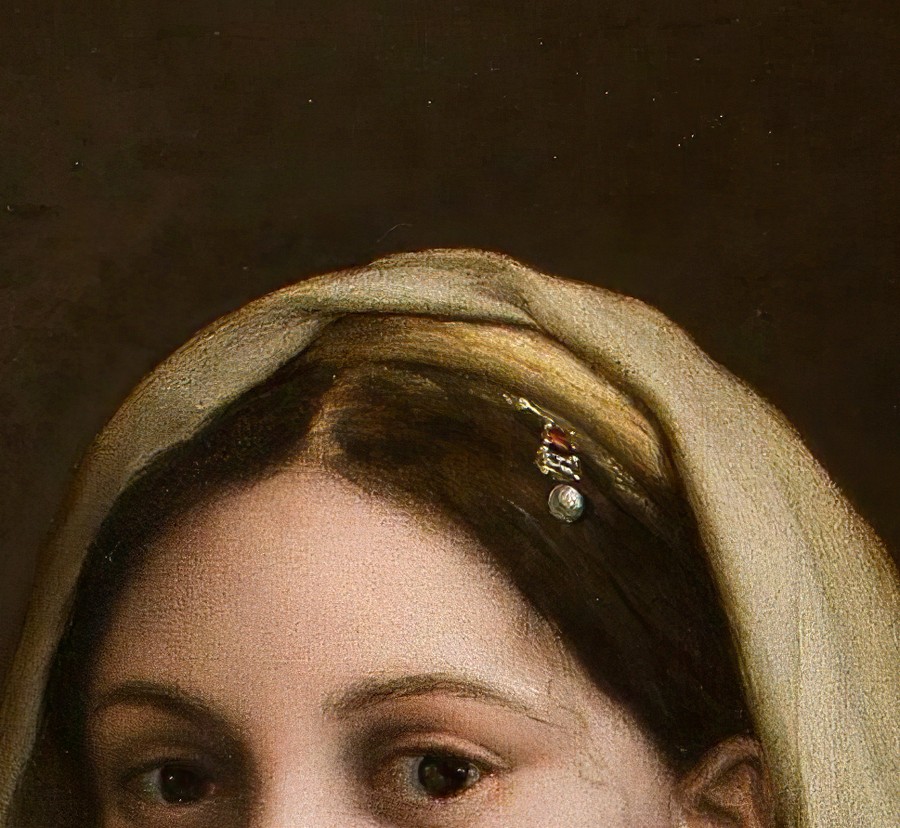
Veil edge and jewels
The veil edge and hair ornaments give the portrait its delicate boundary between display and concealment.
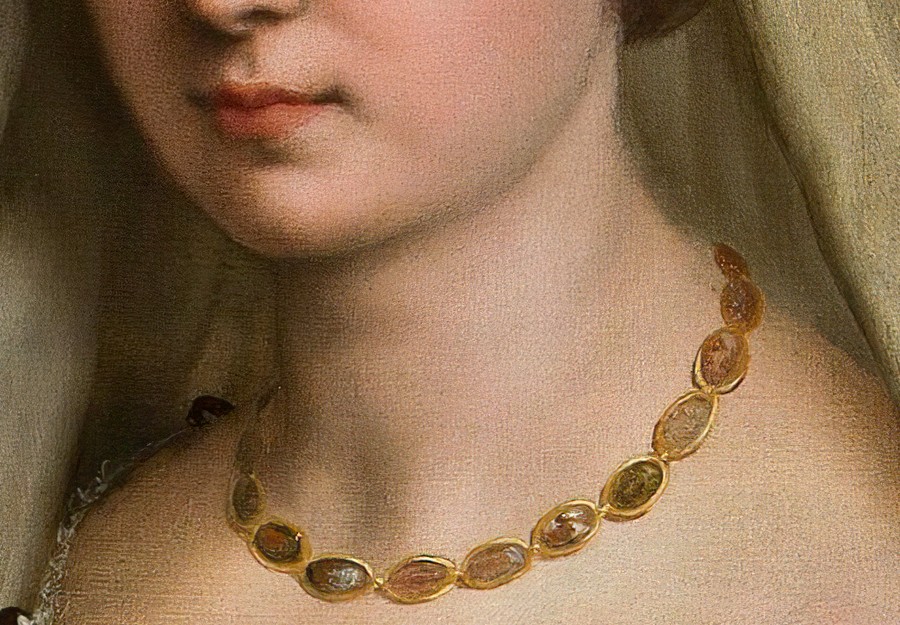
Necklace
The necklace introduces measured ornament without competing with the face.
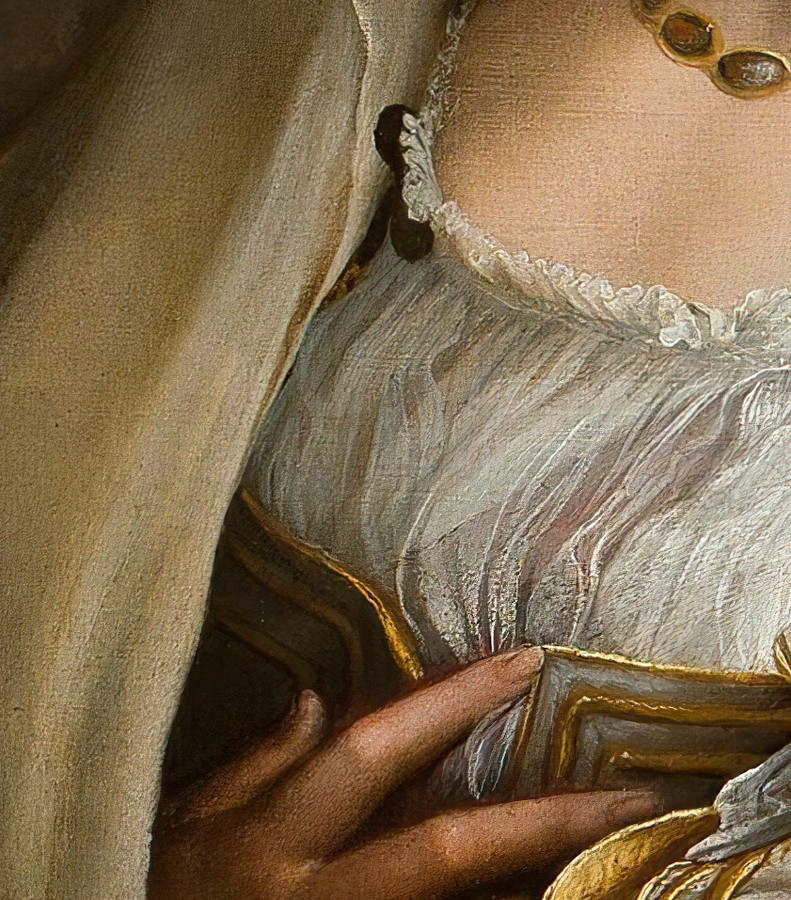
Hand at the breast
The hand draws the viewer back to the sitter's body and social presentation.
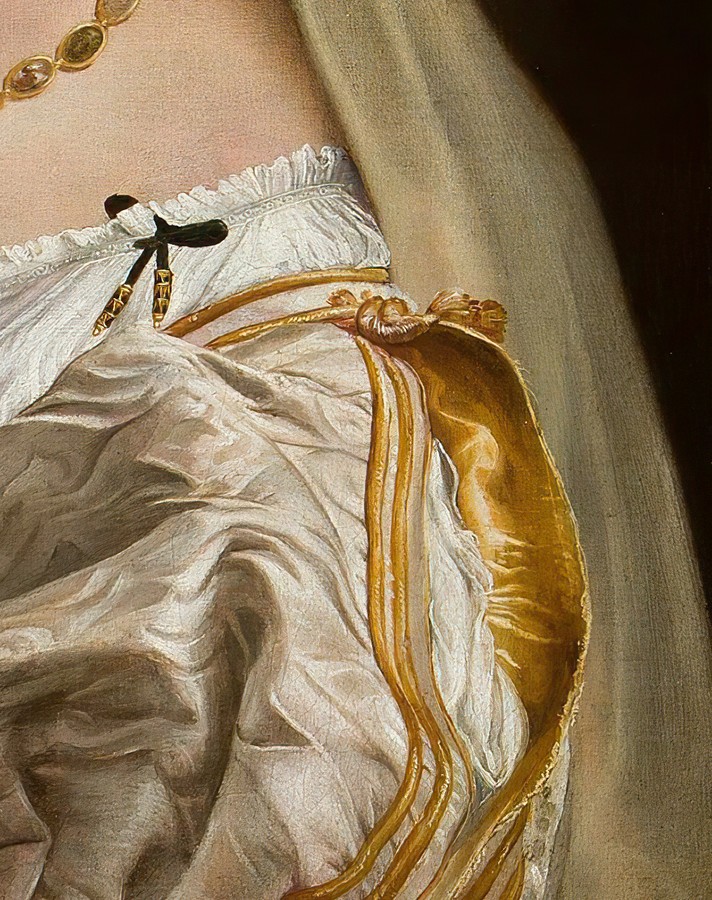
Silk sleeve
The bright sleeve is almost a painting within the painting, showing Raphael's control of white fabric.
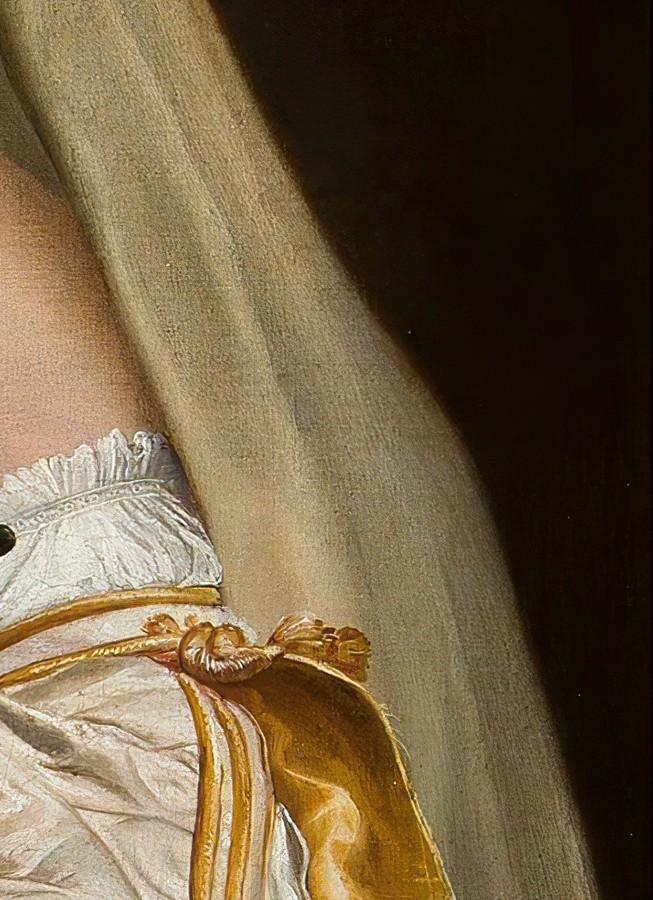
Gold ribbons
The gold ribbons tighten the sleeve's folds and turn costume into a rhythmic surface.
An unknown sitter
No inscription securely names the woman.
Her jewellery, dress and controlled presentation suggest high status, but those clues describe a social role rather than an individual. Many young noblewomen could fit the category.
The absence of identity is frustrating because the portrait feels intensely particular.
Raphael gives psychological presence without giving modern viewers a recoverable biography.
Vasari's testimony
Vasari reported seeing in the house of the Florentine merchant Matteo Botti a portrait of the woman Raphael loved, painted so vividly that she seemed alive.[1]
The Botti provenance of La Velata makes the connection historically significant. Later records confirm that the painting passed from that collection into Medici possession.[2]
Vasari's wording does not call the sitter Margherita Luti or a baker's daughter.
It links the picture with an unnamed beloved, leaving later identification as another step.
Matteo Botti's collection
Matteo Botti belonged to a wealthy Florentine mercantile family whose collection included important works by major artists.[2]
Displaying Raphael's portrait in a private house gave it a setting of elite sociability and connoisseurship. Visitors such as Vasari, Vincenzo Borghini and Francesco Bocchi could know it there.
Bocchi described the work as noble and famous.[2]
Its reputation therefore developed well before the painting entered a princely gallery.
From Botti to Medici
The Botti holdings passed to Cosimo II de' Medici through arrangements confirmed by Matteo Botti's 1619 testament.[2]
Works including La Velata reached Palazzo Pitti and the Medici wardrobe or collection. An inventory in the early 1620s records the portrait within that new environment.
Transfer from merchant house to grand-ducal palace changed its audience and status.
The portrait of an unidentified woman became part of dynastic collecting in Florence.
Several early viewers
Vasari was not the only sixteenth-century writer to encounter the portrait in the Botti house.
Vincenzo Borghini and Francesco Bocchi also knew the collection, and Bocchi's 1591 guide praised the painting as a noble work famous to all.[2]
These notices strengthen the object's Botti provenance and early reputation. They do not all supply independent identification of the sitter.
Several witnesses can confirm a painting's location while repeating one inherited belief about its subject.
A merchant collection and social display
The Botti home demonstrates that major paintings did not circulate only through princes and churches.
Wealthy merchants assembled art that supported hospitality, learning and family prestige. A visitor's access depended on social networks rather than a public ticket.
Within that domestic setting, La Velata may have conversed with other portraits and religious works now dispersed.
Its transfer to Pitti preserved the object but dissolved the arrangement in which Vasari saw it.
Date and Roman context
The Uffizi dates the work approximately 1512–15.[1]
Raphael had moved to Rome in 1508 and was then working for Julius II and Leo X. His portrait practice expanded alongside the Vatican rooms, altarpieces and designs for court patrons.
La Velata belongs to this mature Roman phase even though its early documented home was Florence.
Its later location should not be mistaken for place of execution.
Three-quarter pose
The sitter's body turns rather than facing the picture plane squarely.
One shoulder recedes, allowing light and shadow to establish depth. The head turns back toward the viewer, keeping contact across the angled torso.
The Uffizi relates this device to Leonardo's portrait experiments.[1]
Raphael uses spatial turn to create psychological complexity: the body withdraws while the eyes remain present.
Leonardo's example
Leonardo had transformed portraiture through three-quarter positioning, atmospheric modelling and coordinated hands.
Raphael studied these innovations during his Florentine years. In La Velata, the sitter is not a flat emblem beside a profile inscription; she occupies a shallow but persuasive space.
Hands and face belong to one expressive system.
Raphael absorbs Leonardo's lesson while giving cloth a new monumental role.
The dark background
The nearly unarticulated ground removes external distraction.
No landscape, column or furnished room explains the sitter. Darkness makes pink flesh, white-gold silk and small jewels appear luminous.[1]
It also leaves her status dependent on body and dress rather than location.
The portrait becomes an encounter within a space that feels deep but cannot be entered.
The face in partial shadow
The face does not receive the most brilliant illumination.
It sits slightly behind the glowing sleeve and part of it falls into shade. This restraint makes the dark eyes feel especially concentrated.[1]
Raphael avoids a simple hierarchy in which brightest always means most important.
The eye travels through material splendour toward a quieter inner presence.
The eyes
Her gaze is direct without being aggressively frontal.
Dark pupils and soft surrounding shadow make the eyes seem deep. Their expression can be read as composure, reserve, intelligence or guarded emotion.
No single label captures them because the mouth and body supply no dramatic narrative.
Raphael makes sustained looking the portrait's action.
The right hand at the heart
The woman's right hand rests against her upper chest.
The Uffizi suggests that the gesture may express devotion or love.[1] It can also stabilise the veil and emphasise modest self-presentation.
Fingers lie gently rather than clutching, preserving composure.
The gesture draws meaning inward toward the heart while the other arm projects outward.
The foreground arm
Her left arm extends toward the picture edge.
Foreshortening gives it spatial force and brings the enormous sleeve close to the viewer. The arm acts almost like a ledge made of fabric and flesh.
The Uffizi identifies this device as a way to display material richness and shifting light.[1]
Raphael turns costume into a demonstration of depth.
The great silk sleeve
The sleeve is the portrait's most spectacular passage.
Its pale silk swells around the arm in repeated folds. Highlights break across ridges, while warm pink and grey shadows give the material weight.
The form is too large to function as incidental decoration. It occupies the foreground as a principal subject.[1]
Raphael paints status through the behaviour of cloth.
Fabric as structure
The sleeve broadens the lower composition and balances the smaller head.
Without it, the three-quarter turn might feel narrow and withdrawn. Its mass creates a stable base and leads the eye back toward the torso.
Fold direction also describes the unseen arm beneath.
Costume therefore performs architectural work, organising the portrait's proportions.
Pale dress and changing light
The gown is not one flat white.
Cream, gold, rose and cool grey passages respond to different surfaces and depths. Reflected flesh tones warm nearby silk; deeper folds approach brown.
Raphael makes colour emerge from illumination rather than from a single local label.
The technique gives luxury a tactile, moving presence.
The bodice
The fitted bodice contains the torso within a pattern of edges, fastenings and seams.
Its relative firmness contrasts with the swelling sleeve. The distinction clarifies where clothing shapes the body and where it expands independently.
Gold accents and fine borders indicate costly workmanship.
Dress communicates wealth through construction as much as through jewellery.
Jewellery
Pearls and gold enrich the head and neckline without overwhelming the face.
Pearls could suggest purity, marital virtue and elite expense. Their pale surfaces echo the veil and silk, creating small concentrated highlights.
Jewellery confirms that this is not a casual undressed likeness.
The sitter has been prepared for a formal social image.
Dress and noble status
The Uffizi argues that the sumptuous gown and jewels point toward a commissioned portrait of a young noblewoman.[1]
This interpretation challenges the simple story of a baker's daughter painted as Raphael's private love. Clothing may have been supplied or idealised, but it still establishes the represented identity.
Portraiture shows how a sitter wished to appear, not necessarily her everyday wardrobe.
The image belongs to the politics of status even when the personal name is lost.
The woman as a bride
Veil, youth and luxury make a marriage-related commission plausible.
Renaissance bridal portraits could celebrate alliance, virtue, fertility and household honour. The hand-to-heart gesture may reinforce loyalty or affection.
No surviving document identifies a wedding or husband for this sitter.
“Married woman” is better supported than “specific bride.”
Margherita Luti and the social contradiction
If the sitter were Margherita Luti, the noble costume would require explanation.
Raphael could have dressed a beloved imaginatively, or she may have occupied a more complex social position than the later “baker's daughter” story allows. A private image could adopt elite codes.
Alternatively, the sitter may simply be another woman.
The contradiction is evidence to weigh, not an obstacle to erase.
Comparing the face with La Fornarina
Both women have dark eyes, full faces and related features, leading many viewers to see one model.[3]
Yet an artist's preferred proportions can recur across several sitters. Workshop practice, idealisation and restoration also affect perceived likeness.
The paintings create different identities through costume, pose and setting.
Facial resemblance supports a question; it does not close the case.
Comparing the social presentations
La Velata is veiled, jewelled and enveloped in costly silk. La Fornarina is semi-nude, bound by Raphael's signed armlet and surrounded by plants associated with Venus.
One portrait foregrounds marriage and rank; the other foregrounds erotic and mythological intimacy.
If the same woman appears, Raphael transformed her social meaning radically.
If different women appear, the comparison still reveals the flexibility of his female portrait type.
Similarities with Raphael's Madonnas
Viewers have also found echoes of the face in Raphael's mature images of the Virgin.
Repeated oval, eyes and mouth could result from a favoured living model, an ideal of beauty or the interaction of both. Sacred figures need not be literal portraits.
Identifying every resemblance as Margherita Luti turns visual habit into undocumented biography.
Raphael's style itself is capable of producing kinship.
Oil on canvas
The Uffizi lists the support as canvas.[1]
Canvas offers a woven texture and behaves differently from smooth wood panel. Oil paint can be worked thinly into fabric or built into opaque passages.
Raphael's control of the sleeve depends on transitions from luminous thin layers to fuller highlights.
The material supports both breadth and delicacy.
Surface and touch
The painting repeatedly invites imagined touch: gauzy veil, smooth pearl, satin sleeve, warm skin.
Raphael distinguishes these surfaces through how light breaks, diffuses or reflects. The effect is visual rather than physically accessible.
Museum distance protects the object while intensifying the desire to understand its textures.
Technical virtuosity becomes a form of sensory persuasion.
An attribution once questioned
Early Medici inventories did not always maintain confident attribution to Raphael, and later critics debated the degree of workshop participation.
The painting's fame today can hide that history of uncertainty. Changes in taste, condition and comparison influenced judgments.
The Uffizi now presents it firmly as Raphael and as a summit of his portraiture.[1]
Attribution history remains worth remembering because certainty is achieved, not timeless.
How collection labels changed
When the portrait entered the Medici sphere, early inventory wording expressed uncertainty about whether it was by Raphael.[2]
Later catalogues sometimes lost the attribution before connoisseurs restored it. Such movement reflects shifts in condition, taste and access to comparison rather than alterations to the sitter herself.
The history cautions against imagining museum labels as permanent truths attached from creation.
Even a painting now treated as a defining Raphael passed through periods of doubt.
Prints and reproduction
Prints after La Velata spread its image beyond Florence. The Royal Collection preserves one example within the Prince Consort's Raphael holdings.[3]
Engraving translates pale silk and flesh into lines and tonal systems. It can clarify composition while altering colour's central role.
Reproduction also fixed the title and encouraged comparison with the Fornarina tradition.
The portrait's fame grew through images of the painting as well as access to the original.
Display in the Palatine Gallery
The work hangs in the Jupiter Room of the Palatine Gallery at Pitti Palace.[1]
The gallery preserves a princely mode of dense display rather than the isolated white-wall setting of many modern museums. Nearby frames, furniture and ceiling decoration affect the encounter.
Historic hanging reminds viewers that Medici and later grand-ducal collectors understood paintings as parts of rooms and dynastic magnificence.
The portrait's intimate gaze now operates within palace spectacle.
The frame and bilication
Uffizi interpretation calls attention to historic hanging hardware that allowed paintings to pivot on hinges for changing light conditions.[1]
Before modern electric illumination, movable or bilicated arrangements could improve visibility and manage reflections. The frame and its mounting were practical technologies.
This history challenges the idea that old masterpieces have always hung motionless in their present orientation.
Display is part of an object's changing life.
Interior presence without narrative
No attribute states a profession, family name or event.
The portrait produces meaning from posture, costume and gaze. Its apparent psychological depth is not a report of one recorded emotion but an effect of coordinated ambiguity.
The hand may mean love, devotion or decorum. The eyes can seem open or guarded.
Raphael gives the sitter inner life by refusing to explain her completely.
Scale and viewing distance
At roughly life-size half length, the portrait approaches the dimensions of a person encountered across a room.[1]
The projecting sleeve reaches forward first; eyes and hand-to-heart gesture unfold afterward. This sequence changes when the image is reduced on a screen, where cloth can appear merely decorative.
Physical scale helps explain the painting's celebrated lifelikeness.
The sitter does not occupy a distant miniature world; she shares the spectator's immediate social space.
Femininity and representation
The painting presents elite femininity as modest, materially splendid and emotionally controlled.
Veil and jewellery advertise social virtue; silk advertises wealth; the gaze prevents the woman from becoming only a display surface. Yet her identity is mediated through an artist and the conventions expected by patrons.
Modern viewers can admire the portrait while recognising that it constructs a role.
Its beauty is inseparable from the social codes it refines.
Why La Velata matters
The portrait demonstrates Raphael's ability to make material and mind coexist.
The sleeve is a feat of light, colour and spatial projection, yet it does not reduce the sitter to costume. Her shaded face and deep eyes maintain a quieter centre beyond the brilliant foreground.
The unresolved identity has also become historically instructive. Vasari's testimony and Botti provenance make the beloved-woman tradition important; married dress and aristocratic jewellery make a noble commission equally serious.[1][2]
Rather than choose the most romantic answer, the painting asks viewers to distinguish what is visible, what is documented and what later desire has supplied. That discipline leaves La Velata not anonymous in a weak sense, but open in a powerful one.
The woman's lost name and surviving presence pull in opposite directions. History cannot restore her biography confidently, yet Raphael's scale, surface and sustained gaze ensure that anonymity never turns her into a generic ornament.
That tension gives the portrait an unusually durable and humane authority.
Artist Up Close
Begin with the veil and ask what it communicates before asking whom it names. Its strongest secure message is married status.[1]
Follow the sitter's right hand toward her heart, then trace the opposing movement of the left forearm into the foreground.
Study the sleeve from brightest ridge to deepest fold. Notice that its “white” contains rose, gold, grey and brown.
Let your gaze move from the luminous cloth back to the partially shaded face. Raphael delays psychological encounter behind material display.
Finally, compare the face with La Fornarina while keeping resemblance separate from proof of identity.[3]
Frequently Asked Questions
Discussion
What detail most changes how you read La Velata?
Reader Insights
Which source detail gives the page its strongest anchor?
Which visual or historical distinction should readers keep in mind?
How does this page change the wider picture of Raphael's career?
Join the Conversation
Share your reading below.
References
- Uffizi Galleries, “Woman with a Veil,” inventory 1912 no. 245 View source.
- Memofonte, “Collezioni Toscane dei Secoli XVI–XIX: the Botti collection,” View source.
- Royal Collection Trust, “Portrait of a Lady (‘La Velata’),” RCIN 852099 View source.