

 by Tom Gurney
Tom Gurney BSc (Hons) is an art history expert with over 20 years experience
Published on June 19, 2020 / Updated on August 21, 2026
Email: tomgurney1@gmail.com / Phone: +44 7429 011000
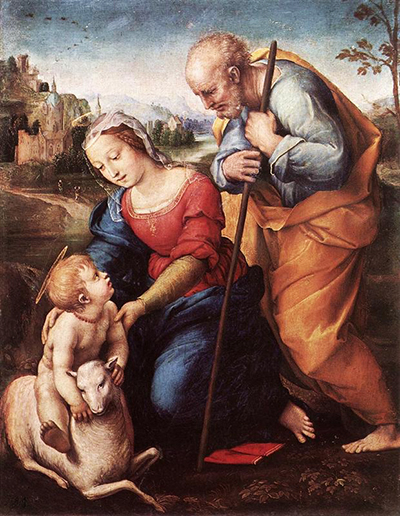
Raphael's Holy Family with a Lamb makes a mother's action the centre of a theological argument. Christ bends over a lamb, embracing the animal that symbolises his future sacrifice. Mary does not pull him away. She actively helps him, while Joseph watches with a meditative expression that reveals his awareness of what the gesture foretells.[1]
The panel is extraordinarily small—28 by 21.5 centimetres—but signed and dated across its front: RAPHAEL · VRBINAS · MD.VII. Painted in 1507, it belongs to Raphael's Florentine encounter with Leonardo. Its composition transforms Leonardo's lost design for a Virgin and Child with Saint Anne, changing both the family structure and the meaning of Mary's response.[1]
Leonardo's Virgin tried to restrain Christ from embracing the lamb while Saint Anne embodied the Church's consent to sacrifice. Raphael replaces Anne with Joseph and lets Mary assist the child. Maternal love becomes willing participation rather than resistance.[1]
At a Glance
- ArtistRaphael
- TitleThe Holy Family with a Lamb
- Date1507
- Mediumoil on panel
- Dimensions28 × 21.5 cm
- Family groupMary, the infant Christ and Saint Joseph
- Central actionChrist embraces a lamb with Mary's help
- Symbolismthe lamb prefigures Christ's sacrificial Passion
- Signature and date
RAPHAEL · VRBINAS · MD.VII - Key precedentLeonardo's lost Saint Anne design described in 1501
- Early recorded ownerCardinal Ippolito d'Este, Tivoli, 1572
- Entered Spanish Royal Collectionearly eighteenth century
- Entered the Prado1837
- Current locationMuseo Nacional del Prado, Madrid, Room 49 in current record
- Inventory numberP000296
Contents
- A panel only twenty-eight centimetres high
- Christ embraces the lamb
- Mary helps rather than prevents
- Joseph as meditative witness
- The lamb as Passion symbol
- Wool, flesh and vulnerable bodies
- Leonardo's lost Saint Anne design
- Raphael's two major changes
- Gesture as theological reasoning
- Landscape and open air
A panel only twenty-eight centimetres high
The painting's physical scale encourages near, private attention. At 28 centimetres high, it is closer to a devotional book than a chapel altarpiece.[1]
Raphael nevertheless fits three figures, an animal and a landscape into the narrow field.
The smallness makes every touch consequential. Mary's hand, Christ's arms around the lamb and Joseph's watchful face can be compared within one concentrated glance.
The panel could be carried more easily than Raphael's large church works, although its exact first patron and use are not securely recorded.
Private scale suits the subject's emotional subtlety. The decisive difference between restraint and assistance lies in the precise direction of Mary's body.
Raphael does not simplify because the support is small. He compresses bodily movement and theological meaning until they become inseparable.
Christ embraces the lamb
Christ bends down and wraps himself around the lamb. The animal is soft, living and accessible to a child, while also carrying one of Christianity's central sacrificial symbols.[1]
John the Baptist would later identify Christ as the Lamb of God. Here the analogy becomes physical before any scroll or adult sermon appears.
The child does not recoil. His willing contact suggests readiness to meet the Passion.
Raphael keeps that symbolism embodied. Christ must balance, reach and press against the animal's wool.
The lamb is not an attribute resting beside him like a label. It participates in the composition and supports movement through the lower field.
In ordinary terms, the action can appear playful and affectionate. In devotional terms, Christ embraces the fate the animal represents.
Both levels are necessary. Without natural play, the symbolism would become stiff; without sacrifice, the scene would lose its spiritual gravity.
Mary helps rather than prevents
Mary leans toward Christ and assists his embrace. The Prado identifies this change as more important than Raphael's replacement of Saint Anne with Joseph.[1]
Her action transforms maternal foreknowledge. She understands the sacrifice and helps the child approach its sign.
This does not make her emotionally indifferent. Assistance can carry sorrow precisely because it refuses to obstruct divine purpose.
Her body forms a bridge from the upper part of the group down toward Christ and the lamb.
Hands and posture make consent visible without speech. Raphael turns a theological position into the direction of an arm and the management of a child's weight.
Mary's participation also binds the group. She does not stand apart as a witness; her support is required for the symbolic action to occur.
The painting's deepest idea lies here: love can enable a destiny it knows will cause suffering.
Joseph as meditative witness
Saint Joseph replaces the Saint Anne who appeared in Leonardo's design.[1]
He watches rather than handling Christ or the lamb. His expression is attentive and meditative, revealing awareness of the gesture's prophetic meaning.[1]
Joseph's restraint creates emotional counterpoint. Christ acts, Mary helps, Joseph contemplates.
The three responses form a complete devotional sequence: willingness, consent and reflection.
His older body also makes the small family group multigenerational without introducing a second maternal figure.
Joseph's position helps stabilise the composition above the lamb's movement. His gaze returns attention toward the symbolic centre.
Raphael gives the guardian of the family a spiritual task: he recognises the future carried by ordinary play.
The lamb as Passion symbol
The lamb evokes sacrifice in Jewish ritual and Christ's role as the Lamb of God who gives himself for humanity.[1]
Its innocence and vulnerability make it an especially powerful counterpart to the child.
Unlike a cross, the animal can respond, bear weight and invite touch. Symbolism enters through a living relationship.
The lamb's white fleece also creates a textural and chromatic focus near Christ's flesh.
Raphael does not depict the animal being sacrificed. Future death is held at a distance, making willing embrace rather than violence the subject.
For a devotional viewer, the scene could prompt reflection on Incarnation: the body that plays in childhood is the body later offered.
Mary’s hand ensures that the Passion sign is not only Christ's private destiny. It belongs to family knowledge and maternal consent.
Wool, flesh and vulnerable bodies
The symbolism gains force from touch. Wool offers a surface different from smooth child flesh, woven garments and distant air. Christ does not merely point toward the lamb; his body encounters its warmth and texture.
Both child and animal are vulnerable. Neither has the physical power associated with adult rule, yet Christian meaning identifies one as voluntary Redeemer and the other as his sacrificial analogue.
Mary's assistance brings a third body into this tactile chain. Her hand supports Christ as his arms close around the lamb, so consent passes through pressure rather than abstract declaration.
The small panel requires the viewer to approach closely enough to imagine these textures. At that distance, the animal cannot remain a generic theological code. It has weight, fleece and life.
Raphael's achievement is to preserve that creaturely presence while making sacrifice unmistakable. The lamb means more because it remains believable as something a child would want to embrace.
Its softness turns prophetic suffering into an encounter shaped first by trust, curiosity and bodily affection in Mary's presence.
Leonardo's lost Saint Anne design
Raphael's composition depends upon an important Florentine precedent by Leonardo. The original design for a high altarpiece at Santissima Annunziata is lost, and the altar was never made.[1]
Its arrangement is known through a letter written in April 1501 by the Carmelite friar Pietro da Novellara.[1]
Novellara described Christ escaping or moving from Mary's hold to embrace a lamb, while Mary tried to restrain him. Saint Anne held Mary back.
The action received an explicit theological reading. Anne personified the Church, which would not prevent Christ's sacrifice despite Mary's maternal reluctance.[1]
Raphael took a known relational problem rather than copying a surviving finished altarpiece.
The lost status of Leonardo's work makes the letter unusually important. Text preserves a compositional and theological event no object now presents in full.
Raphael's two major changes
Raphael alters Leonardo in two decisive ways. First, he replaces Saint Anne with Saint Joseph.[1]
The substitution transforms a layered maternal genealogy into the Holy Family. The older figure no longer physically controls Mary's response.
Second, Mary assists Christ instead of resisting him.[1]
This change removes the conflict between mother's desire and Church's consent. Mary herself participates in divine purpose.
The family is therefore more unified in action. Joseph watches sympathetically, Mary helps, and Christ embraces.
Raphael's panel is not simply a reduced Leonardo. It is an interpretation that revises the emotional theology of the scene.
Influence becomes debate. The younger artist demonstrates understanding by changing what the model means.
Gesture as theological reasoning
No inscription explains Mary's decision. The argument occurs through bodies.
If her hands pulled Christ back, viewers would read protection and resistance. Because they guide him forward, the same maternal care becomes consent.
Joseph's gaze confirms that the action is being understood rather than happening accidentally.
Christ's embrace supplies willing participation from the person whose sacrifice is at stake.
Raphael thus distributes theology among three modes of gesture. The panel can be read without words because posture carries intention.
Its minute scale makes this reasoning especially concentrated. A few centimetres separate obstruction from assistance.
The image demonstrates how visual art can interpret a precedent by altering action rather than changing subject labels.
Landscape and open air
The family appears in an outdoor setting rather than Leonardo's described arrangement being treated as an abstract group.
Landscape gives Christ room to bend toward the lamb and places the animal within a plausible natural world.
Raphael's Florentine Madonnas often join close bodies to atmospheric distance. Here the setting prevents the tightly packed group from feeling cramped.
The horizon also introduces temporal breadth. A brief childhood movement occupies a world extending beyond the small panel.
Nature supports the lamb's ordinary identity as well as its symbolism. It belongs in the setting before it belongs to theological interpretation.
Colour recession lets the eye return toward stronger figures and the animal without flattening the background.
The open air makes the Passion sign gentle but not trivial.
Signed Raphael of Urbino
The inscription RAPHAEL · VRBINAS · MD.VII appears on the front at centre.[1]
It names Raphael of Urbino and gives the Roman numerals for 1507.
The exact date is valuable within a career of rapidly developing Madonna compositions.
The Urbinate identity mattered while Raphael worked in Florence. He could absorb Leonardo and Michelangelo while publicly retaining his place of origin.
Signature also distinguishes the panel from the many small devotional works produced by followers and workshops.
The words belong to the painted surface rather than a later museum label, linking authorship and chronology directly to the object.
Because the panel is so small, the inscription's deliberate visibility makes its confidence still more striking.
Florence in 1507
Raphael spent roughly 1504–08 in Florence, studying local masters and serving sophisticated private patrons.[1]
By 1507 he had moved beyond early Umbrian symmetry toward complex bodily interaction.
The Lamb family shows that development at miniature scale. Christ bends, Mary reaches and Joseph's gaze completes a dynamic triangle.
Leonardo's influence is not atmospheric vagueness in general. It is a precise concern with how one figure's action produces another's response.
Raphael adds his own lucidity. The altered theological roles can be grasped without the psychological uncertainty often associated with Leonardo.
The panel belongs to the same fertile period as several celebrated landscape Madonnas, but the animal and three-person family give it a distinct problem.
An unknown first commission
The Prado record supplies no original commissioner.[1]
The small format and intimate subject suit private devotion, but they do not identify a palace, chapel or owner.
It is tempting to connect every Florentine Madonna to a named marriage or merchant household. Here the evidence does not permit that precision.
The signed date secures when Raphael worked; it does not tell us for whom.
Unknown patronage leaves function to be inferred cautiously from scale and subject.
The panel was made for close contemplation of willing sacrifice. The first person who performed that contemplation remains beyond the surviving record.
The d'Este collections
The earliest owner named in the Prado provenance is Cardinal Ippolito d'Este at Tivoli in 1572.[1]
By 1587 the work was associated with Cardinal Luigi d'Este between Tivoli and Rome.[1]
It then passed through Monsignor Ludovico Bianchetti and an unidentified priest at Reggio before entering the collection of Margherita Gonzaga d'Este at Ferrara, where it remained at least until 1597.[1]
This sequence places the small Raphael within interconnected ecclesiastical and courtly networks.
Its portability would have made movement between residences comparatively easy.
The d'Este history supplies a strong late sixteenth-century chapter while leaving the first seventy years less clear.
Rome, Falconieri and the Spanish Crown
Later provenance may include members of the Mattei di Paganica family, but the Prado marks those links with questions and they should remain uncertain.[1]
The panel belonged to Federico Rorsi in Rome and was with the Falconieri family by 1703.[1]
It subsequently entered the Spanish Royal Collection.
Royal inventories preserved the work before the modern museum was established. Its older number 798 appears painted in orange at the lower left.[1]
In 1837 the panel entered the Museo del Prado, where it now carries inventory P000296.[1]
The journey links Florentine invention, Italian cardinal collections and Spanish royal taste without requiring an invented continuous chain where the record remains open.
How to look at the Holy Family with a Lamb
Begin with Christ's arms around the animal and feel the difference between embrace and mere contact.
Look at Mary's hands. Decide whether their direction restrains or assists, then compare Raphael's solution with Leonardo's described design.
Move to Joseph's face and read meditation as the third response to sacrifice.
Find MD.VII in the signature and remember the panel's exact 1507 date.
Finally, step close enough to register its astonishing size. A theological reinterpretation unfolds within twenty-eight centimetres.
Why the painting matters
The Holy Family with a Lamb is one of Raphael's clearest demonstrations that influence can be transformative. He understands Leonardo's composition deeply enough to change its emotional and theological argument.
Mary's assistance is the decisive invention. Maternal love no longer resists the Passion through instinct while another figure imposes consent; it knowingly helps Christ embrace the sign of sacrifice.
The signed miniature also records Raphael's Florentine confidence with unusual precision.
Its long journey through d'Este, Roman, royal Spanish and Prado collections preserved an intimate work whose meaning depends on centimetres of gesture.
Artist Up Close
Look at where Mary's hand meets Christ's moving body. Direction determines theology.
Notice Joseph's stillness beside the child's active embrace.
Then compare wool, flesh and distant air. Raphael makes a sacrificial emblem remain a living animal in a real landscape.
Frequently Asked Questions
Discussion
What detail most changes how you read Holy Family with a Lamb?
Reader Insights
Which source detail gives the page its strongest anchor?
Which visual or historical distinction should readers keep in mind?
How does this page change the wider picture of Raphael's career?
Join the Conversation
Share your reading below.
References
- Museo Nacional del Prado, “The Holy Family with a Lamb,” inventory P000296. View source.