

 by Tom Gurney
Tom Gurney BSc (Hons) is an art history expert with over 20 years experience
Published on June 19, 2020 / Updated on August 21, 2026
Email: tomgurney1@gmail.com / Phone: +44 7429 011000
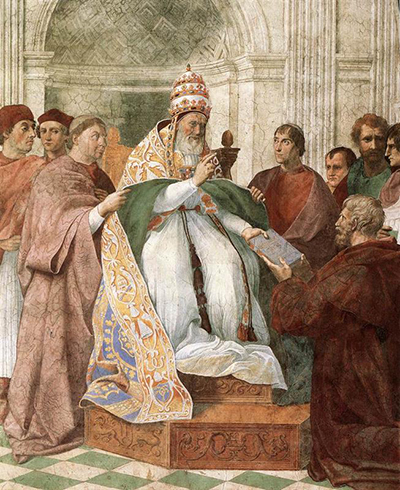
Raphael's Gregory IX Approving the Decretals presents law as a ceremony of transmission. A pope sits enthroned beneath a coffered vault as a legal text is offered before him; cardinals, clerics and attendants compress around the act. The scene is small beside the monumental frescoes elsewhere in the Stanza della Segnatura, but its historical layers are unusually dense. Gregory IX belongs to the thirteenth century, the enthroned pontiff bears the features of Julius II, and two cardinals beside him would become Popes Leo X and Paul III.[1]
The Vatican Museums call the episode the Delivery of the Decretals to Pope Gregory IX. It occupies the lower right of the wall devoted to the cardinal and theological virtues and the law. Above are Fortitude, Prudence and Temperance with Faith, Hope and Charity; across the window, a companion scene shows the Pandects delivered to Emperor Justinian. Canon and civil law thus stand beneath the virtues that ought to direct judgement.[1]
At a Glance
- ArtistRaphael and workshop
- Common titleGregory IX Approving the Decretals
- Vatican titleDelivery of the Decretals to Pope Gregory IX
- Dateabout 1511
- LocationStanza della Segnatura, Vatican Palace, Vatican City
- WallCardinal and Theological Virtues and the Law
- Subjectthe formal delivery of a canon-law compilation to Gregory IX
- Portrait substitutionGregory IX bears the features of Pope Julius II
- Identified cardinalsGiovanni de' Medici and Alessandro Farnese, later Popes Leo X and Paul III
- Companion sceneDelivery of the Pandects to the Emperor Justinian, attributed by the Vatican Museums to Lorenzo Lotto
- Mediumfresco
Contents
- A canon-law scene in a papal library
- What were the Decretals?
- Gregory IX with the face of Julius II
- Giovanni de' Medici and Alessandro Farnese
- Architecture and ceremony
- Canon law and civil law
- The virtues above
- Making the scene
- How to look at Gregory IX Approving the Decretals
- Why the fresco matters
A canon-law scene in a papal library
The Stanza della Segnatura was Julius II's library and private office when Raphael decorated it between 1508 and 1511. Its programme organised supernatural Truth, rational Truth, Good and Beauty across walls devoted to theology, philosophy, virtue and law, and poetry. The ceiling personifications of Theology, Philosophy, Justice and Poetry correspond to the fields below.[2]
The Decretals episode belongs to Good and Justice. This context prevents it from becoming a simple portrait of a pope receiving a book. The legal text appears below moral qualities: Fortitude, Prudence, Temperance, Faith, Hope and Charity. The wall proposes that law requires courage and consistency, wise judgement, self-command and a theological orientation toward belief, expectation and love.[1]
The room's original function matters equally. A library is a site where written authority is preserved and interpreted; an office is where counsel becomes decision. Raphael represents neither a shelf nor a scholar reading alone. He stages a book moving into the presence of institutional power. Text, office and public authority meet in one carefully ordered act.
The room was named for the Segnatura Gratiae et Iustitiae only later, when that supreme court of the Holy See met there around the middle of the sixteenth century.[2] The law wall can seem to anticipate the judicial use, but the fresco was designed for Julius II's earlier library and office. The later name should not be mistaken for the commission's original purpose.
What were the Decretals?
Papal decretals were authoritative letters or decisions that answered legal questions and helped shape the canon law of the medieval Western Church. As rulings accumulated, their organisation became essential for judges, teachers and students. Collections allowed particular decisions to be studied as a more coherent body of law rather than as isolated documents.[5]
Gregory IX commissioned the Dominican jurist Raymond of Peñafort to prepare a new compilation. Promulgated in 1234, it is commonly known as the Decretals of Gregory IX or Liber Extra. It organised material not contained in Gratian's earlier Decretum and became one of the foundational components of the later Corpus Iuris Canonici.[4][5]
Raphael does not illustrate the labour of collecting, comparing and arranging legal texts. He chooses the moment of delivery. That transformation is characteristic of monumental history painting: a long institutional process becomes a visible encounter between the maker or bearer of a book and the authority who receives it. The bound volume concentrates a dispersed legal tradition into one object.
The familiar title “approving the Decretals” emphasises papal authorisation; the Vatican's “delivery” emphasises the ceremonial transfer before the pope. Both point toward the same core event, but the official wording better describes what a viewer sees. The fresco's drama is quiet because legal authority is represented as recognition and reception, not battle.
Gregory IX with the face of Julius II
The enthroned pontiff represents Gregory IX and simultaneously portrays Julius II, who commissioned the Vatican decoration.[1] This double identity is more than a flattering cameo. It connects the current pope to a predecessor associated with the ordering and promulgation of canon law.
Historical portraiture in Renaissance narrative often makes different times coexist. A biblical, ancient or medieval subject could contain contemporary faces, allowing patrons and courtiers to enter a history whose authority reached beyond their own moment. Here the substitution is especially pointed because the office of the papacy provides continuity between Gregory and Julius.
Raphael preserves the scene's medieval subject while giving its institutional centre a recognisable Renaissance presence. Julius is not shown in the intimate, psychologically charged mode of Raphael's independent papal portrait. He appears ceremonially: enthroned, framed by architecture and surrounded by ecclesiastical rank. Office governs individuality.
Yet a portrait still changes the image. The commissioner's body occupies the place where law is acknowledged. Julius II's well-known investment in papal authority, artistic patronage and the renewal of Rome becomes part of the viewer's understanding, even though the fresco does not narrate his contemporary policies.
Giovanni de' Medici and Alessandro Farnese
The Vatican identifies the cardinals beside the pontiff as Giovanni de' Medici and Alessandro Farnese. Giovanni became Pope Leo X in 1513; Farnese became Pope Paul III in 1534.[1] A scene painted for Julius II therefore gathers three successive eras of papal patronage around Gregory IX's legal book.
That knowledge gives the group a retrospective force Raphael could not have fully fixed at the moment of painting. Giovanni's succession was near, but Farnese's pontificate lay decades ahead. Later viewers could look back and see a remarkable concentration of future authority. The room itself would change under both men: Leo used it as a study and music room, while under Paul III the lower-wall wainscot was replaced by chiaroscuro painting associated with Perin del Vaga.[2]
The cardinals also strengthen the ceremony's chain of attention. They do not form a neutral background. Their proximity to the enthroned pope makes the reception of law a corporate act witnessed by the hierarchy. Faces and hats create a measured rhythm around the central exchange.
It is prudent to stop with the figures authoritatively identified by the Vatican record. Crowded Renaissance scenes invite long lists of speculative portraits, but uncertain naming can distract from the composition's clearer claim: papal office and its future succession cluster around a canon-law tradition.[1]
Architecture and ceremony
The scene occupies an awkward space beside a real window, yet Raphael gives it the dignity of an independent chamber. The painted architecture encloses the group, its coffering and vertical supports establishing a courtly setting. The throne supplies a central axis, while figures close around it in a compact semicircle.
Scale distinguishes this episode from the allegories above. The virtues are large and timeless; the Decretals figures are smaller, more numerous and historically dressed. The viewer moves from universal qualities to a particular act. Architecture helps the lower scene hold its own beneath bodies that might otherwise overwhelm it.
The book is the compositional hinge. Hands and glances converge on its presentation. Although the pontiff sits highest, authority circulates through the offered object: a legal compilation made by scholarly labour, borne into papal presence and recognised for use across the Church.
Ceremony slows the event. No figure appears surprised, and no emotional crisis disturbs the gathering. This restraint suits the subject. The fresco communicates the legitimacy of ordered transmission, making concord and hierarchy visually persuasive.
Canon law and civil law
Across the window, the Delivery of the Pandects to the Emperor Justinian represents the Roman civil-law tradition. Justinian's Digest, or Pandects, gathered juristic writings within the sixth-century codification now known collectively as the Corpus Iuris Civilis.[3][6]
The two scenes create a balanced pair: emperor and pope, civil and canon law, ancient empire and medieval Church. The pairing reflects the learned legal culture in which both corpora were studied and applied. It does not claim that the two jurisdictions were identical. The real window keeps them apart even as the lunette unites them beneath virtue.[1]
The Vatican Museums attribute the Pandects scene to Lorenzo Lotto.[1] That specific statement must remain attached to the left-hand episode. It should not be extended to the Decretals scene or the entire Justice wall without further evidence. The ensemble demonstrates how Raphael's overall invention could include distinguishable workshop or associate participation.
The legal pair also completes the room's geography of books. Philosophers read and write across the School of Athens; theologians gather around sacramental truth in the Disputation; poets embody a lineage of inspired words on Parnassus. Here books have explicit juridical force. Knowledge is not only contemplated—it is delivered into institutions.
The virtues above
Fortitude, Prudence and Temperance occupy the lunette with the theological virtues Faith, Hope and Charity.[1] Their position is not a decorative afterthought. They answer a fundamental question posed by the legal scenes: what kind of persons can make or apply law justly?
Fortitude supplies firmness, but without Prudence it can become force without judgement. Temperance limits appetite and excess, but without Fortitude restraint may become inaction. Faith, Hope and Charity orient human conduct beyond calculation. Raphael does not spell out these relationships in text. Proximity and gesture make them available to thought.
Justice is not represented as a fourth monumental cardinal virtue inside the lunette because it governs the wall and appears among the ceiling faculties.[2] The legal ceremonies below are its historical operation. This nested organisation—from ceiling faculty to allegorical qualities to institutional scenes—is one of the Stanza's most sophisticated constructions.
Viewed in isolation, the Decretals scene can look like papal self-celebration. Viewed vertically, the virtues qualify that authority. Julius II occupies Gregory IX's throne, but power is placed beneath moral and theological standards. Patronage and obligation become inseparable.
Making the scene
The Justice wall formed part of Raphael's first Vatican campaign. Large fresco programmes required a developed design, transfer to wet plaster and coordinated execution across successive areas. Workshop participation was not an exception to Renaissance practice but one of the means by which an ambitious invention could be realised.[7]
Raphael's authorship is evident in the scene's clear hierarchy and its integration with the wall. The small space is neither cramped nor visually noisy. Architecture, throne, book and ranks of figures create an immediately readable order. At the same time, the named Lotto attribution across the window warns against treating every passage of the ensemble as a single undifferentiated hand.[1]
Drawings and reproductive prints connected with the law wall reveal how the invention circulated beyond its site.[8] When the composition is removed from the window and lunette, however, part of its meaning disappears. The original is a relation among architecture, allegory and history, not merely a rectangular scene.
How to look at Gregory IX Approving the Decretals
Begin with the book. Follow the hands that carry it and the attention directed toward it. The volume is physically modest, but every aspect of the ceremony establishes its importance.
Then look at the pope in two times. The subject asks the viewer to see Gregory IX, while the portrait asks the viewer to recognise Julius II. Hold those identities together rather than choosing one and discarding the other.
Move outward to the cardinals. Giovanni de' Medici and Alessandro Farnese connect the scene to the future Leo X and Paul III. Their later careers add meaning, but their compositional role is immediate: they make legal reception a witnessed act of the Church.
Finally, step back far enough to see the whole wall. The civil-law pendant lies across the window and the virtues spread above. Only this view reveals Raphael's full argument: laws are transmitted through historical institutions, while justice depends on qualities larger than any ruler.
Why the fresco matters
The Decretals scene condenses several forms of continuity. A thirteenth-century pope receives a legal compilation; a sixteenth-century pope lends him a face; future popes attend; the event belongs to a room later named for papal justice. Raphael turns historical succession into a single ceremonial present.
It also shows how the Stanza's celebrated humanism extends into law. The room is not complete with theology, philosophy and poetry alone. Written norms, courts and offices matter because intellectual and spiritual ideals must shape communal life.
The fresco's modest dimensions are part of its achievement. Without the vast architecture of the School of Athens or the heavenly expanse of the Disputation, it makes a book and a gesture of delivery carry institutional weight. Its quietness is the visual form of authority being settled.
Artist Up Close
Notice how Raphael fits a full ceremony into the field beside a window. The throne anchors a tight architectural bay, and rank is expressed through height, proximity and dress rather than theatrical movement.
Watch the conversion of text into image. The Decretals were the product of compilation and legal organisation, processes difficult to dramatise. Raphael chooses transfer: the book crossing into papal space becomes the visible sign of authorisation.
Above all, compare portrait and office. Julius II is recognisable, but he is made to serve the identity of Gregory IX. Individual likeness strengthens institutional continuity rather than interrupting it.
Frequently Asked Questions
Discussion
What detail most changes how you read Gregory IX Approving the Decretals?
Reader Insights
Which source detail gives the page its strongest anchor?
Which visual or historical distinction should readers keep in mind?
How does this page change the wider picture of Raphael's career?
Join the Conversation
Share your reading below.
References
- Vatican Museums, “Cardinal and Theological Virtues and the Law,” official object record. View source.
- Vatican Museums, “Room of the Segnatura,” official room record. View source.
- Harvard Law School Library, Ames Foundation, “Corpus Iuris Civilis,” digital collection and introduction. View source.
- Library of Congress, catalogue and authority resources for Gregory IX's Decretals. View source.
- Library of Congress, legal-history resources on Raymond of Peñafort and the Decretals of Gregory IX. View source.
- Library of Congress, “The Civil Law System,” legal research guide. View source.
- The Metropolitan Museum of Art, “The Materials and Techniques of Renaissance Art,” Heilbrunn Timeline of Art History. View source.
- Städel Museum, “The Handing Over of the Decretals to Pope Gregory IX,” drawing record. View source.