

 by Tom Gurney
Tom Gurney BSc (Hons) is an art history expert with over 20 years experience
Published on June 19, 2020 / Updated on August 21, 2026
Email: tomgurney1@gmail.com / Phone: +44 7429 011000
Raphael's Baronci Altarpiece no longer exists as a complete painting. Made in 1500–01 for a chapel in Città di Castello, the large wooden work represented the coronation of Saint Nicholas of Tolentino. An earthquake damaged it in 1789; the remains were cut into smaller pictures and dispersed. Four painted fragments are now known, joined in scholarship to preparatory drawings, early records and a partial copy.[1][2]
That broken state is not a footnote to the work. It determines how the altarpiece must be understood. No modern reconstruction can restore every figure, colour, interval or decision with certainty. The surviving faces and sheets offer evidence, but they do not turn loss into completeness.
What remains is nevertheless extraordinary. The commission is Raphael's first documented altarpiece. He was only seventeen, yet the contract already called him magister. It also named the older Evangelista da Pian di Meleto, a former associate of Raphael's father. The Baronci project therefore reveals a young master at the threshold of independence while preserving the collaborative conditions from which that independence emerged.[1]
At a Glance
- Artists named in the commissionRaphael and Evangelista da Pian di Meleto
- Common titleBaronci Altarpiece
- SubjectCoronation of Saint Nicholas of Tolentino
- Commission date10 December 1500
- Completion1501
- PatronAndrea di Tommaso Baronci
- Original locationBaronci chapel, Sant'Agostino, Città di Castello
- Original mediumoil on wooden panel
- Original dimensionsnot securely known
- Major damageearthquake of 1789
- Present statedispersed and partially lost
- Known painted remainsGod the Father and the Virgin at Capodimonte; one angel in Brescia; one angel holding a scroll at the Louvre
- Important related evidenceRaphael's studies, a partial post-damage copy and later scholarly reconstructions
Contents
- Raphael's first documented altarpiece
- Andrea Baronci and an Augustinian chapel
- Who was Nicholas of Tolentino?
- The four surviving painted fragments
- God the Father and the Virgin at Capodimonte
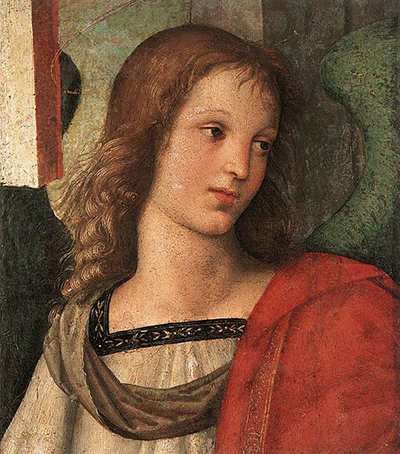
- The Brescia angel disguised as a portrait
- The Louvre angel and its long disappearance
- The 1789 earthquake and dismemberment
- Drawing the composition at the threshold of a career
- Studies, variants and a composition that changed
Raphael's first documented altarpiece
On 10 December 1500, Andrea di Tommaso Baronci commissioned Raphael and Evangelista da Pian di Meleto to paint a large altar image for the family's chapel in the Augustinian church of Sant'Agostino at Città di Castello. The work was completed the next year.[1][3]
Raphael was born in 1483 and was therefore about seventeen. The document's use of magister is significant: youth did not prevent him from being treated as a professional capable of accepting a major public commission.[1]
The term should not, however, erase Evangelista. He had worked in the circle of Giovanni Santi, Raphael's father, and was the older practitioner named alongside the teenager. The contract establishes shared responsibility for delivery, even if later fame encouraged the object to be remembered almost exclusively under Raphael's name.
No surviving record lets us divide the lost surface neatly into “Raphael parts” and “Evangelista parts.” Attribution of individual fragments and passages has required visual and technical judgement. A responsible account can recognise Raphael's formative invention without inventing a precise allocation of hands.
The altarpiece belongs to a period in which workshop continuity, partnership and personal authorship were not mutually exclusive. Raphael could emerge as an independent master through a commission undertaken with someone tied to his father's practice.
Andrea Baronci and an Augustinian chapel
Andrea di Tommaso Baronci ordered the work for a family chapel in Sant'Agostino.[3] The setting placed private commemoration within public religious space. A large painted altar could honour the patron's family while addressing the Augustinian community and worshippers.
The subject was well suited to that church. Nicholas of Tolentino was an Augustinian friar celebrated for ascetic devotion, preaching and care for souls. A painting of his heavenly coronation affirmed the sanctity of the order through one of its most revered members.
The chapel context also helps explain scale and hierarchy. This was not a small domestic picture. The lost composition had to be legible above an altar, coordinate several celestial figures and give Nicholas a commanding devotional presence.
Città di Castello was crucial to Raphael's early career. The Baronci commission was followed by other ambitious works for the city, including the Crucifixion and Marriage of the Virgin. Local patrons gave the young artist opportunities to move rapidly from inherited workshop practice to signed public authorship.
The Baronci project stands at the beginning of that sequence. Its later destruction makes the beginning harder to see, but the contract anchors it more securely in time than many paintings that survive intact.
Who was Nicholas of Tolentino?
Nicholas was a thirteenth-century Augustinian hermit friar associated especially with Tolentino in central Italy. In art he may be identified by the dark Augustinian habit and a star on his breast; other traditions include a book, crucifix, lilies or birds.[4]
The star refers to a light associated with him in legend. It makes the saint legible even when the surrounding narrative is celestial rather than an episode from his earthly life.[4]
The altarpiece's title is sometimes given as the Coronation of the Blessed Nicholas of Tolentino and sometimes as Saint Nicholas. The difference reflects historical naming as well as modern catalogue habits; Nicholas had been canonised in the fifteenth century, well before the Baronci commission.
Coronation imagery places divine recognition at the centre. The lost painting did not simply show a portrait of a friar. It staged his sanctity through an assembly involving God the Father, the Virgin, angels and the kneeling or centrally placed Nicholas, as indicated by surviving pieces and studies.[1][3]
Because the complete surface is gone, every detailed account of the arrangement must be qualified. The subject is secure; the exact final relation of all figures is not.
The four surviving painted fragments
Institutional records identify four painted remains. Capodimonte holds two: God the Father and the Virgin. The Pinacoteca Tosio Martinengo in Brescia preserves an angel. The Louvre owns another angel holding a scroll, or phylactery.[1][3][5]
These are not four predella panels or deliberately independent devotional pictures. They were cut from the damaged altar image. Their present edges, formats and isolated identities result from the object's destruction and later art market.
Royal Collection documentation summarising the scholarship records the four fragments across Naples, Brescia and Paris.[3] Capodimonte's reconstruction work uses their physical evidence—the dimensions of support boards, scale of figures and spatial construction—alongside drawings and the partial copy.[1]
The fragments do not contribute equally. God the Father preserves part of the upper divine hierarchy; the Virgin records another principal celestial presence; the angels retain youthful faces, wings and actions at the composition's sides. Nicholas himself does not survive as a generally recognised painted fragment.
The absence of the titular saint is a central paradox. The work is named for Nicholas, but the most direct access to his designed figure comes through drawings and copies rather than the final painted body.
God the Father and the Virgin at Capodimonte
Capodimonte describes its Eterno and Vergine as two autograph remains of the lost altar image and used them as anchors in a 2021 exhibition devoted to Raphael's working practice.[1]
God the Father would have occupied the celestial order above or around Nicholas. The Virgin supplied another source of heavenly recognition. Seen separately today, each can resemble a self-sufficient devotional half-length. Remembering their cut edges restores their dependence on a much larger event.
The Naples pieces were acquired in Rome in 1799 for the Bourbon collections, but their origin had already been forgotten. Only in 1912 were they reconnected with the Baronci ensemble as scholars also recognised the Brescia angel.[1]
That loss of memory demonstrates how quickly cutting can rewrite identity. Once an altarpiece becomes marketable rectangles, subjects replace structure: “God the Father” and “Virgin” travel more easily than irregular remains of a damaged provincial altar.
Capodimonte's modern study reverses that process intellectually. Board widths, scale and painted space are treated as clues to former placement. The aim is not to pretend the fragments have become whole, but to ask what their material bodies still remember.
The Brescia angel disguised as a portrait
The Brescia fragment entered Paolo Tosio's collection after he bought it in Florence in 1821. It was understood as a portrait of a young man rather than as part of an angel.[2][6]
That misidentification was not innocent ageing. Features revealing the fragmentary state had been covered with a thick dark coating, making the face appear against a neutral background and improving its plausibility as an autonomous picture.[2]
In 1912, Oskar Fischel recognised the supposed portrait as the first angel at the left of the Baronci composition. Treatment removing the black covering exposed a wing and other surviving elements of the original scene.[2]
The case is a vivid lesson in how markets manufacture wholeness. A cut fragment may look more desirable when signs of damage and dependence disappear. The dark background gave the young head a new genre, while the revealed wing returned it to sacred narrative.
Brescia Museums now presents the Angel as one of four surviving pieces from Raphael and Evangelista's commission.[6] Its gentle three-quarter face and sharply described curls can be studied closely, but they should always be imagined as part of a body, action and larger celestial gathering now missing.
The Louvre angel and its long disappearance
The Louvre fragment shows an angel holding a scroll. It is oil on poplar and measures about 58 by 36 centimetres without its accessory framing. The museum acquired it from M. Eligert in 1981.[5]
Its earlier history partly mirrors the shattered ensemble's political movement. The Louvre records it as acquired by Pope Pius VI in Rome before 1791 and taken to France in 1798.[5]
The fragment remained outside public recognition for much of its later history. Its acquisition in 1981 added a fourth surviving painted piece to the developing reconstruction.[1][5]
The scroll implies speech, proclamation or inscription within the original celestial ceremony. Yet its lost text and surrounding figures prevent a secure reading of the angel's full function. It is better to preserve that uncertainty than to supply an imagined message.
The angel's current independent frame and museum identity make close looking possible, but they also complete the historical transformation from altar component to collectible picture. Its small scale relative to the lost whole is easy to forget when it fills a reproduction.
The 1789 earthquake and dismemberment
An earthquake in 1789 seriously damaged Sant'Agostino and the altarpiece.[1][2] The event fractured the object's physical and devotional continuity.
Capodimonte reports that the damaged work was sold to Pope Pius VI and reduced into small pictures.[1] Cutting may have been presented as salvage, but it permanently narrowed the evidence available for understanding Raphael and Evangelista's design.
Damage alone did not create the four museum objects known today. Human decisions after the earthquake determined which areas were trimmed, repainted, sold or lost. Natural disaster and art-market transformation must therefore be distinguished.
A partial copy made after the sale preserved some compositional information. It cannot replace the original, especially where it omits figures or translates damaged passages, but it records relations that isolated fragments no longer show.[1]
The earthquake has become the dramatic hinge in every account of the Baronci Altarpiece. More important than the single date is the long afterlife it initiated: dispersal, mislabelling, acquisition, recognition and repeated attempts to imagine the former whole.
Drawing the composition at the threshold of a career
Several studies open a different window onto the project. A sheet currently on loan to the Metropolitan Museum contains a composition study for the coronation and, on its reverse, a study for Nicholas's head, drapery for angels, birds and an architectural sketch after a Perugino design.[7]
The recto is made in black chalk over preliminary stylus work. Numerous overlapping circles were incised with a compass, and the design was squared.[7] These marks show geometry functioning inside figure invention, not only in later architectural paintings.
Squaring could help transfer or enlarge a design. Compass arcs assist in coordinating curves and positions. The sheet therefore makes planning visible as a layered process: faint construction, black-chalk revision, incised geometry and a grid coexist.
The reverse is strikingly miscellaneous. Nicholas's head shares paper with drapery, birds and architecture. Raphael used the sheet as an active field of thought rather than preserving one clean subject per side.[7]
The birds include swans, a heron with a snake and a falcon in the Met's title. Whether every observation entered the final altar is less important than what their presence reveals: the young artist was looking, borrowing, testing and storing forms while solving a major commission.
Studies, variants and a composition that changed
A related study in Lille records an important stage of the overall design. Royal Collection documentation identifies it as a c.1500–01 study and notes another design on its reverse.[3]
Preparatory drawings do not necessarily reproduce the finished altarpiece. Figures can move, attributes change and discarded options survive on paper after the painted solution has vanished. In the Baronci case, that normal instability becomes unusually consequential because there is no intact final work against which to measure every change.
Another early sheet at the Städel shows the Virgin and Child enthroned with Nicholas before them, dated about 1502–04. The museum identifies Nicholas through the star on his breast.[4] Its exact relation belongs within the broader evolution of Raphael's early Nicholas imagery rather than serving as a transparent diagram of the Baronci panel.
The safest reconstruction therefore uses degrees of confidence. Contract and subject are firmly documented. Four fragments securely establish parts of the painted ensemble. Drawings demonstrate ideas and working methods. A copy preserves a partial later record. The spaces between those categories remain open.
This approach makes uncertainty productive. Instead of asking only “What did it look like?”, the evidence invites another question: “How does knowledge of a lost artwork get built?”
Circles, squaring and the young Raphael's method
The Met sheet's incised compass circles complicate any idea of Raphael's grace as effortless intuition.[7] Curves were tested through instruments as well as hand and eye.
The squared design shows a practical concern with scale. A small conception had to become a large painted altar while preserving relations among saint, divine figures and angels.
The mixture of stylus, chalk and incision also indicates sequence. Some decisions were established lightly; others reinforced; geometric aids crossed or underlay the visible figure study. The sheet preserves time as well as form.
Raphael's later paintings would become famous for compositions that feel inevitable. The Baronci drawings show that inevitability being manufactured through alternatives, measurement and revision at the very start of his documented career.
Collaboration adds another dimension. Drawings associated with Raphael do not reveal exactly how Evangelista participated in panel preparation or paint application. They demonstrate Raphael's design activity, not solitary execution of every stage.
Perugino, Pinturicchio and Luca Signorelli
Capodimonte situates the young Raphael within a network of central Italian examples rather than a single master-pupil line. Perugino offered colour, compositional calm and an efficient workshop language; Pinturicchio supplied decorative precision and animated sacred types; Luca Signorelli provided strongly modelled, monumental bodies.[1]
The reverse of the Met sheet includes an architectural sketch after Perugino's Ranieri Annunciation.[7] Direct borrowing appears not as dependence to be hidden but as part of design practice.
Raphael's strength was his ability to absorb different stimuli and make them work together. The Baronci project, insofar as it can be recovered, belongs to that formative conversation.
The angels' youthful beauty has often been compared with contemporary Pinturicchio or Signorelli rather than explained only through Perugino. Such comparisons remain interpretive, but they resist reducing early Raphael to a pale copy of one teacher.
The lost altarpiece may therefore be understood as a crossroads. Urbino workshop inheritance, Umbrian altarpiece practice, observed nature and competing central Italian styles meet in a commission entrusted to a teenager and an older associate.
Reconstructing without pretending to restore
For its 2021 Raphael exhibition, Capodimonte presented a full-scale reconstruction based on Raphael's preparatory drawings, the partial copy made after the sale and physical observations from the fragments.[1]
Measurements of wooden boards can constrain width and placement. Figure proportions can suggest relative scale. Painted perspective can indicate how fragments related spatially. Drawings and the copy can supply missing outlines with different levels of authority.
These strands do not have equal evidential weight. A surviving painted edge records the object directly; a preparatory idea may have changed; a later copy may omit or regularise; a modern completion necessarily chooses among possibilities.
The reconstruction is most valuable when it displays reasoning rather than concealing it. It allows viewers to test how God the Father, the Virgin and angels may have occupied a larger field, while keeping absent areas visibly dependent on inference.
“Reconstruction” should not be confused with recovery. The original paint, wood, transitions and many figures remain gone. Scholarship can restore relations to thought, not return the altar to material completeness.
Attribution and collaboration
The surviving fragments are routinely associated with Raphael, and Capodimonte describes its two pieces as autograph works.[1] The original commission, however, named Raphael and Evangelista together.
That fact creates a productive tension. The young Raphael's drawings and recognised painted qualities support his central authorship, but documentary honesty prevents the collaborator from vanishing.
Workshop production could include shared preparation, repeated designs and different degrees of intervention across a large panel. Modern expectations of one named genius do not map cleanly onto those arrangements.
The damaged state makes fine division even harder. The fragments preserve only selected zones, while the lost majority might have clarified variations in handling.
A careful account can therefore say three things at once: the Baronci Altarpiece is Raphael's first documented major commission; Evangelista da Pian di Meleto was contractually his partner; and no evidence justifies assigning every missing passage to either artist.
How to look at the surviving evidence
Begin with the four fragments as fragments. Look for cut edges and incomplete actions before allowing the frames to make them seem whole.
Compare the Brescia face with its exposed wing and remember the dark coating that once transformed it into a portrait.
On the Met sheet, seek the compass circles and grid. They are traces of construction beneath apparent grace.
Set drawings beside reconstructions and ask which lines record a final painted fact, which preserve an earlier option and which belong to modern reasoning.
Finally, leave some space blank. Absence is the most truthful representation of much of the Baronci Altarpiece.
Why the Baronci Altarpiece matters
The work matters first because it anchors Raphael's professional beginning. A dated contract places the seventeen-year-old master within patronage, partnership and a demanding public task.
It matters also because its destruction reveals how artworks change identity. An altar became debris, saleable pictures, a supposed portrait, museum fragments and a reconstructed field of study.
The project finally matters as a lesson in disciplined uncertainty. Its surviving evidence is rich enough to support close history but incomplete enough to punish overconfidence. Looking carefully means seeing both Raphael's early ambition and everything that can no longer be known.
Artist Up Close
Study the Brescia angel's curls, then look for the wing that disappeared beneath later dark paint.
Find the Louvre angel's scroll and resist supplying words the fragment no longer preserves.
On the composition sheet, follow compass arcs through figures. Raphael's youthful invention advances through measurement, revision and reuse.
Frequently Asked Questions
Discussion
What detail most changes how you read Baronci Altarpiece: Reconstructing a Shattered First Commission?
Reader Insights
Which source detail gives the page its strongest anchor?
Which visual or historical distinction should readers keep in mind?
How does this page change the wider picture of Raphael's career?
Join the Conversation
Share your reading below.
References
- Museo e Real Bosco di Capodimonte, Raffaello a Capodimonte: l'officina dell'artista, exhibition dossier, 2021. View source.
- Catalogo Generale dei Beni Culturali, “Angelo,” Raphael, 1501, Pinacoteca Tosio Martinengo, catalogue 2k100-00003_R03. View source.
- Royal Collection Trust, “Compositional Study,” RCIN 2864170. View source.
- Städel Museum, “Sketch for an Enthroned Virgin and Child with Saint Nicholas of Tolentino,” inventory 376 Z. View source.
- Musée du Louvre, “Ange tenant un phylactère,” RF 1981 55. View source.
- Fondazione Brescia Musei, “Pinacoteca Tosio Martinengo,” collection history and Raphael Angel. View source.
- Metropolitan Museum of Art, “Composition Study for the Coronation of Saint Nicholas of Tolentino (The Baronci Altarpiece),” approximately 1500–01. View source.