

 by Tom Gurney
Tom Gurney BSc (Hons) is an art history expert with over 20 years experience
Published on June 19, 2020 / Updated on August 21, 2026
Email: tomgurney1@gmail.com / Phone: +44 7429 011000
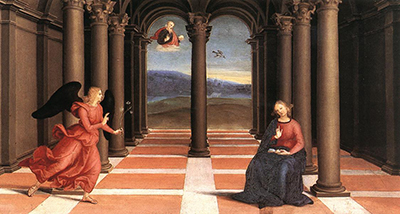
Raphael's Oddi Annunciation unfolds across a measured floor. Gabriel enters from the left, one knee lowered and a lily in hand, while Mary sits beneath a colonnaded shelter at the right with a book on her lap. She turns and raises one hand. Between them, patterned tiles race toward an opening onto distant landscape; above, God the Father and the descending dove make divine action visible.[1][2]
This is not a freestanding Annunciation panel with an independent commission. It occupies the left end of a continuous predella painted about 1502–04 for the Oddi Altarpiece. The central scene is the Adoration of the Magi and the right scene is the Presentation in the Temple. Together they formed the long narrative base beneath Raphael's Crowning of the Virgin.[1][2]
The Vatican's 2022 research dossier connects the scene with Piero della Francesca and Perugino, especially Perugino's Annunciation for the 1497 Fano altarpiece.[2] Raphael's achievement lies in what he does with those foundations. Architecture is not passive symmetry: its floor, columns and opening measure the interval across which a spoken message changes Mary's life.
At a Glance
- ArtistRaphael
- Subjectthe Annunciation to the Virgin
- Date1502–04
- Positionleft scene of the Oddi Altarpiece predella
- Mediumoil and tempera grassa on poplar panel
- Dimensions of complete predellaapproximately 38–39 × 188–190 cm
- Main figuresthe angel Gabriel and the Virgin Mary
- Divine signsGod the Father and the Holy Spirit as a dove
- CommissionerAlessandra degli Oddi for her family's altar
- First settingSan Francesco al Prato in Perugia
- Current objectcontinuous predella, Vatican catalogue MV.40335.0.0
- Related full cartoonLouvre INV 3860, currently documented by the Metropolitan Museum
- Conservationtreated by the Vatican Museums before a 2022–23 Milan exhibition
Contents
- The first scene in a long base
- Gabriel's arrival
- Mary, book and raised hand
- A floor built from perspective
- Columns, opening and landscape
- God the Father and the dove
- Perugino, Fano and Piero della Francesca
- The full cartoon
- A possible perspective exercise
- Colour and the 2022 conservation
The first scene in a long base
A predella runs horizontally beneath the principal image of an altarpiece. Its smaller scenes often narrate episodes that expand the identity of saints or sacred figures shown above. Raphael's Oddi base begins at the left with the Annunciation, continues through the Magi's homage and ends with Christ's Presentation in the Temple.[1][2]
The placement makes the Annunciation a beginning in two senses. Within Luke's Gospel, Gabriel's message announces the conception and future birth of Jesus.[6] Within the altar, it starts the painted sequence that will eventually support Mary's heavenly coronation.
The scene is physically continuous with its neighbours. The whole predella is one long poplar support rather than three autonomous little paintings.[2][3] Modern cropping can conceal that fact. Raphael had to make this episode complete while allowing its landscape horizon, colour and scale to belong to a wider band.
Its left position also affects movement. Gabriel advances inward, from the outer edge toward Mary and toward the rest of the predella. The narrative opens by entering.
Gabriel's arrival
Gabriel crosses the tiled floor with one knee near the ground, balancing descent, reverence and forward motion. His wings identify the heavenly messenger, while the lily carries the conventional association with Mary's purity.
The angel's drapery extends the movement. Folds trail and turn as though arrival has displaced air. Yet the body does not rush violently. Raphael gives the message ceremonial clarity.
One hand addresses Mary while the other carries the flower. Speech itself is invisible, so gesture and direction perform it. Gabriel's body turns the long architectural space into a line of communication.
Luke describes Gabriel being sent to Nazareth, greeting Mary, telling her not to fear and announcing that she will bear Jesus.[6] Raphael does not illustrate each sentence. He compresses greeting, disturbance and divine explanation into a suspended encounter.
The kneeling posture also creates asymmetry. Mary remains seated, anchored within her architectural bay. Gabriel is the force that has just entered and changed the room.
Mary, book and raised hand
Mary sits at the right with a book open or resting on her lap. The object establishes the interrupted life of reading and contemplation. The sacred event arrives within ordinary attention rather than on an empty stage.
Her raised right hand is the scene's most expressive sign. The Vatican dossier interprets it as alluding to Mary's incredulity or questioning response and connects the gesture with Piero della Francesca's Annunciation at Arezzo.[2]
“Incredulity” here should not be confused with refusal. In Luke, Mary is troubled, asks how the announced conception can occur and then accepts the divine word.[6] The hand can hold the moment between surprise and consent.
Raphael avoids theatrical recoil. Mary turns enough to register interruption but retains composure. Her body remains within the measured architecture, while the raised palm introduces a curved, human hesitation against straight columns and tiles.
The book and hand also divide her attention. One belongs to the text she was reading; the other responds to a message now being spoken. The Annunciation becomes a shift from written contemplation to embodied vocation.
A floor built from perspective
The decorative pavement is the scene's great spatial instrument. Repeating geometric units diminish toward a vanishing area at the central opening. The Vatican Museums emphasises how the scheme strengthens recession toward the gentle landscape beyond.[2]
Perspective does more than display Raphael's skill. It gives measurable distance to an immaterial message. Gabriel and Mary occupy different bays, but every floor line draws their positions into a single rational field.
The pattern also regulates the predella's shallow height. Because the scene is long and low, depth could easily appear compressed. Diagonal tile edges create an inward pull without requiring tall architecture.
The vanishing area lies between the figures rather than behind one of them. Empty space becomes active. It is the interval across which greeting, fear, question and acceptance pass.
Piero della Francesca's achievement is especially important here. His integration of geometry, architecture and sacred stillness offered a model for making perspective bear meaning.[2] Raphael adapts that discipline to a more animated exchange.
Columns, opening and landscape
Classical columns divide the foreground into bays while leaving the centre open. Architecture gives Mary a protected place and Gabriel a clear entrance. It does not shut the Annunciation inside a sealed room.
Through the middle, a soft landscape recedes toward low hills. Interior and exterior coexist. The message given in a domestic or architectural setting opens onto a world it will transform.
Columns also create temporal pauses. The eye moves from Gabriel past vertical supports to Mary, then outward through the opening. Solid shafts alternate with empty spans, turning the long scene into a measured rhythm.
The central landscape prevents perspective from ending at a wall. Lines continue toward light and distance, making the encounter feel connected with creation beyond the building.
Raphael's architecture remains ideal rather than archaeological. Its purpose is clarity: support, divide, frame and guide. The sacred event needs no crowded furnishings once floor, book and columns establish place.
God the Father and the dove
Above the human encounter, God the Father appears in the sky and the Holy Spirit descends as a dove. These figures visualise the divine source and means of the conception announced by Gabriel.
Luke states that the Holy Spirit will come upon Mary and the power of the Most High will overshadow her.[6] Raphael translates this explanation into a directional sign descending from above.
The dove's path intersects the architecture without belonging to its perspective. Floor and columns organise earthly space; the descending Spirit crosses that system.
God the Father's smaller celestial figure also balances the low angel. Gabriel has entered the human level as messenger, while the divine sender remains above. The painting distinguishes mission from source.
These signs make visible what Mary cannot yet see as an accomplished event. The Child is absent. Conception is represented through word, Spirit and response rather than through premature narrative outcome.
Perugino, Fano and Piero della Francesca
The Vatican dossier identifies clear debts to Piero della Francesca and Perugino and points especially to Perugino's 1497 Annunciation in the predella of the Santa Maria Nuova altarpiece at Fano.[2]
Raphael inherited more than motifs. From Perugino came a language of calm figures, lucid architecture, balanced landscape and narratives legible at small scale. From Piero came the capacity to make geometry and human stillness mutually reinforcing.
Dependence does not eliminate invention. Raphael intensifies the floor as a visible system, uses the central opening to separate and join the figures, and gives Mary's raised hand an unusually precise emotional function.
The scene therefore records apprenticeship becoming authorship. A young artist demonstrates that he understands established solutions well enough to alter their tempo and emphasis.
The Vatican describes all three predella compartments as close to Perugino yet already moving toward innovative Renaissance spatial answers.[3] The Annunciation makes that double condition especially clear because its order is inherited while its interval feels newly alive.
The full cartoon
A full preparatory cartoon for the Annunciation survives in the Louvre, inventory 3860, and is documented in the Metropolitan Museum's Raphael exhibition.[4] Dated about 1503–04, it measures 28.5 by 42.3 centimetres.
The material description is a record of construction: pen and brown ink, brown wash, ruling in ink and stylus, compass work, axis lines, preliminary stylus and chalk drawing, and pricked contours for transfer.[4]
Two sheets of paper were joined with an overlapping seam to create the original support.[4] The composition was therefore assembled materially before it could guide the painted panel.
Ruling and compass work establish architecture and geometry. Softer underdrawing searches for figures. Pen and wash clarify volume. Pricking turns chosen contours into transferable information. Different tools correspond to different kinds of decision.
The cartoon's scale is close to the predella scene, allowing the design to pass onto the panel with high precision. Marks made for transfer remind us that such drawings were working objects, not created only for later admiration.
A possible perspective exercise
On the reverse of a British Museum metalpoint study for an angel in the main Coronation, Raphael ruled a perspective diagram with stylus and compass. The museum notes a scholarly proposal that the exercise may relate to the Oddi Annunciation predella.[5]
The connection is plausible because the painted floor depends on controlled geometric recession. It is not certain enough to turn the diagram into a definitively labelled study for this scene.
Its value lies in method. Raphael could separate the problem of perspective from the problem of figures, testing spatial construction on the back of a sheet used for another part of the same altarpiece.
This reuse joins heaven and earth within the workshop. One side studies the head and bow hand of an angel musician; the other may test the floor beneath Gabriel and Mary.[5]
The sheet shows how an altarpiece could generate interlocking investigations rather than a single linear stack of sketches.
Colour and the 2022 conservation
The complete predella is painted in oil and tempera on poplar. The Vatican lists it at approximately 38 by 190 centimetres, while other official summaries round the dimensions to 39 by 188.[2][3] These variations describe the same continuous object.
Before its 2022 loan to Milan, the Vatican Museums' paintings and wooden-materials laboratory carried out a delicate conservation treatment. The institution reports that the intervention restored brilliance to Raphael's colours.[3]
Colour matters especially in this small scene. Gabriel must detach from architecture, Mary's clothing must hold the right bay, and the patterned floor must remain legible without overpowering the figures.
Cleaning can recover relationships obscured by aged surface layers, but “original brilliance” should not imply that the object has become newly made. Panel, paint and restorations retain a five-century history.
The treatment also drew attention to the predella as one object. Conserving and exhibiting the full band resists the common habit of reproducing each episode as an isolated miniature.
From Perugia to Paris and Rome
The Oddi Altarpiece remained at San Francesco al Prato until French seizure in 1797 under the Treaty of Tolentino. It travelled to Paris and returned to Italy after Napoleon's fall.[1][2]
Pius VII placed it in the Vatican Pinacoteca rather than restoring it to the Oddi Chapel.[1][2] The predella thus lost its original altar height, frame and relation to Franciscan worship.
Unlike the main field, whose paint was transferred from wood to canvas, the predella remains on its poplar support.[1][2] The two components share provenance but not present material structure.
Today the continuous base is catalogue MV.40335.0.0. Its modern museum life allows close scrutiny of a scene originally placed below a much larger heavenly image.
How to look at the Oddi Annunciation
Begin with the pavement. Follow its diagonals to the central opening before returning to Gabriel and Mary.
Compare the messenger's forward movement with Mary's contained turn. Architecture gives each a different kind of space.
Find the book and raised hand. One records interrupted contemplation; the other makes questioning visible.
Then trace the dove's descent. It crosses a rationally measured world without being governed by its perspective.
Finally, imagine the next scene continuing immediately to the right. The message begins a longer painted infancy.
Why the scene matters
Raphael makes perspective theological without turning it into a cold demonstration. Measured distance is the medium through which divine address reaches a human listener.
The scene preserves his formation under Perugino and his attention to Piero della Francesca while showing an independent sensitivity to pause, response and open interval.
Its surviving cartoon reveals that clarity arose through joined sheets, ruling, compass construction, layered drawing, wash and pricked transfer. Grace was built.
Artist Up Close
Look for the seam that once joined the cartoon's two sheets in the studio history behind the painting.
On the panel, let the raised hand interrupt the floor's geometric certainty.
Then notice how the central opening contains almost nothing, yet holds the entire exchange together.
Frequently Asked Questions
Discussion
What detail most changes how you read The Annunciation in Raphael's Oddi Altarpiece Predella?
Reader Insights
Which source detail gives the page its strongest anchor?
Which visual or historical distinction should readers keep in mind?
How does this page change the wider picture of Raphael's career?
Join the Conversation
Share your reading below.
References
- Vatican Museums, “Raffaello Sanzio, Crowning of the Virgin,” including Oddi predella object data. View source.
- Vatican Museums, “Predella della Pala Oddi,” 2022 research dossier. View source.
- Vatican Museums, “Raffaello: Annunciation, Adoration of the Magi, Presentation in the Temple,” 2022–23 exhibition and conservation record. View source.
- Metropolitan Museum of Art, “The Annunciation (Cartoon for the Left Scene in the Predella of the Oddi Altarpiece),” Raphael, Louvre INV 3860. View source.
- British Museum, “Head and right forearm and hand holding a violin bow,” Pp,1.67, including verso perspective study. View source.
- United States Conference of Catholic Bishops, Luke 1:26–38. View source.