


 by Tom Gurney
Tom Gurney BSc (Hons) is an art history expert with over 20 years experience
Page Created on August 30, 2026 / Page Updated on November 6, 2026
Email: tomgurney1@gmail.com / Phone: +44 7429 011000
Odilon Redon: Introduction
An eye becomes a balloon, lifting a severed head above a marsh. Years later, flowers flare in pink, blue and yellow against a field with no secure depth, while a one-eyed giant peers over a mountain in almost tropical colour. These images can look as though they belong to different artists. They do not. Across charcoal, lithography, pastel and oil, Odilon Redon (1840–1916) kept testing the same possibility: that close attention to the visible world could give credible form to things that cannot be seen.
Redon is often introduced through a neat conversion story—darkness first, colour later. The contrast is real, but the story is too simple. His early noirs are not merely gloomy pictures, and his late flowers are not an escape from them. Both make recognisable forms emerge from uncertain spaces. Both join observation to invention. Both ask the viewer to complete an image that seems to be arriving from somewhere just beyond ordinary perception.[1][2]
At a Glance
- BornBordeaux, France, 1840; died: Paris, 1916.[10]
- Known forcharcoal drawings called noirs, independent lithographs and print portfolios, luminous pastels, paintings and floral still lifes.[2][4]
- Associated movementSymbolism, especially its interest in suggestion, dreams, literature and inward experience.[3]
- Key influencesthe landscape of the Médoc, natural science, botany, literature, music, religion and classical myth.[1][3]
- Defining principleobserved nature was the foundation from which imagination could invent convincing new beings and spaces.[5][6]
Odilon Redon in context
Romanticism
c. 1800–1850Realist contexts
c. 1840–1900Symbolism
c. 1880–1910Eugène Delacroix
1798–1863Rodolphe Bresdin
1822–1885Henri Fantin-Latour
1836–1904Odilon Redon
1840–1916Paul Gauguin
1848–1903Henri Matisse
1869–1954Eye-Balloon
1878Closed Eyes
1890Ophelia among the Flowers
c. 1905–08The Chariot of Apollo
1905–16Pandora
1910/12The Cyclops
c. 1914Contents
- Introduction
- A Visual Language beyond the Visible
- Bordeaux, Peyrelebade and an Education in Looking
- Paris and the Noirs
- Lithographs That Think Like Poems
- Symbolism as a Conversation
- Into Colour, without Leaving Darkness Behind
- Eight Essential Works
- How to Look at a Redon
- Reception and Continuing Influence
A Visual Language beyond the Visible
Redon matters because he made ambiguity feel exact. His creatures may be anatomically impossible, yet an eyelid has weight, a plant grows according to a plausible rhythm, and a cloud of charcoal behaves like real atmosphere. He did not simply record dreams. He built images in which a viewer can recognise a fragment of the world—a profile, an eye, a flower, a horse—and then feel that certainty loosen.
This approach separated him from artists who treated visible appearance as the final subject. It also kept him from becoming an illustrator in the ordinary sense. A poem, biblical episode or myth might initiate a work, but he rarely tried to narrate every event. He sought the pressure and atmosphere of a source: terror without a depicted climax, revelation without a fixed doctrine, or music translated into suspended colour. MoMA’s account of his art usefully places it between description and dream, the observed and the imagined.[2]
That balance gives Redon an unusual reach. He belongs to nineteenth-century Symbolism, but his floating forms and unstable spaces also helped later viewers recognise the beginnings of modernism. His art can be intimate and decorative, grotesque and tender, scientifically curious and deliberately unresolved. Those qualities coexist rather than cancel one another.
Bordeaux, Peyrelebade and an Education in Looking
Born in Bordeaux, Redon passed long stretches of childhood at Peyrelebade, his family's Médoc estate, rather than in his parents' household. Poor health limited his schooling, and the rural environment encouraged solitary looking. It is tempting to treat that childhood as a ready-made explanation for every dark image he later produced, but the more useful connection is practical: landscape, plant life and changing light became durable resources, not a discarded prelude to fantasy.[3][17]
His formation did not follow one confident academic path. The painter Stanislas Gorin, the botanist Armand Clavaud and the printmaker Rodolphe Bresdin offered different kinds of guidance. Gorin opened artistic possibilities; Bresdin demonstrated how black-and-white printmaking could support fantastically dense worlds; Clavaud brought Redon into contact with botany, zoology and contemporary scientific thought. MoMA’s research identifies his interest in fields that included microbiology and the study of unusual bodily forms. Such knowledge did not turn his pictures into scientific diagrams. It gave his inventions a structural vocabulary: spores, polyps, eyes, shells, bones and stems could meet and transform.[3]
The distinction is important. Redon insisted that imagination began with nature. In a recollection published by the Musée d’Orsay, he described first attending minutely to a pebble, blade of grass, hand or profile, and only then experiencing the urge to invent. Nature was his “source,” not a set of appearances to copy passively. Even while he became known for supernatural-seeming subjects, he rejected the idea that he was simply illustrating spirits or escaping reality.[5]
Paris and the Noirs
After settling in Paris in the 1870s, Redon concentrated increasingly on charcoal and other black media. He called the resulting drawings his noirs—literally “blacks.” The name makes colour and material inseparable from subject. On tinted paper he rubbed, wiped, erased and scratched charcoal, creating zones that range from compressed darkness to dusty light. Figures do not sit crisply on top of those surfaces; they condense from them.[7]
The 1878 Eye-Balloon makes the method unmistakable. Its hybrid object is described clearly enough to be absurd: a great eye rises like a hot-air balloon and carries a head on a plate. Yet blurred and erased charcoal creates a sky in which the apparition seems atmospherically possible. The drawing’s mystery therefore lies not only in what it depicts, but in how matter turns into mist. MoMA connects this procedure to Redon’s ambition to put the logic of visible things at the service of the invisible.[6]
Other noirs bring together human faces, plant forms, skeletons, spiders and marine or microscopic life. Metamorphosis matters more than taxonomy. A form can hover between organism and idea, between threat and melancholy. Even monstrous beings often possess an emotional presence: they look anxious, wistful or strangely companionable. Black, for Redon, was not an absence of choice. Subtle differences of pressure, grain and erasure supplied a spectrum of effects and trained the inventive habits he retained in colour.[3][7]
Nor was his career literally colourless before 1890. Redon had made painted landscape studies while developing the public body of noirs. The National Gallery of Art notes that many of these outdoor studies used strong, saturated colour and were kept largely private. They complicate any claim that colour suddenly became available to him only in middle age. What changed was its role in the works he chose to exhibit and develop as his public art.[8]
Lithographs That Think Like Poems
Redon began working in lithography in the late 1870s. At first, the process offered a way to reproduce and circulate the imagery of his charcoal drawings. He soon recognised that it had its own expressive character. Lithographic ink could produce velvety blacks, abrupt glare and delicate grey transitions, while multiple impressions allowed an image to travel beyond the studio.[7]
The portfolio became one of his most consequential formats. Getty records eleven groups of prints organised around shared themes, and MoMA notes his sustained engagement with writers including Edgar Allan Poe, Gustave Flaubert and Charles Baudelaire. Three portfolios responded to Flaubert’s The Temptation of Saint Anthony. Yet these series do not unfold like illustrated storyboards. A caption or literary phrase creates a field of expectation; the image answers with an apparition, a barren landscape or a hybrid body. Sequence generates echoes rather than a plot.[3][7]
That independence is essential to Redon’s modernity. Text and image remain connected but neither simply translates the other. A print can recall the dread of a tale without showing its decisive incident. It can treat a title as a sounding note, then let viewers find their own path through what follows. Redon’s comparison between drawing and music—both suggestive rather than finally defined—helps explain why his most memorable images feel precise but never exhausted by a single reading.[3]
Symbolism as a Conversation
Redon found an attentive audience among the writers, poets, critics and artists associated with Symbolism and Decadence in late nineteenth-century Paris. Their shared interests included dream, the fantastic, inward states and meanings that could be suggested rather than directly stated. Redon’s work participated in that culture without becoming a visual codebook for it. He kept observed nature and the resistant facts of materials at the centre of invention.[2][3]
Literature supplied atmospheres and recurring figures; music offered a model for emotional structure without literal description. Religion and classical myth provided familiar stories that could be made strange again. Science supplied forms that already seemed to cross the border between the known and unknown. The eye, for example, could remain a carefully observed organ while becoming a balloon, a flower, a guardian or an emblem of inward vision.
His position also changed across generations. The NGA’s survey describes younger painters, including Paul Gauguin, as recognising in Redon a spiritual precursor.[8] Contact with Gauguin, Émile Bernard and Maurice Denis formed part of the context for his growing commitment to colour, according to the National Gallery. Yet influence did not flow in only one direction, and Redon did not simply join a younger school. His late art remained unmistakably his own: less concerned with naturalistic space, more willing to make colour itself carry atmosphere.[9]
Into Colour, without Leaving Darkness Behind
From around 1890, colour became increasingly prominent in Redon’s studio work; by the later 1890s, pastel and oil had largely displaced the public noir aesthetic. The transition was gradual in both subject and technique. The Musée d’Orsay points out that charcoal remained present in pastels and that Redon often combined materials. Pastel appealed partly because its powdery, light-absorbing surface could preserve the depth he knew from charcoal while opening a new chromatic range.[4]
The 1890 painting Closed Eyes stands directly on this threshold. Its pale bust, probably based on Redon’s wife Camille Falte, floats against an undefined field. Thin oil paint allows the texture beneath to remain visible. Sleep, death, meditation and apparition are all possible, but none settles the image. Colour has entered; uncertainty has not left.[10]
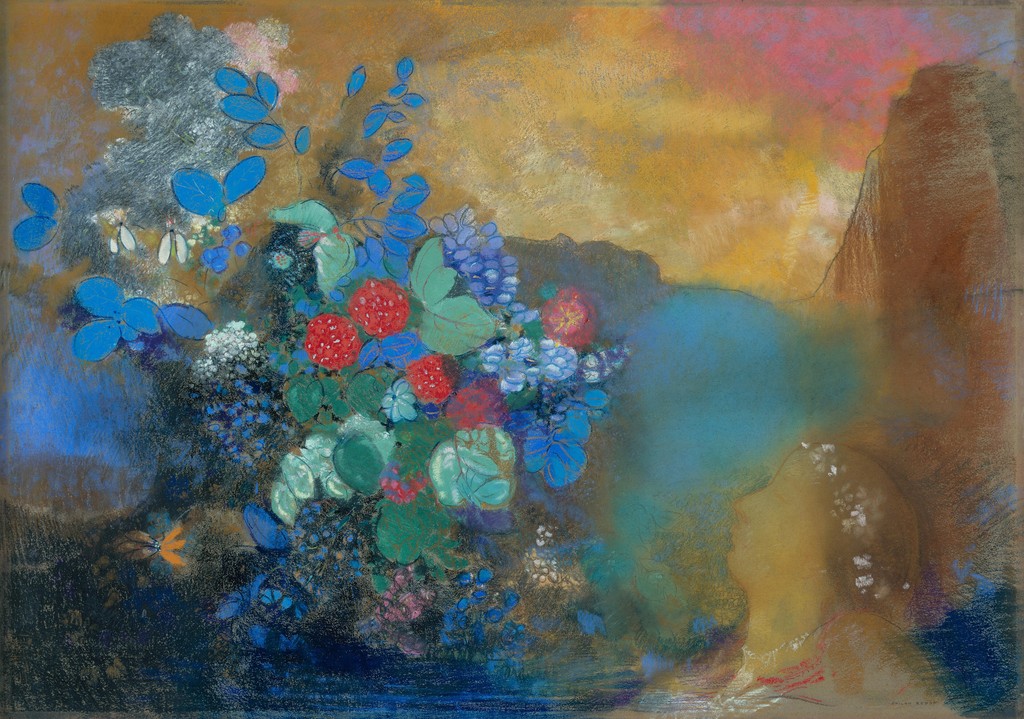
Redon then used pastel and oil for portraits, figures from myth, literary subjects, decorative schemes and an extraordinary sequence of flowers. Brighter hues did not require firmer settings. Bodies, bouquets and clouds often inhabit spaces without measurable distance. In Ophelia among the Flowers, a near-colourless profile rests among blazing pastel blooms. Rather than reconstructing a scene from Hamlet, Redon creates an autonomous meditation on sleep, death and beauty. Swift outlines and complementary colours intensify a design that is close to abstraction while still anchored by a face and flowers.[9]
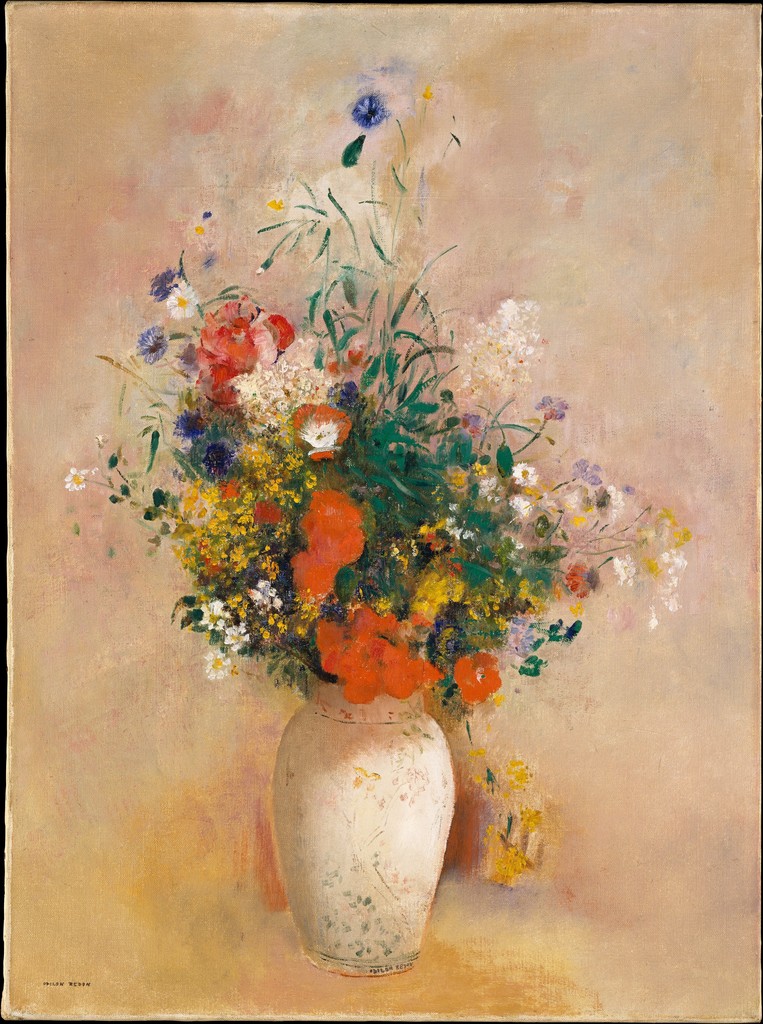
The late floral works show most clearly why “dark artist becomes happy colourist” is inadequate. Poppies and cornflowers may begin in attentive observation, but their scale, spacing and jewel-like patches of pigment make them feel newly imagined. Getty’s gallery text makes the continuity explicit: the flowers’ powdery surfaces and undefined settings let them emerge from the same dreamlike realm as the charcoal monsters.[7] Colour changes the emotional temperature and expands Redon’s means; it does not replace his underlying method.
Large decorative commissions extended this method beyond the isolated easel picture. Fields of colour, floating figures and flowers could surround a room, making atmosphere architectural. The shift also brought wider patronage and recognition. But neither success nor family happiness alone can explain it. Museum scholarship presents several possible pressures—including financial stability, a changing artistic circle and the sense that Redon had taken black as far as he wished—without reducing an extended material evolution to one psychological event.[3]
Eight Essential Works
The Cyclops
In this late painting, Polyphemus peers over a ridge towards the sleeping Galatea. His immense eye recalls the autonomous organs of Redon’s early work, but the landscape is built from startling greens, blues, pinks and golds. Begin here to see continuity at its most vivid: Greek myth, tenderness and menace, bodily strangeness and saturated colour held in one deliberately unstable scene.[11]
Eye-Balloon
The 1878 charcoal drawing is the clearest entrance to the noirs. A single eye functions as creature, aircraft and instrument of vision, while a small head becomes its improbable passenger. Look closely at the erased haze around the balloon. The subject is fantastical, but charcoal’s real behaviour makes its sky persuasive. The later 1882 lithograph is a separate work, not this drawing.[6]
Closed Eyes
Painted in 1890, this quiet bust is a hinge rather than a declaration of rupture. Diluted oil, exposed texture and an undefined setting make the figure seem almost immaterial. Its closed lids can indicate sleep, death or concentration turned inward. It is also historically significant as the first Redon work to enter France’s national collections, selected from his studio in 1904.[10]
Pandora
The National Gallery of Art’s Pandora, dated 1910/1912, suspends myth before consequence. A tall, bowed figure holds the small box while mottled flowers or mineral-like forms gather below her. The narrow canvas makes her both monumental and enclosed. Start here for Redon’s ability to slow a familiar narrative until colour, posture and expectation matter more than action.[12]
Ophelia among the Flowers
Redon’s pastel of about 1905–08 does not illustrate the riverbank described in Hamlet. Ophelia’s profile floats at the edge of a radiant, spatially uncertain field. Her drained face and the high-keyed flowers produce an unresolved state between sleep and death, person and vegetation. It is an ideal work through which to explore literature transformed into visual music.[9]
The Chariot of Apollo
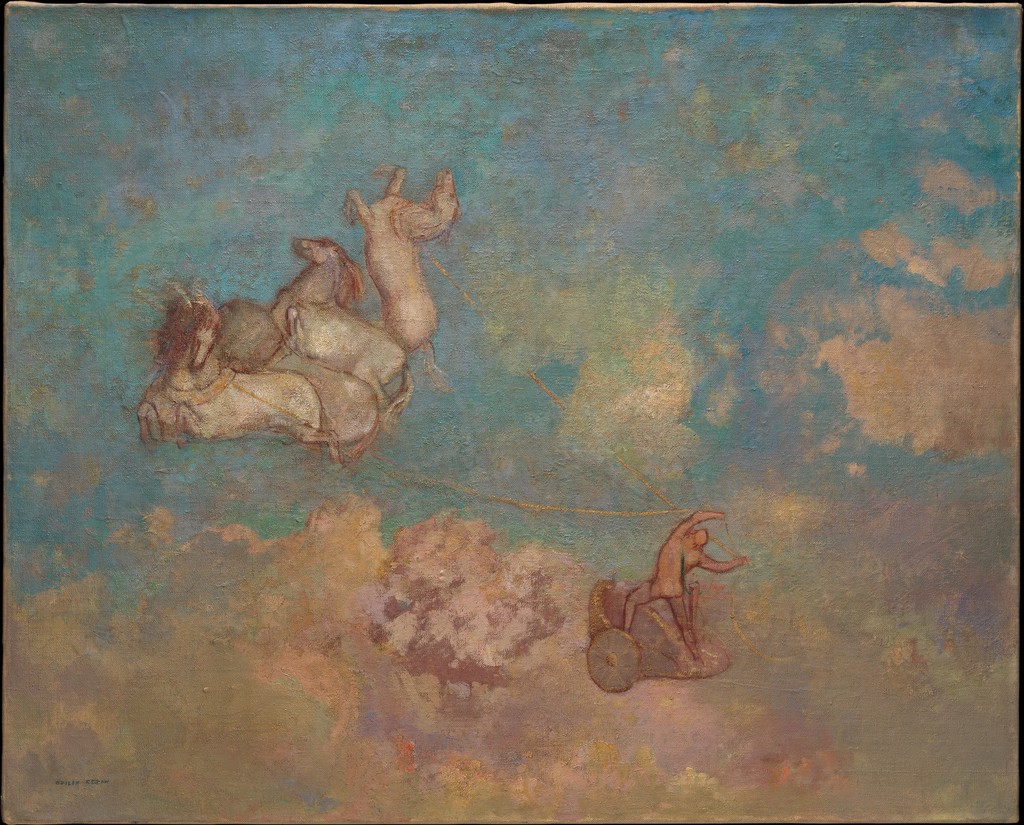
Redon returned to the sun god’s chariot in more than thirty works across oil, pastel and pencil. In the Met’s 1905–16 painting, horses and driver race through a boundless sky with no ground plane to secure them. The repeated motif let him vary speed, light and colour while keeping narrative identification open between Apollo’s command and Phaethon’s dangerous attempt.[13]
Guardian Spirit of the Waters
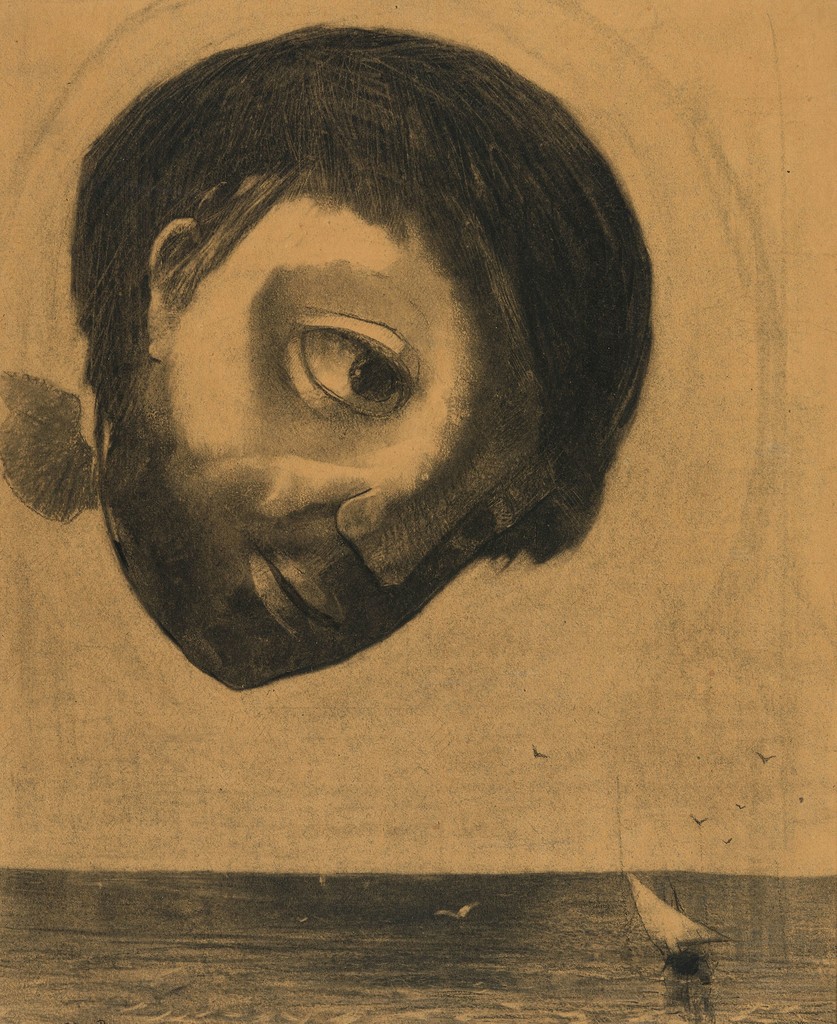
This 1878 charcoal drawing places a vast, watchful head above a tiny boat and dark water. Scale turns a human face into atmosphere: guardian, cloud and apparition at once. Read it beside Eye-Balloon to compare two early inventions in which a floating head transforms landscape, but note the different emotional charge—quiet oversight here, uncanny ascent there.[14]
Vase of Flowers (Pink Background)
Around 1906, Redon made observed poppies and cornflowers reappear as fanciful patches of colour against a misty pink field. The vase gives the bouquet a conventional starting point, but depth soon dissolves. This is the best place to test his famous visible–invisible principle without a monster or myth: reality remains present, then becomes strange through colour and space.[15]
How to Look at a Redon
Begin with the material before deciding what the subject means. In a noir, follow the movement from dense black through smudged grey to bare paper. Erasure may create light rather than merely remove a mistake. In a pastel, notice how powder absorbs light, where black drawing remains beneath colour, and where a contour is sharpened or allowed to disappear. In oil, ask whether the surface behaves like conventional paint or tries to achieve pastel’s matte bloom.[4][7]
Next, locate one form you can name. It might be an eye, stem, profile, horse or vase. Then watch what happens to its scale and setting. Redon repeatedly makes a familiar thing credible in itself but uncertain in relation to everything around it. Finally, resist the demand for a solved symbol. His titles and sources guide attention, yet ambiguity is not missing information. It is an active structure that keeps observation and imagination in motion.
Reception and Continuing Influence
Redon’s unusual imagery initially disconcerted many viewers, while Symbolist writers recognised its power of suggestion. Younger artists valued him as a precursor, and his late colour work broadened his audience.[5][8] Modern collections now make the range difficult to ignore: MoMA alone lists 295 works online, spanning early drawings, print portfolios, pastels and paintings.[16]
His relevance does not depend on retrospectively calling him a Surrealist. Redon belonged to an earlier intellectual and material world. What later artists inherited was a set of possibilities: an image could be rooted in observed nature without copying it; a literary work could be answered without illustration; and a surface could remain beautiful while withholding a single, stable explanation.[2]
Follow Odilon Redon's career through four stages
Bordeaux, Peyrelebade and observed nature
Redon moved between Bordeaux and the Médoc, studied drawing and printmaking, and formed durable interests in landscape, botany, literature and music. Rodolphe Bresdin and Armand Clavaud widened the technical and scientific resources from which his art developed.
Charcoal, lithography and visionary albums
Beginning with the 1879 portfolio In Dreams, Redon made charcoal drawings and lithographic series in which eyes, heads, organisms and literary prompts emerge from manipulated black surfaces.
Closed eyes, pastel and a gradual rebalancing
Colour became increasingly prominent through oil, pastel and mixed media. The transition was gradual: charcoal remained within later pastels, while the apparition-like spaces of the noirs survived in colour.
Flowers, myth, portraiture and decoration
Radiant flowers, portraits, classical and literary subjects and decorative commissions expanded Redon's public range. International exhibitions and younger artists brought wider recognition without making the late works less enigmatic.
Essential works
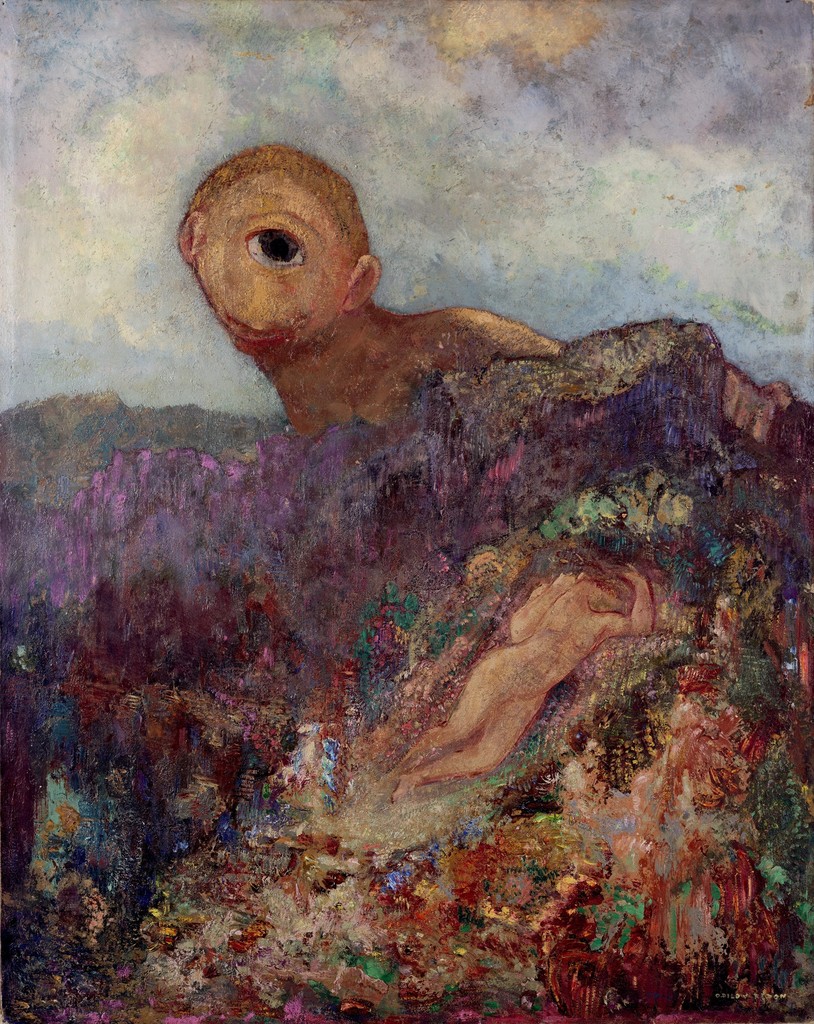
The Cyclops
c. 1914 · Polyphemus's immense eye rises above Galatea in a late painting where colour, desire and menace remain unresolved.
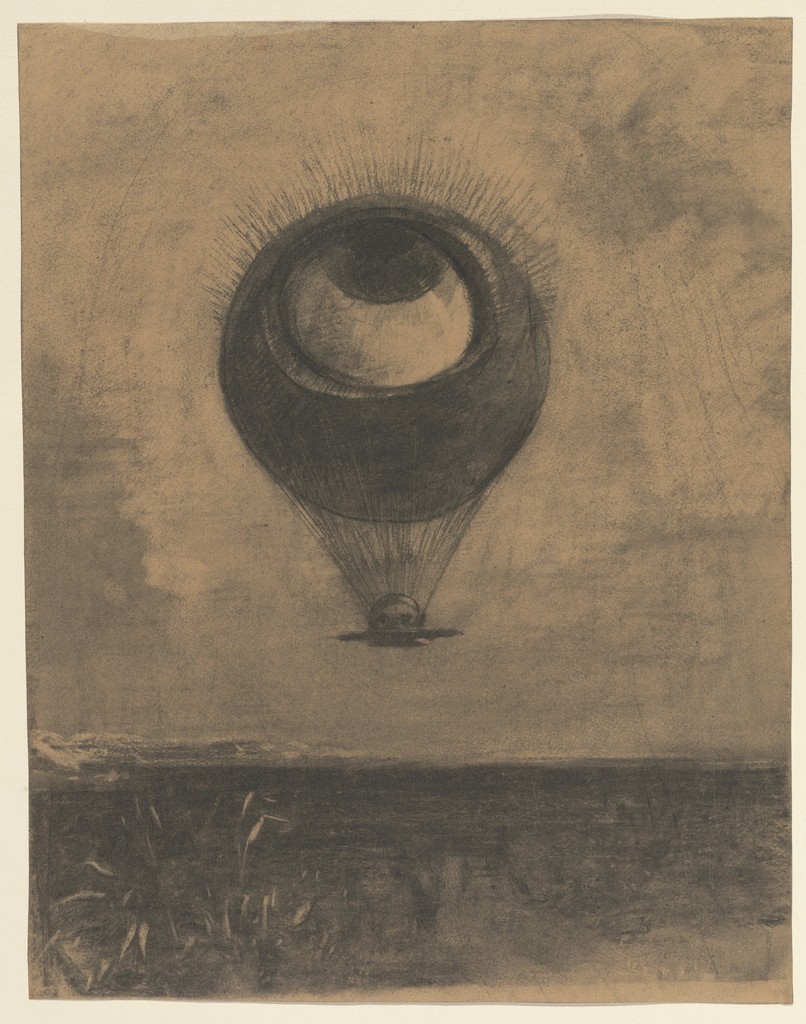
Eye-Balloon
1878 · A severed eye-head ascends through charcoal haze, joining exact drawing to an impossible airborne body.
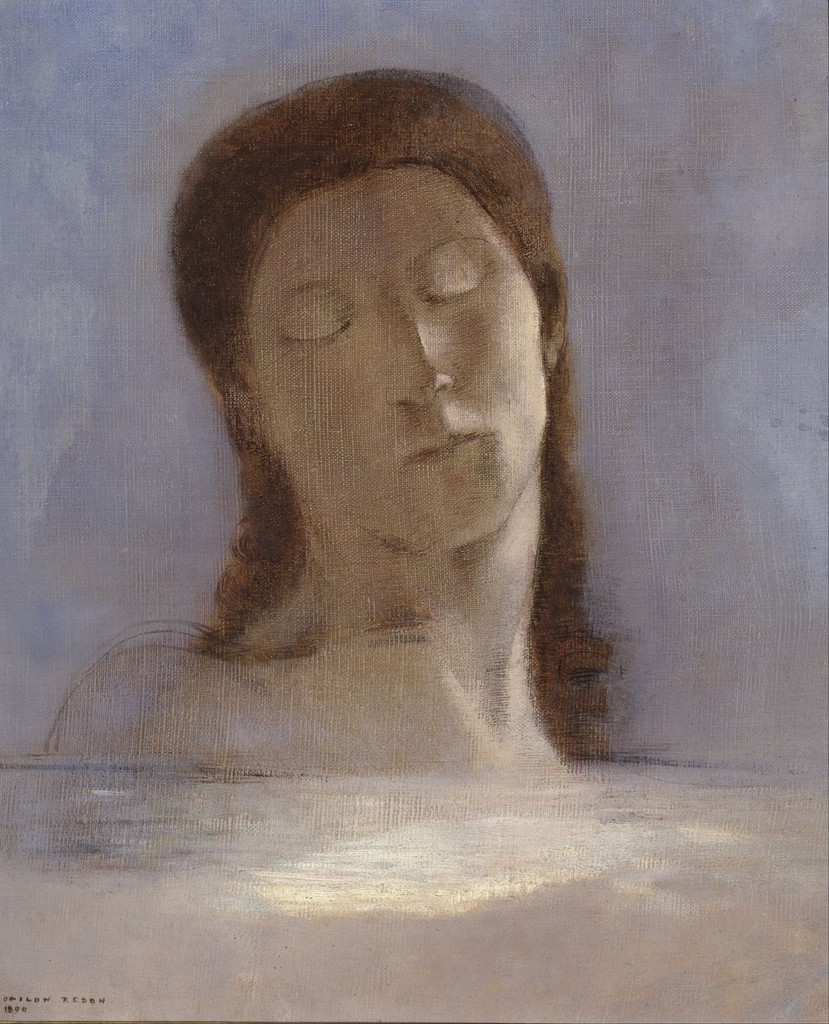
Closed Eyes
1890 · A pale inward face marks colour's emergence while preserving the suspension and silence of the noirs.
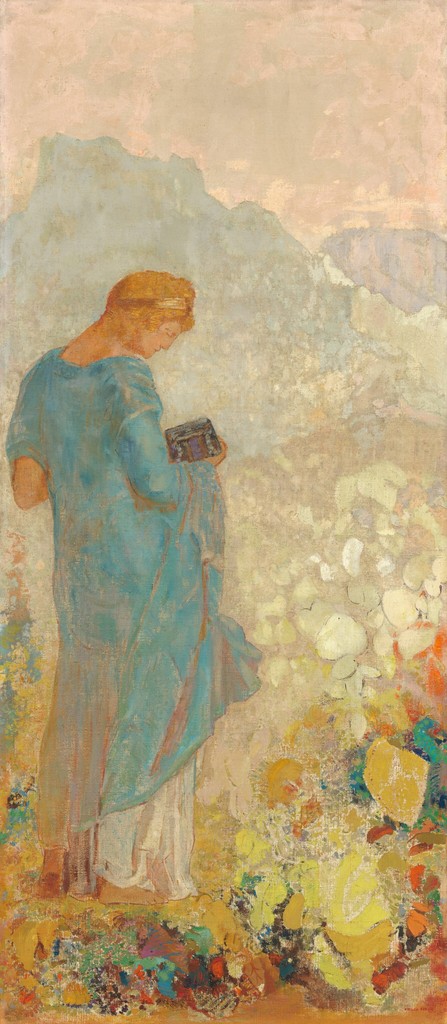
Pandora
1910/1912 · Redon arrests the myth before the box opens, making unseen consequence part of the painting's serene surface.
Ophelia among the Flowers
c. 1905–08 · Pastel flowers and a drifting profile transform Shakespearean narrative into colour, reverie and uncertainty.
The Chariot of Apollo
1905–16 · Horses and charioteer race across a groundless sky in one of more than thirty treatments of the motif.
Guardian Spirit of the Waters
1878 · A colossal floating head dwarfs a distant boat as subtraction and black media turn seascape into apparition.
Vase of Flowers (Pink Background)
c. 1906 · Observed blooms loosen into an invented bouquet whose colour seems to float within a misty pink field.
Researched works directory
This searchable evidence census was assembled from public museum records and a reproducible Wikidata snapshot. It is not a catalogue raisonné, a claim to complete oeuvre coverage, or a substitute for Alec Wildenstein's printed catalogue, which was not consulted for this directory.
| Name | Date | Medium |
|---|---|---|
| A La Vieillesse (To Old Age) | 1886 | |
| A Madman in a Dismal Landscape | 1885 | |
| A Woman Reading a Book or Reading | 1914 | Painting |
| Allégorie : un arbre rouge non rougi par le soleil | 1905 | Painting |
| Alsace | 1914 | Painting |
| Andromeda | 1907 | Painting |
| Andromeda | 1912 | Painting |
| Andromeda enchained | 1905 | Painting |
| Anémones | Date unknown | Painting |
| Anemones and Tulips | 1902 | Painting |
| Animals at the Bottom of the Sea | Date unknown | Painting |
| Antoine: Quel Est Le But de Tout Cela? ... | Date unknown | |
| Apache (Man on Horseback) | Date unknown | Painting |
| Apache (Man on Horseback II) | Date unknown | Painting |
| Apollo | 1905 | Painting |
| Apollo's chariot | 1910 | Painting |
| Apollon vainqueur du serpent Python | 1872 | Painting |
| Apollonius | 1896 | Drawing |
| Apparition | 1905 | Painting |
| Apparition | 1907 | Painting |
| Apres cela je vis descendre du ciel un ange qui avait la clef de l'abime, et une grande chaine en sa main (And I saw an angel come down from heaven, having the key of the bottomless pit and a great chain in his hand) | 1899 | |
| Arabe musicien | 1893 | Painting |
| Arbre dans la lande | Date unknown | Painting |
| Arbre (Tree) | 1892 | |
| Arbres sur un fond jaune | 1901 | Painting |
| Ari | 1898 | |
| Armor | 1891 | Drawing |
| At the Bottom of the Sea | 1905 | Painting |
| Au réveil j’aperçus la Déesse de l’Intelligible au profil sévère et dur [Bij het ontwaken zag ik de godin van het begrijpelijke in een streng en hard profiel], uit de reeks Hommage à Goya. 6 lithographies par Odilon Redon | 1885 | |
| Autoportrait en buste | 1876 | Painting |
| Bain de Venus | 1900 | Painting |
| Barbizon en automne | Date unknown | Painting |
| Baronne de Domecy | 1900 | Painting |
| Baronne Robert de Domecy | 1900 | Painting |
| Barques | 1885 | Painting |
| Barques dans le port | 1880 | Painting |
| Battle with the dragon | 1907 | Painting |
| Beatrice | 1885 | Painting |
| Béatrice | 1897 | |
| Bell-Tower Keeper | Date unknown | Painting |
| Black Sun | 1900 | Painting |
| Bloemstilleven | 1901 | Painting |
| Boqueteau | Date unknown | Painting |
| Bouddha dans sa jeunesse | Date unknown | Painting |
| Bouleaux à Bièvres | Date unknown | Painting |
| Bouquet au vase noir | Date unknown | Painting |
| Bouquet de fleurs | 1900 | Painting |
| Bouquet de fleurs | 1908 | Painting |
| Bouquet de fleurs au mimosa | Date unknown | Painting |
| Bouquet in a Chinese Vase | 1912 | Painting |
| Bouquet of Flowers | 1902 | Painting |
| Bouquet of flowers | 1904 | Painting |
| Bouquet of Flowers in a Green Vase | 1915 | Painting |
| Breton Village | 1890 | Painting |
| Brunnhilde | 1894 | |
| Butterflies | 1910 | Painting |
| C'est le Diable | 1888 | |
| C'est moi, Jean, qui ai vu et qui ai oie ces choses (And I John saw these things and heard them | 1899 | |
| C'etait un voile, un empriente (It was a veil, an imprint) | 1891 | |
| Cain and Abel | 1886 | |
| Caïn et Abel | Date unknown | Painting |
| Caliban, petit monstre ou gnome | 1881 | Drawing |
| Calvary | 1895 | Painting |
| Carnations | Date unknown | Drawing |
| Carton de vitrail | 1911 | Painting |
| Cavalier Galopant (Galloping Horseman) | 1866 | |
| Cellule Auriculaire | 1894 | |
| Cellule Auriculaire (Auricular Cell) | 1894 | |
| Centaur visant les Nues (Centaur aiming at the Clouds) | 1895 | |
| Chaumière bretonne | Date unknown | Painting |
| Chemin près de la mer | Date unknown | Painting |
| Cheval aile (Winged Horse) | 1894 | |
| Cheval cabré sur une cime | Date unknown | Painting |
| Christ | 1887 | |
| Christ and the Samaritan Woman (The White Flower Bouquet) | 1895 | Painting |
| Christ on the cross | 1910 | Painting |
| Ciel couvert sur une lande | Date unknown | Painting |
| Citroen en paprika | 1901 | Painting |
| Cliff Scene | 1895 | Painting |
| Closed Eyes | 1890 | Painting |
| Closed Eyes (Yeux Clos) | 1890 | |
| Colline, près de Royan | Date unknown | Painting |
| Combat équestre | 1910 | Painting |
| Composition à trois personnages (Flagellation ?) | Date unknown | Painting |
| Composition: Flowers | Date unknown | Painting |
| Composition: Flowers without a Vase | Date unknown | Painting |
| Conque marine | Date unknown | Painting |
| Conversation mystique | Date unknown | Painting |
| copie d'après 'La chasse aux lions' de Delacroix | 1865 | Painting |
| Copie d'après 'La Grèce sur les ruines de Missolonghi' de Delacroix | Date unknown | Painting |
| Coquelicots | 1885 | Painting |
| Couverture - Frontispice | 1890 | |
| Crucifixion | Date unknown | Painting |
| Cul-de-Lampe | 1890 | |
| Dans l'Ombre des Gens Pleurent et Prient Entourés d'Autres Qui Les Exhortent | Date unknown | |
| Dans mon rêve, je vis au ciel un visage de mystère | 1885 | |
| Dante and Beatrice | 1914 | Painting |
| De oude Ridder | 1896 | |
| De Strijdwagen van Apollo | Date unknown | Painting |
| Den helige Antonius, bröstbild | 1906 | Drawing |
| Des Fleurs Tombent, et la Tête d'un Python Parait | Date unknown | |
| Des Peuples Divers Habitent Les Pays De L'Océan | Date unknown | |
| Die Kathedrale - 13080 - Bavarian State Painting Collections | 1914 | Painting |
| Druidesse | 1891 | |
| Druidesse | 1892 | |
| Dunes | Date unknown | Painting |
| Edouard Vuillard | 1900 | |
| Een man van het volk. Tekening voor een illustratie in Le Juré van Edmond Picard | 1887 | Drawing |
| Eerbetoon aan Goya | 1895 | Painting |
| Elle Tire de Sa Poitrine une Éponge Toute Noire, La Couvre de Baisers | Date unknown | |
| Elle tire de sa poitrine une eponge toute noire, la couvre de baisers (She draws from her bosom a sponge, perfectly black, and covers it with kisses) | 1896 | |
| Escape to Egypt | Date unknown | Painting |
| Esquisse de vitrail | 1905 | Drawing |
| Et celui qui était monté dessus se nommait la Mort (And his name that sat on him was Death) | 1899 | |
| Et il avait dans sa main droit sept etoiles, et de sa bouch sortait une epee aigue a deux tranchants (And he had in his right hand seven stars; and out of his mouth went a sharp two-edged sword) | 1899 | |
| Et Il Distingue Une Plaine Aride et Mamelonneuse | Date unknown | |
| Et il tombe du ciel une grande etoile ardente (And there fell a great star from heaven burning as it were a lamp) | 1899 | |
| Et l'homme parut, interrogeant le sol d'ou il sort et qui l'attire, il se fraya la voie vers (And Man appeared; questioning theearth from which he emerged and which attracts hi m, he made his way toward somber brightness) | 1883 | |
| Et la-bas l'idole astrale, l'Apotheose (And beyond, the star idol, the apotheosis) | 1891 | |
| Et le diable qui les seduisait, fut jete dans l'etang de feu et de soufre, ou es la b ete et le faux prophete (And the devil thatdeceived them was cast into the lake of fire and brimstone, where the beast and the false prophet are) | 1899 | |
| Et le lia pour mille ans (And bound him a thousand years) | 1899 | |
| Et moi, Jean, Je vis la sainte cite, la nouvelle Jerusalem, qui descendait du ciel, d'aupres de dieu (And I John saw the holy city, new Jerusalem, coming down from God out of heaven) | 1899 | |
| Et Partout ce Sont des Colonnes de Basalte,... La Lumière Tombe des Voutes | Date unknown | |
| ...Et Que Des Vuex Sans Tête Flottaient Comme Des Mollusques | Date unknown | |
| Et un autre ange sortit du temple qui est au ciel, ayant lui aussi une faucille tranchante (And another angel came out of the temple which is in heaven, and he also having a sharp sickle) | 1899 | |
| Etruscan Vase with Flowers | 1905 | Painting |
| étude pour 'La chasse aux lions' d’après Delacroix | 1867 | Painting |
| Eve | 1904 | Painting |
| Evocation of Butterflies | 1910 | Painting |
| Evocation of Roussel | 1912 | Painting |
| Eye-Balloon | 1878 | Drawing |
| Falaise dominant la mer | Date unknown | Painting |
| Fantasia | 1910 | Painting |
| Fantasmagorie | Date unknown | Painting |
| Femme a la torque ornee (Woman with a plumed hat) | 1900 | |
| Femme de Profil (Profile of a Woman) | 1900 | |
| Femme en rouge | 1898 | Drawing |
| Ferme et rochers | Date unknown | Painting |
| Figure | 1901 | Painting |
| Figure cornue | Date unknown | Drawing |
| Figure devant un arbre | 1894 | Drawing |
| Figure portant une tête ailée | 1876 | Drawing |
| Figure, yellow flower | 1901 | Painting |
| Fireplace screen | 1908 | Painting |
| Fishing Boat | Date unknown | Painting |
| Fishing Boats: Memory of Venice | 1908 | Painting |
| Fishing Village, Brittany | 1883 | Painting |
| Five Butterflies | 1912 | Drawing |
| Fleurs | Date unknown | Painting |
| Fleurs dans un paysage de montagne avec visage | Date unknown | Painting |
| Fleurs dans un vase | 1907 | Painting |
| Fleurs dans un Vase bleu | 1903 | Painting |
| Fleurs dans un vase : pivoines | Date unknown | Painting |
| Fleurs des champs | 1906 | Painting |
| Fleurs étranges | 1910 | Painting |
| Flower Clouds | 1903 | Drawing |
| Flowers in a Japanese Vase | 1908 | Painting |
| Flowers in a Vase | 1910 | Painting |
| Flowers in Green Vase | Date unknown | Painting |
| Flowers: Poppies and Daisies | 1867 | Painting |
| Frieze of flowers and berries | 1901 | Painting |
| Frise de fleurs, marguerite rose | 1901 | Painting |
| Frontispiece | 1889 | |
| Gekruisigde Christus | Date unknown | Drawing |
| Geraniums and other Flowers in a Stoneware Jug | 1910 | Painting |
| Grand Bouquet | 1901 | Painting |
| Grand bouquet de fleurs des champs | 1903 | Painting |
| Grand panneau à décor végétal, fond clair | 1901 | Painting |
| Grand tapis de prière | 1908 | Painting |
| Green Death | Date unknown | Painting |
| Grey frieze | 1901 | Painting |
| Groupe de maisons blanches aux toits rouges | Date unknown | Painting |
| Guardian Spirit of the Waters | 1878 | Drawing |
| Hantise (Obsession) | 1894 | |
| Hélène (Ennoia) | Date unknown | |
| Hommage à Goya. 6 lithographies par Odilon Redon | 1885 | |
| Icarus | 1890 | Painting |
| Il Tombe Dans L'Abime, La Tête En Bas | Date unknown | |
| Il y eut aussi des êtres embryonnaires [Er waren ook embryonale wezens], uit de reeks Hommage à Goya. 6 lithographies par Odilon Redon | 1885 | |
| Il y eut des luttes et des vaines victoires (There were struggles and vain victories) | 1883 | |
| Il y eut peut-etre une vision premiere essayee dans la fleur (There was perhaps a first vision attempted in the flower | 1883 | |
| Immédiatement Surgissent Trois Déesses | Date unknown | |
| Initiation to Study—Two Young Ladies | 1905 | Painting |
| J'ai Quelquefois Aperçu Dans Le Ciel Comme Des Formes D'Esprits | Date unknown | |
| Jacob and the Angel | 1907 | Painting |
| Jacob's Struggle with the Angel | 1910 | Painting |
| Jacob Wrestling with the Angel | 1907 | Painting |
| Je Me Suis Enfoncé dans la Solitude. J'habitais L'Arbre Derrière Moi | Date unknown | |
| Je Suis Toujours la Grande Isis! Nul N'A Encore Soulevé Mon Fruit Est Le Soleil | Date unknown | |
| Je t'adore a l'egal de la voute nocturne. O vase de tristesse, o grande taciturne (I adore you as I adore the vault of the night sky, O vessel of sadness, O tall silent woman) | 1890 | |
| Jésus et la Samaritaine | Date unknown | Painting |
| L'Aile impuissante n'eleva point la bete en ces noirs espaces (The impotent wing did not lift the animal into that black space | 1883 | |
| L'Aile (The Wing) | 1893 | |
| L'ange déchu | 1875 | Painting |
| L'ange guerrier | 1900 | Painting |
| L'apparition | Date unknown | Painting |
| L'Araignée souriante | 1881 | Drawing |
| L'Arbre | Date unknown | Painting |
| L'Art Celeste (The Celestial Art) | 1894 | |
| L'Automne en Médoc | 1897 | Painting |
| L'Enlèvement de Ganymède | Date unknown | Painting |
| L'Intelligence Fut A Moi! Je Devins Le Buddha | Date unknown | |
| La Baie des Trépassés | Date unknown | Painting |
| La Barque | 1900 | Painting |
| La Barque rouge | 1900 | Painting |
| La Branche fleurie jaune | 1901 | Painting |
| La captive | 1914 | Painting |
| La Chute de Phaéton | 1906 | Painting |
| La Chute de Phaëton | 1910 | Painting |
| La fleur du marécage, une tête humaine et triste [De moerasbloem, een triest menselijk hoofd], uit de reeks Hommage à Goya. 6 lithographies par Odilon Redon | 1885 | |
| La Mare à Peyrelebade | 1897 | Painting |
| La Mer à Morgat | 1883 | Painting |
| La Mort: C'est Moi Te Rendes Sérieuse; Enlaçons-Nous | Date unknown | |
| La Mort d'Orphée | 1908 | Painting |
| La mort. Mon ironie dépasse toutes les autres! | 1890 | Painting |
| La Mort: Mon ironie depasse toutes les autres! (Death: My iron surpasses all others!) | 1889 | |
| La palme | Date unknown | Painting |
| La Peur (Fear) | 1865 | |
| La route de Bièvres | 1890 | Painting |
| La sirene sortit des flots vetue de dards (The Siren clothed in barbs, emerged from the waves | 1883 | |
| La Sulamite (The Shulamite) | 1897 | |
| La Vieille: Que Crains-tu? Un Large Trou Noir! Il Est Vide Peut-être? | Date unknown | |
| La Vieille: Que Crains-tu? Un large trou Noir! Il est vide peut-etre? (What are you afraid of? A wide black hole! It is empty, perhaps!) | 1896 | |
| Lady of the Flowers | 1892 | Painting |
| Lande avec une mare | Date unknown | Painting |
| Lande nue | Date unknown | Painting |
| Landscape | 1872 | Painting |
| Landscape | Date unknown | Painting |
| Landscape at Daybreak | 1872 | Painting |
| Landscape with Rocks near Royan | Date unknown | Painting |
| Large Vase with Flowers | 1912 | Painting |
| Le Bouddha | 1895 | |
| Le Bouddha | 1906 | Drawing |
| Le Buddha | 1895 | |
| Le Centaure à l'arc | Date unknown | Painting |
| Le Centaure aux coquelicots | 1910 | Painting |
| Le centaure et le dragon | Date unknown | Painting |
| Le char d'Apollon | 1905 | Painting |
| Le Chemin à Peyrelebade | Date unknown | Painting |
| Le Chêne | Date unknown | Painting |
| Le Coursier (The Race Horse) | 1894 | |
| Le Gue (The Ford) | 1865 | |
| Le Jour (Day) | 1891 | |
| Le Jour Enfin Parait,... Et Dans Le Disque Même Du Soleil, Rayonne La Face de Jésus-Christ | Date unknown | |
| Le Liseur (The reader) | 1892 | |
| Le paravent rouge (avec Pégase) | Date unknown | Painting |
| Le pavot noir | Date unknown | Painting |
| Le Petit Vase vert | Date unknown | Painting |
| Le Polype difforme flottait sur les rivages, sorte de cyclope souriant et hideux (Thedeformed polyp floated on the shores, a sort of smiling and hideous Cyclops | 1883 | |
| Le Regard | 1901 | Painting |
| Le Regard | 1910 | Painting |
| Le Rêve – Fleurs et Visage | 1890 | Drawing |
| Le Rocher rose | 1880 | Painting |
| Le Satyre au cynique sourire (The Satyr with the cynical smile) | 1883 | |
| Le Silence | 1895 | Painting |
| Le Vitrail | 1906 | Painting |
| Les Anemones (Still Life with Anemones) | 1905 | Painting |
| Les Bêtes De La Mer Rondes Comme Des Outres | Date unknown | |
| Les Croisés | Date unknown | Painting |
| Les Landes à Peyrelebade | 1885 | Painting |
| Les Parques | Date unknown | Painting |
| Les Quais à Bordeaux | 1900 | Painting |
| Les rochers (Rochers en Bretagne) | 1875 | Painting |
| Les Sciapodes: La tete le plus bas possible, c'est le secret du bonheur! (The Skiapods: "The head as low as possible, that is the secret of happiness!") | 1889 | |
| Les trois vases bleus | 1910 | Painting |
| Liserons et coquelicots dans un petit pichet vert | 1866 | Painting |
| Lueur precaire, une tete a l'infini suspendue(Precarious glimmering, a head suspended | 1891 | |
| Lumière | Date unknown | |
| Lumiere (Light) | 1893 | |
| Madame Arthur Fontaine (Marie Escudier, born 1865) | 1901 | Painting |
| Madame Odilon Redon | 1882 | Painting |
| maison avec deux arbres | Date unknown | Painting |
| Marguerites | 1901 | Painting |
| Marguerites et baies de Sorbier | 1901 | Painting |
| Maurice Denis | 1903 | |
| Médoc, arbres dans la prairie | Date unknown | Painting |
| Médoc, l'arbre | Date unknown | Painting |
| Médoc, la lande | Date unknown | Painting |
| Médoc, le bouquet d'arbres | Date unknown | Painting |
| Melancholy | 1868 | Drawing |
| Mes Baisers ont le Gout d'un Fruit Qui Se Fondrait Dans Ton Coeur!... | Date unknown | |
| Meules couvertes de bâches près d'un arbre | Date unknown | Painting |
| Mme Sabouraud (Thérèse Balandier) | 1907 | Drawing |
| Mon Enfant (My Child) | 1892 | |
| Montagnes des Pyrénées | Date unknown | Painting |
| Morgat vue des dunes de la Palue | Date unknown | Painting |
| moulin en Bretagne | Date unknown | Painting |
| Mystery | 1910 | Painting |
| Mystical Conversation | 1896 | Painting |
| Nasturtium | 1905 | Painting |
| Nature morte | 1901 | Painting |
| Navet | 1875 | Painting |
| Noce juive au Maroc | Date unknown | Painting |
| Nocturne | Date unknown | Painting |
| Nuages clairs sur une lande | Date unknown | Painting |
| Oannès | 1905 | Painting |
| Oannès | 1908 | Painting |
| Oannes and the Sphinx | 1910 | Painting |
| Oannès: Moi, La Première Conscience Du Chaos, J'ai Surgi de L'Abime Pour Durcir la Matière, Pour Régler les Formes | Date unknown | |
| Offrande | Date unknown | Painting |
| Old Man With Wings and Beard or Winged Old Man with a Long White Beard | 1870 | Drawing |
| Ophelia | 1901 | Painting |
| Ophelia | 1905 | Painting |
| Ophelia | Date unknown | Painting |
| Ophelia among the Flowers | c. 1905–1908 | Drawing |
| Ophelia with a Blue Wimple in the Water | 1900 | Painting |
| Orphée | 1910 | Painting |
| Orphée | Date unknown | Painting |
| Orpheus | 1903 | Drawing |
| Pandora | 1910/1912 | Painting |
| Panneau décoratif | 1902 | Painting |
| Pansies | 1905 | Drawing |
| Papillons | 1910 | Painting |
| Paravent d'Olivier Sainsère | 1903 | Painting |
| Parfois on trouve un vieux flacon qui se souvient, d'ou jaillit toute vive une ame qui revient (Sometimes one finds an old reminiscing flask, whence issues in full life a returning soul) | 1890 | |
| Parsifal | 1892 | |
| Passage d'une Ame (Passage of a Spirit) | 1891 | |
| Paul Gauguin | 1904 | Painting |
| Paul Serusier | 1903 | |
| Paysage de Venise | 1908 | Painting |
| Pégase et l'Hydre | 1900 | Painting |
| Pegasus | 1914 | Painting |
| Pegasus and the Hydra | 1907 | Painting |
| Pegasus, the Horse on the Rock | 1908 | Drawing |
| Pélerin du monde sublunaire (Pilgrim of the sublunary world) | 1891 | |
| Perversité | 1891 | |
| Perversite (Perversity) | 1891 | |
| Petite fille tricotant | Date unknown | Painting |
| Peupliers à Peyrelebade | Date unknown | Painting |
| Peyrelebade | 1888 | Painting |
| Pierre Bonnard | 1900 | |
| Piety Beside a Red Tree | 1905 | Painting |
| Pivoine, géranium et lilas | Date unknown | Painting |
| Plante verte dans une urne | Date unknown | Painting |
| Pond in les Landes | 1880 | Painting |
| Port breton | Date unknown | Painting |
| Portrait d'Arï Redon au col marin | 1897 | Painting |
| Portrait d'Arï Redon en profil | 1892 | |
| Portrait de Jeanne Chaine | 1903 | Drawing |
| Portrait de jeune fille sur fond d'arcatures | 1911 | Painting |
| Portrait de Madame Redon | 1911 | Painting |
| Portrait de Paule Gobillard | 1908 | Drawing |
| Portrait of A.M.L. Bonger-van der Linden | 1905 | Painting |
| Portrait of Emile Bernard | 1901 | Drawing |
| Profil de jeune fille parmi les fleurs | 1905 | Painting |
| Profil de lumiere (Profile of light) | 1886 | |
| Profile | Date unknown | Painting |
| Profile and Flowers | 1912 | Drawing |
| Profile of a Woman with a Vase of Flowers | 1900 | Painting |
| Profile on Red Meanders (formery known as Jeanne d'Arc) (see Google Books) | 1900 | Drawing |
| Prophète | Date unknown | Painting |
| Puis l'ange prit l'encensoir (And the angel took the censer) | 1899 | |
| Quadrige, le char d’Apollon | 1909 | Painting |
| Quand s'eveillait la Vie au Fon de la matiere obscure (When life was awakening in the depths of obscure matter | 1883 | |
| Reflections | 1903 | Drawing |
| rocher en Bretagne | Date unknown | Painting |
| Rocher sur la grève | Date unknown | Painting |
| Rochers de Vallières, près de Royan | Date unknown | Painting |
| Rochers en Bretagne | 1884 | Painting |
| Rochers près de Royan | Date unknown | Painting |
| Rochers sur la plage | Date unknown | Painting |
| Rocks on the Beach | 1883 | Painting |
| Rocky Peak | 1875 | Painting |
| Rocky Slope | Date unknown | Painting |
| Roger and Angelica | 1910 | Drawing |
| Roger et Angélique | Date unknown | Painting |
| Roger Marx | 1904 | |
| Roland à Ronceveaux | 1862 | Painting |
| Rose, iris et marguerites dans un vase vert | Date unknown | Painting |
| rue à Saint-Georges-de-Didonne | Date unknown | Painting |
| Rue de village | 1875 | Painting |
| Rue Douarnenez | 1880 | Painting |
| Sailboats (Allegorical Landscape) | 1907 | Painting |
| Saint Anthony and the Two Temptresses (Saint Antoine et deux Tentatrices) | 1896 | Drawing |
| Saint-Antoine...A travers ses longs cheveux qui lui couvraient la figure, j'ai cru reconnaitre Ammonaria (Saint Anthony: "Beneathe her long hair , which covered her face, I thought I recognized Ammonaria) | 1889 | |
| Saint-Antoine: Au Secours Mon Dieu! | Date unknown | |
| Saint George and the Dragon | Date unknown | Drawing |
| Saint George and the Dragon (Saint Georges et le dragon) | 1909 | Painting |
| Saint Jean | 1910 | Drawing |
| Saint John | 1900 | Painting |
| Saint Sebastian | 1900 | Painting |
| Saint Sebastian | 1910 | Painting |
| Saint Sebastian (Basel) | 1910 | Painting |
| Saint Sébastien | 1910 | Painting |
| Salomé | 1910 | Painting |
| Sans cesse a mes cotes s'agite le demon (Ceaselessly by my side the demon stirs) | 1890 | |
| Seated Man | Date unknown | Painting |
| Self-portrait | 1867 | Painting |
| Self-portrait | 1880 | Painting |
| Self-portrait | 1885 | Painting |
| Si par une nuit lourde et sombre, un bon chretien, par charite, derriere quelque vieux decombre, enterre votre corps voute (If on a close dark night a good Christian, out of charity, behind some old ruin, buries your arched body) | 1890 | |
| Silence | 1911 | Painting |
| Siren | 1900 | Painting |
| Small Grey Panel I | 1901 | Painting |
| Small Grey Panel II | 1901 | Painting |
| Sommeil de Caliban | 1895 | Painting |
| Sous-bois au printemps | Date unknown | Painting |
| Sous l'aile d'ombre | Date unknown | |
| Sous l'aile d'ombre, l'etre noir appliquait une active morsure (Beneath the wing of shadow the black creature was biting energetically) | 1891 | |
| Spring | 1907 | Painting |
| Still Life with Flowers | 1905 | Painting |
| Still Life with Fruit | 1905 | Painting |
| stillife | Date unknown | Painting |
| Sur le fond de nos nuits dieu de son doigt savant dessine un cauchemar multiforme et sans treve (On backdrop of our nights God with His knowing finger traces a multiform implacable nightmare) | 1890 | |
| Symbolic Head | 1890 | Painting |
| Tete d'Enfant avec Fleurs (Head of a Child with Flowers) | 1897 | |
| Tete d'Enfant (Head of a Child) | 1899 | |
| Tête d'Orphée | Date unknown | Painting |
| The Angel Raphael Leaving Tobit and His Family | 1862 | Painting |
| The Birth of Venus | 1906 | Painting |
| The Birth of Venus | 1912 | Painting |
| The Book of Light | 1893 | Drawing |
| The Buddha | 1904 | Painting |
| The Chariot of Apollo | 1905–1916 | Painting |
| The Chariot of Apollo series | Date unknown | Painting |
| The chariot of the Sun | 1910 | Painting |
| The Crucifixion | 1904 | Painting |
| The Cyclops | c. 1914 | Painting |
| The Death of Orpheus | 1904 | Painting |
| The Devil (Le Diable) | 1896 | Drawing |
| The Dog | 1896 | |
| The Fisherwoman | Date unknown | Drawing |
| The Flowers in a Blue Vase | 1913 | Drawing |
| The Golden Cell | 1892 | Painting |
| The Gothic Window | 1900 | Painting |
| The Green Vase | Date unknown | Painting |
| The Grey Sail | Date unknown | Painting |
| The Haunting (Hantise) | 1893 | Artwork |
| The Headhunter and His Family | 1870 | Drawing |
| The Mount of Calvary | 1895 | Drawing |
| The Muse on Pegasus | 1908 | Painting |
| The Port of Morgat | 1882 | Painting |
| The Potted Geranium | 1865 | Painting |
| The Prayer | 1893 | Painting |
| The Queen of Sheba (La Reine de Saba) | 1896 | Drawing |
| The Red Boat | 1910 | Painting |
| The Red Man | 1905 | Painting |
| The red poppy | 1895 | Painting |
| The Red Tree | 1905 | Painting |
| The Sea in Brittany | Date unknown | Painting |
| The Shadow (L'Ombre) | 1896 | Drawing |
| The Tree | 1875 | Painting |
| The Two Graces | 1900 | Painting |
| The Winged Man | 1890 | Painting |
| The Yellow Sail | 1905 | Painting |
| Three Fates | 1900 | Painting |
| Trees in Bièvres | Date unknown | Painting |
| Trees in the Blue Sky | 1883 | Painting |
| Triumph of Truth | 1870 | Painting |
| Tronc d'arbre dans la plaine | Date unknown | Painting |
| Two Dancers | Date unknown | Painting |
| Two Young Girls among Flowers | 1912 | Painting |
| Un étrange jongleur [Een vreemde evenwichtskunstenaar], uit de reeks Hommage à Goya. 6 lithographies par Odilon Redon | 1885 | |
| Underwater Vision | 1910 | Painting |
| Une femme revêtue du Soleil (A woman clothed with the sun) | 1899 | |
| Une longue chrysalide couleur de sang (A longchrysalis, the color of blood) | 1889 | |
| Vase de fleurs | 1915 | Painting |
| Vase de fleurs | Date unknown | Painting |
| Vase of Flowers | 1867 | Painting |
| Vase of Flowers | 1890 | Painting |
| Vase of Flowers | 1901 | Painting |
| Vase of Flowers | 1904 | Painting |
| Vase of Flowers | 1905 | Painting |
| Vase of Flowers, after Cézanne | 1896 | Painting |
| Vase of Flowers (Pink Background) | c. 1906 | Painting |
| Vase with Bindweed and Camomile | 1867 | Painting |
| Vase with Wild Flowers | 1900 | Drawing |
| Vieil arbre dans une prairie | Date unknown | Painting |
| Vierge | 1916 | Painting |
| Vieux Chevalier (Old Knight) | 1896 | |
| Village by the Sea in Brittany | 1880 | Painting |
| Village dans les Basses-Pyrénées | Date unknown | Painting |
| Village Square, Brittany | 1883 | Painting |
| Village sur la côte de Bretagne | Date unknown | Painting |
| Vision | 1890 | Painting |
| Vision dans les nuages | 1900 | Painting |
| Vision- vase of flowers | 1900 | Painting |
| Voici La Bonne-Déesse, L'Idéenne des Montagnes | Date unknown | |
| Volupte, Fantome Elastique! (Pleasure, elastic phantom!) | 1890 | |
| Wildflowers | 1905 | Drawing |
| Wildflowers in a Long Neck Vase | Date unknown | Painting |
| Window | 1907 | Painting |
| Winged Horse | 1895 | |
| With Closed Eyes | Date unknown | Painting |
| Woman in a gothic arcade- woman with flowers | 1905 | Painting |
| Yellow frieze | 1901 | Painting |
| Yeux Clos (Closed Eyes) | 1890 | |
| Young Man (Jeune Homme) | 1896 | Drawing |
| Young Woman in Profile | 1910 | Drawing |
| Young woman standing | Date unknown | Painting |
Frequently Asked Questions
Odilon Redon was a French artist born in Bordeaux in 1840 who died in Paris in 1916. He worked across drawing, printmaking, pastel and painting. Associated with Symbolism, he developed a personal visual language in which natural observation, science, literature, music, religion and myth feed images of dreams, hybrid beings, flowers and suspended figures.[1][3]
He is famous for two visibly contrasting but connected bodies of work: the charcoal drawings he called noirs and the luminous pastels and paintings of his later career. Disembodied eyes, strange organisms, literary apparitions, mythological figures and radiant flower arrangements recur across these media. His achievement lies as much in suggestive atmosphere as in unusual subject matter.[2][7]
The noirs are Redon’s drawings in charcoal and related black media, developed especially in the 1870s and 1880s. He used rubbing, wiping, scratching and erasure to make light, darkness and figures emerge together. The term refers to both their black material world and their often mysterious subjects. His black-and-white lithographs are closely related, but they are prints with their own expressive logic.[5][7]
There is no single proven cause. The change unfolded gradually from around 1890 and became pronounced later in that decade. Contact with younger artists, growing recognition, greater stability and a desire to explore new materials all form part of the context. Pastel also offered continuity: its powdery, matte surface could retain charcoal-like depth while giving Redon an intense range of colour.[3][4]
Start with Eye-Balloon to understand the material and imaginative logic of the noirs, then Closed Eyes to see colour enter without resolving ambiguity. Compare Ophelia among the Flowers and Vase of Flowers (Pink Background) for pastel and oil, literature and observation. Finish with The Cyclops or The Chariot of Apollo to see how late myth carries the strange scale and floating space of Redon’s earlier visions.[6][9][11][13][15]
Discussion
Use this evidence-led guide as a starting point for close looking rather than a final verdict.
Share an observation about Odilon Redon or a source that adds useful context.
Reader Insights
Which work most clearly complicates the familiar division between Redon's noirs and his later colour?
Where do Bordeaux, literary networks, natural science or older art most productively alter your reading?
Which source or surviving object would you investigate next?
Join the Conversation
Add your reading below, keeping observations specific and evidence clear.
References
- J. Paul Getty Museum, Odilon Redon: Otherworldly Visions, accessed 30 August 2026.
- Museum of Modern Art, Beyond the Visible: The Art of Odilon Redon, accessed 30 August 2026.
- Museum of Modern Art, Beyond the Visible Showcases the Mysterious and Atmospheric Works of Nineteenth-Century Artist Odilon Redon (press release), accessed 30 August 2026.
- Musée d’Orsay, Redon 1840–1916, accessed 30 August 2026.
- Musée d’Orsay, Drawings by Odilon Redon (1840–1916), accessed 30 August 2026.
- Museum of Modern Art, Eye-Balloon (Œil-ballon), 1878, accessed 30 August 2026.
- J. Paul Getty Museum, Odilon Redon: Otherworldly Visions—Gallery Text, accessed 30 August 2026.
- National Gallery of Art, Picturing France, 1830–1900, accessed 30 August 2026.
- National Gallery, London, Ophelia among the Flowers, accessed 30 August 2026.
- Musée d’Orsay, Les Yeux clos (Closed Eyes), accessed 30 August 2026.
- Kröller-Müller Museum, The Cyclops, accessed 30 August 2026.
- National Gallery of Art, Pandora, accessed 30 August 2026.
- Metropolitan Museum of Art, The Chariot of Apollo, accessed 30 August 2026.
- Art Institute of Chicago, Guardian Spirit of the Waters, accessed 30 August 2026.
- Metropolitan Museum of Art, Vase of Flowers (Pink Background), accessed 30 August 2026.
- Museum of Modern Art, Odilon Redon, accessed 30 August 2026.
- Metropolitan Museum of Art, Fantastic Blooms: Odilon Redon in The Met Collection, accessed 30 August 2026.