by Tom Gurney
Tom Gurney BSc (Hons) is an art history expert with over 20 years experience
Published on June 19, 2020 / Updated on October 14, 2023
Email: tomgurney1@gmail.com / Phone: +44 7429 011000
Introduction
Masaccio’s Expulsion from the Garden of Eden is one of the most emotionally direct images of the Early Renaissance. Painted in the Brancacci Chapel at Santa Maria del Carmine in Florence, the narrow fresco shows Adam and Eve driven from Paradise beneath an armed angel, but Masaccio reduces the biblical story to such concentrated bodily grief that the scene feels almost painfully immediate. The fresco is usually dated to about 1424–27, within the first Brancacci campaign involving Masolino and Masaccio.
Its position opposite or in close visual dialogue with Masolino’s Temptation of Adam and Eve makes the contrast especially powerful: Masolino presents the couple before the Fall with elegance and composure, while Masaccio shows the consequences as shame, loss and irreversible movement. The difference is not simply one of “old” and “new” styles. Masaccio’s innovation lies in making theology physical.
Adam’s hidden face, Eve’s open mouth, their nakedness and the force of the angel above them turn the Fall into a human experience carried through bodies rather than decorative symbols. Later generations responded intensely to that directness. The Brancacci Chapel became a major place of artistic study, and Michelangelo in particular was associated with drawing from Masaccio’s figures there, helping extend the fresco’s influence into the mature Renaissance.
At a Glance
- ArtistMasaccio
- TitleExpulsion from the Garden of Eden
- Datec. 1424–27
- MediumFresco
- LocationBrancacci Chapel, Santa Maria del Carmine, Florence
- SubjectAdam and Eve expelled from Eden after the Fall
- Biblical sourceGenesis 3
- Companion contrastMasolino’s Temptation of Adam and Eve
- Key expressive devicesnakedness, gesture, bodily movement, directional light and foreshortening
- Adamcovers his face in grief
- Evecries out while attempting to cover her body
- Angelarmed, strongly foreshortened and driving the pair outward
- Later alterationfoliage was added to conceal nudity
- Modern restorationlater coverings removed during twentieth-century restoration
- Historical importancelandmark in the Renaissance representation of shame, grief and the human body
Contents
- The Story in Genesis
- Adam
- Shame and Nakedness
- The Sword
- No Decorative Escape
- Emotion without Narrative Detail
- Classical Sources and the Nude
- Expulsion as Loss
- When Were They Added?
- The 2022–24 Conservation Campaign
- Why the Fresco Feels Modern
- The Direction of the Bodies
- Why the Expulsion Matters
- Frequently Asked Questions
- References and Research Sources
The Story in Genesis
The fresco belongs to the biblical story of Adam and Eve after they have eaten from the forbidden tree. Their disobedience brings knowledge, shame and divine judgement, and God expels them from Eden while placing a guardian at the entrance. Masaccio does not narrate the temptation itself here. That moment is represented separately by Masolino, allowing the chapel to divide the Fall into before and after: seduction on one side and consequence on the other.
Why the Expulsion Appears in a Saint Peter Cycle. The Brancacci Chapel is principally devoted to the life of Saint Peter, so the presence of Adam and Eve requires explanation. The Genesis scenes establish the theological problem to which Christ and the Church provide the answer: humanity falls, Christ redeems, and Peter becomes one of the principal agents through whom the Christian community is founded. The Expulsion therefore operates at the beginning of a much larger salvation history. Its grief is not an isolated tragedy but the condition from which the rest of the chapel’s Christian narrative develops.
A Narrow Fresco. The composition is strikingly compressed. Adam and Eve fill much of the narrow vertical field, while the angel hovers above and a simple architectural boundary marks the lost Paradise behind them. Masaccio uses the restricted format to intensify the experience. There is nowhere for the figures to escape visually, so the viewer confronts their bodies almost directly.
Movement Out of Eden. Adam and Eve move forward rather than standing statically beneath judgement. Their stride makes expulsion an action unfolding through time. The movement also carries them towards the spectator’s world. Paradise remains behind, while fallen humanity appears to enter the same physical condition occupied by the viewer.
Adam
Adam covers his face with both hands. The gesture conceals his expression almost completely, yet it communicates shame and despair more forcefully than a carefully described face might have done. His body bends slightly as he walks, making grief affect posture as well as gesture. Masaccio therefore treats emotion as something experienced by the whole body.
A Hidden Face. Adam’s hidden face is one of the fresco’s boldest decisions. Renaissance painting increasingly valued individual physiognomy, but Masaccio deliberately denies it here because the act of covering becomes more expressive than facial detail. The gesture is universally legible. Adam appears unable to look outward, and the viewer understands his grief precisely through that withdrawal.
Eve. Eve reacts differently. She raises her face, opens her mouth and cries out while attempting to cover her breasts and pubic area. Her gesture combines shame with vocal lament. Where Adam turns inward, Eve’s suffering is projected outward, creating a complementary emotional pair.
The Open Mouth. Eve’s open mouth is particularly powerful because painted figures do not literally make sound. Masaccio nevertheless makes the viewer imagine a cry, transforming visual expression into an almost auditory experience. The gesture contributes to the fresco’s immediacy. Eve is not posed as a graceful penitent but caught in the physical act of anguish.
Shame and Nakedness
After eating the forbidden fruit, Adam and Eve become aware of their nakedness. Masaccio makes this theological transformation central by showing the couple completely exposed and immediately attempting to hide themselves. Their nudity is therefore not decorative. It is part of the narrative meaning because bodily self-consciousness is one of the consequences of the Fall.
The Human Body after the Fall. Masaccio’s bodies are not idealised abstractions. They possess weight, vulnerability and imperfect physical presence, making the Fall visible as a change in the way human beings inhabit their own bodies. This is one reason the fresco feels so modern to later viewers. Theology becomes psychology through anatomy and gesture.
The Angel. Above the couple, an angel drives them outward. The figure carries a sword and is strongly foreshortened, giving the sensation of descending or projecting into the same space as Adam and Eve. The angel’s action creates directional force. Divine judgement is not passive; it propels the figures physically away from Paradise.
Foreshortening. Foreshortening allows Masaccio to represent the angel as a body seen at an angle rather than as a flat emblem. Limbs and torso contract visually according to the spectator’s viewpoint. This treatment connects the sacred figure with the same spatial world as Adam and Eve. Even the supernatural obeys optical experience.
The Sword
The angel’s sword intensifies the sense of irreversible exclusion. It signals both judgement and the guarded boundary between humanity and the lost garden. Masaccio avoids elaborate violence. The weapon is enough to make the expulsion feel enforced.
The Gate of Paradise. The architectural opening behind the figures marks Eden’s boundary. Compared with the elaborate spatial constructions elsewhere in the chapel, the setting is unusually reduced. This restraint serves the emotion. Masaccio gives just enough architecture to establish departure and then allows the human bodies to dominate.
Light. Directional light models Adam and Eve strongly, giving their torsos and limbs real volume. Shadows across the bodies make flesh appear tangible rather than outlined. This consistent modelling connects the fresco with Masaccio’s broader Brancacci language. The same light that gives apostles physical authority also makes fallen humanity painfully present.
Light and Vulnerability. The illumination does more than describe anatomy. Because Adam and Eve are naked, light exposes them in a way that clothed figures elsewhere in the chapel do not experience. The result intensifies shame. Their bodies seem subjected to visibility itself.
No Decorative Escape
There is little landscape, ornament or elaborate architecture to soften the scene. The viewer has almost nothing to examine except bodies, angel and movement. This economy is one of Masaccio’s great strengths. Emotional intensity comes from concentration rather than accumulation.
Masolino’s Temptation of Adam and Eve. Masolino’s Temptation provides the obvious counterpart. His Adam and Eve stand calmly beneath the tree, their bodies elegant and controlled as the serpent approaches. The scene represents temptation before its consequences are known. Its visual serenity therefore suits the narrative moment even as its style differs strongly from Masaccio’s.
Before and After. Seen together, the two frescoes create a devastating before-and-after sequence. Masolino’s couple inhabit a balanced Paradise, while Masaccio’s bodies are broken emotionally by what has happened. The stylistic difference intensifies the theological difference. Graceful stability becomes exposed suffering.
Not Simply Gothic versus Renaissance. It is tempting to use the pair as a textbook comparison between International Gothic and Renaissance naturalism. The contrast is real, but the chapel’s collaborative context makes a more nuanced reading preferable. Masolino was a sophisticated painter capable of spatial innovation, while Masaccio could still work within inherited religious conventions. The pairing is powerful because two legitimate artistic languages serve different stages of the same story.
Emotion without Narrative Detail
Masaccio does not show the serpent, forbidden fruit, God’s accusation or the moment of judgement. All of those events are compressed into the emotional consequences carried by Adam and Eve. This economy demonstrates remarkable confidence. The viewer does not need every narrative step because the bodies reveal what has happened.
Adam and Eve as Archetypes. The figures are individual enough to feel human but universal enough to function as the ancestors of fallen humanity. Their grief belongs both to the biblical couple and to the human condition imagined by Christian theology. Masaccio therefore balances specificity with archetype. The bodies are real enough to persuade and general enough to represent everyone.
Giotto and Emotional Gesture. The fresco naturally recalls Giotto’s earlier ability to make sacred emotion legible through bodily action. Giotto’s mourners bend, reach and collapse, allowing physical gesture to carry psychological meaning. Masaccio extends that tradition through stronger anatomical presence and fifteenth-century spatial understanding. The emotional seriousness is inherited, but the body becomes even more exposed.
Donatello and Bodily Force. Donatello provides another important contemporary parallel. His sculpture repeatedly gives bodily stance and movement psychological intensity, qualities that Masaccio translates into painted form. The Expulsion shows particularly clearly why their artistic worlds are often compared. The figures feel almost sculptural despite being painted directly onto plaster.
Classical Sources and the Nude
Renaissance artists were increasingly studying ancient sculpture and the nude body as a carrier of human meaning. Masaccio’s Adam and Eve participate in that broader recovery without becoming idealised classical athletes. Their bodies are theological rather than heroic. The nude is used to reveal vulnerability, not triumph.
Eve and Antique Models. Scholars have often noted possible classical resonances in Eve’s pose, particularly the ancient tradition of the modest Venus who covers her body. The comparison is suggestive because the gesture of modesty becomes transformed from idealised beauty into shame after the Fall. Even where no direct prototype can be proved, Masaccio’s Florence was increasingly receptive to ancient bodily forms. Classical vocabulary could therefore acquire new Christian meaning.
Adam’s Grief. Adam’s gesture has also been compared with ancient and medieval expressions of mourning. Covering the face suggests grief too intense for outward display. Masaccio strips the gesture of ornament and gives it complete emotional responsibility. The unseen face becomes one of the strongest expressions in the chapel.
Theological Shame. Christian interpretations of Genesis often understood the Fall as damaging the original harmony between reason, desire and body. Adam and Eve’s sudden need to cover themselves therefore carries more than social embarrassment. Masaccio gives that theological rupture physical form. Their bodies have become objects of painful self-awareness.
Expulsion as Loss
The movement forward creates a sense of permanent separation. Adam and Eve do not merely leave a garden; they leave a condition of innocence. Masaccio’s sparse setting helps make that abstraction understandable. Paradise is behind them, and there is no visual suggestion that they can return.
The Fresco and the Viewer. Because the figures move outward, the spectator occupies the world into which they are expelled. This creates a powerful devotional identification. The viewer does not watch safely from Paradise. The viewer stands on the side of fallen humanity.
Relationship to the Rest of the Chapel. The surrounding Saint Peter cycle then provides the theological continuation. Baptism, healing, charity and apostolic authority become parts of the Christian response to the fallen condition established by Adam and Eve. The Expulsion therefore gives emotional urgency to scenes that might otherwise seem merely institutional. The Church exists because humanity needs restoration.
The Later Fig Leaves. At some point after Masaccio’s lifetime, painted foliage was added to cover the nudity of Adam and Eve. The intervention reflected later standards of decorum and significantly altered the visual and theological impact of the fresco. Covering the bodies reduced precisely the vulnerability Masaccio had made central. Shame remained part of the story, but the viewer no longer confronted the couple’s exposure as directly.
When Were They Added?
The exact chronology of the coverings has often been associated broadly with later post-Renaissance censorship and changing attitudes towards nudity. Unless supported by a specific archival record, it is safer not to assign the intervention to one named individual or exact moment. What matters securely is that the additions were later than Masaccio and not part of his original conception.
The 1980s Restoration. The major Brancacci restoration of 1981–89 recovered the frescoes’ clearer and more brilliant colour, according to the Comune di Firenze. During twentieth-century restoration the later coverings over Adam and Eve were removed, restoring the original nude figures. This changed the scene dramatically. The bodies once again became fully exposed, bringing modern viewers closer to Masaccio’s uncompromising treatment of shame.
Restoration and Meaning. The removal demonstrates that conservation is interpretive as well as technical. Restorers are not merely cleaning surfaces; their decisions can restore or suppress fundamental aspects of iconography. In the Expulsion, nudity is inseparable from meaning. Returning it altered the emotional force of the entire composition.
Colour after Cleaning. Modern restoration also changed perceptions of Masaccio’s palette. Centuries of dirt and altered surface coatings had made the Brancacci frescoes appear darker and more sombre. The recovered colour reveals that monumentality does not depend upon brown austerity. Masaccio’s forms remain severe even within a clearer and more varied chromatic world.
The 2022–24 Conservation Campaign
The Comune di Firenze began a new diagnostic and conservation campaign in 2022, examining the chapel at close range and addressing local problems in plaster and painted surface. The project continued the technical study made possible by earlier restoration and concluded with reopening in May 2024. This modern research reinforces the fresco’s status as an active material object rather than an image preserved unchanged since the fifteenth century. Its survival depends upon repeated observation and intervention.
Michelangelo and the Brancacci Chapel. The chapel became one of Florence’s most famous places of artistic study. Later accounts and modern institutional interpretation associate Michelangelo with drawing Masaccio’s figures there. The Expulsion would have offered him an extraordinary lesson in how the nude can communicate emotion through the entire body. Masaccio’s figures are not anatomical demonstrations; anatomy is subordinated to psychological force.
Michelangelo’s Sistine Expulsion. Michelangelo later painted the Fall and Expulsion on the Sistine Chapel ceiling. His treatment is far more muscular and complex, but the idea of making Adam and Eve’s transformation visible through monumental naked bodies belongs to a tradition in which Masaccio’s example was foundational. The relationship should not be reduced to one copied pose. Masaccio’s deeper legacy lies in proving that the nude body could carry enormous theological and emotional weight.
Later Renaissance Influence. The fresco influenced generations because its lesson was portable. Painters could adopt its emotional economy, bodily gravity and exposed vulnerability without reproducing the exact composition. This is one reason Masaccio’s very small surviving corpus had such disproportionate effect. A few figures could become permanent points of reference.
Why the Fresco Feels Modern
Modern viewers often describe the Expulsion as psychologically immediate because the gestures require little specialist iconographic knowledge. Covering one’s face, crying out and attempting to hide the body are understandable across large cultural distances. That accessibility should not obscure the painting’s theological sophistication. Masaccio achieves universality by grounding Christian doctrine in recognisable human behaviour.
Pain rather than Beauty. The fresco also challenges the idea that Renaissance naturalism was primarily about ideal beauty. Adam and Eve are compelling because grief disrupts beauty. Masaccio’s humanism is therefore not sentimental optimism. The human body can be dignified precisely when it is suffering.
The Limits of Idealisation. Eve’s anatomy and Adam’s posture are not designed to provide detached aesthetic pleasure. Their forms are subordinated to narrative urgency. This willingness to sacrifice grace for truth is one of the most radical aspects of the scene. Emotional necessity overrides decorative perfection.
Silence and Sound. Adam’s grief is silent because his face is hidden, while Eve’s open mouth implies a cry. The contrast gives the scene an imagined acoustic dimension despite the silent medium of fresco. Masaccio therefore differentiates suffering through more than pose. One figure collapses inward; the other projects grief outward.
The Direction of the Bodies
Both figures move in the same direction, but their upper bodies react differently. This gives the composition unity without repetition. The shared stride makes expulsion collective, while contrasting gestures preserve individuality. Humanity falls together, but Adam and Eve experience the loss differently.
The Angel as Counterforce. The angel’s body occupies the air above them and pushes visually in the same direction. Sword, gesture and foreshortening combine into a force that makes the movement feel compelled. The composition therefore has a clear directional vector. Every major form participates in expulsion.
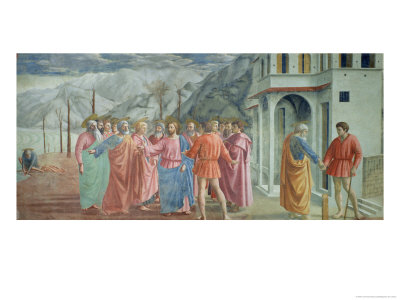
Space without Perspective Display. Unlike the Tribute Money or Holy Trinity, the fresco contains almost no obvious architecture through which to demonstrate linear perspective. Yet the figures occupy space convincingly because their bodies are modelled volumetrically and their movement establishes depth. This is a useful reminder that Masaccio’s revolution was broader than perspective. He could create spatial truth through the body alone.
Why the Expulsion Matters within Masaccio’s Career. The fresco reveals Masaccio at his most concentrated. In other works he coordinates large groups, architecture and complex narrative, but here almost everything has been stripped away so that two naked bodies can carry the full theological burden. That economy proves how secure his understanding of figure painting had become. He no longer needs elaborate setting to make a scene monumental.
Why the Expulsion Matters
Masaccio’s Expulsion from the Garden of Eden matters because it turns one of Christianity’s foundational stories into an immediate human experience. Adam and Eve do not symbolise grief from a safe distance; they bend, cover, cry and move as bodies overwhelmed by what has happened. The painting’s naturalism is therefore inseparable from theology. Nakedness expresses the new shame created by the Fall, the angel enforces separation from Paradise and the direction of movement carries fallen humanity towards the viewer’s own world.
Its relationship with Masolino’s Temptation deepens the effect. The serenity before the Fall and the anguish after it occupy the same chapel, making stylistic contrast part of the narrative experience. The later addition and removal of coverings demonstrate how powerfully nudity determines interpretation. Once the fig leaves were removed during modern restoration, the original vulnerability returned and Masaccio’s uncompromising conception became visible again. Above all, the fresco shows why Masaccio mattered to later Renaissance artists. He proved that the human body could communicate theology, psychology and narrative at once, and that a painting could become more sacred rather than less sacred by making suffering unmistakably human.
Frequently Asked Questions
Discussion
Use this space to discuss Adam and Eve - Expulsion from the Garden of Eden by Masaccio, its source evidence and how it fits into Masaccio's wider cluster.
Keep comments focused on close looking, attribution language, object evidence and page-specific caveats.
Reader Insights
Which detail on this page most changes how you read the work?
How does this page connect to Masaccio's paintings, fresco technique or Florentine setting?
Where should the wording stay cautious because the source evidence is qualified?
Join the Conversation
Share your reading of Adam and Eve - Expulsion from the Garden of Eden by Masaccio below.
References and Research Sources
- Smarthistory, Masaccio, Expulsion of Adam and Eve from Eden in the Brancacci Chapel, for dating, iconography, gesture, the angel and the relationship with Masolino’s Temptation. View Source
- Smarthistory, Masaccio, The Tribute Money and Expulsion in the Brancacci Chapel, for the chapel context, bodily naturalism and later artistic study. View Source
- Comune di Firenze, Cappella Brancacci in Santa Maria del Carmine, for commission history, later alterations, fire and the 1981–89 restoration. View Source
- Comune di Firenze, L’ultimo restauro, for the modern diagnostic and conservation campaign begun in 2022. View Source
- FeelFlorence, Cappella Brancacci, for the institutional framing of Masaccio’s intervention as a major Renaissance revolution and the wider chapel chronology. View Source