


 by Tom Gurney
Tom Gurney BSc (Hons) is an art history expert with over 20 years experience
Published on June 19, 2020 / Updated on November 5, 2026
Email: tomgurney1@gmail.com / Phone: +44 7429 011000
Lawrence Alma-Tadema Quotes and Their Context
Lawrence Alma-Tadema’s comments about painting reveal an artist concerned with preparation, personal judgment and the imaginative reconstruction of the past. The most useful quotations are attached to a recoverable setting: a biographer describing a conversation, or an interviewer asking which painting best represented him. Read in that setting, a short remark can illuminate his work without becoming a universal rule for every artist.
The selections here come principally from Helen Zimmern’s early study and Frederick Dolman’s interview published in The Strand Magazine in July 1901. Zimmern reports the painter’s opinions on artistic education; Dolman questions him about his own pictures. Their accounts let us distinguish Alma-Tadema’s reported voice from a critic’s description or a modern summary. [1] [2]
At a Glance
- Early accountHelen Zimmern’s biographical study
- InterviewFrederick Dolman, The Strand Magazine, July 1901
- ThemesEducation, artistic judgment and reconstructing antiquity
Contents
- On travel and artistic education
- What it means to have found a direction
- Choosing a painting to represent him
- Reconstructing ancient Rome
- Spring: research and the freedom to combine
- The studio as part of the imagined world
- A later claim about Greeks and Romans
- Reading the artist without surrendering judgment
On travel and artistic education
“It is my belief that an art student ought not to travel.”
This arresting statement appears in Zimmern’s account of Alma-Tadema’s views on studying abroad. Its continuation is essential: he thought travel could benefit someone who had already developed an artistic purpose and could recognise what was useful. The remark questions the timing of travel rather than denying the value of encountering other art. [1]
There is a practical distinction here between collecting impressions and knowing how to use them. A student confronted by an impressive tradition may imitate its visible features without understanding the decisions behind them. A more experienced painter can compare those decisions with a developing purpose of their own.
The statement remains an opinion in a reported conversation, not a reliable law of artistic development. Some artists have changed direction because they travelled early; others benefited from working within a familiar environment. Its interest is that Alma-Tadema connected learning with a sense of artistic identity, rather than assuming that proximity to masterpieces automatically produced original work.
What it means to have found a direction
Zimmern illustrates the argument with the succinct phrase “Rubens was already Rubens.” The words suggest that influence becomes useful when an artist can transform it, rather than simply receive it. They are part of the same discussion, not an unrelated motivational saying. [1]
For a viewer, the idea suggests a way to examine an elaborate historical painting. Ask which elements have been selected from the past, then ask how they have been made to belong together. A borrowed architectural detail may carry documentary authority, but its position within a composition is a new decision. The painter determines its scale, lighting, relationship to a figure and contribution to an atmosphere.
This makes individuality a matter of relationships rather than novelty in every component. An artist can work with inherited subjects and still make distinctive pictures. Conversely, unusual subject matter does not by itself guarantee a personal way of seeing. The quotation becomes useful when it directs attention to the choices connecting the parts.
Choosing a painting to represent him
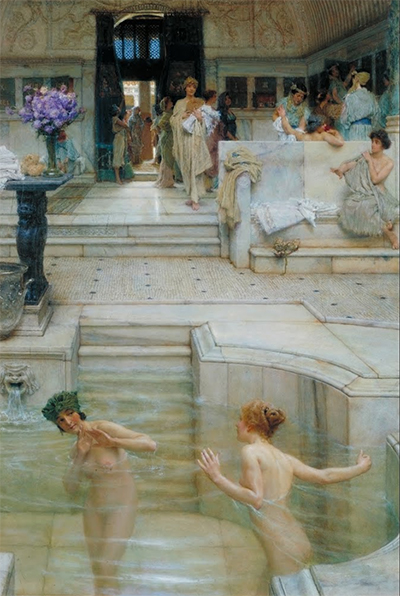
Dolman’s interview asks Alma-Tadema which of his works he liked best. The reported answer distinguishes a picture loved because of private associations from one chosen to represent his achievement publicly. He selects The Baths of Caracalla, while allowing that his current state of mind may influence the decision. [2]
This is an unusually helpful distinction for anyone looking at art. Personal attachment and critical judgment can overlap without being identical. We may cherish a modest image because of a memory, then recognise greater ambition in another work. An artist is not exempt from that difference simply because he made both pictures.
The interview also resists turning an answer into a permanent ranking. A preference expressed at one moment does not tell us what the artist would have chosen throughout his life. Keeping the date and the interviewer attached to the remark preserves that openness. It also keeps a revealing conversation from becoming an unsupported claim about an absolute favourite.
Reconstructing ancient Rome
“a picture of ancient Rome as it was”
The phrase occurs in the same interview, where Alma-Tadema explains his reconstruction of the Baths. Dolman’s report describes the use of archaeological drawings and later adjustments to the picture with studies and models. The artist’s claim to historical reconstruction therefore sits beside an account of active, revisable pictorial work. [2]
A reconstruction is a proposal about how fragments might once have belonged together. It does not simply reproduce a surviving view. That difference helps explain the attraction of Alma-Tadema’s interiors: the painter gives material evidence an inhabitable setting, complete with distances, surfaces and human movement.
The phrase also invites scrutiny. A convincing marble surface does not prove that every person, object and activity has been assembled exactly as it would have appeared in antiquity. Historical knowledge and imaginative staging can coexist. The viewer can enjoy the scene while asking which parts depend on surviving evidence and which are the painter’s contribution.
Spring: research and the freedom to combine
The Getty Museum’s account of Spring, painted in 1894, describes a flower-filled procession through a richly constructed Roman city. It identifies references to fertility and seasonal abundance while observing that the particular festival represented is uncertain. Its interpretation is appropriately more qualified than a precise identification of one ancient ceremony. [3]
That uncertainty changes the experience of the painting. Rather than treating every detail as a footnote to a single historical event, we can examine how the procession works as a whole. Vertical architecture frames moving bodies, while flowers and textiles carry colour through a crowded space. The setting supplies grandeur, but the people create its pace.
Read beside the interview’s reconstruction claim, the painting encourages two kinds of attention. One follows the evidence and asks about ancient objects or rituals. The other follows the composition and asks how an abundant visual world has been created. Neither enquiry has to remove the pleasure of the other.
The studio as part of the imagined world
Research published in British Art Studies examines the relationship between Alma-Tadema’s studio-homes and the ancient world of his pictures. It draws attention to archaeological material among his studies and to the importance of the spaces in which the artist worked and displayed his work. The studio becomes part of the historical enquiry, rather than a neutral room outside it. [4]
This gives a useful context for the distinction between travel and artistic direction. The past could be encountered through a journey, but also through photographs, drawings, objects and arranged interiors. A painter’s working environment could bring those different forms of evidence into continuing contact.
For the viewer, that connection raises a question about the boundary between research and performance. A carefully arranged room can support work while also shaping how visitors understand the artist. The same intelligence that creates a convincing setting inside a painting may organise the setting in which the painting is first seen. Recognising this does not make the achievement less substantial; it makes the process more interesting.
A later claim about Greeks and Romans
A modern Christie’s essay repeats a short declaration in which Alma-Tadema invites anyone wanting to know how Greeks and Romans looked to “come to me.” The essay presents this as the painter’s claim, but the immediate context supplied there is not a dated transcript of the original occasion. It is best treated as a reported saying rather than given a precise speech date that the source does not establish. [5]
The remark neatly captures an aspect of his public reputation. His pictures could seem to provide access to an ancient world made tangible through materials, furnishings and bodies. Yet the invitation is most illuminating as a statement of ambition. It asks us to consider the persuasive power of the image rather than certify every detail within it.
A short quotation can easily become more confident as it is repeated. Retaining the words reported by a later source keeps the difference visible between a recoverable interview and an attractive declaration preserved at a greater distance.
Reading the artist without surrendering judgment
Alma-Tadema’s comments become most rewarding when they return us to a particular painting. His views on education invite us to look for transformed influences. His distinction between affection and achievement helps us examine our own preferences. His account of reconstructing Rome makes us ask how evidence becomes a coherent imagined place.
The pictures can also question the words. An artist’s account explains a purpose but does not determine every effect. Viewers may notice a tension, pleasure or theatrical quality that the speaker did not discuss. That freedom is part of an active encounter with art.
A dependable quotation page therefore keeps both the sentence and its setting available. The speaker, the reporting writer, the date and the kind of document all matter. With those relationships intact, even a small number of remarks can open a substantial conversation about looking, learning and the making of historical images.
Works discussed on this page
Selected works discussed in the article. Different objects retain separate records; source links are in References.
| Name | Date | Medium |
|---|---|---|
| Spring | 1894 | Painting |
| The Baths of Caracalla | Discussed in the 1901 interview | Painting |
Frequently Asked Questions
Zimmern’s account presents a more qualified view: he questioned travel before a student had developed a clear artistic direction, while recognising its usefulness for an established artist.
Dolman reports that Alma-Tadema chose The Baths of Caracalla as the picture by which he wished to be represented, while distinguishing that judgment from personal affection for a work.
Discussion
Consider how the documented words and objects change your understanding of the artist.
Reader Insights
Which source most changes the way you look at the works?
Which distinction between objects or speakers is most useful?
What would you like to compare next?
Join the Conversation
Share a detail, comparison or question about Lawrence Alma-Tadema Quotes and Their Context below.
References
- Helen Zimmern. Sir Lawrence Alma Tadema. Early biographical study, including reported remarks on travel and artistic education. Project Gutenberg eBook 69208. View source.
- Frederick Dolman. Pictures Preferred by Their Painters. The Strand Magazine, volume 22, number 127, July 1901, pp. 3–15. Alma-Tadema interview consulted through the hosted transcription, not an independently inspected original magazine scan. View source.
- J. Paul Getty Museum. Lawrence Alma-Tadema, Spring, 1894, 72.PA.3. Collection commentary on the procession and uncertain festival identification; accessed 5 November 2026. View source.
- British Art Studies, issue 9. Artists’ Houses, conversation publication, including An Aura of Antiquity: Archaeology and the Ancient World in Alma-Tadema’s Studio-Homes. Relevant discussion of archaeological studies and studio settings. View source.
- Christie’s. How Lawrence Alma-Tadema’s visions of Victorians in togas made him a hit in London — and a player in Hollywood. 6 February 2025. Later reported saying; original utterance date not established by this entry. View source.