



 by Tom Gurney
Tom Gurney BSc (Hons) is an art history expert with over 20 years experience
Published on June 19, 2020 / Updated on October 14, 2023
Email: tomgurney1@gmail.com / Phone: +44 7429 011000
Käthe Kollwitz: Introduction
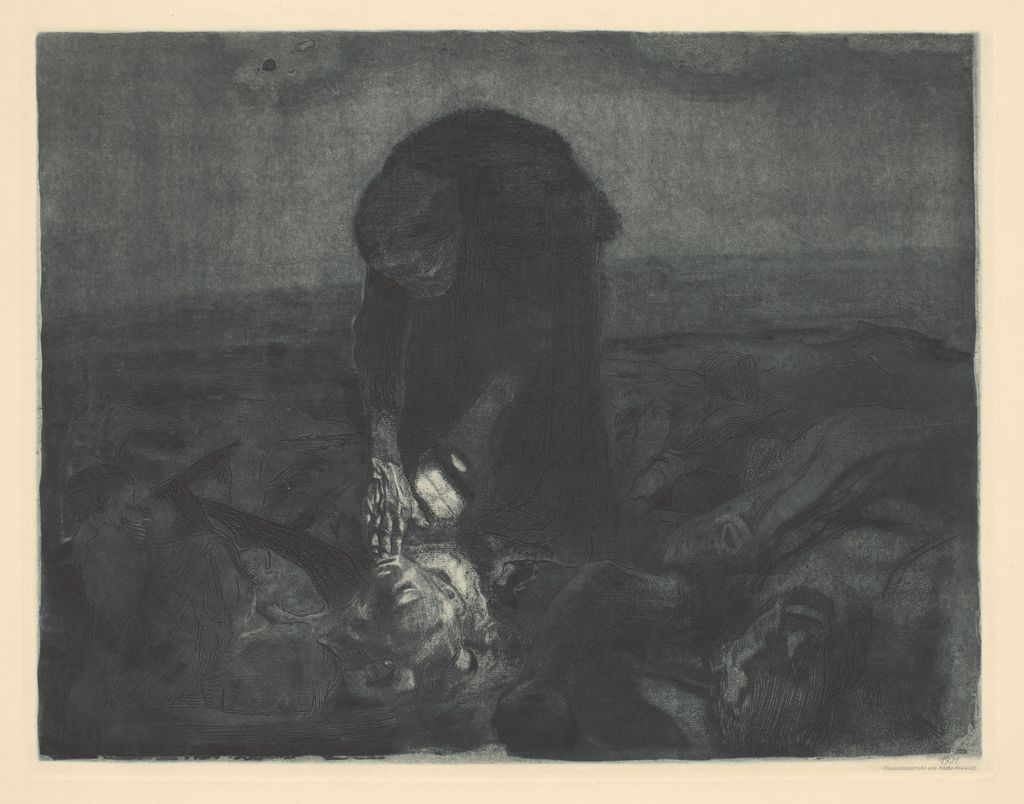
In Käthe Kollwitz’s The End (Ende), a loom fills the left half of a low-ceilinged room. Light draws the eye towards a woman by the window and the people carrying a body through the doorway. Only after taking in that movement do you begin to make out the bodies already lying in the dark foreground. In the National Gallery of Art’s impression, fine lines and grainy tones make that delayed recognition possible. The last sheet of A Weavers’ Revolt brings the consequences of a public uprising into a room where people made their living. The loom tells you whose room it is. The open door tells you that the work of bringing in the dead is still going on. [1] [2]
Käthe Kollwitz
At a Glance
- LifeBorn in Königsberg in 1867, Käthe Kollwitz spent most of her working life in Berlin and died in Moritzburg in 1945. [3]
- MediaEtching, lithography and woodcut, as well as drawing, posters and sculpture. [3] [4]
- SubjectsWorking life, collective resistance, parenthood and the experience of loss. [4]
- A place to startRead A Weavers’ Revolt in sequence, then compare the 1918 etching of The Mothers with the woodcut published in War in 1923. [2] [4] [5]
Kollwitz’s artistic connections
Teachers, print rooms, collectors and exhibitions shaped the places where Kollwitz’s work could be seen.
- Max Lehrs: Lehrs negotiated directly with Kollwitz for the Weavers impressions that reached Dresden. [6]
- Auguste Rodin: Kollwitz visited Rodin during her Paris trips and pursued her own sculpture training. [7]
- Campbell Dodgson: Dodgson collected Kollwitz prints in Germany before his bequest took them to the British Museum. [8]
- Strasbourg’s print collection: The city’s Battlefield impression entered the collection in 1908, the publication year of the cycle. [9]
Käthe Kollwitz in context
Königsberg, Berlin and Munich
Training to 1890Kollwitz studied in several cities before returning to Berlin after her marriage. [3]
Berlin
1891–1943The household in Prenzlauer Berg and later Academy and Klosterstraße studios offered different working conditions. [3]
Roggeveld and Vladslo
1932 and 1956The 1932 memorial moved with the consolidation of military graves in 1956. [10]
Max Lehrs
Print room and exhibition supportThe Dresden print-room director helped place good impressions in an exhibition and collection. [6]
Auguste Rodin
Studio visitsHugo von Tschudi introduced Kollwitz to Rodin, whose sculpture she admired. [7]
Campbell Dodgson
Print collectorHis early purchases and later bequest shaped the British Museum holdings. [8]
Kollwitz and the Prussian Academy
1919–1933Her election and leadership preceded the Academy’s forced resignation in 1933. [11]
A Weavers’ Revolt
1893–97The six sheets take a revolt from household distress to collective action and its aftermath. [2]
Separate impressions and hand-worked proofs show how Kollwitz developed the image. [12]
Peasants’ War
1901–08The seven plates combine the revolt with the aftermath in Battlefield and The Prisoners. [13]
War
1921–22, published 1923The woodcuts give sustained attention to the experience of those left behind. [14]
The Grieving Parents
1932 installationTwo kneeling figures face the graves in the memorial’s later location at Vladslo. [10]
Mother with Her Dead Son
1937–39 modelThe small sculpture precedes the 1993 enlargement at the Neue Wache. [16]
Contents
- From art school to a career in Berlin
- Four print cycles and how they unfold
- Drawings, self-portraits and posters
- Sculpture and the spaces of mourning
- Where to study her work
From art school to a career in Berlin
Kollwitz trained in painting and drawing at schools for women in Berlin and Munich. In Berlin her teacher Karl Stauffer-Bern introduced her to the work of Max Klinger, whose print cycles showed how a subject could develop across a succession of images. She married the doctor Karl Kollwitz in 1891. Their home and his medical practice in Prenzlauer Berg placed her in a working-class district where the pressures of making a living would become a persistent subject of her art. Berlin also supplied the workshops her practice depended on. The Felsing firm in Charlottenburg printed much of her etched work during her lifetime. [3] [17]
Her breakthrough came at the Great Berlin Art Exhibition in 1898, where she showed A Weavers’ Revolt. The jury recommended a medal, but Kaiser Wilhelm II prevented the award. Recognition followed in Dresden, where the print-room director Max Lehrs championed her work. Their correspondence shows what that support meant in practice. On 8 June 1898 Lehrs asked her to reserve a set of particularly good impressions for the following year’s exhibition, with the possibility that the print room might keep it. Five days later she replied that she would need to have more good impressions made of the final plate. Even at the moment a series was making her name, getting it in front of a new audience depended on which sheets she could supply. [2] [17] [6]
During the next decade Kollwitz made Peasants’ War and experimented with colour printing. She travelled to Paris in 1901 and 1904, visited Auguste Rodin’s studios and studied sculpture at the Académie Julian on the second trip. A colour lithograph such as the 1903 Bust of a Worker Woman with Blue Shawl gives a sense of how far her experiments ranged. In the impression shown at MoMA in 2024, three printed colours build up the portrait. The shawl is a distinct area of colour, while the broken marks across the face draw attention to the woman’s averted gaze. Colour had a part in how Kollwitz directed attention well before the broad blacks of her later woodcuts. [7] [18] [19]
Her younger son Peter was killed in October 1914, shortly after volunteering for military service. His death shaped years of work on the First World War and its aftermath. By 1918, as the poet Richard Dehmel called for a final mobilisation, Kollwitz publicly opposed sending more young people to fight. In 1919 she became the first woman elected to full membership of the Prussian Academy of Arts since 1833, and in 1928 she took charge of its master studio for graphic arts. The Nazi regime forced her out in 1933 after she signed a renewed appeal for left-wing unity against National Socialism. She continued to make prints and sculpture, left Berlin during the Second World War and spent her final months in Moritzburg. The biography follows her family, work and public commitments, and the timeline sets the major works alongside the events of her life. [3] [11] [20]
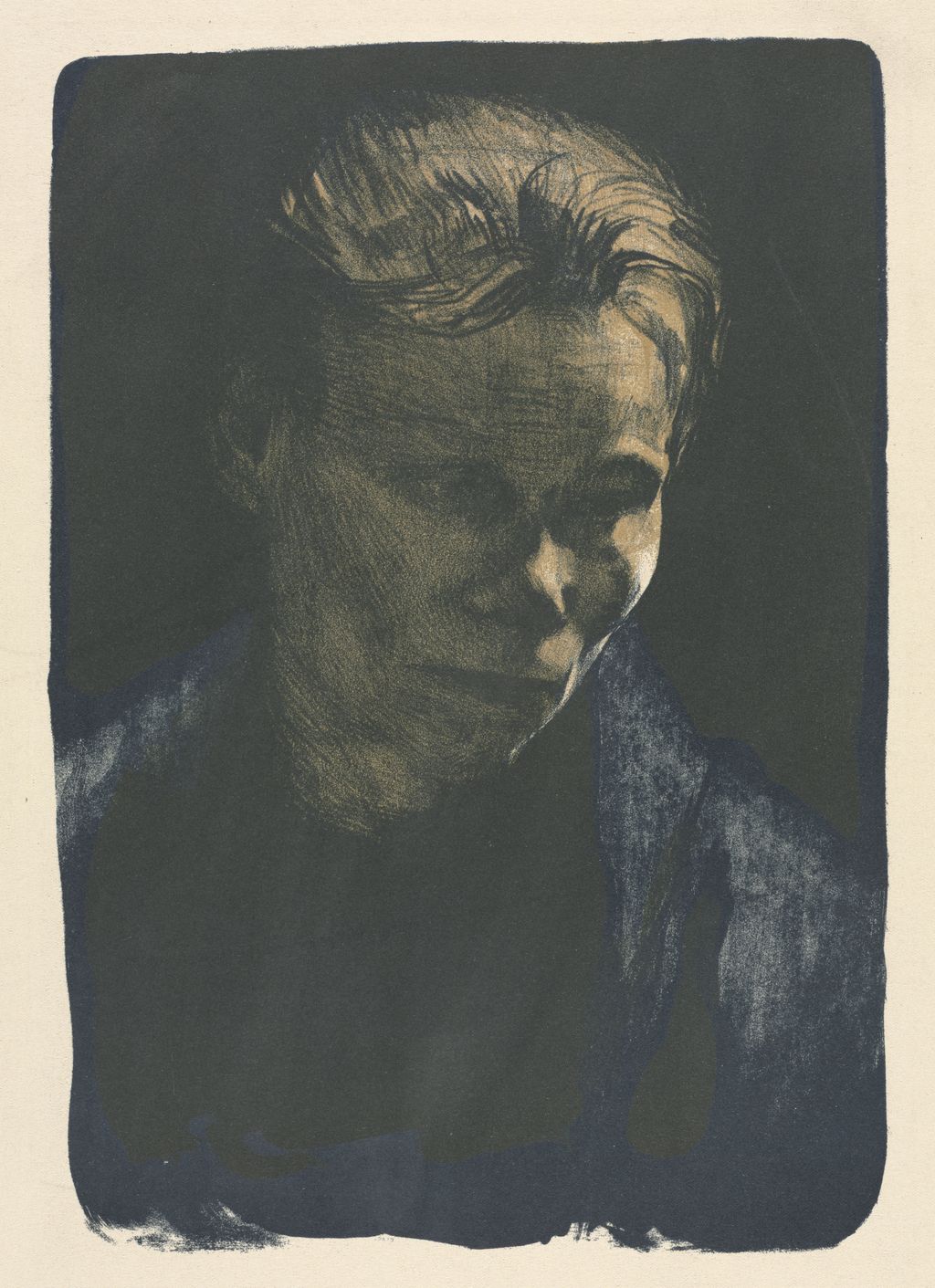
Käthe Kollwitz, Working Woman with Blue Shawl, 1903. Colour lithograph, Klipstein 68, state III/III. Cleveland Museum of Art, 1932.320. Image source. CC0 / Public domain. Resized and exported as JPEG.
Four stages of Käthe Kollwitz’s career
The periods group related developments. Prints, sculpture and public work overlap across the boundaries.
Drawing and printmaking
Kollwitz learned drawing and printmaking in Königsberg, Berlin and Munich. Reading Zola and studying Klinger gave her different starting points for making work in series. [3]
Making a name in print
Kollwitz established a working life in Berlin, developed two major print cycles and tried sculpture and colour printing during the years of her Paris visits. [7]
Mourning, relief and resistance
War and bereavement shaped her woodcuts, relief appeals and the long development of the memorial to Peter. [14]
Working under restriction
After her forced departure from the Academy, Kollwitz worked in smaller studios and developed the lithographs of Death and several late sculptures. [15]
Four print cycles and how they unfold
A Weavers’ Revolt
Gerhart Hauptmann’s play about the Silesian weavers’ uprising of 1844 prompted Kollwitz to imagine a revolt in settings and clothing familiar to her own generation. The first three sheets are lithographs. Poverty and death within a household lead to a meeting where the weavers plan their response. The three etchings that follow take the action into the open before The End returns indoors. Read in sequence, A Weavers’ Revolt makes the march feel like something that has gathered force in rooms like the one where the cycle ends. [1] [2]
The space around the figures changes with what they are able to do. In Need, a woman bends over a child in a room so compressed that the adults seem scarcely to have space to move. The march opens into a long horizontal sheet, giving the crowd room to gather and proceed. The loom in The End brings the sequence back to the conditions that set it in motion. It still takes up much of the room even when the work has stopped. [1] [2] [21]
Peasants’ War
For Peasants’ War, Kollwitz turned to the German uprising of 1524–25, which she had read about in Wilhelm Zimmermann’s history. The seven sheets, published as a portfolio in 1908, move through agricultural labour, sexual violence, preparation, revolt and defeat. The opening pair gives the rising a bodily history. Men strain to pull a plough, and a woman lies amid trampled vegetation. In the final sheets the momentum of the charge gives way to a search among the dead and the confinement of survivors. [13]
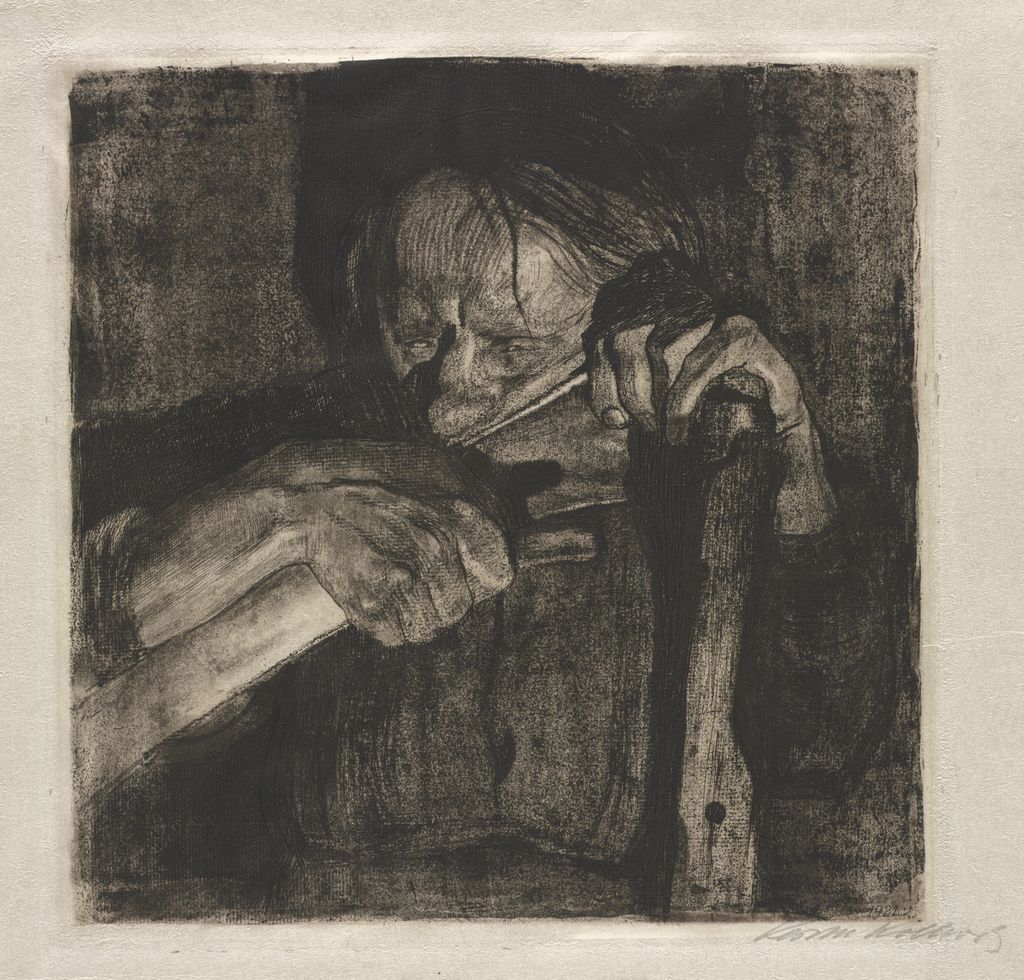
The third sheet, Sharpening the Scythe, shows how much of that drama Kollwitz could put into a pause. Among the preliminary designs are a scene in which a man guides a woman in using a scythe and a discarded composition showing the woman at full length. In the square composition chosen for the cycle, her head, arm and blade take up nearly the whole field. The crop brings us close enough to read her narrowed eyes while leaving the object of her attention outside the frame. The blade belongs to the world of agricultural labour introduced at the beginning of the series. In her hands it carries the possibility of revolt. [13] [22] [23]
MoMA’s 2024 exhibition traced that change through drawings and trial impressions. Its checklist records two impressions of the rejected Inspiration design from the same state of the plate. One, lent by the Mayer family, also carries charcoal, white chalk and ink worked directly onto the sheet. The other, from Berlin’s Kupferstichkabinett, is catalogued without those additions. Kollwitz could test an idea with a few marks on paper before deciding whether to change a plate. In this case she ultimately changed the composition itself. [18] [23]
War
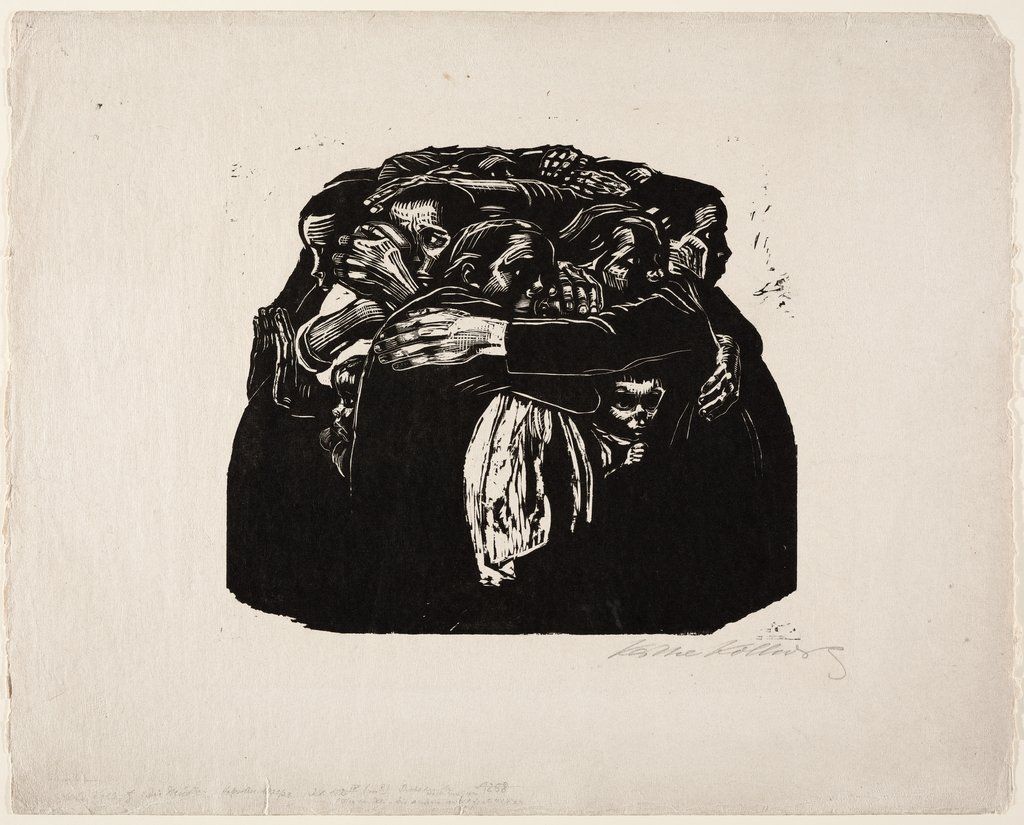
Kollwitz tried etching and lithography before settling on woodcut for War, the seven-sheet portfolio Emil Richter published in 1923. The image MoMA chose to introduce its 2024 retrospective was a rejected version of The Mothers, an etching from 1918 in the Ute Kahl collection. Kollwitz worked over this particular impression in black ink, opaque white, charcoal and pencil. A 1919 lithograph and a 1921 study in black ink and opaque white also appeared in the exhibition. In the study, she cut the drawing out and pasted it onto a larger sheet. The dense ink already suggests the areas of black she would obtain from the woodblock. [4] [18] [24] [14]
In the early versions, women hold their children individually. In the published woodcut, their dark clothing forms a nearly continuous mass. Narrow white cuts pick out the faces, arms and hands that define the group, and a child peers through an opening. The shelter seems both strong and precarious because its walls are made of people. MoMA’s own impression, 470.1992.6, is from the seventh and final state of the block. Seen in the portfolio, the group answers the opening image of a mother holding out her infant. MoMA reads that change from offering to enclosure as a refusal of the demand that families sacrifice their children to war. [5] [24] [14]
The portfolio’s reach mattered to Kollwitz. In an October 1922 letter to the French writer Romain Rolland, she described wanting the prints to travel widely and convey what people had endured. The group in The Mothers is held together by gestures that need little explanation from a caption. The same is true of the bowed bodies in The Parents, where the pressure of one figure against the other makes the loss tangible. [21] [14]
Death
The eight lithographs of Death, made between 1934 and 1937, explore variations on an encounter. Death reaches into a group of children in one print and is recognised as a friend in another. In the final sheet, Call of Death, a hand touches the shoulder of a woman whose features are Kollwitz’s own. Where War links people through the consequences of a shared catastrophe, Death distinguishes between seizure, welcome and summons. Much depends on the distance between a hand and a body, and on what the living figure does as that distance closes. [14] [15]
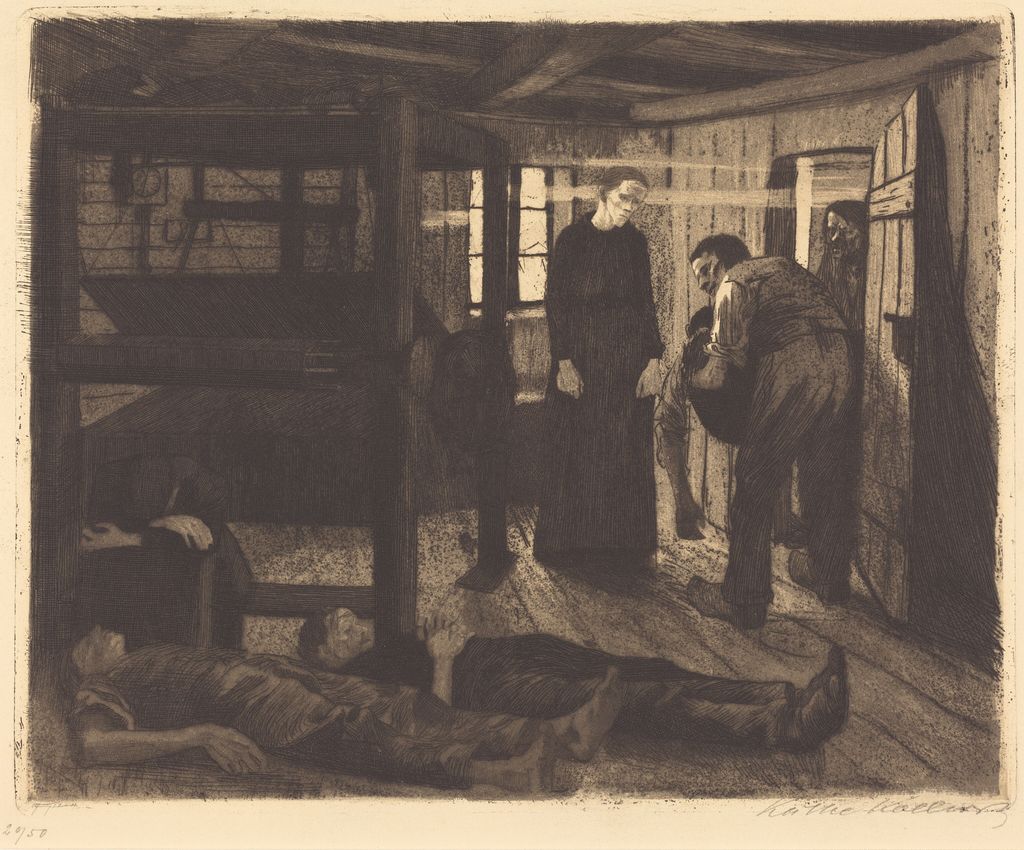
Käthe Kollwitz, The End, 1897. National Gallery of Art, 1943.3.5307. National Gallery of Art, Washington. Image source. Public domain. Resized and exported as JPEG.
Drawings, self-portraits and posters
The earliest drawing currently known by Kollwitz is a small graphite portrait of Arthur Schopenhauer, made in 1883 when she was sixteen and still signed her work as Käthe Schmidt. Cologne traces it to a printed portrait she copied while learning to draw from existing images and plaster models. The sheet was known to researchers but its whereabouts were uncertain. Brian McCrindle acquired it among a group of Kollwitz papers in 2014 and gave it to the Kollwitz Museum Köln in 2025. It is absent from the Nagel and Timm catalogue of drawings. Where MoMA’s trial impressions recover stages in the making of familiar works, this little drawing takes the surviving record of her practice back to her teenage training. [18] [25]
By 1909 Kollwitz was using the texture and colour of the sheet itself to direct attention. In Out of Work, a drawing in black chalk with touches of opaque watercolour on brown paper, a man bends his head into his fists while a woman looks across the room, children asleep against her. The chalk gives his clenched pose more weight than her faintly drawn face. Her open eyes are easy to miss at first. Once noticed, they make the family’s stillness feel like a vigil. The Berlin address recorded on the back ties the sheet to the home and workplace from which Kollwitz observed the life of the district. [26]
Kollwitz began sending drawings to the Munich satirical weekly Simplicissimus in 1908. The editors gave her latitude over her subjects and sometimes supplied titles or sharp captions of their own. A quiet scene of hunger or unemployment could therefore have a different effect on a magazine page, where an editorial line might give the reader an immediate target for anger. Her drawings allow time for other things to register, such as the wakefulness of the woman in Out of Work. [26] [27]
Kollwitz used her own face to test what an image could convey with progressively fewer marks. In the fourth state of her 1924 woodcut Self-Portrait, she shows much of her seated figure, with one hand on her knee. She later cut the block to roughly half its former height. In the shorter version the face and raised hand command the image. A related brush drawing on dark green paper uses opaque white to try out the effect of lines that would print white in the woodcut. Cologne’s Kn 203 IV and Kn 203 VI b preserve two stages of that decision. The museum’s record also gives a way into the wider body of self-portraits and the catalogue that identifies states of her prints. [28] [29]
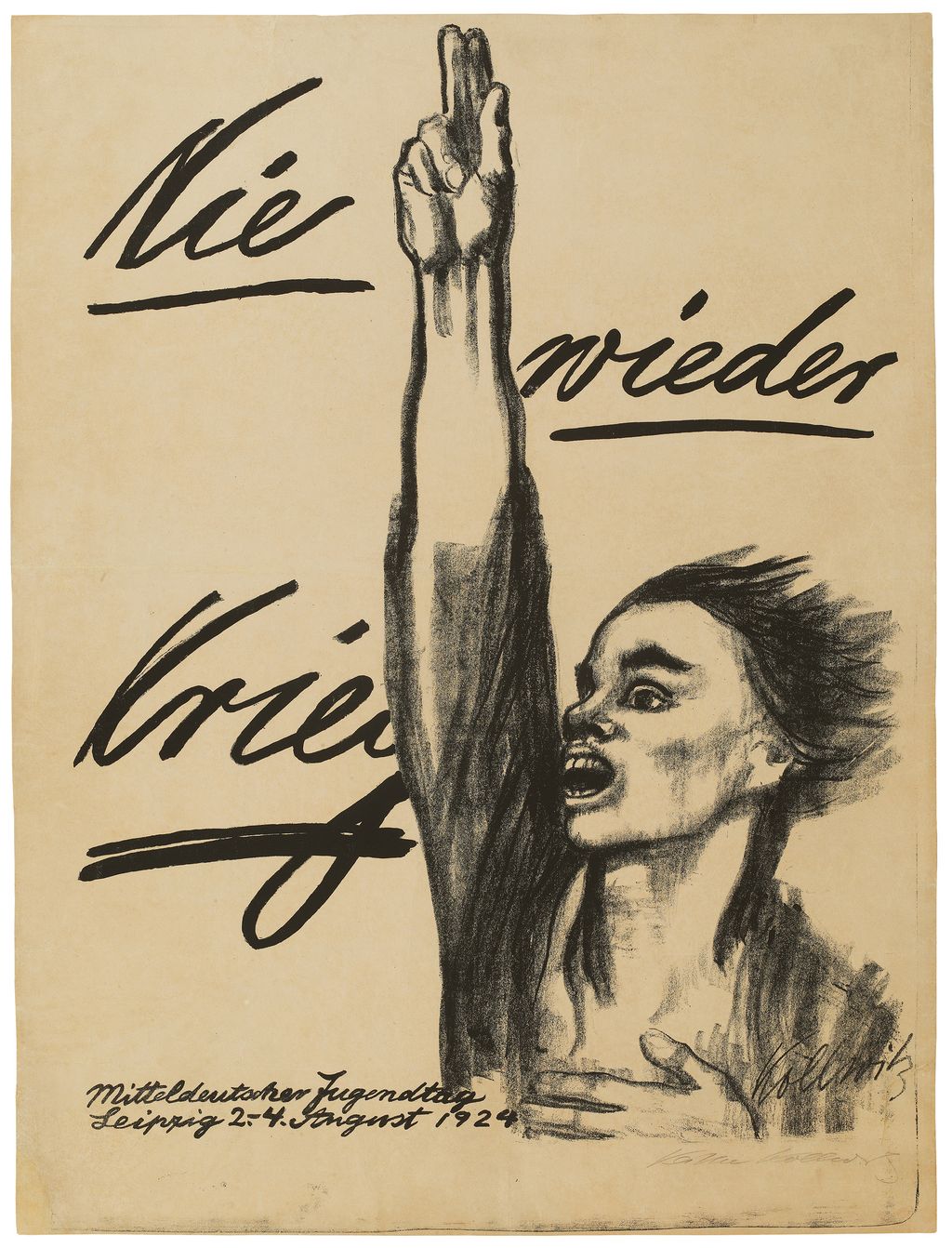
A campaign poster had to work at a distance. For the Socialist Workers’ Youth gathering in Leipzig in 1924, Kollwitz made Never Again War!, a lithograph in which a young man raises one hand in an oath and presses the other to his chest. In Cologne’s lettered impression, Kn 205 III b, his arm rises into the handwritten slogan. The open mouth gives the words a speaker, and the raised hand makes the declaration legible before the lettering can be read. Where The Mothers draws the eye inwards towards a child, the poster directs its gesture outwards towards people who might take up the pledge themselves. [5] [30]
Sculpture and the spaces of mourning
An early plaster, The Lovers of 1913, shows what Kollwitz could do with a viewer’s freedom to move around a sculpture. The plaster in the Museum of Fine Arts, Boston, is one of the few early models of hers to survive the Second World War. MoMA’s exhibition proposed Rodin’s The Kiss as a possible precedent and drew attention to what happens when the group is seen from different angles. The man’s arms encircle the woman in an embrace, but from another viewpoint her slack arms and the weight of her body in his lap can suggest a Pietà. Strasbourg’s exhibition also connected the group with Kollwitz’s drawings and prints in which Death holds a figure. The same arrangement of limbs can bring intimacy or vulnerability to the fore. [18] [20] [14]
In Belgium, The Grieving Parents consists of two kneeling stone figures. The father folds his arms across his body and the mother bends forward. The space between them gives each a separate posture of grief, while their shared orientation directs attention towards the graves. Installed at Roggeveld in 1932, the original pair moved with the burials to the German military cemetery at Vladslo in 1956. Peter lies near the figures. Their position among many other graves makes the relationship between this family and the wider losses of the war visible in the cemetery itself. [10]
In Mother with Her Dead Son, the small Pietà modelled in 1937–39, Kollwitz brings two bodies into a single outline. The seated mother’s heavy garment frames the son drawn up between her knees. From the front, his curled form is almost absorbed into hers. Cologne distinguishes the date of the model from that of its zinc cast, made in 1941–43 and just under 39 centimetres high. Harald Haacke’s bronze enlargement, installed in Berlin’s Neue Wache in 1993, is roughly four times the original size. The smaller group invites close attention to the places where the bodies meet. In the memorial, that enclosed silhouette holds the centre of the room. The two settings show how much scale and placement can change the experience of Kollwitz’s sculpture. [16]
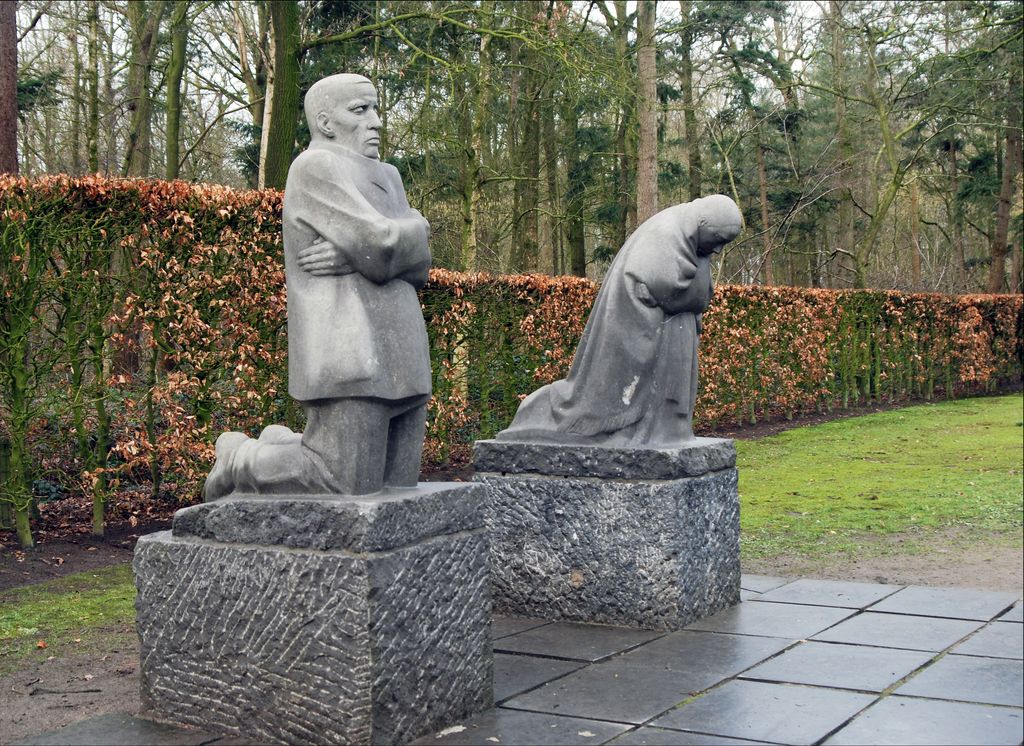
Käthe Kollwitz’s Grieving Parents at Vladslo, the memorial’s location since 1956. Photograph by Bva, resized. Image source. CC BY-SA 3.0. Resized and exported as JPEG.
Where to study her work
Dresden, Paris and Strasbourg
Lehrs drew on Dresden’s print-room holdings when he published the first catalogue of Kollwitz’s prints in 1903. His interest extended to trial impressions and rejected designs, the kinds of sheets that show how the work changed. In Paris, Noël Clément-Janin was already attending to similar qualities. Writing about Carmagnole and the weavers prints shown at Galerie Hessèle in 1901, he singled out her handling of grain and varnish. The Institut national d’histoire de l’art preserves examples of what those early collectors and critics could study, including Arbeiterfrau (EM KOLLWITZ 17), an impression on Japanese paper thin enough for the image to show through the back. [6] [21] [29]
Strasbourg offers a separate history of early French collecting. The Musée d’Art moderne et contemporain’s Battlefield, the sixth sheet of Peasants’ War, entered the collection as a gift on 27 June 1908, the year the portfolio appeared. Its Joconde record, accession 5.916, identifies both the print’s etched and drypoint work and the textures transferred into the image through soft ground. In 2019–20 Strasbourg and the Kollwitz Museum Köln brought the local holdings together with loans for Je veux agir dans ce temps. The exhibition put prints such as Battlefield into a career that also included intimate drawings, campaign posters and sculpture. [20] [13] [9]
British collections and the Ikon tour
The British Museum’s collection owes much to Campbell Dodgson, who began buying Kollwitz’s prints in Germany before the First World War under Lehrs’s influence and bequeathed his holdings to the museum in 1948. Other impressions took a different route. The Contemporary Art Society records that it bought a second-state impression of the 1903 Working-class Woman in Profile, Looking Left in 1939 and presented it to the British Museum in 1945. The clasped hands and turned head give the sitter a presence that rewards the same close attention as one of Kollwitz’s self-portraits. [8] [31]
Ikon and the British Museum’s Portrait of the Artist opened in Birmingham in 2017 and travelled to Salisbury, Swansea and Hull before its London showing in 2019–20. Its groups of self-portraits, scenes of working life and images of war and remembrance offered a way to follow her treatment of the face and hands across different subjects. The inclusion of both War and the memorial woodcut for Karl Liebknecht also made it possible to compare her treatment of wartime bereavement with a public farewell to a murdered political figure. [8] [32]
MoMA, Frankfurt and Bielefeld
MoMA’s retrospective ran from 31 March to 20 July 2024. Organised by Starr Figura with Maggie Hire, it brought together about 120 drawings, prints and sculptures from European and North American collections. Its checklist, installation photographs and audio guide allow readers to reconstruct comparisons that are difficult to make from separate collection records. The published Mothers can be followed through two abandoned print versions and a cut-and-pasted drawing, while the successive designs for Sharpening the Scythe reveal how the woman came to command the whole composition. [4] [5] [18] [23]
The Städel Museum’s 2024 exhibition in Frankfurt examined the conflicting roles later assigned to Kollwitz, from exemplary mother to political symbol, alongside the formal choices visible in her work. At Kunsthalle Bielefeld that same year, Taking a Stand placed her work alongside Mona Hatoum’s. The curators connected the two through the vulnerability of bodies and domestic spaces under institutional violence. Bielefeld’s guide also makes room for the particularities of individual objects, including the exhibited 1903 experimental impression of Woman with Dead Child with a sprayed gold-coloured background. The gold brings to mind older religious images of mourning, an association that comes through differently in MoMA’s monochrome impression of the same work. The exhibitions and collections behind these comparisons are part of the wider history of Kollwitz’s reception. [33] [34] [12]
Essential Käthe Kollwitz works
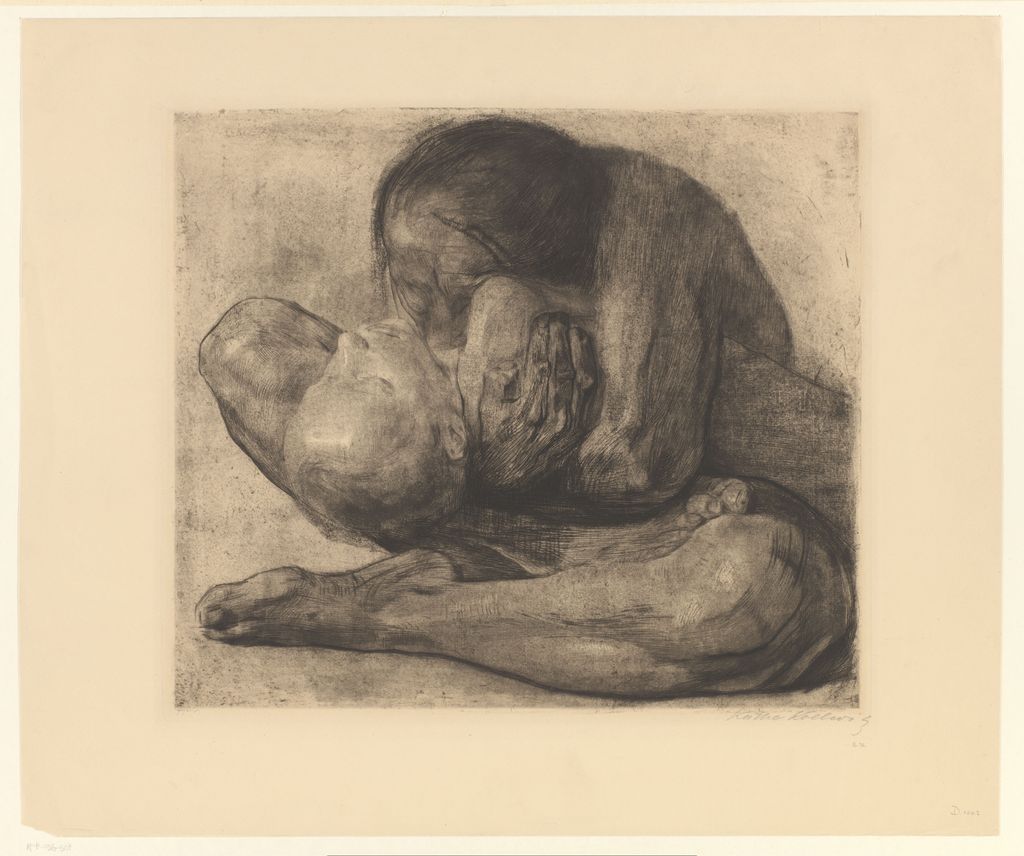
Woman with Dead Child
1903 · A tightly folded embrace tested across proofs and impressions. [12]
Sharpening the Scythe
1905 · The hand, blade and lowered face give the coming revolt a concentrated gesture. [22]
The Mothers
1921–22 · The figures close ranks around the children inside the sixth sheet of War. [5]
Städel Museum, Frankfurt am Main · Image source · Image licence
Never Again War!
1924 · A raised arm and handwritten slogan turn a youth rally’s appeal into a single striking image. [30]
The Grieving Parents
1932 · Two separate granite figures frame a space for mourning. [10]
Photograph by Bva, resized · Image source · Image licence
Käthe Kollwitz artworks directory
Selected documented works, including the complete published sequences of the five cycles discussed here. Catalogue links identify the specific record behind each row.
Frequently Asked Questions
Kollwitz often revised a plate or block after taking a trial impression. A print pulled after a change records a new state. Impressions from the same state can still differ in ink, paper or marks added by hand. MoMA’s checklist records two impressions of Inspiration from state IV, one with charcoal, chalk and ink additions. In Cologne’s 1924 woodcut Self-Portrait, the change between states is visible at a glance because Kollwitz physically shortened the block. A museum accession number identifies the particular sheet you are looking at. [18] [28] [29]
Compare the hands in The Mothers, Never Again War! and Call of Death. In the woodcut, hands and arms draw people into a protective group. In the poster, a raised hand carries a pledge into public space. In the late lithograph, a hand touching a shoulder is enough to interrupt a life. Look at what each hand touches and how much space Kollwitz leaves around it. [5] [15] [30]
Woman with Dead Child is a 1903 print for which Kollwitz posed with Peter when he was seven. In The Grieving Parents, completed after his death in the First World War, two separate stone figures kneel in a military cemetery. Mother with Her Dead Son is the small sculptural group she modelled in 1937–39, later enlarged for the Neue Wache. The print presses two bodies together, the cemetery memorial puts grief into the space between figures, and the late sculpture gathers mother and son into one silhouette. [10] [16] [12]
Discussion
Look again at the images and ideas explored in Käthe Kollwitz. These editorial prompts invite your observations.
Reader Insights
How does Kollwitz change the way we see a crowd across the four print cycles?
What does seeing an impression alongside a preparatory study add to your reading of a work?
Which institution’s records would you use to start comparing Kollwitz’s working proofs?
Join the Conversation
Share a detail, comparison or question about Käthe Kollwitz below.
References
- National Gallery of Art, The End (Ende), accession 1943.3.5307. View source.
- Kollwitz Museum Köln, A Weavers’ Revolt, cycle catalogue. View source.
- Kollwitz Museum Köln, Käthe Kollwitz biography. View source.
- Museum of Modern Art, Käthe Kollwitz, 2024 retrospective and exhibition archive. View source.
- Museum of Modern Art, The Mothers, state VII/VII, accession 470.1992.6. View source.
- Staatliche Kunstsammlungen Dresden, Kupferstich-Kabinett, Kollwitz–Lehrs correspondence, letters of 8 and 13 June 1898, 01/KK 04 Bd. 4, nos. 535–539. View source.
- Kollwitz Museum Köln, Parisian Inspirations. View source.
- British Museum, Portrait of the Artist: Käthe Kollwitz, exhibition press release. View source.
- French Ministry of Culture, Joconde, Schlachtfeld, Blatt 6, Strasbourg accession 5.916. View source.
- Flemish Heritage Inventory, Treurend ouderpaar (Vladslo – WOI). View source.
- Akademie der Künste, About Käthe Kollwitz. View source.
- Museum of Modern Art, Woman with Dead Child, state VIII/X, 1903. View source.
- Kollwitz Museum Köln, Peasants’ War, cycle catalogue. View source.
- Museum of Modern Art, Käthe Kollwitz, 2024 extended gallery labels. View source.
- Kollwitz Museum Köln, Death, series catalogue. View source.
- Kollwitz Museum Köln, Pietà (Mutter mit totem Sohn), Seeler 37, with the Neue Wache enlargement. View source.
- Kollwitz Museum Köln, Chronology for 1891–1900. View source.
- Museum of Modern Art, Käthe Kollwitz, 2024 exhibition checklist. View source.
- Institut national d’histoire de l’art, Buste d’une ouvrière au châle bleu, de Käthe Kollwitz. View source.
- Musée d’Art moderne et contemporain de Strasbourg, Käthe Kollwitz. Je veux agir dans ce temps, exhibition dossier. View source.
- Nathalie Muller, Institut national d’histoire de l’art, Käthe Kollwitz (1867–1945), part 2. View source.
- Kollwitz Museum Köln, Sharpening the Scythe, Kn 88, with studies and proofs. View source.
- Museum of Modern Art, Käthe Kollwitz, exhibition section texts. View source.
- Kollwitz Museum Köln, The Mothers, Kn 176, with preparatory work and rejected versions. View source.
- Kollwitz Museum Köln, Arthur Schopenhauer, 1883. View source.
- National Gallery of Art, Out of Work, 1909 drawing. View source.
- Kollwitz Museum Köln, Sozialkritik, collection overview. View source.
- Kollwitz Museum Köln, Selbstbildnis, Kn 203 IV and VI b, with preparatory drawing NT 1001. View source.
- Kollwitz Museum Köln, Catalogue Raisonné of the Prints, overview and publication history. View source.
- Kollwitz Museum Köln, Never Again War, poster Kn 205 III b. View source.
- Contemporary Art Society, Working-class Woman in Profile, Looking Left, acquisition record. View source.
- Ikon Gallery, Portrait of the Artist: Käthe Kollwitz, exhibition and tour record. View source.
- Städel Museum, Kollwitz, 2024 exhibition companion. View source.
- Kunsthalle Bielefeld, Taking a Stand. Käthe Kollwitz, Mona Hatoum, exhibition and media guide. View source.
More KOLLWITZ Works
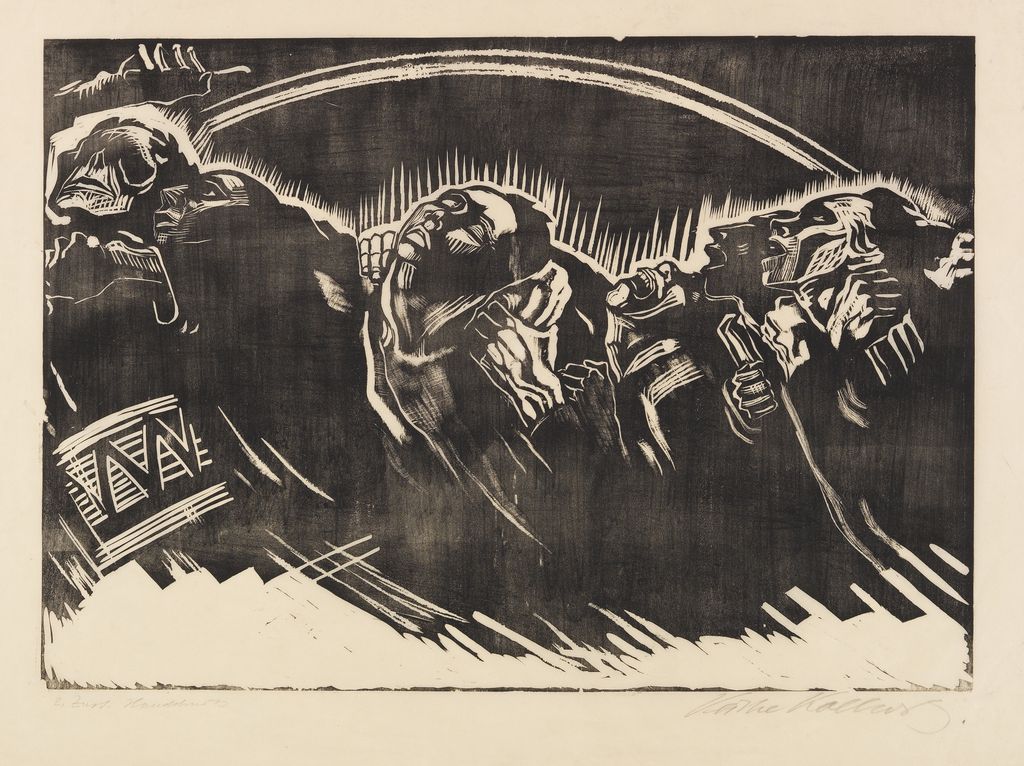

The Mothers
The Mothers, 1921–22. Städel Museum, Frankfurt am Main, SG 4289A D. Image source. Public domain. Resized and exported as JPEG.
The Grieving Parents
The Grieving Parents at Vladslo, the memorial’s location since 1956. Photograph by Bva, resized. Image source. CC BY-SA 3.0. Resized and exported as JPEG.
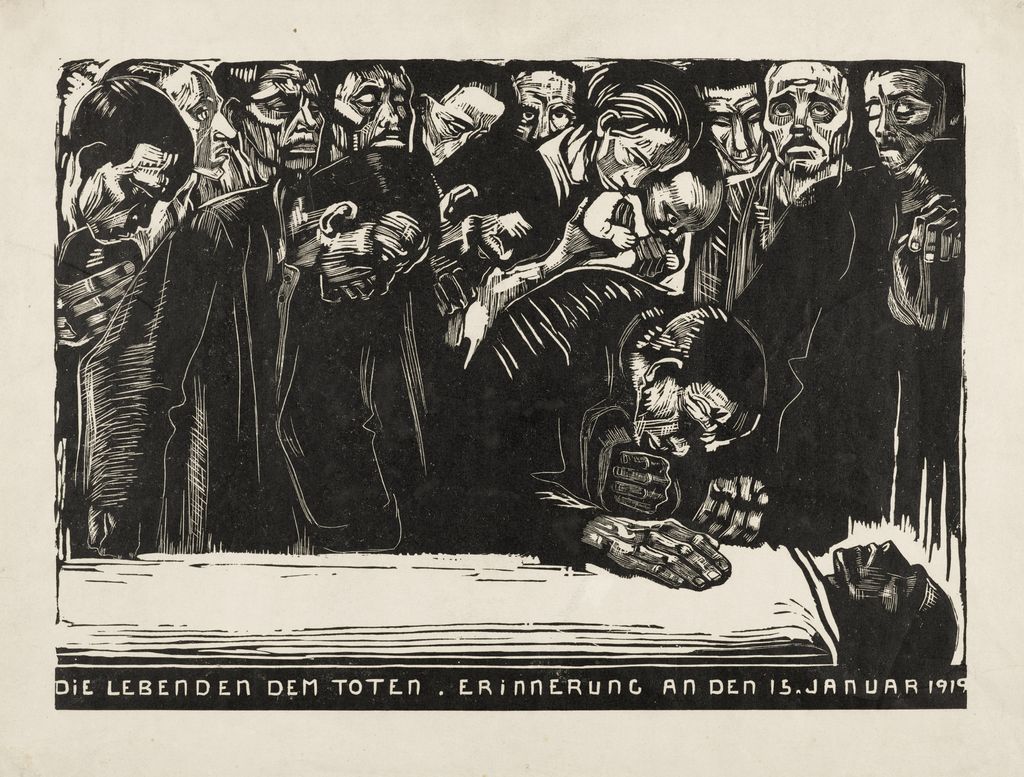
Memorial for Karl Liebknecht
Memorial for Karl Liebknecht, 1920. Kunstsammlungen Chemnitz, 86-47, Kn 159 VI. Photo: Kunstsammlungen Chemnitz/PUNCTUM/Bertram Kober. Image source. Public domain. Resized and exported as JPEG.