



Detail of Mary’s head, crown and book. See the full panel and its neighbours in KIK-IRPA’s high-resolution viewer.
Buy Art Prints Nowfrom Amazon
* As an Amazon Associate, and partner with Google Adsense and Ezoic, I earn from qualifying purchases.
 by Tom Gurney
Tom Gurney BSc (Hons) is an art history expert with over 20 years experience
Page Created on June 19, 2020 / Page Updated on November 1, 2026
Email: tomgurney1@gmail.com / Phone: +44 7429 011000
The Virgin Mary in the Ghent Altarpiece
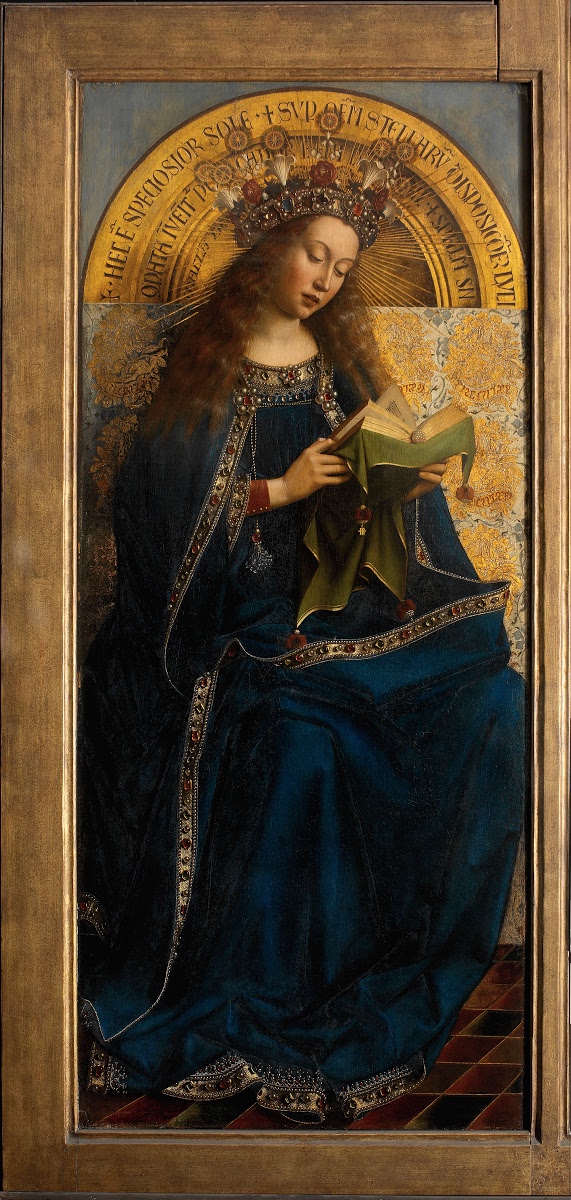
A crown rises above Mary's inclined head, but her attention falls towards an open book. This combination of royal splendour and absorbed reading defines her image in the upper centre of the opened Ghent Altarpiece. She sits on the viewer's left of the enthroned Deity, opposite John the Baptist. Saint Bavo's Cathedral describes her as reading a prayer book; she has no Christ Child on her lap. [1]
The whole panel reveals much more than the familiar close view of her face. The blue mantle spreads below the book almost to the tiled floor, edged with a bright succession of jewels. Behind her, a patterned cloth meets a great arch of writing. To understand the figure, follow these distinct surfaces: painted flesh and hair, the book and green covering, the folds of the robe, and the fragile ornament of the throne setting.
At a Glance
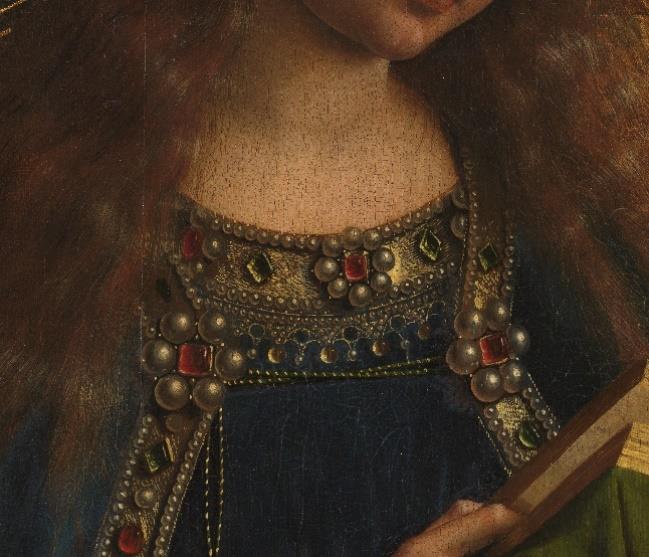
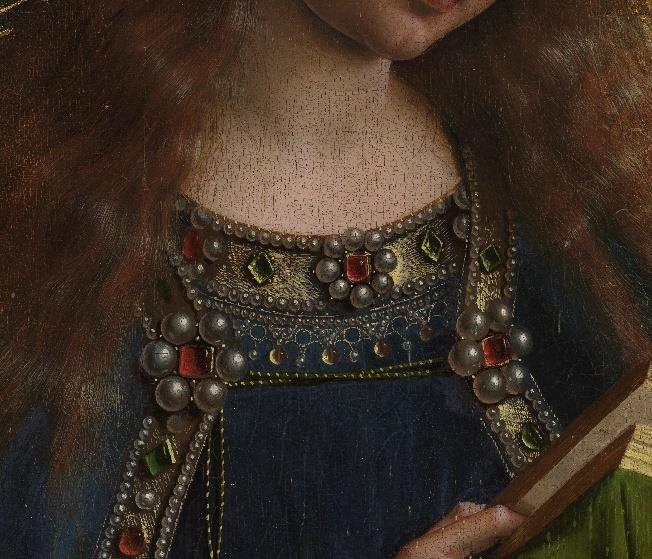
Compare the jewelled neckline at two treatment stages
Details from The Virgin Mary in the Ghent Altarpiece
Before treatment: neckline and jewels
Before treatment. Unmodified published image, 649 × 557 pixels; KIK-IRPA, December 2024, page 5, photograph 6. © Sint-Baafskathedraal Gent, www.artinflanders.be, photo KIK-IRPA.
During cleaning: neckline and jewels
During cleaning. Unmodified published image, 652 × 559 pixels; KIK-IRPA, December 2024, page 5, photograph 7. © Sint-Baafskathedraal Gent, www.artinflanders.be, photo KIK-IRPA. This is a treatment stage.
Reading within the heavenly assembly
The surrounding figures give Mary's concentration a public setting. The singing angels occupy the neighbouring panel, while the Baptist across the centre holds his own book and raises a hand. Mary's activity is comparatively contained: her gaze and fingers remain close to the pages. That visual difference lets each figure contribute a different form of attention to the assembly.
Susan Jones's Metropolitan Museum essay calls the central trio a Deësis, identifying the middle figure as Christ the High Priest, with Mary and John in positions associated with intercession. The cathedral's guide allows the central figure to signify either the Father or the Son. Mary's presence therefore helps explain a recognised devotional arrangement without settling the Deity panel's disputed identity. These are interpretations of the ensemble, rather than a title written beneath Mary's chair. [3][1]
She also differs from the Virgin Annunciate on the closed exterior. There Mary responds to Gabriel in an interior; here she is already crowned and enthroned among heavenly figures. Her book belongs to this second appearance. A proposed transcription or interpretation of the exterior book cannot simply be carried over to the volume in her hands on the open altarpiece.
A book supported by cloth and hands
Lukas–Art in Flanders describes Mary's deep blue robe, jewelled border, flowing hair and absorption in a prayer book. The green fabric makes that book a substantial object rather than a bare symbol. It hangs below her hands, ending in red tassels, and separates the pale leaves from the blue clothing beneath. The published whole-panel image also shows a raised leaf near the upper edge of the volume. [2]
Look at how little the hands have to do. One supports the book while the other reaches towards its opening; the fingers do not break the figure's general stillness. The leaves fan away from the binding, and the green cloth folds under their weight. This small cluster of angled edges interrupts the longer downward movement of hair, mantle and jewelled border. It gives the eye a place to rest after the crowded crown.
No complete page transcription is supplied by the cathedral's short guide. Calling the object a prayer book identifies the action and devotional character; it does not establish which passage Mary is reading. The large, much more legible inscription above her head offers another kind of text, addressed to anyone looking at the painting rather than to its depicted reader. [1]
The jewelled mantle and the scale of the body
Weale's 1912 catalogue distinguishes the close-fitting blue dress, with sleeves buttoned at the wrist, from the ample mantle over it. He describes the mantle's fastening as a tasselled cord attached to two jewels on the border, and notes the rows of pearls enclosing its precious stones. These details help explain the costume's construction: the mantle hangs and gathers around a seated body rather than forming an undifferentiated blue silhouette. [5]
The painted stones catch light differently from the pearls. Faceted green and red shapes sit beside rounder pale forms, with tiny highlights bringing their surfaces forward. Their colours can be described without assuming that paint alone provides a mineral identification. Near the neck, the ornaments form an intricate band. Farther down, the border travels diagonally across the lap before returning towards the floor, making the drapery's changing planes easier to follow.
At the bottom, a narrow area of red and dark tiles remains visible beside the robe. The expanding folds take up almost the entire width of the figure's space. Her face may seem intimate in a cropped reproduction, but the full mantle gives that expression a monumental seated presence. The small book and the broad sweep of fabric depend on one another for their sense of scale.
Flowers, stars and the heavenly crown
Ghent's official symbolism guide names lilies, roses, lily-of-the-valley and columbines in the crown. It associates them respectively with Marian meanings including virginity, love and humility, and relates the flowering headdress to May, the month in which the altarpiece was presented in 1432. These associations give the natural forms a devotional role without making the calendar date proof of each flower's selection. [6]
The blossoms rise from a structure already filled with gems and pearls. They are not a separate wreath laid neatly above a metal crown: leaves, petals and jewelled supports overlap. Against the surrounding gold, pale flowers and darker red blooms remain distinct. The result combines the freshness of growth with the durability and value suggested by precious materials.
Lukas–Art in Flanders interprets the surrounding stars through the twelve-star crown of the woman in Revelation. Angela Maria La Delfa's 2020 study makes the distinction between the symbolic total and what can readily be counted: she identifies eight clear stars, three partly obscured ones and a presumed twelfth behind the crown. The scheme of twelve is therefore an iconographic reconstruction, not twelve equally exposed ornaments. Weale's older description counted eight. [2][7][5]
Did Bridget of Sweden's visions influence this Mary?
La Delfa argues that Bridget's Revelations help explain the combination of loose luminous hair, an elaborate crown, blue clothing and a queenly Mary already enthroned without the Child. She compares particular descriptions of Mary's appearance and virtues with the painting, extending an earlier proposal by Grantley McDonald. The argument treats the figure as a distinctive combination of devotional traditions, rather than a routine repetition of a Last Judgment intercessor. [7]
Such parallels are significant evidence for interpretation, but they are not a surviving commission instructing the painters to illustrate Bridget. The crown's flowers can carry familiar Marian associations as well as participating in a proposed connection with a vision. Neither approach requires a single exclusive meaning for every blossom. The painting may draw its force from the convergence of recognised religious images and texts.
A different emphasis appears in Stéphane Lojkine's French study at Aix-Marseille University. He connects the enthroned group with the tradition of the Coronation of the Virgin, comparing its frontal arrangement with earlier and contemporary examples. In this reading, the relationship between the figures can express Mary's enthronement even without showing the immediate act of placing a crown on her head. This is an interpretive comparison, not evidence that a particular Italian painting served as the Van Eycks' model. [4]
Watch: Jan van Eyck in context
Choose a Smarthistory close reading of the Arnolfini Portrait or the closed and opened Ghent Altarpiece.
Jan van Eyck, The Ghent Altarpiece (2 of 2)
Follow the heavenly figures and the gathering around the Lamb when the wings open.
Watch on YouTubeWhat does the arch above her head say?
The arch praises a figure surpassing the sun and the ordered stars, reflecting eternal light and divine purity. McDonald's study identifies the text as an adaptation of Wisdom 7:29 and 7:26, placed in that order. In the biblical book the subject is Wisdom. Its application to Mary belongs to Christian interpretation and worship; the passage does not originally name her. [8]
McDonald points to the same ordering of the verses in northern liturgical uses for the Assumption, including Bruges, Leuven, Brussels and Saint-Omer. He also explores a connection with Bridget's account of Mary reflecting the Trinity. These comparisons make the wording part of a wider devotional culture, while the precise route by which it entered the painting remains a historical proposal. The inscription is more specific than a general statement that Mary is beautiful: it connects light, wisdom, purity and divine reflection. [8]
Its arched position matters visually. The words surround Mary's flowered crown and golden rays, while her eyes remain on a different text below. The viewer reads across the top and then looks down towards her reading. Writing belongs both to the pictured object and to its explanation, joining the act of looking to a sequence of attention within the panel.
A sixteenth-century viewer noticed her mouth
Lucas de Heere's 1565 ode to the altarpiece singles out Mary's pleasing expression, then observes that her mouth seems to read devoutly. He immediately praises the crown and ornaments. The early Dutch text, available in a scholarly edition through the Netherlands' DBNL, gives us a particular historical response to the same combination of reading and splendour that remains striking today. [9]
De Heere's observation is not evidence of an audible voice within the painting. It records how the parted lips made the depicted action seem alive to one sixteenth-century observer. It is also a reminder that the lowered eyes should not make us overlook the mouth. Expression extends across the face, while the great apparatus of crown and jewels surrounds a relatively small, attentive human action. [9]
The blue robe has a history of its own
Conservator Kathleen Froyen's September 2025 account explains the exceptional cost of ultramarine made from lapis lazuli, as well as its vulnerability. In dark passages, deterioration can turn the blue greyish and dull, weakening the contrast that models folds. She describes this change as irreversible. Retouching can improve the perceived volume without reversing the altered pigment chemically. [10]
Froyen specifically says that the team was then treating Mary's monumental robe and hoped for results comparable to those achieved on a lower-register prophet. The prophet's completed treatment illustrates an approach; it is not a photograph of Mary's finished robe. Her dated statement therefore supports a discussion of the problem and intended visual recovery, rather than a claim that every blue passage had already been restored. [10]
Follow a fold from the lap into a deep shadow and the issue becomes concrete. The robe needs differences within blue to make a protruding ridge distinct from a recess. A photograph may preserve the overall colour and silhouette while losing much of that internal articulation. Surface condition consequently affects the apparent weight and position of Mary's body, not just whether the blue looks bright.
The cloth behind her is built in relief
The gold-patterned background imitates a costly textile through an additional material technique. A 2024 conference report by Sophie Kirkpatrick and colleagues describes a sequence in which moulded tin foil received a supporting filler before attachment, gilding and colouring. Their investigation combined scans across the panels with analysis of small samples to distinguish the material layers and investigate deterioration. The cloth of honour is therefore partly a manufactured relief, rather than an effect produced entirely with brushstrokes. [11]
A May 2026 preprint from the research team gives further findings, including samples specifically taken from Mary's panel. It reports layered filler, tin, gilding and paint, with the organic mixture beneath the tin dominated by drying oil rather than simply pure wax. Microscopy documents cracks and separation within the structure; analysis identifies tin corrosion products. French facilities including Synchrotron SOLEIL contributed to the examinations. [12]
This remains a preprint, and the authors reserve questions about possible interactions between tin and the surrounding organic materials for further work. The findings should not be converted into a single, conclusively identified cause for every damaged patch. They do explain why stabilising Mary's glittering backdrop involves more than treating gold leaf: failure in a concealed supporting layer can endanger the layers above it. [12]
Hair, tassels and repairs in the background
Verougstraete and Verbaal's 2022 study draws particular attention to the meeting of Mary's hair and the unicorn-patterned cloth. They argue that some background ornament was painted flat where fine locks were intended to pass over it, avoiding an unsuitable thickness of relief. Later cleaning removed hair in places and exposed passages that were meant to be only partly visible; subsequent gilding altered the transition. [13]
The same study distinguishes an original pendant below one of the green covering's tassels from another pendant painted over a damaged background. It also separates an early painted numeral 7 from a later visible 27. Whatever broader interpretation follows, these observations insist on locating a detail within its material layer. A bright gold strip or clearly painted number is not automatically the best-preserved evidence of the first design. [13]
The proposed repairs also change how the luxurious objects should be viewed. Apparent sharpness may belong to an addition, while a fragmentary patch can preserve an earlier effect. Comparing a normal photograph with scientific images can reveal relationships that a single polished reproduction conceals. The differing condition of adjacent areas makes the panel an uneven historical surface, even where the visual impression remains continuous.
Does the brocade commemorate Hubert?
The cathedral's history page adopts Verougstraete and Verbaal's proposed reading of the repeated background inscription as a reference to Brother Lubrect, an archival form of Hubert's name, and a date associated with his death. It presents the upper register as Jan's memorial extension to his brother's work, with Mary and the Baptist interceding for him as well as for humanity. This is the cathedral's account of a scholarly interpretation, not an undisputed signature assigning every part of Mary's panel. [14]
The study reads the date as 1427, whereas the lost tomb inscription, known through later transcriptions, gave 1426; its authors discuss different conventions for beginning the year. The discrepancy belongs to the argument and should remain visible. Neither the numeral alone nor a modern transcription of it independently resolves the entire division of work between the brothers. [13]
What the current treatment has established
KIK-IRPA's March 2024 report describes how removing discoloured varnish restored distinctions between the central figures and their backgrounds. Examination then located extensive sixteenth-century overpaint on the cloaks. Carefully chosen test areas assessed the survival and condition of the earlier paint before larger-scale removal proceeded. These were separate stages: uncovering an old surface layer did not by itself establish that it was original. [15]
The December 2024 update reported that about half the later additions on the central cloaks had been removed at that point. That progress figure concerns the central figures collectively at a specified date; it is not a current percentage for Mary's whole panel. The close views near the beginning of this page, published in that release, show the jewelled neckline before treatment and during cleaning. Their labels preserve that distinction. [16]
Mary's panel also has a different travel history from the shutters that went to Berlin. KIK records that the three central upper paintings were confiscated in 1794, remained in Paris until 1815 and returned to Ghent in 1816. Their condition must therefore be considered through their own interventions and circumstances, rather than by importing the Berlin shutters' later splitting into an account of this panel. [17]
As of 29 October 2026, the institute lists the upper-register campaign as ongoing, with completion expected in spring 2027. Its programme combines support and paint stabilisation, investigation, retouching of losses and attention to the visual balance of the whole register. It also continues to examine the brothers' respective contributions. A dated treatment photograph is valuable evidence of that work, but does not establish that the entire campaign has finished. [17]
A reading Virgin with a wider afterlife
The Poldi Pezzoli Museum connects its Reading Virgin, attributed to Antonello da Messina, with Flemish precedents including this crowned, book-holding Mary at Ghent. Its account also relates that picture to the Reading Virgin in Baltimore and the Salting Madonna in London. The comparison concerns a devotional type capable of adaptation; it does not make the later pictures exact copies of Mary's panel or settle the Milan work's disputed authorship. [18]
Return to the full-length figure after examining the details. The crown reaches upwards, the book opens across the hands, and the mantle settles towards the tiles. The arch addresses the viewer with words about light and purity while Mary attends to her pages. Ornament, text and bodily posture work together, giving the heavenly queen a recognisable act of concentration.
Related reading


Discussion
What do you notice in The Virgin Mary in the Ghent Altarpiece? Share a close observation or a source that adds useful context.
Join the Conversation
Keep observations specific and evidence clear.
References
- Saint Bavo's Cathedral, Dutch panel guide, Mary and the central upper figures. View Source
- Lukas–Art in Flanders, The Ghent Altarpiece: Virgin Mary, collection image and description. View Source
- Susan Jones, “The Ghent Altarpiece,” Metropolitan Museum of Art, 2002. View Source
- Stéphane Lojkine, “Iconologie de la fable mystique,” Aix-Marseille University, Utpictura18, section on the Ghent Altarpiece. View Source
- W. H. James Weale, The Van Eycks and Their Art, 1912, pp. 41–42. View Source
- Visit Gent, “The symbolism behind the Ghent Altarpiece,” Mary's flower crown. View Source
- Angela Maria La Delfa, “The Virgin in the Ghent Altarpiece and the Revelations of Saint Bridget of Sweden,” De Medio Aevo 14, 2020, pp. 83–98, especially 87–90. View Source
- Grantley McDonald, “A Further Source for the Ghent Altarpiece? The Revelations of Bridget of Sweden,” Oud Holland 128, 2015, pp. 1–16, especially 9–10; original article held by RKD, Netherlands Institute for Art History. View Source
- Lucas de Heere, Den hof en boomgaerd der poësien, 1565, ode XI, lines 10–12, p. 29; W. Waterschoot edition, 1969, DBNL. View Source
- Kathleen Froyen, “The conservation in three details,” 19 September 2025, ultramarine and Mary's robe. View Source
- Sophie Kirkpatrick and colleagues, “Characterisation of the Tin Relief Decorations,” ChemCH2024 Proceedings, p. 88. View Source
- Sophie Kirkpatrick and colleagues, Multimodal Characterization of the Tin Relief Decorations on the Van Eyck's Ghent Altarpiece and Their Degradation Process, May 2026 preprint, selected material analyses and Virgin samples. View Source
- Hélène Verougstraete and Wim Verbaal, The Ghent Altarpiece and the Inscription on the Cloths of Honour behind Mary and John the Baptist, 2022, especially pp. 18–28 and 5–7. View Source
- Saint Bavo's Cathedral, The Ghent Altarpiece, account of the proposed memorial inscription. View Source
- KIK-IRPA, first upper-register results, 26 March 2024, pp. 1–4. View Source
- KIK-IRPA, phase-three update, 10 December 2024, pp. 1–2 and 5, photographs 6–7. View Source
- KIK-IRPA, current upper-register restoration and research project, consulted 29 October 2026. View Source
- Poldi Pezzoli Museum, The Reading Virgin, inventory 6286, collection entry and Flemish comparisons. View Source


 Jan van Eyck.jpg)
 Jan van Eyck.jpg)


