


 Buy Art Prints Now
from Amazon
* As an Amazon Associate, and partner with Google Adsense and Ezoic, I earn from qualifying purchases.
 by Tom Gurney
Tom Gurney BSc (Hons) is an art history expert with over 20 years experience
Page Created on June 19, 2020 / Page Updated on November 1, 2026
Email: tomgurney1@gmail.com / Phone: +44 7429 011000
The Arnolfini Portrait
A man raises his hand while a woman rests hers in his other palm. Between them, a small dog looks towards us. Behind them, a mirror returns their backs and two visitors at a doorway outside our direct view. The painting offers an encounter so convincing that it is tempting to treat it as a surviving instant of domestic life. Yet Jan van Eyck revised its people and possessions extensively before arriving at this arrangement. Its extraordinary appearance of certainty coexists with uncertainty about the couple and the occasion.[1][2]
Signed and dated 1434, the picture is in London's National Gallery, inventory NG186. The painted surface measures 82.2 by 60 centimetres; the complete oak support is slightly larger. The Gallery's full title, Portrait of Giovanni(?) Arnolfini and his Wife, retains a question mark. “Arnolfini Wedding” remains a familiar alternative name, including in this page's address, but a marriage ceremony is an interpretation rather than an established fact about the scene.[1][2]
At a Glance
Annotated Details from The Arnolfini Portrait
Look closely at the room before deciding what event the portrait records. Match the numbered points to the details below.
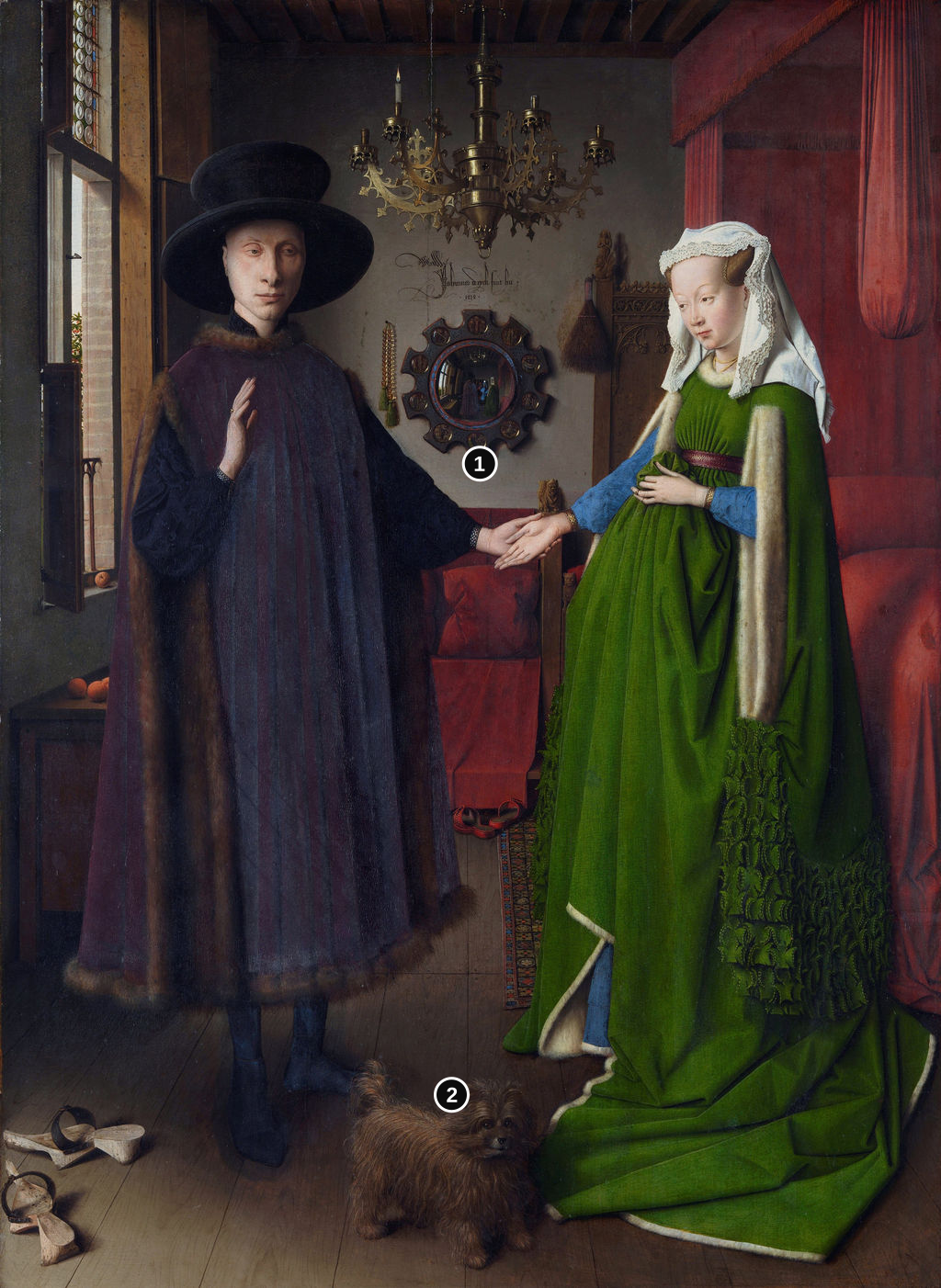
Details from THE ARNOLFINI PORTRAIT
Select a detail to enlarge it. Return to the numbered overview to find its position.
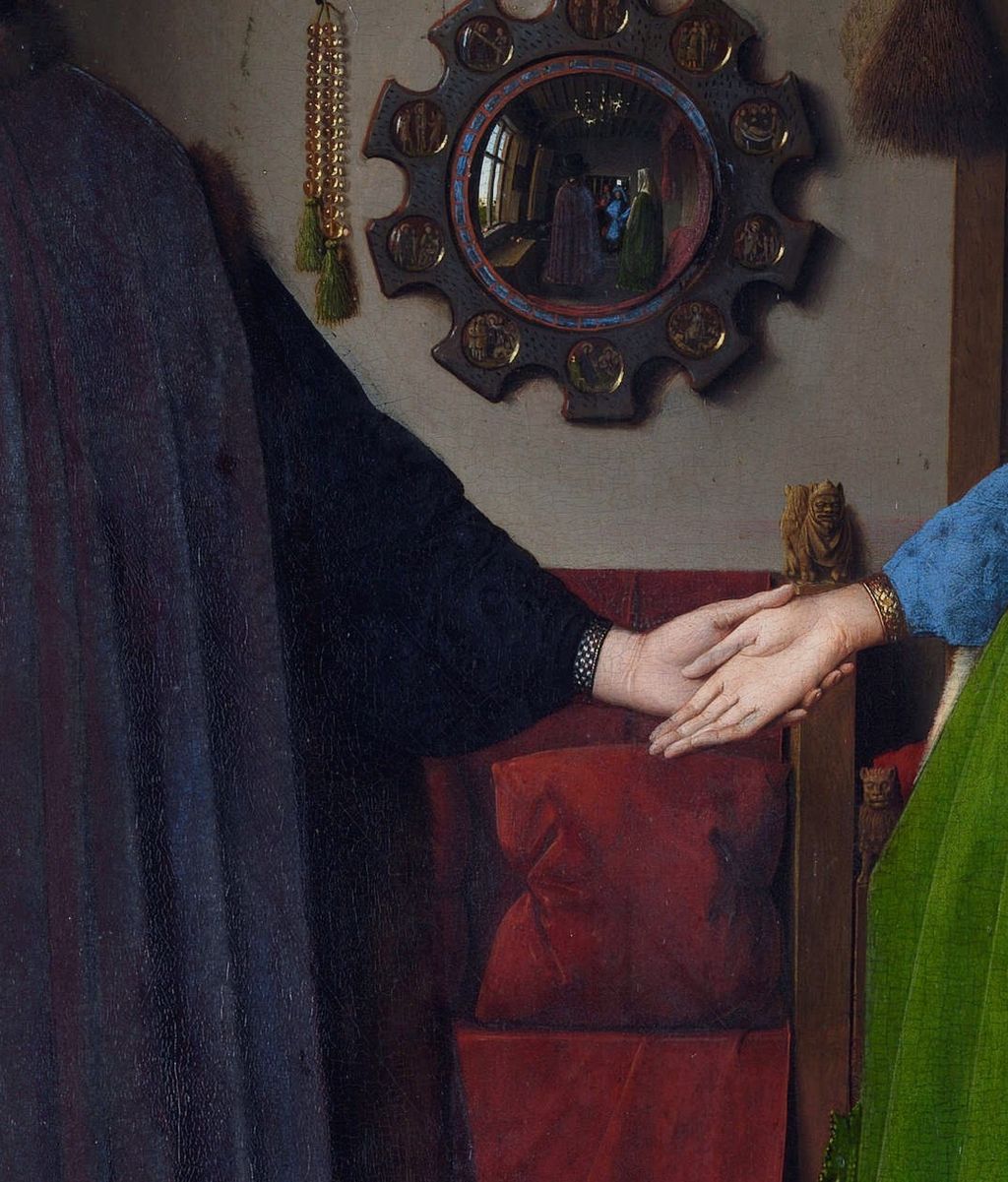
Convex mirror
The small mirror opens the painted room beyond the two main figures. Its reflections invite questions about viewpoint; they do not prove a wedding ceremony.
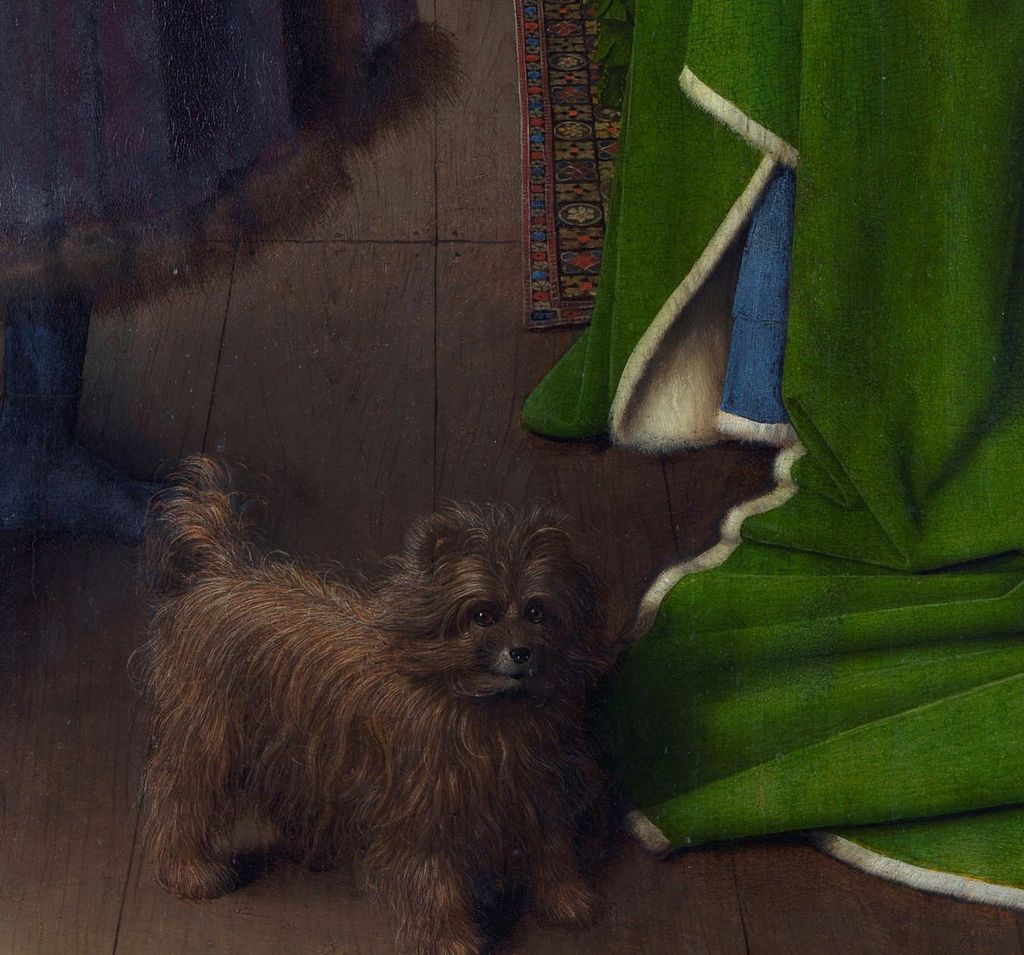
Dog and foreground
The dog and floor objects make the room feel inhabited. Their meanings are debated, so the visible details come before a fixed symbolic reading.
Begin with the figures and their hands
The pair occupy most of the room's height. The man's broad dark hat and hanging robe give him a narrow, almost columnar silhouette. The woman's green dress spreads outwards, its train creating a much larger area of colour. Their differences are balanced across the central hand contact. Her lowered head and his more outward-facing posture suggest distinct attitudes without supplying a conversation. We are given a relationship to observe, but no spoken words explain it.
His right hand is raised; his left supports her right. Her remaining hand gathers the gown. Looking carefully at this arrangement matters because some historical accounts described the hands inaccurately and then used that description to identify a marriage ritual. The actual contact is light and poised. It can suggest affection, presentation or a solemn relationship, but a gesture's familiarity does not identify a unique ceremony. The later discovery that the artist altered the hands further complicates any claim that their exact positions reproduce prescribed actions.[2][3]
Neither figure is simply an undistorted anatomical record. The heads and hands receive disproportionate emphasis, while the shoulders and upper bodies are restricted. The woman's long fingers and high forehead contribute to a refined presentation. Such adjustments need not destroy likeness. They show the painter deciding which features should carry recognition and attention. This is a portrait composed for sustained viewing, in which bodily proportions serve the encounter rather than provide a neutral set of measurements.[2]
Dress, workmanship and the apparent pregnancy
The woman's green gown is lavish in its quantity of cloth and in the labour of its finishing. Its hanging sleeves have elaborate cut decorations; pale fur borders the openings, and blue material appears beneath. The white veil is folded into a complicated shape over dressed hair. Small gold ornaments do not dominate the display. The chief impression comes from expensive surfaces and their careful arrangement, especially the mass of cloth held across her front.[1][2]
That gathered material creates the rounded outline often described as pregnancy. The National Gallery explains it through contemporary dress rather than treating it as proof of an expected child. Van Eyck's Saint Catherine in the Dresden Triptych offers a useful comparison: a virgin saint can have a similarly expansive silhouette. The portrait therefore cannot establish a pregnancy from the abdomen's shape. It equally cannot supply a medical account of the unidentified woman's life.[1][2]
The man's apparently sombre dress is also materially rich. Campbell identifies the wide hat as plaited straw coloured black, and the outer garment as probably velvet, lined with costly fur. What now looks nearly black includes purplish colour. Small differences between the hat, robe and sleeves prevent the figure from becoming one unbroken dark shape. His clothing projects prosperity with restraint. Reading its darkness solely as mourning would bypass its equally plausible role as luxurious formal dress.[2][6]
There is a productive tension between season and presentation. The cherry tree outside carries fruit, while the couple wear substantial fur-trimmed garments. This can be understood as the portrait giving special prominence to valuable clothes rather than documenting what someone happened to wear comfortably on a summer morning. A representation of status can select and combine appearances. The clothing offers evidence of how the pair are presented, not a reliable weather report or a calendar of the sitting.[2]
A reception room with a conspicuous bed
The interior combines a timber floor and ceiling with plastered walls, a window, upholstered furniture and a bed covered in red. The red hangings form a broad backdrop to the woman, while the darker space beneath the window supports the man. Her white veil projects against both wall and bed curtain. The furnishings are not evenly distributed: their placement leaves faces, hands and valuable objects clear enough to be inspected separately.
A bed in such a setting need not identify a private bedroom. The National Gallery describes a reception room in which an elaborate bed was a prestigious possession to display. The gathered curtain makes its rich covering particularly visible. A modern division between sleeping space and formal entertaining should not be imposed automatically on the image. The bed can contribute to a household's public presentation even while retaining associations with marriage, birth and death.[1][2][6]
Other furnishings support the impression of a wealthy urban home. Red-covered seating, a small patterned carpet, carved wood and polished metal distinguish it from a bare working interior. Yet there is no great display of silver plate, marble flooring or wall tapestry. Campbell places this between ordinary comfort and princely ostentation. The room's social effect depends on that balance: the couple appear to possess desirable goods without being presented in a ducal palace.[2]
Domestic display and devotion were not incompatible. Jacob Wisse's account of private life in the Burgundian Netherlands describes prosperous citizens using art to express both ambition and personal piety. That broader setting helps explain why prayer beads and sacred images can inhabit a room of costly furnishings. It does not establish that this particular portrait was commissioned for prayer, nor does it turn every possession into a disguised religious emblem. Several kinds of value could be visible together.[16]
Light, fruit and access to distant goods
Daylight enters through the left window, touching the man's face and the folds facing it. Glass survives in the painted window's upper sections; open shutters and the lower opening allow a view beyond. The green of the cherry tree punctuates a largely enclosed interior. The contrast between that glimpse and the room's dense furnishings keeps the outside world present without turning the picture into a landscape.
Four oranges provide a different connection with that world. One sits on the sill and others lie on the chest. They are bright, bounded shapes among much larger areas of cloth and wood. Campbell relates them to costly imported fruit available in Bruges and to the trading world of Italian merchants. Their apparent casualness is itself a form of display. Goods need not be arranged in a formal still life to proclaim that a household can obtain them.[2]
The orange on the sill also gives Van Eyck an opportunity to show reflected colour in polished wood. The effect ties the fruit to its immediate setting rather than allowing it to float as an isolated symbol. Claims that the oranges mean innocence, fertility or lost paradise require more than their presence. Their economic and pictorial functions remain observable even when a proposed symbolic association cannot be securely attached to this commission.
The chandelier and the candle in daylight
The brass chandelier is almost a second crown above the couple. Its branching forms cut across the plain wall, with bright edges making metal convincing against darker passages. A candle burns on the left side of the painted object. Other holders are empty or retain traces of use. The contradiction between a small flame and sufficient daylight has encouraged interpretations ranging from divine presence to a particular marital observance or the survival of one spouse.[2][6]
Its material and scale deserve attention before choosing among those readings. Campbell's catalogue compares the chandelier with costly metalwork and contemporary inventories. It also notes a practical difficulty: the depicted height leaves inadequate room for the raising-and-lowering mechanism suggested by comparable objects. The chandelier looks usable at first glance, but its place in the room is governed partly by the composition. Visual prominence has taken precedence over a completely reconstructable installation.[2]
An apparently unnecessary candle can serve several functions. It may honour a visitor, provide an opportunity to contrast kinds of light, or carry an association understood by the original viewers. No surviving instruction from the patron tells us which was intended here. The burning wick is secure; the claim that it proves one specific ritual is not. The candle becomes especially revealing when considered alongside the later interpretations of the portrait, rather than treated as an answer independent of them.[2][6]
Dog, pattens, beads and carved figures
The dog is small relative to the human figures but placed directly in the foreground. Its eyes and dark nose turn its face into another point of address. Loose-looking strands of hair contrast with the smooth boards beneath it. The animal gives the room an inhabited quality and helps bridge the space between the visitors implied by the mirror and the two main sitters. Its significance need not be exhausted by identifying a modern breed.[2]
Dogs could carry associations of attachment or fidelity, but those associations do not certify a wedding. Koster also compares the animal's position with dogs at the feet of women on funerary monuments. These readings ask different questions of the same painted pet. One concerns a bond within a household; another concerns remembrance after death. Neither eliminates the dog's immediate work as an animated presence at the threshold of the image.[6]
The discarded footwear likewise rewards precise description. The man's wooden pattens are outdoor overshoes; he has not become barefoot. The woman has another pair near the back of the room. Taking off muddy protective shoes on entering is different from removing all footwear on sacred ground. A theological reading built on bare feet starts from an inaccurate observation. The worn surfaces and their position also contribute to the picture's account of bodies moving between street and interior.[2]
Beside the mirror hang translucent beads with green tassels. On the furniture are both a sacred carved figure, identified as Saint Margaret with her dragon, and more fantastic carvings. A brush hangs nearby. These small things bring devotional practice, domestic maintenance and ornamental workmanship into close proximity. They have encouraged elaborate explanations of childbirth and danger, but a figure's recognisable identity does not establish the biography of the woman standing below it.[2][6]
A mirror that admits the viewer
The convex mirror changes the room's direction. Instead of simply returning the faces already in front of us, it shows their backs, the window and an entrance opposite. Two people appear at that entrance, one in blue and one in red. We can imagine occupying their position, arriving before the couple. This is one reason the man's raised hand can look like a greeting: the reflection supplies a plausible recipient beyond the painting's visible front boundary.[1][2]
The circular image compresses a much wider space than a flat mirror of the same apparent size would show. Architectural lines curve and small figures crowd towards its centre. Its broad view does not make every reflected proportion a trustworthy survey of an actual house. The mirror is painted with the same freedom as the larger room. It provides a convincing account of another direction while remaining an element Van Eyck could enlarge, reduce and redesign.[2][3]
Ten roundels surround the glass. Beginning below and continuing around the frame, the sequence moves through Christ's suffering to the Harrowing of Hell and Resurrection. These are identifiable sacred scenes rather than a vague impression of religious ornament. Their tiny scale creates a nested experience: the viewer looks at a household, then at a mirror, then at miniature images within that mirror's surround. Devotional history frames the reflected present of the couple.[2]
This combination helps explain why the mirror remains so compelling even without named witnesses. It links the painted room to our space, while its frame links domestic looking to Christian imagery. Its presence can support an argument about marriage or memory, but it cannot select the argument by itself. The two reflected people have no surviving labels, and the original commission has not supplied their names.[1][2]
The signature's unusual claim
Above the mirror, decorative writing announces Johannes de eyck fuit hic, followed by 1434. In English this states that Jan van Eyck was, or has been, here. It differs from a simple claim that he made the work. The line occupies the depicted room and meets the eye between chandelier and mirror. Its flourish is almost another luxury object, although the presence being advertised is the painter's own.[2]
The Gallery asks whether the foremost visitor might be Jan. That is a persuasive visual possibility, especially given the inscription's location, but it is not an identified self-portrait supported by a separate document. Campbell also distinguishes the phrase from wording used to introduce witnesses in legal records. The painted year lacks a precise day or a second witness's name. Writing that asserts presence does not automatically perform the legal work of a marriage certificate.[1][2]
The Quotes and Inscriptions guide compares this wording with Van Eyck's speaking frames. Here its special role lies in the room: looking at the mirror and reading the signature become linked actions. The maker appears to enter his own construction, and the spectator is offered a similar route inside. The claim can remain powerful even when we decline to invent an exact historical visit behind it.
Watch: Jan van Eyck in context
Choose a Smarthistory close reading of the Arnolfini Portrait or the closed and opened Ghent Altarpiece.
Jan van Eyck, The Arnolfini Portrait
Look closely at the room, mirror and gestures in the London double portrait.
Watch on YouTubeWhat the earliest inventories actually establish
The earliest surviving description is in Margaret of Austria's 1516 inventory, made at her palace in Mechelen. It names a man in a form usually understood as Arnolfini, describes him with his wife in a chamber, credits the painter Johannes and records the gift from Diego de Guevara. A marginal instruction concerns adding a lock. A later inventory of 1523–24 describes the standing couple touching hands and the two closing shutters bearing Diego's arms.[2]
These records strongly anchor the history of the object, but they were written more than eighty years after the painted date. They do not provide a commission contract or give the man's forename. Different renderings of the family name have required interpretation. Nor does either inventory supply the woman's name. Recognising the painting in an early description is therefore a different achievement from identifying every person represented within it.[2][7]
Stephan Kemperdick's published abstract for a 2023 Courtauld lecture makes that distinction especially clear: the usual family identification still rests on interpreting those two inventories, without independent corroboration. The abstract calls for attention to their textual and material context. It does not furnish a newly proven replacement name. Its value here is to prevent a long-established title from being treated as though an original sitter inscription had survived on the panel.[7]
Two Giovannis and an important marriage date
The Arnolfini were a Lucchese family with several members active in northern Europe. The two Giovannis most often discussed are Giovanni di Nicolao and Giovanni di Arrigo. Patronymics matter: dropping the fathers' names can merge different careers and marriages. Campbell favours Giovanni di Nicolao, resident in Bruges by 1419 and engaged in the trade in expensive goods. The Gallery's present account follows that preference while retaining qualification.[1][2]
An archival payment for a ducal wedding gift places Giovanni di Arrigo's marriage in 1447, thirteen years after the picture's date. That is a substantial obstacle to the familiar claim that Van Eyck painted his actual marriage to Giovanna Cenami in 1434. It does not, on its own, identify the painted man as someone else. A betrothal or a different relationship would require its own evidence. The document limits an argument; it does not automatically complete every remaining argument.[2][5]
Giovanni di Nicolao presents a different difficulty. He married Costanza Trenta in 1426, but a letter written by her mother in February 1433 reports that Costanza was already dead. It does not establish a precise date or cause of death. Campbell therefore proposes an otherwise undocumented second wife if the painting shows this Giovanni with a living wife in 1434. That second marriage remains a hypothesis, not a recovered certificate naming the woman beside him.[2][6]
The single portrait in Berlin offers a closely related male face, generally considered older and more simply dressed. Comparison can strengthen an argument that Van Eyck portrayed the same man twice. Yet the Berlin picture does not supply an independent name that resolves London's uncertainties. The resemblance and the documentary identification should remain distinct parts of the evidence rather than being allowed to confirm each other in a circle.[2]
Wedding, betrothal, memorial or presentation?
Erwin Panofsky's influential 1934 interpretation made the portrait a private marriage witnessed by the painter, with domestic objects carrying concealed religious significance. It helped establish the “wedding” story in teaching and popular culture. Campbell rejects its legal premises and argues instead for a portrait of a married pair receiving visitors. His account shows why the precise hand arrangement, the inscription and the history of later descriptions matter to this disagreement.[2]
Edwin Hall and Linda Seidel have defended a betrothal reading. Seidel's 2022 essay continues to consider Giovanni di Arrigo and a prospective representation of Jeanne Cenami, despite the later documented marriage. This differs from the Gallery's preferred identification and from a claim that an actual wedding occurred in 1434. Mentioning it as an attributed interpretation preserves the continuing debate; it does not restore the old unqualified names to the picture's caption.[5]
Margaret Koster's 2003 proposal accepts Giovanni di Nicolao but identifies the woman as the deceased Costanza. She reads the portrait as a memorial, drawing together the contrasting candles, the distribution of scenes around the mirror, the dog and comparisons with commemorative imagery. She also relates alterations in the painting to the possible development of that purpose. This is a coherent scholarly hypothesis assembled from several kinds of evidence, rather than a fact established by the mother's letter alone.[6]
Its limits are important. The death notice does not prove that Costanza appears here, that she died in childbirth or that a change of purpose occurred during painting. Nor can darker dress or a lighted candle independently establish bereavement. Equally, an artist could paint a dead person, so death before 1434 does not make a memorial interpretation impossible. The issue is the evidence connecting this particular picture to that particular woman, not a supposed rule that both sitters must have been alive.[2][6]
Dutch scholarship has also questioned how meanings are assigned to the objects. Reindert Falkenburg's discussion of Jan Baptist Bedaux explains an alternative to treating ordinary things as neutral forms concealing a theological code: objects and gestures may already carry meanings in social practice. Falkenburg does not simply endorse every conclusion Bedaux drew. The methodological lesson is useful even while the ceremony remains disputed. A thing can be socially significant without acting as a secret word in a fixed visual dictionary.[4]
The composition developed beneath the paint
Infrared reflectography reveals a substantial brush-drawn preparation under the finished surface. Outlines establish the people, room and principal furnishings; hatching builds areas of shadow. The method exposes portions of an earlier design that normal light conceals. It does not provide a film of the entire painting process or dates for each individual decision. Absence of a visible line must also be distinguished from proof that the painter never considered an object before applying colour.[2][3]
In this case the evidence for revision is unusually rich. The man had different positions for his features, shoulders, raised hand and feet; his robe was shorter. The woman's eyes and hand arrangement also changed. The mirror was larger and octagonal in the drawing. The carpet was extended, and the arrangement of the bench and brush developed. These changes affect the painting's central relationships as well as its peripheral furnishings.[2][3]
No underdrawing was found for several conspicuous elements, including the dog, oranges, beads, pattens and chandelier. The chandelier lies over work already done for the wall. Billinge and Campbell's technical study therefore complicates a reading in which every celebrated detail belonged to a fully specified initial programme. But late addition does not mean lack of significance: a painter can develop meaning during execution. The technical sequence sets conditions for interpretation without choosing a complete narrative for us.[2][3][6]
The green dress is made from layers
Van Eyck's illusion of materials depends on different kinds of marks and paint structure. The green gown, red hangings, dark garments and shining metal do not all achieve their effects by the same means. Technical analysis identifies translucent applications as well as opaque layers. The picture's precision should not be confused with a single microscopic method used uniformly across the panel.[2]
For the green dress, the Gallery records a verdigris-containing surface glaze over opaque preparations incorporating verdigris, lead-tin yellow and lead white. The analysed binding medium is heat-treated linseed oil with some pine resin. The 1997 methods-and-materials table explicitly distinguishes this mixture from simply calling the paint “copper resinate”. A sample tells us about a particular passage. It should not be expanded into a universal secret formula for every colour in every Van Eyck painting.[2][15]
The red bed incorporates a different layering of reds and earth colour, while natural ultramarine appears in several passages, including the blue underdress. Tiny highlights, restrained shadows and translucent colour work together to distinguish surfaces. The painter could also be economical: a dark contour and bright stroke may define part of a metal fitting while allowing the wall colour between them to supply its middle tone. Close looking reveals selective decisions rather than an infinitely even finish.[2]
A finger or thumb softened the shadow near the dog's leg, leaving a recognisable impression; scratched marks describe parts of the hanging brush. Such evidence brings the painted room back to a working surface. Fingers, a brush point and the manipulation of wet paint contribute to things that seem almost touchable. The portrait's refinement is compatible with speed and direct intervention, rather than requiring every convincing detail to have been built from laborious, separate outlines.[1][2]
Perspective and a modern optical hypothesis
The room gives a strong sensation of depth, but its scale and lines do not simply converge into a single, photographically consistent construction. Floorboards, furniture and reflected architecture encourage movement through the space. The vertical sequence of chandelier, signature and mirror steadies that movement. Some apparent inconsistencies help keep objects unobscured and the couple prominent. Treating them only as mistakes would overlook what they achieve within the picture.[2]
A 2021 account from the French research laboratory LORIA describes Gilles Simon's computational analysis of vanishing points in five Van Eyck paintings. He finds a recurring pattern and proposes a device allowing several viewpoints, using an Arnolfini-room reconstruction to explain how it might have worked. This is a model inferred from the images, not a surviving apparatus or a documented statement by Jan. The laboratory presents the proposal strongly; it should still be identified as Simon's argument rather than silently substituted for an established account of the workshop.[8]
The distinction is useful for viewing. A geometric reconstruction can test relationships that the eye accepts readily, while infrared evidence can show that the painter changed those relationships. Neither method identifies the sitters or recovers the patron's instructions. Mathematical regularity, a possible optical procedure and deliberate compositional adjustment are different questions. An explanation of one need not settle the others.
Oak, conservation and the lost surround
The support consists of three vertically grained oak boards, joined and reinforced with dowels. Unpainted margins survive, with small attached fragments indicating an original engaged frame. The complete panel measures 84.5 by 62.5 centimetres, larger than the image normally reproduced. Those edges are material evidence of construction. They remind us that the portrait began as a framed wooden object, rather than a borderless rectangle in a book or on a screen.[2]
Campbell's condition account records the 1942–43 cleaning, small losses, a scratch across the mirror and altered or greyish blue-containing passages. Protective layers on the reverse obstruct informative X-radiography; infrared examination has therefore been particularly important. These are findings reported by a dated technical account, not a claim that the page describes a new conservation campaign. General good preservation does not mean that all colours and surface coatings remain exactly as they were in 1434.[2]
The frame now around the picture is itself fifteenth-century Netherlandish, but it is not the original surround. The Gallery describes water-gilt walnut with a pine back frame and records repeated reframing after acquisition. Age alone does not prove that a frame has always belonged to a painting. Surviving fragments at the panel's edges and documentary descriptions of lost covers provide different, more specific evidence for its earlier presentation.[1][2]
By 1516 the portrait had closing shutters; they remained recorded in 1700 and are now lost. Diego de Guevara's arms and device appeared on them, and later descriptions mention marbling. He may have decorated existing wings or commissioned them. The evidence does not decide their date of origin. Opening those shutters would once have revealed a painted welcome into a room. That physical act gives the familiar composition another setting in which to imagine an early spectator.[2]
How collectors changed its story
Diego de Guevara is the first recorded owner, and his gift took the picture into Margaret of Austria's collection. He moved within Burgundian and Habsburg court circles; a portrait probably representing him by Michel Sittow survives in Washington. The National Gallery of Art qualifies that sitter identification, so it should not be used as an unquestionable likeness of the donor. It nevertheless places the portrait's collecting world alongside other surviving evidence for courtly patronage.[11]
Seidel's later research asks what Margaret might have valued in the work. She considers its place among private pictures, dynastic memories and the experiences of women whose marriages were shaped by politics. This approach shifts attention from an imagined original ceremony to later viewing. Her suggestions about the occasion of Diego's gift and Margaret's personal response remain hypotheses: no recovered note tells us exactly what she felt when looking at the couple.[5]
The portrait passed to Mary of Hungary and then into the Spanish royal collection. A visitor in 1599 reported verses from Ovid, subsequently described on its frame. By 1700, an inventory construed the scene as a pregnant German woman marrying by night, with the verses suggesting deception. Campbell regards the Ovidian wording as a later addition; Koster leaves open an earlier origin. Since the frame is lost, its text and date cannot be examined directly. It must be kept separate from the surviving signature above the mirror.[2][6]
The candle, dress and added words had helped generate a different story around the same image. A later inventory's confident narrative is therefore evidence of reception, not automatically of Van Eyck's intention. Campbell's 2021 update adds that the picture was still recorded in Madrid in 1808 and 1811, then misattributed to Holbein. Even authorship could be forgotten while the objects and gestures continued to invite explanation.[2]
From uncertain wartime passage to public collection
How the painting left Spain is unresolved. It came into the hands of the Scottish soldier James Hay, who served in the Peninsular War and fought at Vitoria. A story published later places his acquisition during convalescence in Brussels after Waterloo. Campbell sets that account beside the possibility of an acquisition in Spain. Neither should be converted into an unbroken, documented transfer. Hay's presence at particular battles does not establish precisely where he obtained this picture.[2]
A firmer sequence begins with its submission through Thomas Lawrence for the Prince Regent's inspection in 1816 and its return in 1818. It appeared at the British Institution in 1841; the National Gallery bought it in 1842 for 600 guineas and displayed it publicly the following year. The acquisition brought a remarkable early Netherlandish interior into a collection more familiar to British students through other schools of painting. Its later fame should not make that institutional change seem inevitable.[2][12]
The room travels into books and other paintings
The composition circulated before the portrait reached London. KBR's French account of Loyset Liédet's illumination of David Aubert in his scriptorium, in Histoire de Charles Martel, identifies a cluster of Arnolfini references: mirror, reflected figures, wall writing, chandelier, beads, dog, oranges and brush. The manuscript was copied for Philip the Good and its illumination completed under Charles the Bold. The borrowed room becomes a place of writing and princely oversight, showing how adaptable Van Eyck's arrangement could be.[9]
That cluster is more informative than a vague resemblance between two interiors. It also warns against treating every later use as a guide to the portrait's original subject. An illuminator could reuse its visual authority without representing marriage. The copying process preserves evidence of artistic attention while changing the figures, activity and purpose. The room's afterlife is therefore part of its history, not a missing set of instructions for decoding the commission.[2][9]
In nineteenth-century Britain the painting offered another kind of model. The Gallery relates William Holman Hunt's Lady of Shalott designs to its mirror, and discusses Millais's Mariana through detailed colour, furnishings and the solitary flame. These artists turned inward-looking rooms into settings for new literary narratives. Their responses help explain why the portrait became so influential: its treatment of ordinary things could be admired both as close observation and as an invitation to make objects bear meaning.[13][14]
A Rijksmuseum record provides a more modest witness to that wider circulation: a small photomechanical reproduction associated with Franz Hanfstaengl, dated around 1898 to 1903 at the latest, printed in a photographic journal. Its scale and medium differ radically from the oak panel. The portrait's modern familiarity owes something to such portable images, through which an intricate room became available far beyond the collection that owned it.[10]
Return finally to the hands, faces and mirror together. A claim about the event must account for the documents; a claim about a symbol must fit the particular object; an account of literal realism must reckon with revisions and altered space. None of those demands diminishes the pleasure of looking. They make it possible to admire the painting's abundance while seeing how deliberately that abundance was made, and how much of its human story still remains open.
Related reading


Discussion
What do you notice in The Arnolfini Portrait by Jan van Eyck? Share a close observation or a source that adds useful context.
Join the Conversation
Keep observations specific and evidence clear.
References
- National Gallery, London, “The Arnolfini Portrait”, NG186: current object description, metadata and frame history. View Source.
- Lorne Campbell, “The Arnolfini Portrait”, The Fifteenth Century Netherlandish Paintings, 1998, updated September 2021: catalogue, technical examination, inventories, identities, interpretations and provenance. View Source.
- Rachel Billinge and Lorne Campbell, “The Infra-red Reflectograms of Jan van Eyck's Portrait of Giovanni(?) Arnolfini and his Wife Giovanna Cenami(?)”, National Gallery Technical Bulletin 16, 1995, pp. 47–60: underdrawing and design changes. View Source.
- Reindert L. Falkenburg, “Iconologie en historische antropologie: een toenadering”, in Gezichtspunten, 1993, especially pp. 139–150: Dutch discussion of Panofsky, Bedaux and socially embedded symbolism, DBNL. View Source.
- Linda Seidel, “Poor Little Rich Girl(?): Margaret of Austria and the Arnolfini Portrait”, Different Visions 8, 2022: sitter debate, collecting context and women's later experience. View Source.
- Margaret L. Koster, “The Arnolfini Double Portrait: A Simple Solution”, Apollo 158, no. 499, 2003, pp. 3–14: memorial interpretation; consulted through a scanned text reprint. View Source.
- Stephan Kemperdick, “Arnolfini?”, Courtauld, 6 November 2023: published lecture abstract questioning the identification's documentary basis. View Source.
- LORIA, “Les secrets de la perspective chez Jan Van Eyck dévoilés par la vision par ordinateur”, 2021: Gilles Simon's computational and optical-device proposal, read in French. View Source.
- KBR, “Qui copie qui : peinture ou miniature ?”: Liédet's manuscript illumination and its Arnolfini references, read in French. View Source.
- Rijksmuseum, “Reproductie van Portret van Giovanni Arnolfini en zijn vrouw door Jan van Eyck”, RP-F-2001-7-968-6-185: Hanfstaengl photomechanical journal image, read in Dutch. View Source.
- National Gallery of Art, Washington, “Portrait of Diego de Guevara (?)”, Michel Sittow, 1937.1.46: qualified sitter identification and court service. View Source.
- National Gallery, “Reflections: Behind the inspiration”, acquisition section: 1842 purchase and British reception. View Source.
- National Gallery, “Reflections: Behind the inspiration”, William Holman Hunt section: Lady of Shalott and mirror. View Source.
- National Gallery, “Reflections: Behind the inspiration”, Mariana section: Millais's response and rejected mirror. View Source.
- Rachel Billinge and collaborators, “Methods and Materials of Northern European Painting in the National Gallery, 1400–1550”, National Gallery Technical Bulletin 18, 1997, Table 1: sampled green dress medium. View Source.
- Jacob Wisse, “Burgundian Netherlands: Private Life”, Metropolitan Museum of Art, 2002: private patronage, devotional objects and domestic display. View Source.
 Jan van Eyck.jpg)
 Jan van Eyck.jpg)


