


 Buy Art Prints Now
from Amazon
* As an Amazon Associate, and partner with Google Adsense and Ezoic, I earn from qualifying purchases.
 by Tom Gurney
Tom Gurney BSc (Hons) is an art history expert with over 20 years experience
Page Created on June 19, 2020 / Page Updated on November 1, 2026
Email: tomgurney1@gmail.com / Phone: +44 7429 011000
The Singing Angels of the Ghent Altarpiece
Eight angels crowd around a single music book, their faces animated by an activity the painting makes us imagine but cannot let us hear. They wear jewelled headbands and sumptuous copes, yet have no wings. Lukas–Art in Flanders identifies them as a heavenly choir singing polyphony, the interweaving of several melodic lines associated with the Burgundian court. The object is simultaneously a sacred image and an extraordinarily attentive representation of people making music together.[1]
The Singing Angels occupy the opened upper register, on the viewer’s left of the enthroned Virgin Mary. Across the central group, the Music-making Angels provide their instrumental counterpart. Adam stands farther out towards the left edge. This position matters: the choir belongs immediately beside the heavenly court, above the worshippers gathered around the Lamb. The cathedral’s Dutch guide explains the singers through the harmonious many-voiced music of the Burgundian period.[2]
At a Glance
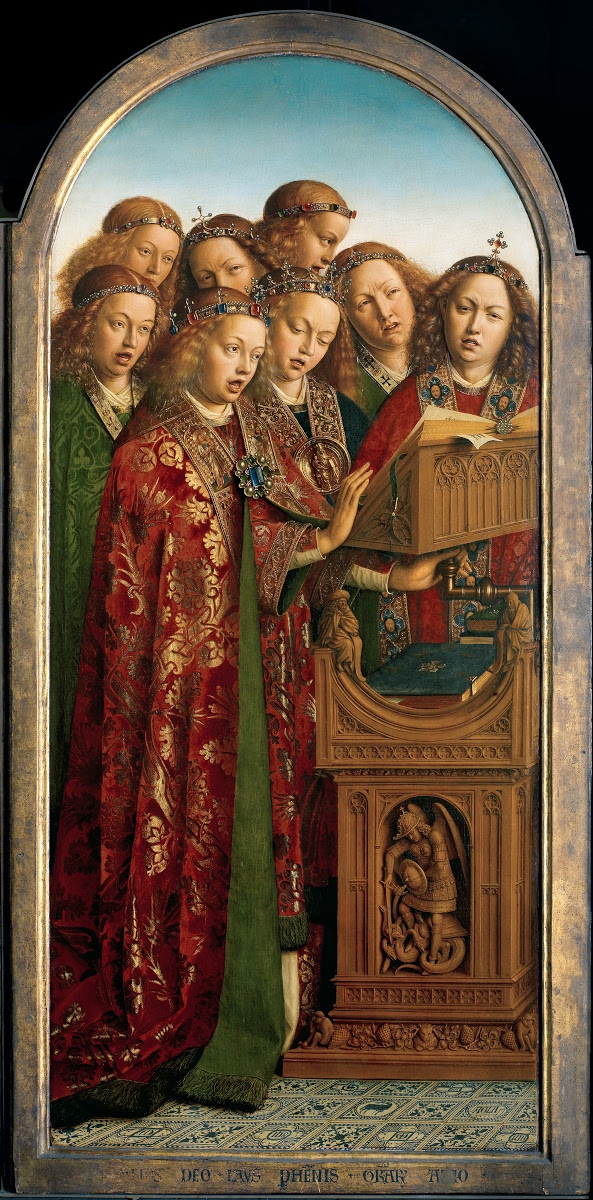
Eight faces, one performance
Look first at the heads rather than the gold. A face near the upper left peers past another singer; the head above the middle turns towards the book; the foreground mouths open in different shapes. Brows lift or contract, eyelids narrow, and the eyes do not all converge on the same point. These differences prevent the group from becoming a repeated decorative pattern. The singers seem to be negotiating a performance with separate bodily responses.
The packing of those heads is equally important. Foreground shoulders partly conceal the figures behind them, while the pale sky leaves their jewelled outlines clearly visible. The tallest head approaches the arch without touching it. Below, the largest sweep of red cloth carries the eye towards the floor; the lectern answers it with a more rigid upright. The choir’s activity is concentrated above, but its bodies and furniture occupy a coherent, crowded space.
That human appearance has a theological purpose in Visit Gent’s interpretation. The wingless angels connect an unknowable heavenly service with worship that a church congregation could recognise. The group is not presented as a cloud of flying spirits. Its shared book, close gathering and visible effort suggest the practical coordination of singers. Nevertheless, familiarity does not establish that these are portraits of particular Ghent choristers. The guide’s account explains the image’s accessibility rather than identifying its models.[3]
Can their mouths tell us the vocal parts?
The temptation to hear particular voices is longstanding. In the ode published in his 1565 collection, Lucas de Heere praises the heavenly singers’ discant and says their different voices can be recognised through their mouths and eyes. The original Dutch passage survives in the edition available through the Netherlands’ DBNL. It records a sixteenth-century viewer’s delighted response to the panel’s persuasive animation. It does not preserve the music sung at the altarpiece’s inauguration or supply a list of named performers.[5]
Marina Belozerskaya’s Getty study offers a more specific modern reading. She associates the three foreground figures towards the left with lower voices, the strained faces towards the right with a higher range, and the figures behind with a middle register. Her language is explicitly tentative. The discussion places this painted choir beside the prestige of skilled sacred polyphony in churches and princely chapels: selecting complementary voices was part of creating an impressive musical establishment. That context makes the differentiation plausible without turning every facial muscle into a dependable pitch indicator.[4]
Kathi Meyer-Baer proposed another explanation in 1970. Questioning the identification of strained high notes, she connected the expressions with Jean Gerson’s account of the spiritual song of the heart. Joy, hope, compassion, fear and grief could be represented through a set of contrasting affections. Her Appendix IV presents this as a proposed solution, supported by comparison with other angels in the altarpiece. It is an interpretation of spiritual expression, not a discovered instruction from the painters or donors. Its value lies partly in showing that the faces admit more than one historically informed reading.[6]
These accounts do not require the same conclusion. De Heere celebrates the illusion of distinguishable voices; Belozerskaya relates the faces to vocal ranges; Meyer-Baer asks whether they express inward devotional states. The visible starting point is secure: the mouths and brows differ. Deciding exactly what each difference signifies requires an argument. A useful close examination keeps that distinction intact rather than labelling every head soprano, tenor or bass as though the painting supplied a key.
The music book and the singer’s hand
The open volume presents another kind of evidence. Visit Gent reports a few visible notes as ut [fa] ut [la] and identifies mensural notation, which could communicate measured note values. The brackets belong to the guide’s transcription and should be retained. Such a fragment does not identify an entire composition. The same account notes that singers might know their music by heart and consult a common book as a reminder. Their scattered gazes therefore need not mean that they are inattentive or that the book is irrelevant.[3]
The volume is placed high, its pale pages opening towards the faces. Beneath it, the sloping wooden rest creates a visual bridge between the singers and the viewer. One foreground hand is raised beside that slope; another reaches towards the support. The fingertips and bent wrists introduce small, changing movements beside the stand’s fixed geometry. The painting thus gives music a bodily rhythm through hands as well as mouths, while leaving the exact instant of the gesture unstated.
W. H. James Weale’s 1912 catalogue describes an open antiphoner on the oak lectern, three further books below, and a brass support rising from the stall. He reads the forward singer’s gesture as beating time. His inventory is particularly useful because it directs attention beneath the conspicuous open volume to the working equipment of the choir. The identification of a time-beating gesture remains a reading of an arrested action; it cannot tell us the tempo, the complete rhythmic pattern or the identity of the piece.[7]
A carved battle beneath the score
The furniture contains a second image. Saint Michael stands over a dragon in the tall carved compartment below the book. Small figures perch on the curved sides above him, while foliage and creatures occupy the base. These details make the stand resemble an elaborate piece of carved church furnishing rather than a plain music desk. The carved arches above and the sharp little shadows between carved forms also provide a different kind of craftsmanship from the textiles next to them.
Laura Slater’s University of Oxford discussion relates Michael’s victory to Revelation 12 and reads the carved vine and fruit through Eucharistic associations. Below the panel, the frame inscription praises God through enduring song and thanksgiving. The choir’s work is therefore expressed in three linked ways: the figures perform it, the carved furnishing places it within sacred history, and the wording states its devotional purpose. This is a developed iconographic interpretation; the identification of Michael is firmer than any claim to reconstruct every association a fifteenth-century worshipper would have made.[8]
The little combat is easy to overlook because the red cope and expressive faces attract attention first. Its placement nevertheless has considerable force. The singers stand above a defeated enemy, and their music book rests over a scene of heavenly victory. The miniature warrior’s raised action contrasts with the choir’s absorbed concentration. The relationship gives the panel an internal movement from conflict near the floor to collective praise above, without requiring the whole altarpiece’s programme to be retold here.
Watch: Jan van Eyck in context
Choose a Smarthistory close reading of the Arnolfini Portrait or the closed and opened Ghent Altarpiece.
Jan van Eyck, The Ghent Altarpiece (2 of 2)
Follow the heavenly figures and the gathering around the Lamb when the wings open.
Watch on YouTubeHeaven’s choir and Ghent’s actual singers
Barbara Haggh’s study of Burgundian music provides an unusually precise connection with the donors’ foundation. In 1435 Joos Vijd and Elisabeth Borluut established a daily Mass administered through the church’s cotidiane, the body responsible for singing the daily offices. Haggh traces the foundation through the Ghent civic record and explains how its priests were incorporated into that musical organisation. The relationship places the painted singers beside an institution supported by the patrons, rather than leaving them as a general emblem of heavenly harmony.[9]
There is an important limit. Haggh finds no evidence that polyphonic singing was prescribed or actually included at the daily Mass before the Lamb. A chaplain serving it in 1484–85 was a tenor who had notated Masses in discant elsewhere, but that later evidence does not establish the original service’s precise musical form. The distinction helps us understand the choir honestly: its heavenly many-voiced praise can evoke the church’s musical aspirations without becoming a literal record of what was performed every day below it.[9]
Slater also places the singers within the eternal praise described in Revelation, alongside the instrumental angels’ allusion to Psalm 150. The visual pairing can suggest the fullness of worship through voices and instruments. It does not establish that the harp, bowed instrument and organ all accompanied this particular painted vocal passage together. The companion panel has its own evidence about instruments, handling and musical practice; those questions deserve their separate account.[8]
Liturgical clothing and painted precious things
The leading red cope almost fills the lower left of the image. Gold patterns expand across its broad surface, then narrow or disappear where the fabric folds. A richly decorated band follows the opening, and a large clasp catches the eye near the chest. Behind it, green, blue and red garments divide the compressed group without separating it into isolated figures. The different colours help us distinguish bodies whose shoulders and arms overlap.
Weale distinguishes apparelled albs, copes and a dalmatic, and notices miniature saints beneath canopies along one decorated border. Another border repeats representations of the Holy Face. He also describes two contrasting clasps: a round one containing a seated figure with the tablets of the Law, and a lobed, gem-set example. These observations reveal how much imagery is carried by the clothing itself. The choir is richly vested for sacred service; its splendour extends beyond expensive-looking fabric to tiny images placed within the ornaments.[7]
The jewelled headbands provide another variation. Some run almost horizontally across a forehead; others rise into small crosses and projecting ornaments. Their delicate points stand against the sky, making the heads simultaneously individual and ceremonially unified. Soft waves of hair contrast with the hard little highlights of the settings. The paint differentiates several effects of material through scale and reflected light, although a coloured painted stone is not an analytical identification of a particular mineral.
Visit Gent singles out the blue jewel on the forward singer’s clasp, interpreting its tiny window reflection as a reference to the Vijd Chapel. At ordinary screen size, the detail is difficult to judge. The identification should be understood as the guide’s reading of a painted reflection, rather than independent proof of the exact position of a real window. Its broader interest is clear: an apparently minute piece of jewellery can connect heavenly splendour with the experience of light in an earthly room.[10]
The patterned floor and AGLA
Below the garments, blue-and-white tiles turn towards the picture plane in a shallow band. Their repeated divisions establish a surface under the feet, while letters and small emblems interrupt the geometric rhythm. Visit Gent identifies signs associated with Christ and Mary, the Lamb, and AGLA. The floor is therefore another inscribed surface within the choir’s setting. Its marks belong to the same sacred environment as the music and carved stand, even though the viewer may notice them only after looking down from the faces.[10]
Jacques Paviot’s French-language study, with Dina Goren’s contribution, investigates the Greek and Hebrew-looking inscriptions in Eyckian pictures. AGLA derives from the initials of a Hebrew invocation asserting the Lord’s enduring power. Paviot stresses that the abbreviation also circulated in the medieval Latin world through protective prayers and conjurations. Its appearance in Van Eyck’s paintings need not demonstrate direct command of Hebrew or access to an exceptionally obscure theological system.[11]
For the angel panels specifically, he proposes that AGLA on the tiles could function as protection against demonic forces. That interpretation has a suggestive neighbour in Michael’s victory over the dragon on the lectern, but the two do not constitute a surviving explanation written by the artist. The useful distinction is between the letters’ documented circulation and their precise intended force here. Paviot’s research supplies a historical range of meanings while resisting an exaggerated picture of the painter as a linguistic scholar.[11]
A wing panel changed into a separate exhibit
The choir’s present appearance also belongs to a physical history. KIK-IRPA records that the angel shutters were sold in 1816 and entered the royal collection in Berlin in 1821. In 1894 their wooden supports were sawn through their thickness and cradled so that the paintings formerly on opposite sides could be displayed simultaneously. They returned to Ghent in 1920 after the First World War. Separation changed how the object could be exhibited as well as the structure supporting its paint.[13]
Hélène Verougstraete-Marcq and Roger Van Schoute’s French study of the frames adds a significant point. Their examination followed the altarpiece’s dismantling in 1986, and they argued that frames and supports must be studied together as parts of a constructed piece of furniture. The 1894 intervention affected frames as well as panels: the divided frames were backed with softwood elements. A familiar frontal reproduction consequently conceals an important alteration in the original relationship between painted face, painted reverse and surrounding joinery.[12]
This distinction is especially relevant to the inscription beneath the singers. Its position belongs to the frame’s contribution to the picture, not merely to a later explanatory label. At the same time, a photograph of the surround is not sufficient evidence that every visible moulding, surface finish or repaired section retains its untouched fifteenth-century condition. The French study demonstrates why a history of this panel has to include carpentry, not just the imagery visible from the front.[12]
What the current research can establish
The March 2024 conservation report states that non-original varnish had been removed from the angel panels. It also describes University of Antwerp macro X-ray fluorescence examination of both groups during summer 2023. Element-distribution maps help distinguish pigments, condition and changes beneath the visible surface. The report’s illustrated rediscovered harp-player’s hand belongs to the instrumental panel; it should not be presented as a discovery about a singer. Findings must stay attached to the particular object examined.[14]
By December 2024, KIK-IRPA reported cleaning of the two angel panels as well advanced, within an ongoing programme. Its description of removing roughly half the sixteenth-century overpaint concerned the cloaks of the three central enthroned figures, not a measured percentage of this choir. The report also explained the eventual use of reversible retouching for losses and a final varnish. Those are dated treatment statements, not evidence that every part of the present work was then finished.[15]
The current project record gives the upper-register campaign as 2023 to spring 2027. It identifies drying cracks and original compositional changes among the particular issues of the angel panels. A revised form beneath the surface may therefore be part of the painters’ work, while a different passage may be a later addition or repair. Scientific examination and close treatment distinguish those histories. They do not justify assigning each face, jewel or carved ornament to Hubert or Jan from a small reproduction.[13]
A French archive of the choir’s later life
The Musée national Picasso-Paris preserves a late nineteenth-century albumen photograph of the Singing Angels, inventory APPH13449. It measures 22.5 by 10.2 centimetres and carries a handwritten identification of the Van Eycks and singing angels on its reverse. The photograph entered the museum through the Picasso succession’s gift in 1992, as part of an album reproducing old masters. The record documents another way the panel circulated: as a portable photographic image available for close study far from Ghent. It does not establish that Picasso copied the choir or endorsed a particular musical interpretation.[16]
The photograph, the historical descriptions and the present technical investigation ask different questions of the same object. A face can persuade a poet that he recognises a voice; a musicologist can test the limits of that impression; a conservator can establish which physical layers carry it. Looking between them makes the choir richer without pretending its sound has been recovered. Its lasting achievement is to give individual effort, collective worship and extraordinarily elaborate things a convincing place within one silent performance.
Related reading


 Jan van Eyck.jpg)
Discussion
What do you notice in The Singing Angels of the Ghent Altarpiece? Share a close observation or a source that adds useful context.
Join the Conversation
Keep observations specific and evidence clear.
References
- Lukas–Art in Flanders, The Ghent Altarpiece: Singing Angels, collection description, whole-panel photograph and rights. View Source
- Saint Bavo’s Cathedral, Dutch panel guide, upper-register arrangement and singing angels. View Source
- Visit Gent, “Heavenly notes and angelic song,” wingless singers, common book and fragmentary notation. View Source
- Marina Belozerskaya, Luxury Arts of the Renaissance, Getty, 2005, pp. 191–195, sacred polyphony and proposed vocal ranges. View Source
- Lucas de Heere, Den hof en boomgaerd der poësien, 1565, ode XI, lines 17–20, W. Waterschoot’s 1969 edition, DBNL. View Source
- Kathi Meyer-Baer, Music of the Spheres and the Dance of Death, Princeton, 1970, Appendix IV, pp. 357–359, proposed spiritual affections. View Source
- W. H. James Weale, The Van Eycks and Their Art, 1912, pp. 42–43, books, gesture, vestments and ornaments. View Source
- Laura Slater, “Singing to Heaven in the Ghent Altarpiece,” MALMECC, University of Oxford, 2019, lectern, frame inscription and heavenly worship. View Source
- Barbara Haggh, “The Mystic Lamb and the Golden Fleece,” Revue belge de Musicologie, 61, 2007, pp. 5–59, especially 8–9, foundation and musical evidence. View Source
- Visit Gent, “The symbolism behind the Ghent Altarpiece,” jewel reflection and tiled floor. View Source
- Jacques Paviot, with Dina Goren, “Les inscriptions grecques et hébraïques dans les tableaux eyckiens,” 2006, especially pp. 71–73, AGLA and its circulation. View Source
- Hélène Verougstraete-Marcq and Roger Van Schoute, “Les cadres de l’Agneau mystique de Van Eyck,” Revue de l’Art, 77, 1987, pp. 73–76, especially p. 73, divided supports and frames. View Source
- KIK-IRPA, current upper-register project record, provenance, panel condition and 2023–spring 2027 campaign. View Source
- KIK-IRPA, 26 March 2024 press kit, pp. 5, 16–17, varnish removal, material history and MA-XRF. View Source
- KIK-IRPA, 10 December 2024 press release, p. 2, dated cleaning and treatment update. View Source
- Musée national Picasso-Paris, APPH13449, late nineteenth-century photograph of the Singing Angels, archival record. View Source


 Jan van Eyck.jpg)
 Jan van Eyck.jpg)


