 Buy Art Prints Now
from Amazon
* As an Amazon Associate, and partner with Google Adsense and Ezoic, I earn from qualifying purchases.
 by Tom Gurney
Tom Gurney BSc (Hons) is an art history expert with over 20 years experience
Page Created on June 19, 2020 / Page Updated on November 1, 2026
Email: tomgurney1@gmail.com / Phone: +44 7429 011000
The life of Jan van Eyck
Jan van Eyck's documented life begins with employment rather than childhood. In 1422 he was already working for John of Bavaria at The Hague. By 1425 he had entered the service of Philip the Good, Duke of Burgundy; in 1428–29 he travelled to Portugal to portray the duke's prospective bride. The following decade brought a house and workshop in Bruges and the surviving signed paintings on which much of his reputation rests. He died there in 1441. These are the main landmarks of an unusually well-connected painter's career, but the spaces between them have not all been filled.[1][2]
His biography survives in several forms. Court accounts record employment, journeys and gifts; church records preserve commissions and burial arrangements; inscriptions identify particular pictures and sitters. Recent archival discoveries have added information about his marriage and workshop. Each kind of evidence answers different questions. A payment can place him in someone's service without naming a surviving painting. A signed portrait can establish a day's place in his working chronology while leaving its first use uncertain. Following those distinctions produces a richer life than treating every plausible story as established fact.[1][3]
At a Glance
Origins, relatives and education
Maaseik, in the Meuse region, is the probable birthplace generally associated with Van Eyck. His birth year remains unknown. Dates around 1380, 1390 or the end of the fourteenth century are estimates, sometimes influenced by the apparent age of the sitter in a possible self-portrait. They should not be turned into a secure birthday. Campbell also notes that the order of birth of Jan and his painter brothers Hubert and Lambert is not established. The familiar picture of an older Hubert teaching a younger Jan lacks a surviving apprenticeship record.[1]
A Vatican register entry published by Hendrik Callewier in 2021 associates Jan and his wife Margareta with the diocese of Liège. It provides contemporary evidence for their origins, but the medieval diocese covered a wide area. It does not name Maaseik as Jan's birthplace or identify the place where he trained. Its value is greater when that geographical limit is retained: a document can strengthen a regional connection without settling every local claim made about it.[3]
The brothers' shared profession nevertheless matters. Hubert's part in the Ghent Altarpiece and Lambert's later appearances prevent Jan's career from being understood solely as the story of an isolated individual. Family links could carry knowledge, materials and business relationships, although the surviving sources do not reveal exactly how that happened here. Nor does the name Van Eyck itself identify every person bearing it as a member of this household. Biographical research has had to distinguish the painter from namesakes and spelling variants rather than simply collect every reference to a Jan or Johannes.[1][3]
His inscriptions and working notes suggest considerable literacy. Latin, Dutch and French appear in his pictures, sometimes with Greek letter forms, while a portrait drawing preserves colour notes. These are signs of an accomplished practitioner operating in more than one written culture. They do not reveal a school, university or curriculum. The distinction is useful because courtly sophistication need not depend on an invented account of formal education. The surviving objects show what he could do with words and scripts, while leaving the route by which he learned those skills largely hidden.[19][20]
The Hague, 1422–25
At The Hague he worked for John of Bavaria, ruler of Holland and a former bishop-elect of Liège. The court accounts place him in a professional setting with assistants before any securely dated surviving panel can be attached to these years. The record therefore finds an established painter rather than a novice. His work belonged to a princely household whose visual requirements could include decoration, objects and ceremonial display as well as independent pictures. It would be misleading to imagine this employment only through the small portraits now familiar from museums.[2][4]
Dutch archival scholarship has made the accounting evidence less simple than it first appears. Jos Koldeweij's review for the RKD's Oud Holland discusses Anne-Maria van Egmond's work on the Hague court and the differing interpretations of payments. An entry of November 1425 for the painter has been read as evidence of a final visit, whereas another interpretation leaves his physical presence uncertain. Even the classification of payments has been debated. These distinctions affect how confidently an account book can be converted into an itinerary or a salary history.[4]
The missing early pictures are a separate problem. Employment in the 1420s establishes that Jan was painting, but it does not give us an uncontested sequence of extant works showing his development. An unsigned image with Eyckian features cannot automatically be assigned to the Hague period to fill that gap. The French INHA's career record likewise distinguishes work for the residence from identifiable surviving commissions. What can be reconstructed is an institutional beginning: a painter already trusted with court work before the surviving signed corpus becomes visible.[4][5]
John of Bavaria died in 1425, bringing that employment to an end. Jan's transition to Philip the Good's service is one of the clearest changes in his career. The new appointment connected him to a larger Burgundian network, but it did not erase the experience of working at The Hague. Both phases show a painter whose professional position was tied to a ruler's household. The later appearance of paintings for private patrons should be understood as an extension of that career, rather than evidence that court employment was merely an early episode.[2][6]
Philip the Good: appointment, Lille and financial security
A document of 19 May 1425 records Jan's appointment as painter to Philip the Good. The title valet de chambre placed him within the ducal household. It indicated a personal connection to princely service as well as the task of making images. He was based at Lille during much of the later 1420s. The Thyssen-Bornemisza biography considers work on the duke's residence there probable, while the administrative record also preserves travel and other duties. The surviving career cannot be reconstructed as a series of portraits of Philip alone.[6][7]
The position offered standing and a continuing income, which helped distinguish Jan from painters wholly dependent on separate commissions. Yet household rank did not remove him from practical business. Payments had to be authorised, registered and delivered, and a patron's favour did not prevent delays. The best-known evidence is Philip's intervention in 1435 when financial officials resisted or delayed implementation of the painter's pension. The duke insisted on payment because he intended to employ Jan on important works and did not expect to find a replacement whose abilities pleased him equally.[8][28]
Lille also matters as an archival centre. Records now held in northern France help connect Jan's work in the Netherlands with a court whose administration and residences crossed modern national borders. Albert Châtelet's discussion of Jacques Paviot's archival research describes how rereading known texts and finding payments altered the chronology of journeys, including a 1435 journey between Bruges and Arras. The date of a payment and the date of the activity it reimburses need not be identical. This is one reason even a well-documented court painter can have a biography that requires continual revision.[9]
Journeys and the limits of the diplomatic label
The accounts show that Philip used Jan for travel as well as painting. A pilgrimage made for the duke and other journeys described as secret have encouraged theories about distant destinations. The words do establish trust and movement; they do not disclose a complete route. Proposed visits to the Holy Land, Ottoman territories or particular foreign courts require more than the phrase “secret journey.” A cautious account can acknowledge the possibilities without making a tour of those places part of Jan's established life.[6][9]
Calling him a diplomat is useful when it describes participation in a diplomatic enterprise, but it can also suggest more authority than the records demonstrate. A painter accompanying envoys might provide a likeness, observations or a trusted service without directing negotiations. His skills were valuable within the machinery of the court. It is more informative to ask what a specific mission required of him than to imagine an unlimited secret political career behind every unexplained absence from Bruges or Lille.[7][10]
His movement also brought him into a professional world beyond his own workshop. The Flemish Art Collection chronology records visits to Tournai and contact with its painters' milieu. Such entries place him among other successful practitioners rather than outside the ordinary social structures of art-making. They should not, however, be expanded into undocumented lessons or conversations. An artist's presence at a gathering can show recognition and association while leaving the artistic consequences open.[6]
Portugal, 1428–29
The Portuguese embassy provides a much more substantial itinerary. Bart Fransen's study, drawing on the surviving French account of the expedition in Belgian archives, describes the party leaving Sluis in October 1428, passing through English ports and reaching Portugal in December. Its purpose was to negotiate Philip's marriage to Isabella, daughter of King John I. Jan's stated task was to paint the prospective bride from life. A likeness could convey information across the distance separating the two courts while negotiations proceeded through envoys and written exchanges.[10]
The mission shows portraiture performing practical work within a dynastic negotiation. The painter was not simply visiting a foreign country for inspiration: he had a defined responsibility to a patron who could not see Isabella in person. The original likeness has not survived. Fransen explains the usual reconstruction that two versions accompanied communications sent back by land and sea, while treating the duplication as an inference from the dispatch arrangements. The distinction between the documented act of portraying her and the reconstructed number of portraits is worth retaining.[10]
There was a long wait for a response from Philip, followed by arrangements for Isabella's journey north. The embassy account gives a picture of delays, ceremonies and travel through the Iberian Peninsula. It has also tempted later writers to connect almost any unusual plant, tile or building in Jan's paintings to this trip. His encounters may have enlarged his visual experience, but a resemblance in a later picture does not establish a particular sketchbook, commission or visit. The record of making Isabella's portrait is much stronger than many proposed links between the journey and surviving panels.[7][10]
Later images of Isabella need their own histories. The French Ministry of Culture's record for a portrait in Dijon calls it a copy and questions both the sitter and its relationship to Jan's lost likeness. The costume suggests a later model, and Isabella of Bourbon has been proposed as an alternative identity. This is a concrete warning against illustrating the embassy with an unqualified “portrait by Van Eyck.” The work of the historical painter and the later history of images attached to a princess's name are related questions, but they are not interchangeable evidence.[11]
Philip and Isabella married in 1430. Jan's court service continued beyond the embassy and into the years when most of his surviving dated pictures were made. The Portuguese episode thus belongs within a sustained professional relationship. It also exposes an imbalance in the biography: one of his most consequential documented portraits is lost, whereas several surviving likenesses have no securely named sitter. Fame and preservation have not followed the same paths as the importance of the original commissions.[6][7][11]
Ghent and a shared family achievement
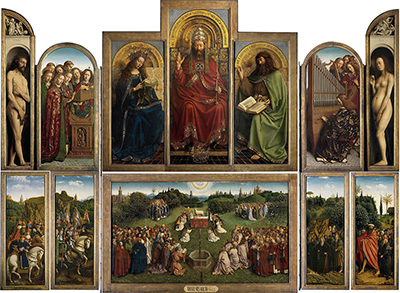
The Ghent Altarpiece joined Jan's work to that of Hubert, who died in 1426. Its frame inscription says Hubert began the undertaking and Jan completed it for Joos Vijd. Saint Bavo's Cathedral records its presentation in 1432 in the chapel of Vijd and Elisabeth Borluut. This was a major commission beyond the ducal household, associated with a donor couple's worship and memorial provision. Its completion places Jan at the centre of one of the largest surviving achievements of early Netherlandish painting without explaining the date of his first involvement.[12]
The division between the brothers is more than a problem of choosing names for a label. KIK-IRPA's lower-register research identifies a developed early painted composition attributed to Hubert beneath Jan's reworking. The latter changed the landscape and placed the monumental fountain over an earlier spring. Such findings make Hubert's contribution more tangible while showing how extensively Jan could revise an existing project. They do not reduce the whole altarpiece to a neat formula in which one brother supplied the design and the other merely applied colour.[13]
Watch: Jan van Eyck in context
Choose a Smarthistory close reading of the Arnolfini Portrait or the closed and opened Ghent Altarpiece.
Jan van Eyck, The Arnolfini Portrait
Look closely at the room, mirror and gestures in the London double portrait.
Watch on YouTubeFor Jan's biography, the altarpiece is a secure landmark with an unresolved prehistory. It links his family, his mature artistic practice and patrons outside the court. The full programme, panel arrangement and later adventures belong to the Ghent overview. Here the essential point is the scale and complexity of the responsibility he brought to completion while remaining Philip's servant. The inscription and scientific evidence provide firmer ground than an imagined account of the brothers' personal relationship during the work.[12][13]
Bruges: house, neighbours and urban work
Jan settled in Bruges in the early 1430s. Museum summaries differ over the precise date of his arrival, while property records make his household and workshop increasingly visible. Musea Brugge describes the city as the base from which he produced the mature works now best known. It was a place of courtly presence, commerce and specialised production, with foreign merchants among its residents. These connections help explain why a ducal painter could find patrons among clerics, traders and other professionals without abandoning his court position.[14]
The location of his premises is now better understood than it was in many older biographies. A Flemish heritage report by Sofie Vanhoutte and Frederik Roelens records old brick walls found during works at Gouden-Handstraat 6, on property associated with Jan from 1431 to 1441. The archaeological discovery does not reveal the contents of his studio or a surviving room in which a particular picture was painted. It anchors the biography to a physical urban site and shows how evidence for an artist's environment can come from building remains as well as documents and pictures.[15]
He also worked for the city. The record of painting and gilding statues for the town hall in the mid-1430s shows activity beyond the portable panels preserved in museums. The older chronology and modern discussions differ over how to count the sculptures and associated work, so the commission is better introduced without forcing one total. What matters is the nature of the job: colour and gilding on public sculpture belonged within the professional life of the same painter who made intimate portraits and devotional images. The city and the court were overlapping spheres of work.[5][8]
Clerical, mercantile and professional patrons
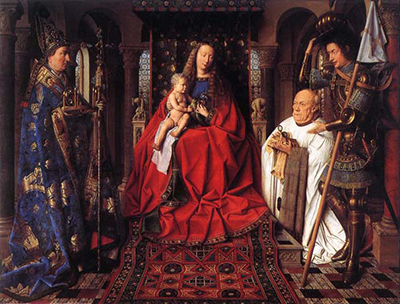
Canon Joris van der Paele's commission makes the urban network particularly concrete. Musea Brugge's original-frame transcription names the donor, the two chaplaincies he founded and completion in 1436 after a commission begun in 1434. The picture brought his identity into a sacred company at Saint Donatian's. For the biography, it demonstrates an important clerical relationship and a substantial undertaking extending across more than one year. The foundation and its continuing worship explain why the donor's presence cannot be reduced to the modern category of a privately owned portrait.[16]
Nicolas Rolin offers a different connection to Burgundian power. As Philip's chancellor, he belonged to the political world that also employed Jan, but the Louvre's painting shows him praying opposite Mary and the Christ Child. Its broad dating around 1430–35 does not establish one day or year in Jan's movements. Nor should Rolin's office make every question about the commission self-evident. The patron is identifiable, while the work's original function and display remain subjects of research. Patronage links can be firm even when the circumstances of a particular encounter are not.[17]
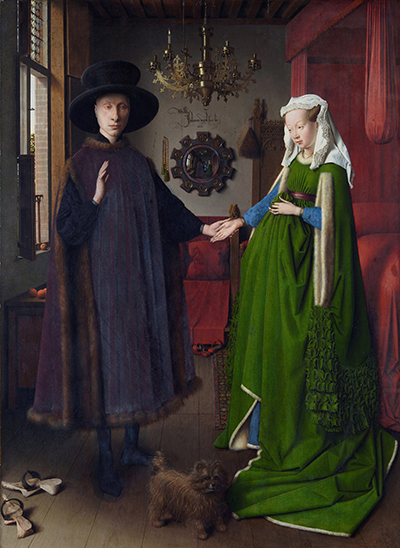
The Arnolfini Portrait, dated 1434, belongs to the mercantile side of Bruges. The National Gallery gives a probable identification of its couple and does not regard a wedding ceremony as securely established. It shows that Jan's portraiture reached the city's international trading community, but cannot be used as an eyewitness record of a named marriage. Its biographical value lies in the range of social relationships his work could address and in the signed date. The competing identifications are examined in the linked painting article.[18]
His picture of the goldsmith Jan de Leeuw adds a fellow craft professional. The portrait's inscription identifies its subject and carries the year 1436; the painted lion plays on his name. Such evidence gives a different kind of access from the uncertain identity of the Arnolfini woman. It also puts Jan's world in contact with the skilled making of precious objects, which belonged to the same city economy as painting. The portrait does not prove that every painted jewel was copied from De Leeuw's work, but it establishes an acquaintance beyond princely and ecclesiastical patrons.[20]
Margareta and the painter's household
Jan's wife is securely identified by the original frame of her portrait in Bruges. Its inscription says her husband completed it on 15 June 1439, when she was thirty-three. The speaking formulation gives her a place in the surviving record that a likeness alone could not supply. It also supports an approximate birth year around 1406, without furnishing a full family history. The panel and its marbled reverse survive as physical evidence of the household, while her maiden name and the circumstances of the marriage remain uncertain.[19]
A marriage around 1433 is often proposed because a child is recorded in 1434, but that is an inference rather than a surviving wedding record. Philip's participation as godfather, represented at the baptism, and his gift of silver vessels make the household's relationship with the court unusually visible. They show favour extending into family life. They do not give a complete list of the children or establish that the infant's name and sex are beyond dispute. A baptismal payment can reveal an important social bond without supplying a modern family register.[6][8]
The domestic picture should therefore be understood through several kinds of evidence together. A dated portrait shows Margareta's age; a court gift records recognition of a child; a later papal entry names the married couple jointly. These are substantial findings for a fifteenth-century family, but they cannot tell us every role she played in the business. Describing her simply as a model understates her historical presence. Describing her as a documented painter or long-term workshop director would require evidence that has not been found.[3][19][27]
Signatures and the dated working life
Inscriptions establish a concentration of surviving work in the 1430s. The National Gallery's Léal Souvenir is dated 10 October 1432; its sitter remains unknown. The date is valuable even without a name, because it fixes one object within a career otherwise known mainly from payments. Its French words of remembrance and simulated stone parapet also show that a portrait's message could extend beyond likeness. They should not be forced into a confident personal story about Jan's relationship with the unidentified man.[21]
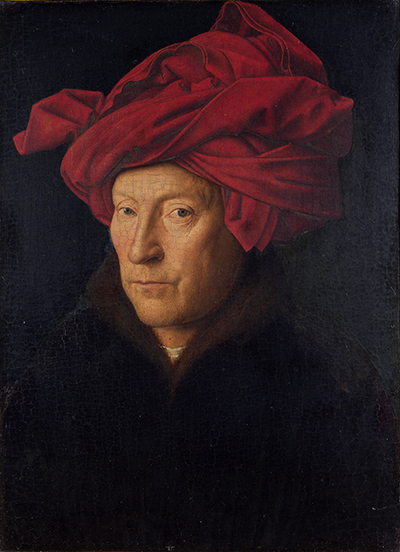
The possible self-portrait of 1433 offers another limit. The original frame records 21 October and carries Jan's motto, but the National Gallery retains a question mark in the sitter's identification. A forceful gaze and apparent use of a mirror make self-portraiture plausible; they do not create an independently verified image of the painter. Estimating his birth date from the face would compound one uncertain interpretation with another. The work is securely a dated statement of authorship, while its biographical portrait identity remains qualified.[22]
His use of language is part of that self-presentation. Leo van Puyvelde's study in the Dutch-language academy proceedings examines the motto, the De Leeuw inscription and the colour notes on the Dresden portrait drawing. The notes matter as practical working evidence: they record distinctions to remember when translating a face into paint. Attempts to derive an exact birthplace or a complete account of his education from spelling go further than the surviving material warrants. The words show an observant and literate craftsman, while their full interpretation has its own scholarly history.[20]
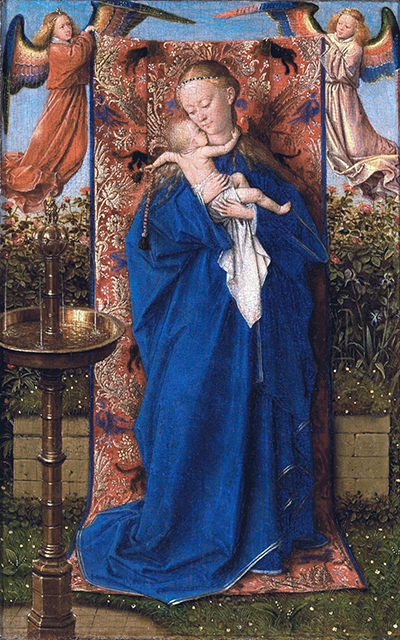
The nearly monochrome Saint Barbara, dated 1437, complicates the idea that an inscribed frame always marks a fully resolved painted surface. KMSKA presents the disagreement over whether the panel is unfinished or was conceived in a monochrome form. For a biography, it belongs among the dated works but cannot supply a story about why Jan abandoned it, if he did. The little Madonna at the Fountain of 1439, with its signed marbled frame, represents another securely dated endpoint in the surviving corpus. These works demonstrate variety within the final decade, not a complete calendar of activity.[23][24]
Assistants and the business after the master
A workshop was part of Jan's documented practice. Campbell records assistants in the Hague years and later in the early 1430s. Preparing supports, handling materials and helping fulfil commissions required an organisation that cannot be reconstructed by looking only for a second painter's style in the finished pictures. Conversely, the fact of a workshop does not justify assigning every uneven passage to a named assistant. The records establish employment and collaboration more readily than they divide the execution of each surviving work.[1][28]
One late commission shows the problem clearly. According to the Frick's research, Jan Vos became prior of the Bruges charterhouse in April 1441 and commissioned the Virgin and Child with saints and himself as donor soon afterwards. Jan laid out the composition; an unidentified member of the workshop completed it after his death. The painting thus belongs to the end of his commissioned career, while its final execution extends beyond his life. Attribution to “Jan van Eyck and workshop” conveys a history that either a wholly autograph label or a wholly later-copy label would lose.[25]
The panel also had an active life after completion. The Frick documents an indulgence secured in 1443 for prayers said before it, connecting its use to Vos's intended memorial. That evidence helps explain why unfinished projects needed completion: patrons wanted effective objects for worship, not simply relics of a deceased painter's hand. The workshop's responsibilities could outlast Jan because a commission had its own religious and social purpose. Its continuing use supplies evidence about the later object, without proving that the original painter controlled every decision made after his death.[26]
The final year, death and burial
A new source places Jan and Margareta together in March 1441. KU Leuven's account of Callewier's discovery explains that the surviving evidence is an administrative entry in the Vatican records, not the letter delivered to the couple. It records their application for a confessional privilege. Its importance is both personal and methodological: the painter appears with his wife outside the financial documents that dominate his biography. The entry adds a religious action taken by the household without telling us that he was already fatally ill.[29]
Callewier's scholarly publication dates the entry to 26 March and explains the permission to choose an appropriately qualified confessor. A papal favour could matter to mobile people and to those concerned about their spiritual provision. The timing near Jan's death has encouraged a possible connection with declining health, but the request does not state a diagnosis. His cause of death remains unknown. Treating the document as proof of plague, or as a psychological confession attached to one of his painted faces, would turn a valuable discovery into speculation.[3][29]
He died in Bruges in 1441 and was buried at Saint Donatian's. Institutions differ over the month and day given in summaries, partly because burial payments and other administrative dates have been used to reconstruct the event. This biography therefore retains the secure year rather than pretending that all published chronologies agree. The later action of his brother Lambert to obtain a different burial location within the church is another sign of family involvement after his death. It also shows how the archive can preserve the care of a grave more clearly than the last weeks of a life.[3][28]
Philip's relationship with the household continued after the painter's death through financial help for the widow. The payment acknowledges Jan's service and her children. It does not by itself establish destitution, or prove the later size of a business under her management. The question of what happened to the workshop has often been answered too confidently from these fragments. Margareta and Lambert had reasons to protect the estate, yet the tasks of supporting a family, completing panels and maintaining a permanent workshop need not have been carried out by the same person.[3][27][28]
Reassessing the posthumous workshop
The strongest recent revision concerns the supposed house called The Wild Sea. In 2022 Jan Dumolyn, Susan Frances Jones, Ward Leloup, Toon De Meester and Mathijs Speecke reassessed property and family evidence. They rejected the old identification of its owner with Jan's widow, strengthened the case for the Gouden-Handstraat premises and proposed that the Bruges workshop closed by spring 1444. They allow a possible role for Margareta in winding down the business, but find no support for the familiar picture of her managing it until about 1450. This is an argued reconstruction, not a surviving closure notice.[27]
The revision changes how later Eyckian paintings should be understood. Similarity to Jan's style does not require a single family workshop operating unchanged for a decade. Former employees, independent followers and other painters could transmit compositions and techniques. Petrus Christus was an important successor in Bruges, but a direct apprenticeship under Jan is not securely documented. The distinction allows influence to be taken seriously without converting every likeness of style into a personal relationship. His impact could continue through objects and working knowledge even when the exact chain of teaching remains uncertain.[27][28]
Reputation, lost works and the later legend
Jan's standing was international early on. Campbell records the Italian humanist Bartolomeo Fazio's praise in 1456, and testimony to works abroad enlarges the range beyond the surviving portraits and devotional panels. Lost secular compositions, including a scene involving bathing women, remind us that the present corpus is not a complete account of his output. Written notices preserve subjects and reception while withholding the original paint, dimensions and full appearance. They can broaden the biography without authorising an imagined visual reconstruction.[1][6]
Attributions and reported inventions have also accumulated around the name. Châtelet's account of Paviot's research describes archival evidence for a globe made by the astronomer Guillaume Hobit, complicating a famous geographical work associated with Jan. That case is worth keeping distinct from the securely documented paintings. A court could bring several kinds of specialist together, and later praise could simplify who did what. Such reports need to be weighed as historical testimony rather than accepted automatically because they add another accomplishment to an already exceptional career.[9]
The most persistent legend credited him with inventing oil painting. Oil had a much longer history. The Met's account explains how early Netherlandish painters exploited its translucent colour, flexible handling and capacity for fine modelling, and how those methods spread through several channels. Jan's achievement does not depend on a single technical invention. It lies in the range of effects and encounters he created through an existing medium, within a professional world of patrons, assistants and material expertise. Replacing the inventor story with that evidence makes the artist's actual work more understandable.[30]
The paintings and drawings guides follow the surviving objects alongside this documentary history. Their dates and inscriptions connect particular acts of making to the court appointments, journeys and household records. The gap between that evidence and Jan's later fame remains substantial, but new archival work continues to narrow it.[1][3]
Related reading
 Jan van Eyck.jpg)
Discussion
What do you notice in Jan van Eyck: Biography? Share a close observation or a source that adds useful context.
Join the Conversation
Keep observations specific and evidence clear.
References
- Lorne Campbell, “Jan van Eyck,” National Gallery catalogue, 1998, online version 2025: origins, family, employment, assistants, signatures and early reputation. View Source
- National Gallery, London, “Jan van Eyck”: documented career and uncertain origins. View Source
- Hendrik Callewier, “A new document on Jan van Eyck: his request for a confessional letter in the Vatican Archives,” Simiolus 43 (2021), pp. 16–25, author-posted full text: joint petition, origins, household and final records. View Source
- Jos Koldeweij, review of Anne-Maria van Egmond's study of the Hague court, Oud Holland/RKD, May 2022: accounting evidence and alternative readings of payments. View Source
- INHA, AGORHA, “Jan van Eyck”: institutional career and civic-work record. View Source
- Till-Holger Borchert, “Jan van Eyck,” Flemish Art Collection chronology: court, travels, Bruges and family. View Source
- Museo Nacional Thyssen-Bornemisza, “Eyck, Jan van”: court employment, Lille and Portuguese mission. View Source
- J. Cyril M. Weale, Van Eyck, “Period of Great Endeavour,” historical account available through Project Gutenberg: ducal intervention and civic work. View Source
- Albert Châtelet, “Du nouveau sur Jan Van Eyck,” Bulletin Monumental 153 (1995), pp. 80–81: discussion of Jacques Paviot's archival findings. View Source
- Bart Fransen, “Jan van Eyck y España. Un viaje y una obra,” Anales de Historia del Arte 22 (2012), pp. 39–58, especially pp. 40–42: embassy narrative and limits of travel-based attribution. View Source
- Ministère de la Culture, POP/Joconde, “Portrait présumé d'Isabelle de Portugal,” notice 01370005168: later Dijon copy and disputed identification. View Source
- Saint Bavo's Cathedral, “The Ghent Altarpiece”: donors, frame attribution and 1432 presentation. View Source
- KIK-IRPA, “The mystery of Hubert van Eyck and the Ghent Altarpiece solved”: lower-register painted stages. View Source
- Musea Brugge, Van Eyck in Bruges press dossier, 2020: workshop and local context. View Source
- Sofie Vanhoutte and Frederik Roelens, Brugge, Gouden-Handstraat 6, Onroerend Erfgoed report 247, 2022, official publication record: archaeological discovery at the painter's property. View Source
- Musea Brugge, “Madonna with Canon Joris van der Paele,” 0000.GRO0161.I: donor, chaplaincies and frame dates. View Source
- Musée du Louvre, “La Vierge du chancelier Rolin,” INV 1271: patron, dating and devotional encounter. View Source
- National Gallery, London, “The Arnolfini Portrait,” NG186: probable sitters, date and revised wedding interpretation. View Source
- Musea Brugge, “Portrait of Margareta van Eyck,” 0000.GRO0162.I: original frame, age and completion date. View Source
- Leo van Puyvelde, “De taal van Jan van Eyck,” academy proceedings, 1955, via DBNL: motto, De Leeuw inscription and portrait-drawing notes. View Source
- National Gallery, London, “Portrait of a Man (Léal Souvenir),” NG290: date, inscription and unknown sitter. View Source
- National Gallery, London, “Portrait of a Man (Self Portrait?),” NG222: qualified identity and dated original frame. View Source
- KMSKA, “Saint Barbara,” 410: date and disputed finish. View Source
- KMSKA, “Madonna at the Fountain,” 411: 1439 panel and frame. View Source
- Frick Collection, “The Charterhouse of Bruges: Jan van Eyck, Petrus Christus, and Jan Vos,” exhibition research: 1441 commission and workshop completion. View Source
- Frick Collection, Charterhouse exhibition introduction: 1443 indulgence and the panel's memorial use. View Source
- Jan Dumolyn, Susan Frances Jones, Ward Leloup, Toon De Meester and Mathijs Speecke, “Margaret van Eyck, a house called ‘The Wild Sea’ and Jan van Eyck's posthumous workshop,” The Burlington Magazine 164 (2022), pp. 120–30, institutional repository copy: property and family reassessment. View Source
- Susan Jones, “Jan van Eyck (ca. 1390–1441),” Metropolitan Museum of Art, 2002: court status, assistants, Lambert and Petrus Christus. View Source
- KU Leuven Kulak, report on Hendrik Callewier's Vatican discovery, 2021: distinction between administrative entry and missing letter. View Source
- Susan Jones, “Painting in Oil in the Low Countries and Its Spread to Southern Europe,” Metropolitan Museum of Art, 2002: earlier use of oil and transmission of technique. View Source
 Jan van Eyck.jpg)