


 Buy Art Prints Now
from Amazon
* As an Amazon Associate, and partner with Google Adsense and Ezoic, I earn from qualifying purchases.
 by Tom Gurney
Tom Gurney BSc (Hons) is an art history expert with over 20 years experience
Page Created on June 19, 2020 / Page Updated on November 1, 2026
Email: tomgurney1@gmail.com / Phone: +44 7429 011000
Vera Icon: the Bruges witness to a lost Van Eyck Holy Face
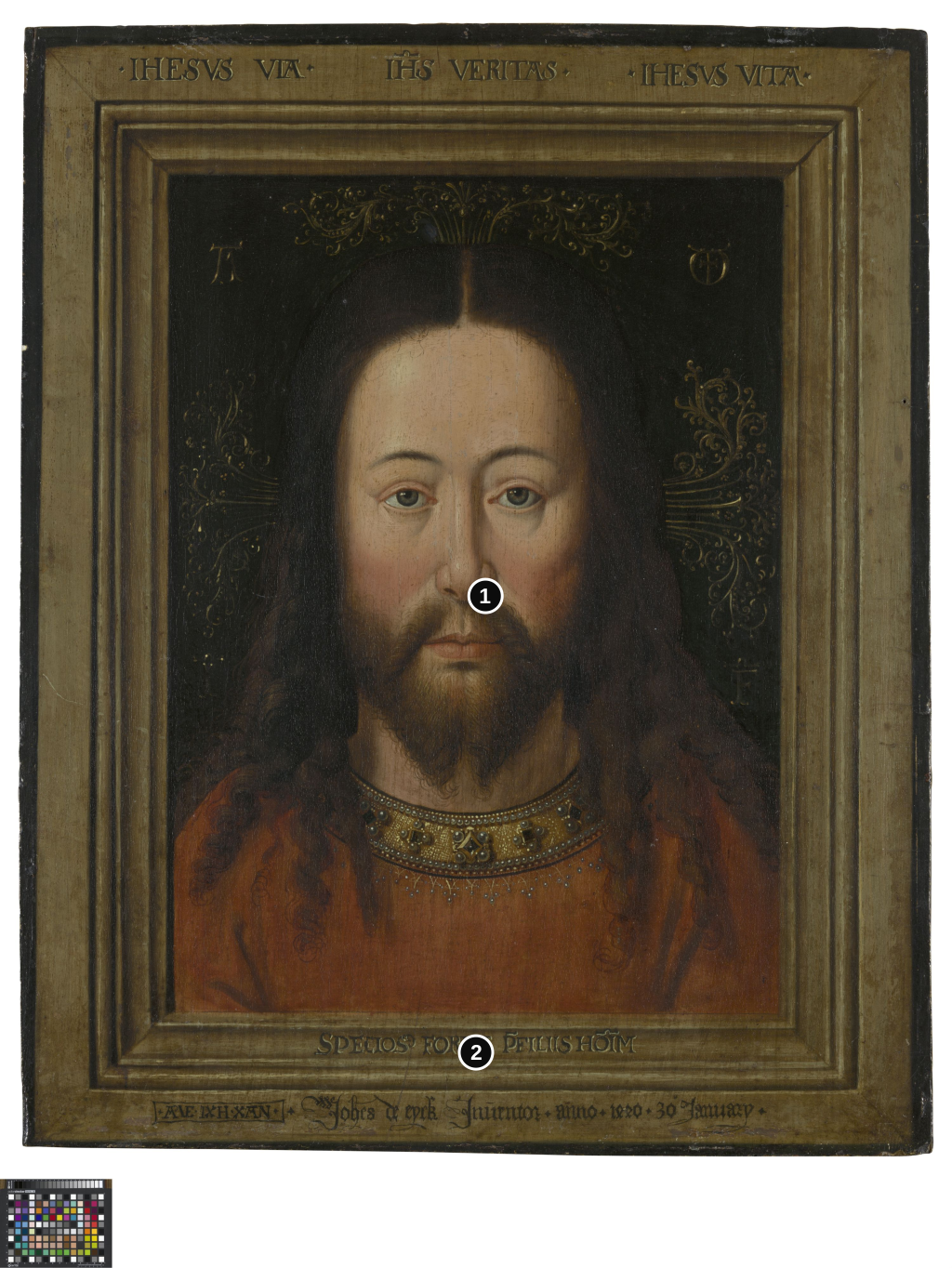
Christ looks directly out of the Bruges Vera Icon, surrounded by words that identify him and name Jan van Eyck as the design's inventor. Yet this is not a surviving painting from Jan's lifetime. Musea Brugge catalogues it as an anonymous copy after him, made about 1601–25. Its painted date, 30 January 1440, belongs to the claim about a lost model.[1]
The distance between model and copy gives the picture its particular interest. A face intended to convey an enduring sacred presence also preserves the reputation of an earlier artist. Looking carefully involves both encounters: Christ's gaze towards the viewer and a later painter's attempt to carry an Eyckian invention forward. The surviving object can be examined; the missing work it invokes cannot.
At a Glance
Annotated Details from Vera Icon: the Bruges witness to a lost Van Eyck Holy Face
These views show Musea Brugge's seventeenth-century copy. Its painted claim about Jan van Eyck refers to a lost earlier design. Match the numbered points to the details below.
Details from VERA ICON: THE BRUGES WITNESS TO A LOST VAN EYCK HOLY FACE
Select a detail to enlarge it. Return to the numbered overview to find its position.
Face and gaze
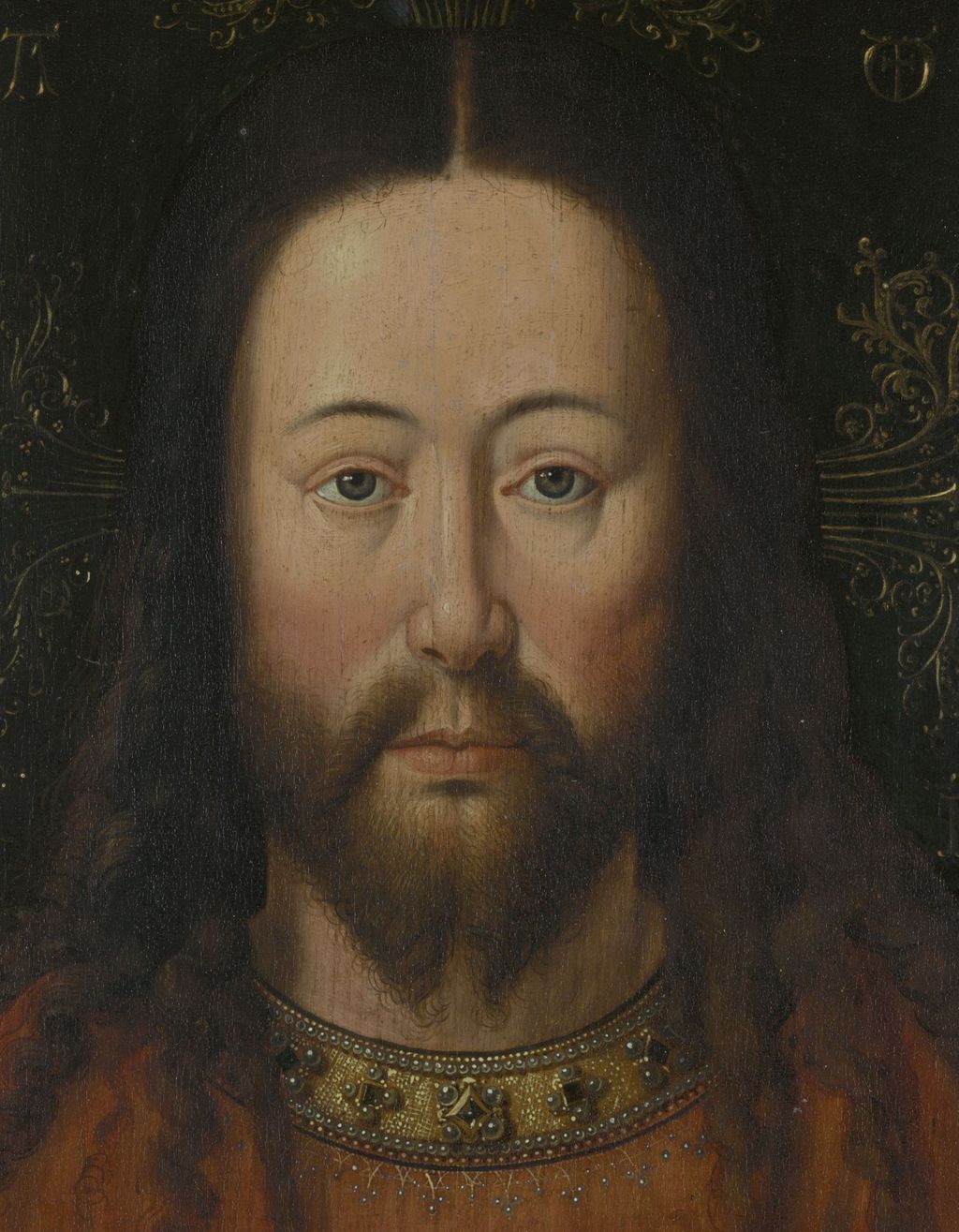
The direct gaze, parted hair and divided beard belong to the surviving anonymous copy. Musea Brugge relates this idealized face to the Letter of Lentulus.
Painted frame and date
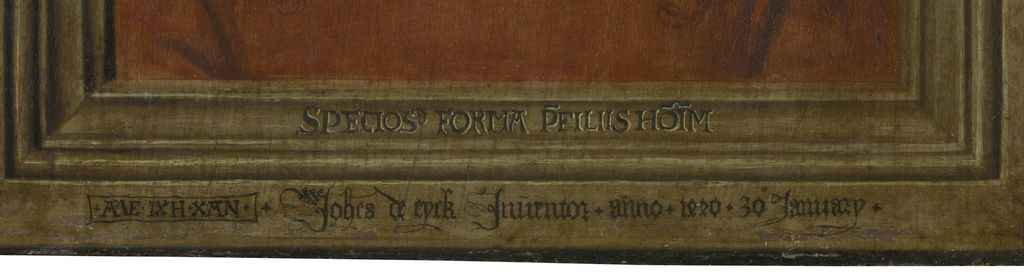
The border names Jan the inventor and gives 30 January 1440 for the claimed lost model. It does not date the surviving seventeenth-century copy; institutional records give different ranges.
The panel and its different dates
The Groeningemuseum's inventory number is 0000.GRO0206.I. Its record specifies oil on oak, 33.2 by 26.9 centimetres overall, and a reverse ownership mark reading PS with 1637. The front's 1440 inscription, the museum's production range and the reverse date concern different events.[1]
There is a further discrepancy in institutional dating. M Leuven's work list for Dieric Bouts. Beeldenmaker gives the Musea Brugge loan as 1635–37, later than the online collection record's 1601–25. Both place it in the seventeenth century. The exhibition list does not explain the revised range, so it should not be silently substituted for the owning museum's date or used to identify the initials PS.[2]
A practical consequence follows when identifying reproductions. The Bruges face wears a jewelled neckline; related copies in Munich and Berlin have lettering on the garment instead. They also carry different border texts. The opening image and the enlarged view on this page show the Bruges panel, allowing its inscriptions to be followed as parts of one identifiable object.
An imagined likeness
The face is almost rigorously frontal, but its effect depends on small variations within that arrangement. Light moves across the forehead, nose and cheeks rather than flattening them into a single pale shape. Dark hair encloses the skin on both sides. Against that dark field, the eyes and narrow mouth become unusually prominent; little outside the head competes with their stillness.
The beard divides beneath the chin, repeating the central parting above the forehead. Long locks descend towards the shoulders, while the rounded neckline closes the figure below. The face therefore sits within several nested boundaries: hair, garment, ornament and the broad painted border. Each brings the gaze back inward. There is no gesture, open book or surrounding episode to redirect attention towards an unfolding story.
John Oliver Hand relates this kind of face to the apocryphal Lentulus letter and a comparable description in Ludolph of Saxony's Life of Christ. Parted hair, an unblemished brow and a divided beard belong to a transmitted ideal of Christ's appearance. The letter is a medieval text claiming ancient authority, not an eyewitness record from the Roman administration. Its relevance concerns the construction of a recognisable sacred likeness.[3]
An inherited formula need not produce an impersonal image. Here the visible modelling of eyelids, cheeks and lips encourages the response normally given to a portrait: a sense that a particular presence faces us. The paradox is productive. A face with apparently individual features presents an identity already supplied by words and tradition, rather than by a documented encounter between painter and sitter.
Reading the border
Musea Brugge transcribes the upper declaration of Jesus as way, truth and life, the lower praise of his beauty, the motto associated with Jan, and the name Johannes de Eyck followed by Inventor. Alpha and omega also appear above the head. These inscriptions combine devotional identification with a statement about the origin of the design.[1]
The upper words recall John 14:6, while the beauty formula echoes Psalm language applied to Christ. They make the border part of contemplation rather than a neutral edge. A viewer can move from face to text and back again, relating the appearance of the man to the sacred qualities the words assert. The image invites sustained attention without supplying a narrative scene.
The word Inventor is especially revealing. It credits the devising of a composition, leaving room for another hand to execute this surviving version. Read in a seventeenth-century painting, Jan's name does not operate like a newly authenticated signature on his own material surface. Likewise, the copied date cannot by itself establish the lost model's original support, dimensions or exact appearance.
The imitation mouldings make that distinction harder to notice at first. Bright edges and adjacent shadows create the impression of a substantial enclosure, while the lettering seems integrated into its structure. Image and written testimony acquire a single visual authority. The border's convincing appearance is something the copyist achieved; it is not independent verification that every word was transcribed unchanged from a fifteenth-century frame.
The mark on the back has a more limited role. It concerns ownership of this later panel, whereas the front reaches back to Jan. The public object record supplies no identification of PS or continuous provenance connecting the two periods. Initials can anchor a question without answering it. Assigning them to a named collector would require evidence beyond the resemblance of letters.
A “true image” without a miraculous cloth
The conventional title Vera Icon means “true image.” Hand distinguishes the overlapping traditions of Veronica's Holy Face, the Passion-associated veil and the eastern Mandylion of Edessa. Their legends concern a likeness miraculously impressed on fabric. He also traces Holy Face images accompanying prayers and indulgences, showing why repeated likenesses could matter as devotional objects. These traditions are historical contexts for a painted panel, not proof that it is itself a contact relic.[3]
Watch: Jan van Eyck in context
Choose a Smarthistory close reading of the Arnolfini Portrait or the closed and opened Ghent Altarpiece.
Jan van Eyck, The Arnolfini Portrait
Look closely at the room, mirror and gestures in the London double portrait.
Watch on YouTubeThe distinction is visible here. The Bruges painter presents Christ's neck, clothed shoulders and ornamental surroundings; no woman holds a veil and no fabric is shown carrying an imprint. The picture employs the directness associated with a sacred likeness while remaining a deliberately made image. Its material identity as oil on wood and its devotional claim need not be confused.
London's National Gallery places the lost Eyckian Holy Face within the development of close devotional images that circulated north and south of the Alps. Its account of Benedetto Diana's Christ Blessing also acknowledges much older representations of Christ. Jan's importance concerns a particular influential presentation, not the invention of Christ portraiture. Diana's later blessing figure demonstrates how the broader tradition could develop beyond a simple frontal head.[4]
The Bruges copy's compactness supports intimate viewing, but format alone does not establish its first setting. A small panel could be moved, owned, displayed or used in several ways. Without a commission or early inventory securely identifying this object, a specific private chapel, patron or devotional routine should remain unassigned.
Different copies preserve different claims
Berlin's Gemäldegalerie has a related Holy Face, catalogue 528. Its 2023 exhibition list dates the actual oak painting about 1500, while its copied inscription gives 31 January 1438, rendered there as 1439 in modern reckoning. The museum explicitly leaves open whether the panel faithfully repeats a Jan original or is a later creation in his style. Its uncertainty should accompany the attractive early date.[5]
Berlin's 2021 Solly exhibition label is equally instructive about reception. Around 1820 the picture was admired as an original, apparently validated by Jan's signature and motto. The label now calls it a copy of about 1500–20 and suggests that even the inscription could be a pastiche. A statement once accepted as authentication has become part of the evidence requiring explanation.[6]
Hand's discussion separates the Bruges and formerly Swinburne versions bearing a 1440 claim from a Berlin–Munich group carrying a 1438 date. His notes also report a lost-frame inscription associated with the Swinburne picture. This is testimony about another witness, not direct access to the missing frame. The different groups should not be merged into a single unchanged reproduction.[3]
The resulting picture of transmission is more useful than a tidy family tree with every connection made certain. A copy can repeat a face while modifying clothing, wording or presentation. Two panels can share a model without sharing a date of execution. The survival of several versions broadens the evidence, but no amount of agreement between later objects restores the lost original's paint for examination.
New evidence from Spain
Manuel Parada López de Corselas and Jesús Folgado García's 2020 study identifies a related panel in Segovia's church of San Millán and a Holy Face miniature in an Ávila choirbook of 1470–72. They associate both with the jewelled-neckline group represented in Bruges. Their discussion of the documented Flemish Holy Face at El Parral proposes a route for transmission, rather than establishing a continuous provenance for the Bruges object.[7]
The same authors propose an alternative source for the Eyckian design: the Shroud then associated with Lirey, rather than the Roman Mandylion. They connect this hypothesis with Burgundian relic politics and a possible journey by Jan. These remain proposals; the article does not produce a commission showing that he painted the Holy Face after inspecting the Shroud. The distinction between suggestive historical setting and a documented act of making is essential.[7]
The Spanish comparisons give the copy history geographical and material substance. A design could be adapted in another region and another medium rather than merely duplicated. The relevant question becomes which features were retained, changed or newly emphasised. This makes the neckline, lettering and framing useful evidence: they are small details through which differing routes of reception can be tested.
French institutional research supplies a useful parallel without making every Holy Face Eyckian. The Louvre's account of its Valencian panel of about 1450 describes a Holy Face on one side and the Virgin on the other, probably carried in processions. It relates the work to Byzantine-derived devotion, local Valencian models and Flemish innovations in modelling. This is a different surviving object with a different physical history, not proof that Jan's lost panel formed a diptych.[8]
Petrus Christus changes the encounter
Petrus Christus's Head of Christ, about 1445, now at the Metropolitan Museum of Art, offers another kind of response. The museum connects it to Jan's lost Holy Face, but Christus adds thorns, blood and a furrowed brow. Its oil-painted parchment is laid on wood, unlike the Bruges copy's oak-panel description. A fictive frame still brings the face close to the viewer.[9]
That change alters what the viewer is asked to contemplate. In Bruges, the smooth brow and elaborate neckline give the face a stately calm. In Christus, the visible injuries bring suffering into the encounter. Both can be compelling devotional images, but the resemblance does not make Christus's painting an exact record of Jan's missing work. Adaptation can be evidence of a model's importance precisely because it changes the model.
The two works also differ chronologically as surviving objects. Christus's fifteenth-century response predates the Bruges panel by well over a century. A later copy can preserve a design that an earlier adaptation already transformed. It is therefore useful to distinguish the age of a panel from the age of the composition it represents, rather than arranging all related faces as if each had been copied from its nearest surviving predecessor.
What remains open
The Van Eyck paintings guide treats the Bruges Vera Icon as evidence for a lost design. That is its strongest position within the cluster. The panel preserves a face, ornamental choices, devotional texts and an explicit claim of Eyckian invention. Its own seventeenth-century dating remains separate from the date it attributes to the model. Compare the different later witnesses to the lost Maelbeke Madonna and Woman Bathing, then the surviving original frame of the Madonna at the Fountain. Each requires its own distinction between object and transmitted design.
Several questions cannot presently be answered from these witnesses: who commissioned Jan's image, where it first stood, how faithfully the Bruges painter repeated its inscriptions, and whether all related versions derive from two originals or a more complicated process. The surviving copy's layers and paint handling cannot be used as direct scientific evidence about Jan's absent surface. Research can sharpen the distinctions without making the missing object physically available.
For close looking, return to the eyes, then move outward through the beard, jewelled collar and lettered border. Each contributes a different kind of authority: bodily presence, sacred recognition and the name of an admired painter. The Bruges panel brings them together in an image that continued to matter long after Jan's death, while keeping the lost invention just beyond direct reach.
Related reading


Discussion
What do you notice in Vera Icon: the Bruges witness to a lost Van Eyck Holy Face? Share a close observation or a source that adds useful context.
Join the Conversation
Keep observations specific and evidence clear.
References
- Musea Brugge, Vera Icon, Groeningemuseum 0000.GRO0206.I; Dutch object description, dimensions, inscriptions, reverse mark and dating — View Source.
- M Leuven, Dieric Bouts. Beeldenmaker, exhibition work list, Musea Brugge loans, PDF p. 3; alternative 1635–37 dating — View Source.
- John Oliver Hand, “Salve sancta facies: Some Thoughts on the Iconography of the Head of Christ by Petrus Christus,” Metropolitan Museum Journal 27 (1992), pp. 7–18, especially pp. 10, 12, 14, 16–18 — View Source.
- National Gallery, Benedetto Diana, Christ Blessing, NG2725; full relevant overview and in-depth account of Holy Face transmission — View Source.
- Staatliche Museen zu Berlin, Zoom auf van Eyck, exhibition work list (2023), PDF p. 3, catalogue 528 — View Source.
- Staatliche Museen zu Berlin, Solly collection exhibition labels (2021), PDF p. 30, catalogue 528; copy attribution and possible pastiche inscription — View Source.
- Manuel Parada López de Corselas and Jesús Folgado García, “Jan van Eyck's Holy Face, the Holy Shroud, and Spain,” Colnaghi Studies Journal 7 (October 2020), pp. 22–41, especially pp. 25–31 and notes 10, 23–40; RKD-hosted issue — View Source.
- Musée du Louvre, “Le musée du Louvre acquiert un exceptionnel ‘primitif’ espagnol: Sainte Face et Vierge en buste” (July 2020), French account of a separate Valencian panel and its probable processional use — View Source.
- Metropolitan Museum of Art, Petrus Christus, Head of Christ (Ecce Homo), about 1445, accession 60.71.1; relationship to the lost Eyckian model and material details — View Source.


 Jan van Eyck.jpg)
 Jan van Eyck.jpg)


