


 Buy Art Prints Now
from Amazon
* As an Amazon Associate, and partner with Google Adsense and Ezoic, I earn from qualifying purchases.
 by Tom Gurney
Tom Gurney BSc (Hons) is an art history expert with over 20 years experience
Page Created on June 19, 2020 / Page Updated on November 1, 2026
Email: tomgurney1@gmail.com / Phone: +44 7429 011000
The lost Madonna of Nicolas van Maelbeke
Mary stands beneath a vaulted portico, holding Christ while a richly vested churchman kneels nearby. Beyond the architecture, a landscape opens into the distance. This is the broad design associated with Jan van Eyck's Madonna of Nicolas van Maelbeke, a painting formerly in Ypres and now lost. Its appearance must be approached through surviving drawings, later painted versions and written descriptions. None is interchangeable with an original panel that we can examine today.[1][2]
The distinction becomes especially important when the composition is illustrated in colour. The large triptych in Bruges was adapted for Petrus Wijts centuries after Van Eyck's lifetime. The early silverpoint drawings record selected features on paper. The engraving reproduced on this page belongs to the circle of the Brothers Wierix, about 1575–85. These witnesses preserve the design's influence while leaving its original paint, full colour and exact authorship beyond direct inspection.[1][3][9]
At a Glance
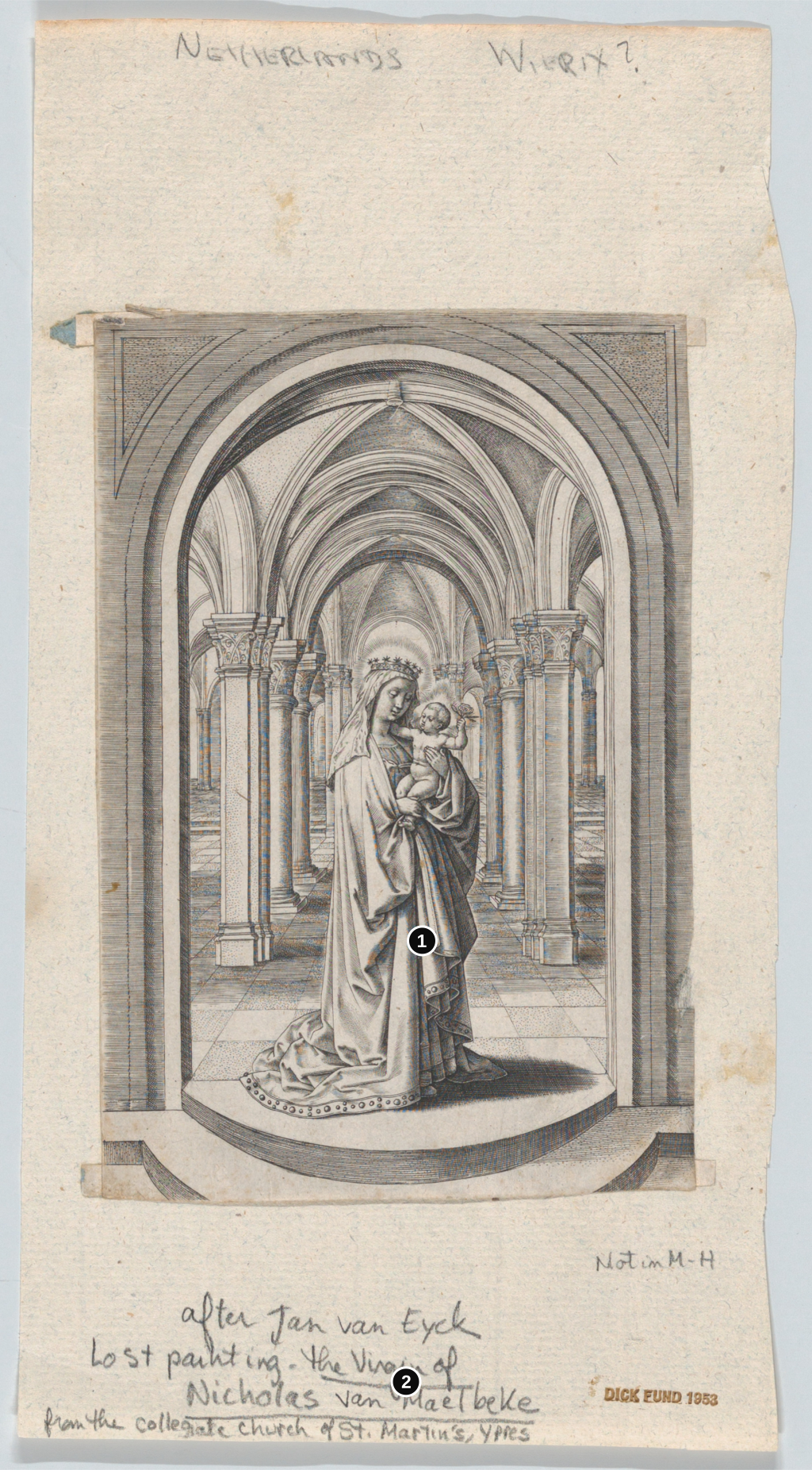
Annotated Details from The lost Madonna of Nicolas van Maelbeke
This 1575–85 engraving by the circle of the Brothers Wierix, now at the Met, is a later witness to a lost commission, not Jan's original painting or the Albertina silverpoint. Match the numbered points to the details below.
Details from THE LOST MADONNA OF NICOLAS VAN MAELBEKE
Select a detail to enlarge it. Return to the numbered overview to find its position.
Central figure
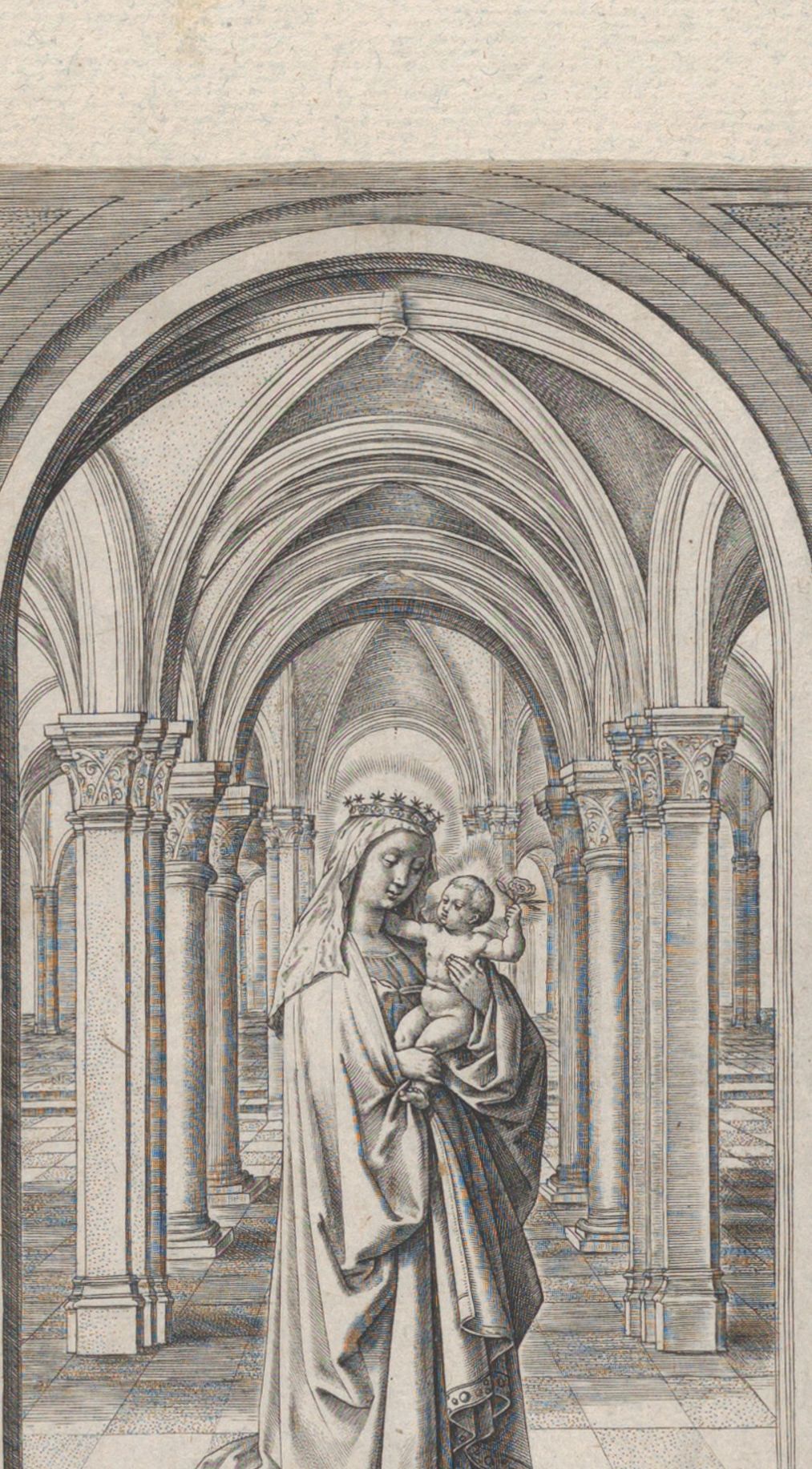
The engraved Virgin under Gothic arches preserves an idea of the lost design, with details mediated by a later printmaker.
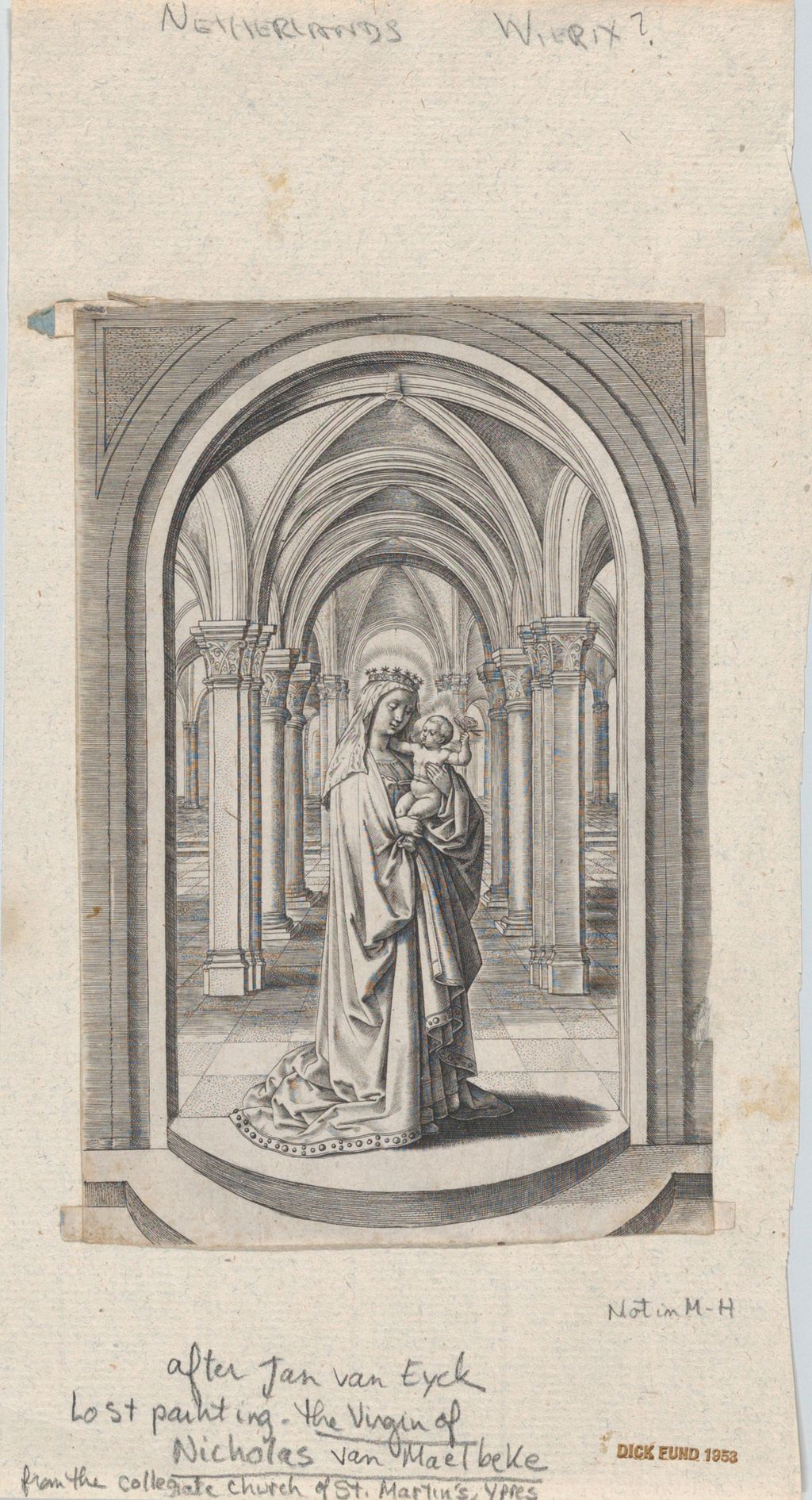
Printed sheet
The whole sheet shows the print as documentary evidence for a lost composition, not an extant van Eyck panel.
A churchman seeking remembrance
Nicolas, also written Nicolaes or Nikolas, van Maelbeke was provost of Saint Martin's in Ypres. The Frick Collection places his lost picture among Van Eyck's memorial commissions: images in which a donor's likeness before Mary and Christ could sustain remembrance and invite prayer. Such a function joins a portrait to an enduring petition. The person remains visibly present within a sacred encounter after his earthly life has ended.[2]
The surviving Van der Paele Madonna helps explain that ambition, but Maelbeke's commission had its own setting and history. A memorial could be planned while its patron was alive. Maelbeke's death in 1445 therefore does not establish when Jan painted the image or when it first reached Ypres. Nor does the memorial category, by itself, recover a lost frame inscription or determine every detail of its mounting.[2][5]
Older museum accounts commonly place the project around 1439–40 and describe it as Van Eyck's last, unfinished painting. More recent scholarship questions how securely those familiar claims follow from the surviving evidence. It remains a work associated with the end of his career, but “unfinished at his death” should not be treated as an observation made on a surviving original.[1][5]
Was the painting left unfinished?
A 2022 study by Jan Dumolyn, Susan Frances Jones and colleagues distinguishes the centre from the wings attached to it. Marcus van Vaernewyck's sixteenth-century description calls the wings unfinished; it does not necessarily establish that Jan's central painting was incomplete. The authors also question whether those wings were themselves by Van Eyck. A statement about one component cannot automatically describe the production of the whole ensemble.[5]
The two early drawings provide another disputed argument. Both describe Mary and the architecture more fully than the donor and landscape. Some scholars have understood them as records of a painting still being completed in the workshop. Others interpret the omissions as deliberate selection from a finished model. Their uneven detail cannot, without further evidence, supply a dated report on the original's state.[5]
The same study rejects 1445 as a secure completion date. Its association with the painting rests on a late eighteenth-century Ypres chronicle by Petrus Martinus Ramaut, published through Liévin de Bast in 1825. The authors consider that testimony unreliable for dating completion and argue that the picture was finished before 1444, potentially within Jan's lifetime. This is a revision of the historical argument, not a new discovery of the missing panel.[5]
The responsible account therefore leaves open how much, if anything, was finished after Jan's death in 1441. The lost work remains important to discussions of his workshop, but it cannot prove a prolonged continuation under a particular successor. Its reputation as a final masterpiece and the evidence for its manufacture have to be considered separately.
Two drawings, two acts of looking
The Albertina sheet in Vienna measures 27.8 by 18 centimetres. The Frick's 2018 exhibition attributed it cautiously to Petrus Christus, after Jan van Eyck and workshop, and dated it about 1445. The Ghent exhibition's published captions instead identify an anonymous southern Netherlandish maker and give approximately 1450. Both descriptions concern a drawing after the composition, rather than an autograph sheet securely signed by Jan or Christus.[3][6]
A second drawing in the Germanisches Nationalmuseum, Nuremberg, is much smaller, 13.4 by 10.2 centimetres; Ghent dated it about 1445–50. Their importance lies partly in this early transmission. Artists found the pose and architecture worth recording close to the period of the lost work, at different physical scales. The existence of two sheets also permits comparison of choices that a single witness might conceal.[6]
The Vienna draughtsman followed the deep folds of Mary's mantle and the constructed architecture with particular attention. Most of the donor material and the landscape were omitted. The Frick explains this as a selective practice familiar in fifteenth-century workshops. A useful model could preserve forms for later use without duplicating every part of a painting. An omission in the copy is consequently not proof of absence in its source.[3]
The drawn folds give Mary's body weight; the architecture provides a setting through which that weight can be understood. Fine metalpoint lines make contours, turns and shadows available for study. They cannot return the oil picture's colour relationships or distinguish its final glazes. Looking at the sheets as drawings allows their own precision to emerge while keeping the qualities of the missing painted surface unreconstructed.
The Wijts triptych in Bruges
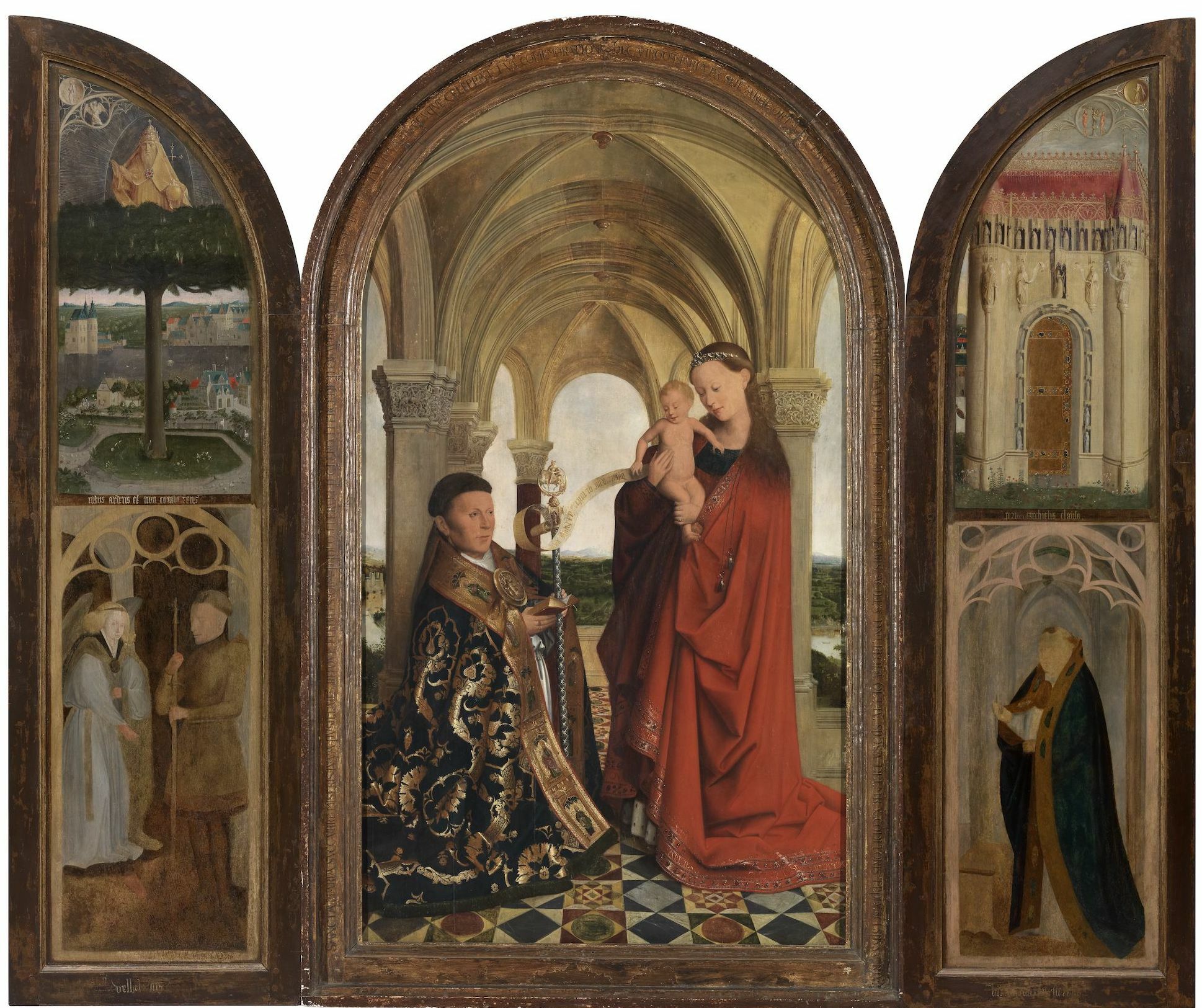
The coloured triptych now associated with Musea Brugge records a further stage in the design's life. Its central panel was made for Petrus, or Pieter, Wijts, canon and cantor at Saint Martin's, in the first half of the seventeenth century. An anonymous painter replaced the earlier donor with Wijts and substituted a cantor's staff for a provost's. The image served a new person's commemoration within the same church community.[1]
Watch: Jan van Eyck in context
Choose a Smarthistory close reading of the Arnolfini Portrait or the closed and opened Ghent Altarpiece.
Jan van Eyck, The Arnolfini Portrait
Look closely at the room, mirror and gestures in the London double portrait.
Watch on YouTubeThis substitution is more than a small correction to a face. Office, identity and devotional purpose were renewed together. A prestigious older composition supplied the framework, but the kneeling figure addressed a different future audience. Wijts's likeness is evidence of that later commission. It cannot be used as a reliable portrait of Maelbeke, even where the surrounding architecture appears to preserve the earlier design closely.
The open triptych shows Mary standing at the right of the centre, with the donor kneeling at the left. Her long red garment forms a broad descending shape beside his patterned vestment. Vaults connect the figures above, while openings carry the eye towards the distant landscape. These are visible features of the surviving painted witness. They give an intelligible arrangement to compare with the drawings, without restoring Jan's original colours or handling.
Scale reinforces the difference between the witnesses. Ghent gives the later centre as 172 by 99 centimetres, with shutters 172 by 41 centimetres. This is a substantial painted object beside the small silverpoints. Its dimensions make the design's potential monumentality understandable, but they measure the surviving copy. They cannot be adopted as exact dimensions of the lost Van Eyck without an independent record.[6]
The object also has a layered history. Ghent's 2019 exhibition captions date its centre to the first half of the seventeenth century and its outer panels to the first half of the sixteenth. That division matters: the surviving ensemble should not be given one undifferentiated date, still less treated as three preserved panels by Van Eyck. Its components require their own examination.[6]
What the wings say about Mary
Art in Flanders identifies the internal scenes as the burning bush and Gideon on the left, with Ezekiel's closed gate and Aaron on the right. The exterior shows Emperor Augustus's vision of Mary and Christ amid musical angels. The programme centres on Mary's virginity and her role as an intercessor for Wijts. Open and closed, the object presents different routes towards the same principal sacred figure.[7]
The burning bush offers an image of something bearing divine presence without being consumed. The closed gate supplies another language of passage and preservation. Gideon's fleece and Aaron's flowering rod likewise belong to the older biblical imagery through which Christian viewers interpreted Marian subjects. Their value within the triptych is relational: the side scenes frame the central mother and child through events read as anticipations.[7]
Borchert's 2007 Bruges study reproduces Van Vaernewyck's description of the Ypres work, naming the four inner-wing subjects and noting their unfinished state. The written record therefore supports more than a modern guess made from the surviving Wijts ensemble. Yet it still does not establish who painted the original attached wings, when they were joined to the centre, or whether their appearance matched every later detail.[4][5]
The exterior's vision adds another change of viewpoint: a ruler encounters a sacred apparition rather than a churchman kneeling immediately beside Mary. That programme can be studied securely on the later object. Assigning its exact arrangement, inscriptions or finish to Jan requires evidence beyond the copy's persuasive completeness. The distinction between an identifiable subject and an identifiable painter remains essential.
A copy once celebrated as the original
The history of attribution shows how convincing the later triptych could be. A 1930 article by J. Dochy in Biekorf, preserved by the Dutch Digital Library for Literature, welcomed its cleaned appearance as Van Eyck's last work. It described colour, landscape and supposed unfinished passages as evidence for the master's late technique. Today the article is valuable testimony to an earlier belief, rather than a technical account of an authenticated Van Eyck.[8]
Scientific evidence changed that belief. Borchert reports that investigation by KIK-IRPA in Brussels established that the central panel's wood could not support a fifteenth-century date: its earliest possible use fell in the late sixteenth century. Removing overpaint could reveal an earlier layer of this object without making it Jan's original. The age of its support imposed a limit that stylistic enthusiasm could not overcome.[4]
The donor portrait has itself undergone repeated alteration. Art in Flanders records numerous overpaintings and the removal of the latest intervention in the 1970s. The visible face is therefore part of the copy's conservation history as well as its devotional purpose. It should not be treated as an untouched likeness whose identity was always transparent.[7]
The copy's documented later route also reaches France and Britain. Borchert's acquisition study lists it in a Paris private collection in 1937, subsequently with the Earl of Warwick at Warwick Castle, and later in another British private collection. The Flemish Art Collection records its acquisition for Bruges at a London auction. These movements belong to the Wijts object, whose identity can be traced through changing attribution. They offer no evidence that Jan's missing panel followed the same route.[1][4]
This is why the copy retains value after losing an autograph attribution. It preserves a monumental design and documents the authority Van Eyck's composition carried for another patron. It also shows how restoration, ownership and scholarship changed what viewers thought they possessed. Those histories belong to the surviving triptych; they do not fill the missing original's conservation record.
Prints, influence and disappearance
The Met's engraving provides a different kind of access. Its current record assigns it to the circle of the Brothers Wierix, after Jan van Eyck, about 1575–85. The trimmed sheet measures 16.7 by 11.3 centimetres. It is a printed interpretation made more than a century after Jan's death, not either early silverpoint drawing and not the original painting. Its line and portable sheet belong to a later means of circulating the composition.[9]
Petrus Christus's Exeter Virgin offers another route of transmission. The Frick connects its architecture and Marian grouping with the Maelbeke design, while making the Vienna drawing's possible authorship by Christus conditional. Resemblance can establish a productive artistic relationship without documenting Christus as Jan's assistant or naming him as the person who finished the Ypres work.[2][3]
The original's later fate remains incomplete. Bruges research follows written reports of it in Ypres over subsequent centuries and places its disappearance during the upheavals of French occupation near the end of the eighteenth century. That broad account is not a witnessed destruction or a recoverable last transfer. The later triptych's ownership history must not be silently substituted for the missing work's journey.[4]
What can be recovered is substantial: a patron and commemorative purpose, a commanding Marian design, an early interest in its forms, and a long history of adaptation. The strongest account also recognises where the strands separate. A selective drawing, an altered memorial for Wijts, a later print and a chronicle each preserve something different. Together they keep the Maelbeke Madonna within Van Eyck's history while allowing the original to remain honestly lost.
Related reading


Discussion
What do you notice in The lost Madonna of Nicolas van Maelbeke? Share a close observation or a source that adds useful context.
Join the Conversation
Keep observations specific and evidence clear.
References
- Flemish Art Collection, “Groeningemuseum presents new acquisition: the Wijts Triptych”; later donor, changed staff, commemorative function and surviving copy. View Source.
- The Frick Collection, The Charterhouse of Bruges: Jan van Eyck, Petrus Christus, and Jan Vos, 2018 exhibition press essay; memorials and the Maelbeke–Exeter relationship. View Source.
- The Frick Collection, “The Virgin and Child with a Donor”, 2018 exhibition object note; Albertina drawing, conditional attribution and selective copying. View Source.
- Till-Holger Borchert, Musea Brugge acquisition study, 2007, relevant PDF pp. 2–7, hosted by CODART; written witnesses, copy attribution, wood dating and reported disappearance. Its workshop chronology is reconsidered by reference 5. View Source.
- Jan Dumolyn, Susan Frances Jones, Ward Leloup, Toon De Meester and Mathijs Speecke, “Margaret van Eyck, a house called ‘The Wild Sea’ and Jan van Eyck's posthumous workshop”, The Burlington Magazine 164 (2022), pp. 120–130, especially pp. 123–124 and 128, notes 18–20 and 52–53; disputed unfinished state and 1445 date. View Source.
- Museum of Fine Arts Ghent, Van Eyck: An Optical Revolution, image captions issued 18 September 2019, PDF pp. 5–6, entries 11–13; drawing attributions and separate centre/wing dating. View Source.
- Art in Flanders / Musea Brugge, “Madonna met Petrus Wijts”, image 0040165005; wing subjects, overpaint history and public-domain photograph. View Source.
- J. Dochy, “Het Laatste Werk van Jan van Eyck”, Biekorf 36 (1930), pp. 193–199, DBNL edition; historical reception, not the present attribution. View Source.
- Metropolitan Museum of Art, Virgin and Child in a Church, also known as the Van Maelbeke Virgin, circle of the Brothers Wierix, 1575–85, engraving, 53.601.18(192); current object metadata. View Source.
 Jan van Eyck.jpg)
 Jan van Eyck.jpg)


