


 Buy Art Prints Now
from Amazon
* As an Amazon Associate, and partner with Google Adsense and Ezoic, I earn from qualifying purchases.
 by Tom Gurney
Tom Gurney BSc (Hons) is an art history expert with over 20 years experience
Page Created on June 19, 2020 / Page Updated on November 1, 2026
Email: tomgurney1@gmail.com / Phone: +44 7429 011000
Saint Jerome in His Study in Detroit
A red-clothed reader rests his head on one hand; a lion lies beneath his crowded desk. Detroit currently attributes Saint Jerome in His Study to Jan van Eyck, about 1435. Its authorship and date remain disputed.[1]
The questions begin with things actually present in the picture: a letter addressed to Jerome, a possible 1442 date, and objects whose overlapping paint layers have been examined. They extend to an Italian inventory, a miniature destroyed in a fire and the fate of Jan's Bruges workshop. Together these provide several ways into an unusually intimate image of holy learning. None requires treating every attractive hypothesis as a settled fact.
At a Glance
Annotated Details from Saint Jerome in His Study in Detroit
The Detroit painting's small interior should be read with its debated attribution in mind. Match the numbered points to the details below.
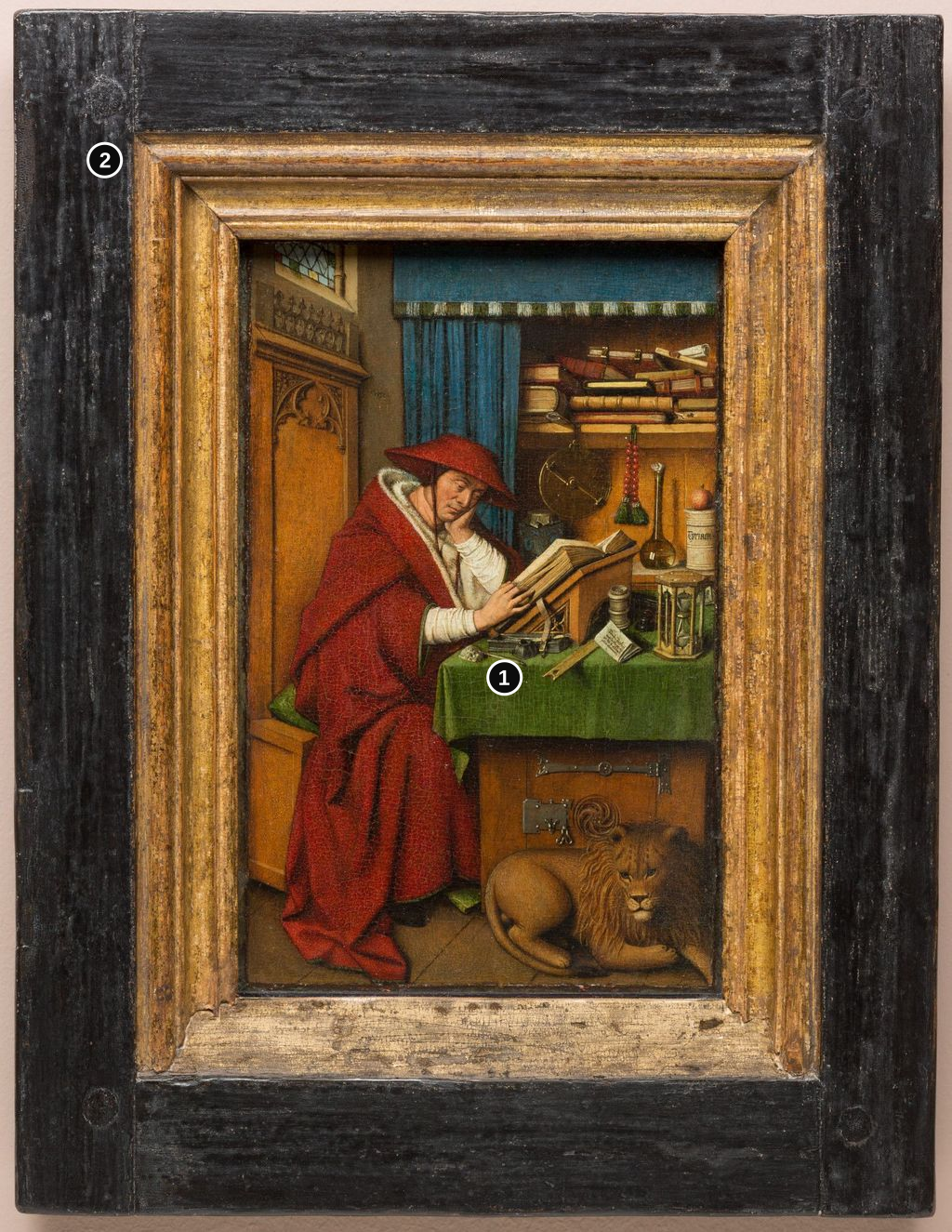
Details from SAINT JEROME IN HIS STUDY IN DETROIT
Select a detail to enlarge it. Return to the numbered overview to find its position.
Scholar at work
Jerome bends over his desk in a compact study, joining scholarly labour to a devotional setting.
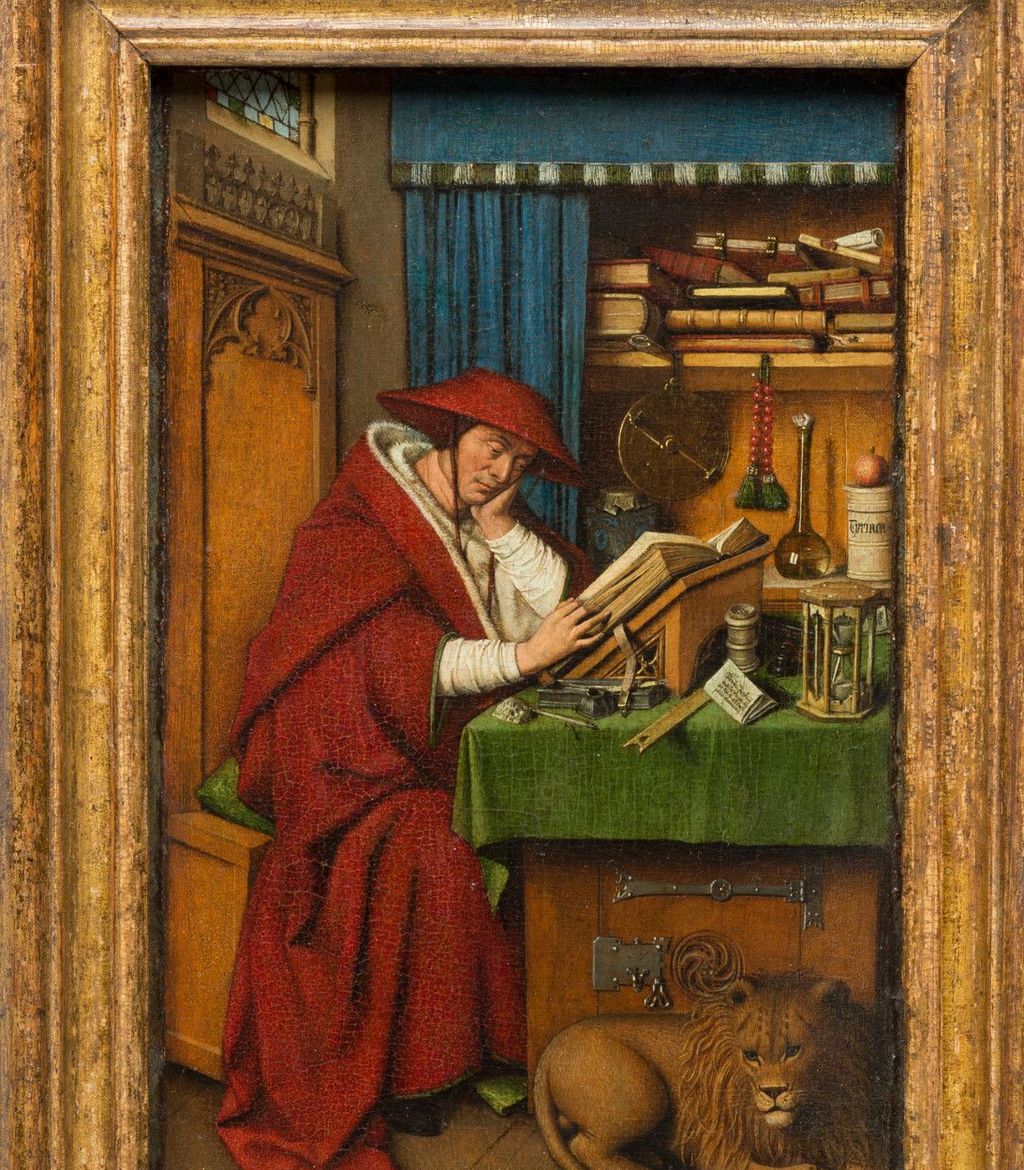
Frame and setting
The full painted and framed object gives scale to the study; this is the Detroit picture, not the later Nason engraving.
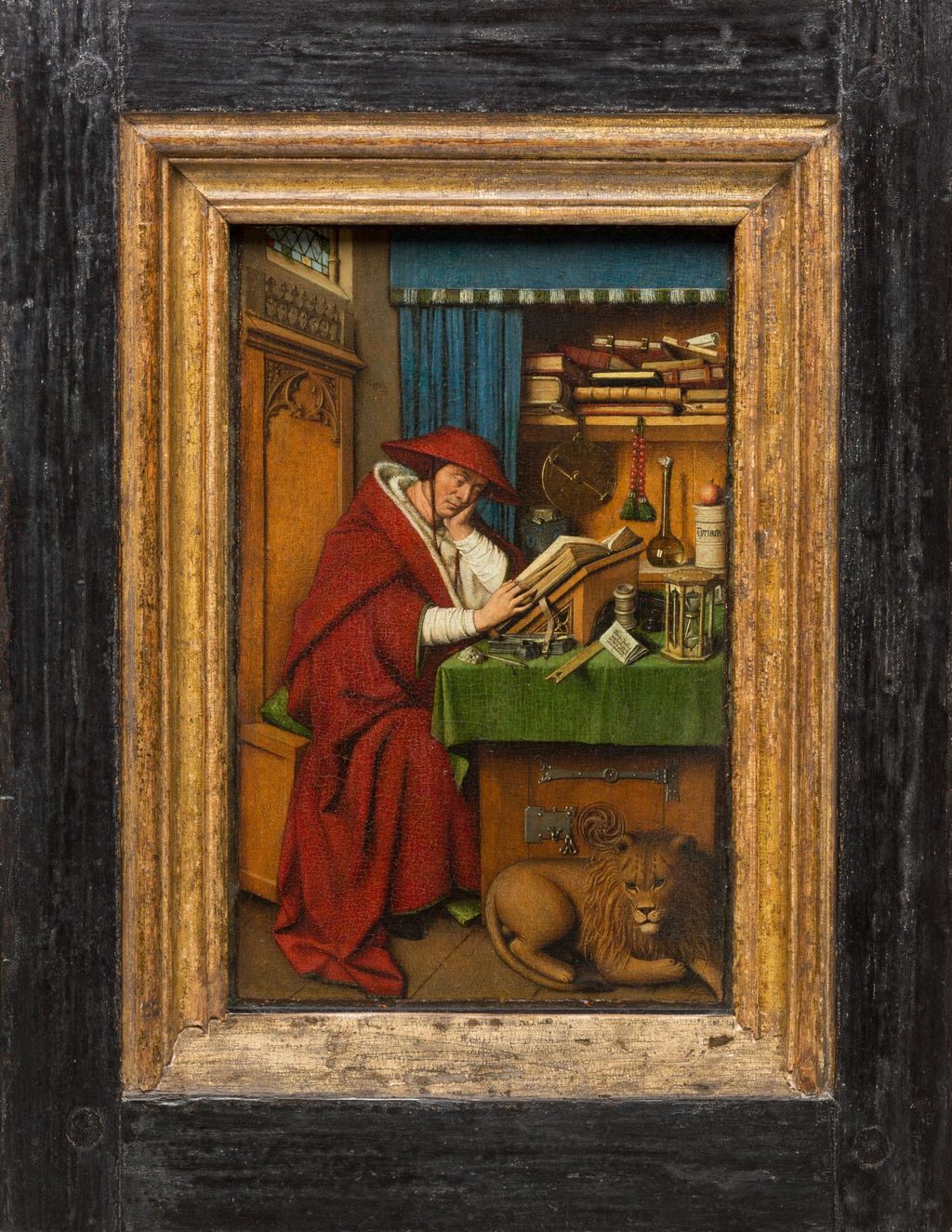
A very small, closely furnished room
The painting measures 20.6 by 13.3 centimetres unframed, with a painted surface of 20 by 12.4. Detroit lists oil on linen paper on oak, accession 25.4, City of Detroit Purchase.[1]
That compression is central to the viewing experience. At normal reading distance the red clothing dominates; enlarged, the room breaks into individual surfaces. The fur lining around Jerome's neck differs from the folds of his white sleeve. A green cloth drapes over the desk, while the cupboard underneath exposes warm wood, metal fittings and a carved circular ornament. These contrasts establish the weight and texture of a room whose contents would otherwise merge into a crowded pattern.
Look first at the diagonal made by the open volume. It rises from Jerome's hands towards the right, interrupting the upright curtain folds and the horizontal shelf. The bent head answers that diagonal. His supporting hand brings the gesture back to his face, forming a small circuit of attention between eyes, hands and page. Although the book is the centre of his activity, his posture conveys sustained concentration through the whole upper body.
The lion gives the lower half a different rhythm. Its body curls along the floor, its forelegs extend towards the right, and its head turns outward. The saint looks into a book; the animal appears to acknowledge the space in front of the picture. Between them, the hanging red robe creates a broad, irregular vertical mass. The floor is therefore more than an empty base: it connects a private act of reading with an animal presence immediately accessible to the viewer.
Why Jerome wears a cardinal's hat
Jerome's association with translating the Bible into Latin explains the importance of books in his imagery. Here he appears as a scholar indoors, rather than as a penitent in the wilderness. The red cardinal's clothing is a later artistic convention, not a record of an office he held: the cardinalate developed after his lifetime. Caroline Campbell's National Gallery study makes this distinction while comparing the Detroit picture with later treatments of the subject.[2]
The anachronism has a practical visual effect. Red clothing and the broad hat identify a dignified church scholar before a viewer reads any inscription. Their rich colour also binds the seated figure together across a very small surface. The pale face and sleeve remain visible within this continuous red shape, keeping the human act of reading distinct from the collection of objects around it.
The lion recalls Jerome's legendary removal of a thorn from its paw. Here the animal rests beside him, turning a miracle story into quiet companionship.[1]
Books, vessels and passing time
The shelves promise learning through accumulation. Books lie horizontally in uneven piles, with pale page edges and darker covers breaking up the recess behind the curtain. Some lean or project rather than forming a perfectly ordered display. Below, the open volume belongs to the immediate task. The contrast between stored books and the one being read makes the room feel usable: a collection has been drawn upon, not simply arranged for admiration.
The blue curtain is especially important to that effect. It partly screens the books and provides a strong colour boundary behind the red hat. Its narrow fringe marks a transition from the broad fabric above to the folds beside the saint. In a room with little open depth, the curtain produces an alternating sequence of concealment and exposure. We see enough of the shelf to understand its fullness, while its remaining contents seem to continue behind the cloth.
Detroit identifies an astrolabe and interprets the hourglass as mortality, the labelled jar as a snakebite antidote and the pomegranate as Resurrection. These are attributes within an imagined scholar's room.[1]
Their arrangement also rewards looking before interpretation. The astrolabe occupies a darker space beneath the shelf; the hourglass stands forward near the desk's edge. A glass vessel catches light against the wood, while the opaque jar presents its lettering towards us. Circular, cylindrical and angular shapes compete within a narrow strip beside the reader. Meaning is carried by recognisable implements, but their different responses to light help make the grouping persuasive as a still life.
The folded letter is particularly conspicuous among these objects because its pale surface interrupts the green cloth. It lies at an angle towards the viewer, well below the saint's face. Its writing creates a second act of reading within the composition: Jerome attends to his volume, while we are invited to examine the address. That double invitation helps explain why a tiny inscription has become so consequential in discussions of the picture.
What the letter actually says
The address names Lord Jerome and calls him cardinal-priest of the Holy Cross of Jerusalem. The Metropolitan Museum's 1994 transcription does not name Niccolò Albergati. Edwin Hall's suggestion that the picture was a diplomatic gift connected with the 1435 Congress of Arras is one historical interpretation reported there, rather than a surviving commission document.[3]
The argument for Albergati depends on the church title. In a French review published in Scriptorium in 1955, Frédéric Lyna explained Erwin Panofsky's reading: Santa Croce in Gerusalemme was Albergati's titular church, whereas Saint Anastasia was the title conventionally associated with Jerome. The unexpected substitution could therefore be a compliment to the living cardinal through the image of a learned saint. This is a specific iconographic proposal, not a discovery of Albergati's name in the painted address.[4]
If persuasive, that connection gives the painting a purpose beyond general devotion: the saint's scholarship could honour a contemporary churchman's identity. It still leaves several questions open. A reference to a patron does not tell us who paid the painter, who received the finished object or when it left the workshop. Nor does the resemblance between a saint and a living churchman automatically establish a disguised portrait. Those separate propositions require separate evidence.
The portrait traditionally identified as Cardinal Albergati is a useful companion for this problem, but its sitter's name also needs qualification. Joining two uncertain identifications cannot turn either into a document. The Detroit letter remains valuable precisely because its wording can be distinguished from the historical reconstruction built around it.
Watch: Jan van Eyck in context
Choose a Smarthistory close reading of the Arnolfini Portrait or the closed and opened Ghent Altarpiece.
Jan van Eyck, The Arnolfini Portrait
Look closely at the room, mirror and gestures in the London double portrait.
Watch on YouTubeThe Medici inventory: a close match with a missing bridge
A second strand of evidence comes from the 1492 inventory of Lorenzo de' Medici's possessions. In his 1888 French publication of the Medici collections, Eugène Müntz printed an entry describing a small Flemish panel of Jerome studying, a little cupboard with books represented in perspective, and a lion at his feet. It names Master Giovanni of Bruges, specifies oil painting, records a case and gives a value of thirty florins. These details make the entry a compelling comparison for the Detroit composition.[5]
Its particular strength is the conjunction of features. Jerome alone would be too common a subject to identify a small picture. Adding the study, cupboard of books, lion, Flemish origin and named Bruges master produces a much narrower description. Müntz's edition also places the entry among other portable possessions, rather than presenting it as an account of a public altarpiece. The case is a useful reminder that a small painting could be protected and moved.
There are also clear limits. The inventory description gives no dimensions matching Detroit's measurements, no accession number and no continuous succession of owners leading to the present panel. A workshop repetition or another version of a similar design could satisfy much of its wording. The case recorded in 1492 cannot simply be identified with the frame in a modern photograph. The document supports the existence of an Eyckian Jerome in the Medici collection; identifying that object with Detroit's is an additional step.[5]
The source consulted here is Müntz's printed transcription, not the original fifteenth-century manuscript. That distinction matters because an edited historical text, a painting's visible appearance and its later provenance are different kinds of evidence. They reinforce one another only where their details actually meet. The inventory offers an unusually evocative early parallel without supplying the missing bridge across the following centuries.
From Mantua and Venice to Detroit
Detroit's later provenance includes Ferdinando Carlo Gonzaga in Mantua, then Johann Matthias von der Schulenberg in Venice before 1738. His family's 1741 and 1774 inventories list it as number 38, attributed to Mantegna. It reached Berlin dealer Paul Bottenwieser before Detroit's 1925 purchase.[1]
The Mantegna attribution is not evidence that he painted the picture. It records how an earlier collection classified it, and helps explain why a work now discussed within Netherlandish painting can have a substantial Italian collecting history. An inventory attribution belongs to the history of reception as well as provenance. The same object can retain its identity while the name attached to it changes.
This makes the proposed Medici connection both plausible and incomplete. A later presence in northern Italy fits the broader story of an admired Flemish composition travelling south, but does not establish the route from Florence to Mantua. A responsible provenance leaves that gap visible instead of filling it with an assumed inheritance or sale. The record becomes more informative when its well-described later stages are separated from its hypothetical beginnings.
Cleaning changed the attribution debate
The painting's appearance has not been stable throughout modern scholarship. Hugh Hudson's 2009 study, available through the RKD, recounts William Suhr's 1956 removal of overpaint from the cloak and hat. Those passages had helped sustain arguments for more than one hand. Cleaning encouraged renewed support for Jan, while subsequent technical criticism, including Paul Coremans's examination, raised different objections. Later doubts even extended to authenticity. Hudson treats this changing history as part of the object’s scholarly reception.[6]
That episode explains why older reproductions and descriptions need care. An opinion about heavy repaint cannot automatically be transferred to the revealed surface, while the removal of repaint does not guarantee that every remaining passage is intact. Conservation alters the material available for comparison; it does not provide a mechanical attribution. The quality of a hand, a fold or a transition has to be judged in relation to its condition.
Molly Faries's 2001 account of technical research reports a substantial advance. Investigation established that the oak support, including its marbled reverse, was original rather than evidence of a later transfer. The paper layer was compatible with fifteenth-century practice, as were the pigments. Dendrochronology indicated that the wood could have been available after 1426, leaving execution within Jan's lifetime possible. Infrared examination revealed too little possible underdrawing to settle authorship. These findings displaced the modern-forgery suspicion without identifying an individual painter.[7]
Paper on wood is therefore not a shorthand explanation for a modern copy. It describes a layered object whose original construction has itself been investigated. The relevant comparison is with other small early Netherlandish paintings using an intermediate support, including the Philadelphia Saint Francis Receiving the Stigmata, which uses parchment. The distinction between paper and parchment should be retained; a related construction need not be an identical technique.[7]
What paint overlaps can tell us
Maryan Ainsworth's 1994 catalogue discussion addressed the sequence of painting rather than appearance alone. It noted curtains partly over books, an hourglass over the table and a lion over the desk. She regarded this additive procedure, together with the awkward chair perspective, as evidence against Jan's usual practice. Her conclusion favoured an anonymous close follower; it found no distinctive grounds for naming Christus or separating two painters. That is a reasoned attribution argument within a dated publication, not the wording of Detroit's current label.[3]
These observations make the small room useful for understanding how connoisseurship and technical study interact. A pile of books is simultaneously a painted object, a compositional choice and a record of working order. Recognising that the curtain overlaps it is different from deciding who habitually worked that way. The first concerns a material relationship; the second depends on comparison with a wider body of securely attributed paintings.
Ainsworth also discussed the design's relationship to the Thomas Aquinas study miniature formerly in the Turin–Milan Hours, destroyed in 1904, and to later Bruges illuminations now in Baltimore and Paris. Similar desks, curtains and books connect manuscript and panel traditions. Such correspondences preserve evidence of a circulating design without establishing that every related image shares one painter.[3]
The possible 1442 date and the posthumous workshop
The apparent date above Jerome's head is crucial because Jan died in 1441. A 2022 Burlington Magazine study by Jan Dumolyn, Susan Frances Jones, Ward Leloup, Toon De Meester and Mathijs Speecke revisited the workshop after his death. It notes that the date precedes the paint's crack pattern, but that the technical study had not invasively established its age or originality. An old inscription is not necessarily an original completion date.[8]
The same study narrows the proposed continuation of Jan's workshop through fresh Bruges property research: its final phase may have extended from summer 1441 to spring 1444. It also challenges the assumption that Christus's acquisition of Bruges citizenship on 6 July 1444 proves he had not been there earlier. These findings make posthumous production historically conceivable while leaving the painter unidentified. Neither a widow's involvement in workshop affairs nor Christus's possible earlier presence assigns the brushwork in Detroit.[8]
The useful conclusion is therefore a range of possibilities. If the inscription belongs to the original campaign, 1442 would favour completion after Jan's death. If added later, it cannot date the first paint. Workshop continuity provides a setting in which an assistant might finish or repeat a design, but it cannot resolve the inscription by itself. Detroit's about-1435 dating and the alternative workshop chronology should remain visibly distinct.
Following the evidence today
Belgium's KIK-IRPA database records the picture under Jan's workshop with an uncertain 1442 date and a former attribution to Christus. Its photographs and research-file listings document a long institutional interest, including files from 1961 and scientific imaging recorded in 2021. These are useful research leads, but file metadata is not the content of the examination reports. The database's qualified attribution also shows why there is no single label shared by every institution.[9]
For a viewer, the most productive starting point is still the painting: the red-clothed reader, the book angled towards him, the curtained shelf and the lion beneath. Return from these to the letter and the possible date, then to the records outside the frame. The image rewards close attention before an attribution is decided. Its ability to make a scholar's tiny room feel densely inhabited survives the disagreement about which hand achieved it.
Detroit also owns Thomas Willoughby Nason's 1944 engraving after the composition, accession 71.109. Printed in black ink on wove paper, it is a separate twentieth-century work, not another record of the fifteenth-century panel. The distinction matters when searching for images under the shared title Saint Jerome in His Study.[10]
Related reading

 Jan van Eyck.jpg)

Discussion
What do you notice in Saint Jerome in His Study in Detroit? Share a close observation or a source that adds useful context.
Join the Conversation
Keep observations specific and evidence clear.
References
- Detroit Institute of Arts, Saint Jerome in His Study, accession 25.4; current object data, iconography and provenance — View Source.
- Caroline Campbell, National Gallery, “Antonello da Messina, Saint Jerome in his Study,” in Building the Picture (2014); cardinal's dress and comparison — View Source.
- Maryan W. Ainsworth, Petrus Christus: Renaissance Master of Bruges (Metropolitan Museum of Art, 1994), pp. 68–71; complete Detroit entry and notes consulted — View Source.
- Frédéric Lyna, review of Studies in Art and Literature for Belle da Costa Greene, Scriptorium 9:2 (1955), p. 327; French account of Panofsky's letter interpretation. Relevant page consulted, rather than the original 1954 chapter — View Source.
- Eugène Müntz, Les collections des Médicis au XVe siècle: le musée, la bibliothèque, le mobilier (Paris, 1888), p. 78, within the 1492 inventory; printed transcription consulted — View Source.
- Hugh Hudson, Jan van Eyck, The Ince Hall Virgin and Child, and the Scientific Examination of Early Netherlandish Paintings (2009), pp. 233–234; conservation and attribution history — View Source.
- Molly Faries, “Reshaping the Field: The Contribution of Technical Studies,” in Maryan W. Ainsworth, ed., Early Netherlandish Painting at the Crossroads (Metropolitan Museum of Art, 2001), pp. 77–78 — View Source.
- Jan Dumolyn, Susan Frances Jones, Ward Leloup, Toon De Meester and Mathijs Speecke, “Margaret van Eyck, a house called ‘The Wild Sea’ and Jan van Eyck's posthumous workshop,” The Burlington Magazine 164 (February 2022), pp. 120–130; especially p. 123 n. 17 and pp. 128–130 — View Source.
- KIK-IRPA, BALaT, De heilige Hiëronymus, object 40004099; attribution, photographs and file metadata — View Source.
- Detroit Institute of Arts, Thomas Willoughby Nason, Saint Jerome in His Study (1944), accession 71.109 — View Source.

 Jan van Eyck.jpg)
 Jan van Eyck.jpg)


