


 Buy Art Prints Now
from Amazon
* As an Amazon Associate, and partner with Google Adsense and Ezoic, I earn from qualifying purchases.
 by Tom Gurney
Tom Gurney BSc (Hons) is an art history expert with over 20 years experience
Page Created on June 19, 2020 / Page Updated on November 1, 2026
Email: tomgurney1@gmail.com / Phone: +44 7429 011000
Portrait of an Older Man, traditionally called Cardinal Albergati
The broad red robe establishes the sitter's presence before the small details of his face come into focus. Pale fur turns around his neck, two buttons close the garment, and fine lines gather around eyes that look past us. Jan van Eyck has given this older man a remarkably particular appearance. Giving him a name is harder. Vienna's Kunsthistorisches Museum calls the painting Cardinal Niccolò Albergati (?); the question mark preserves a dispute that neither the convincing likeness nor its famous preparatory drawing has resolved.[1][2]
This is an accepted painting by Van Eyck in the museum's Picture Gallery, inventory GG 975. It is painted on oak, with a present overall size of 34 × 29.5 centimetres. Its likely date belongs in the mid-to-late 1430s: Vienna's object record gives around 1435, while the National Gallery's portrait exhibition announcement tentatively places it in 1438. Both the familiar cardinal's name and an alternative description, an elderly scholar, remain qualified.[1][3]
At a Glance
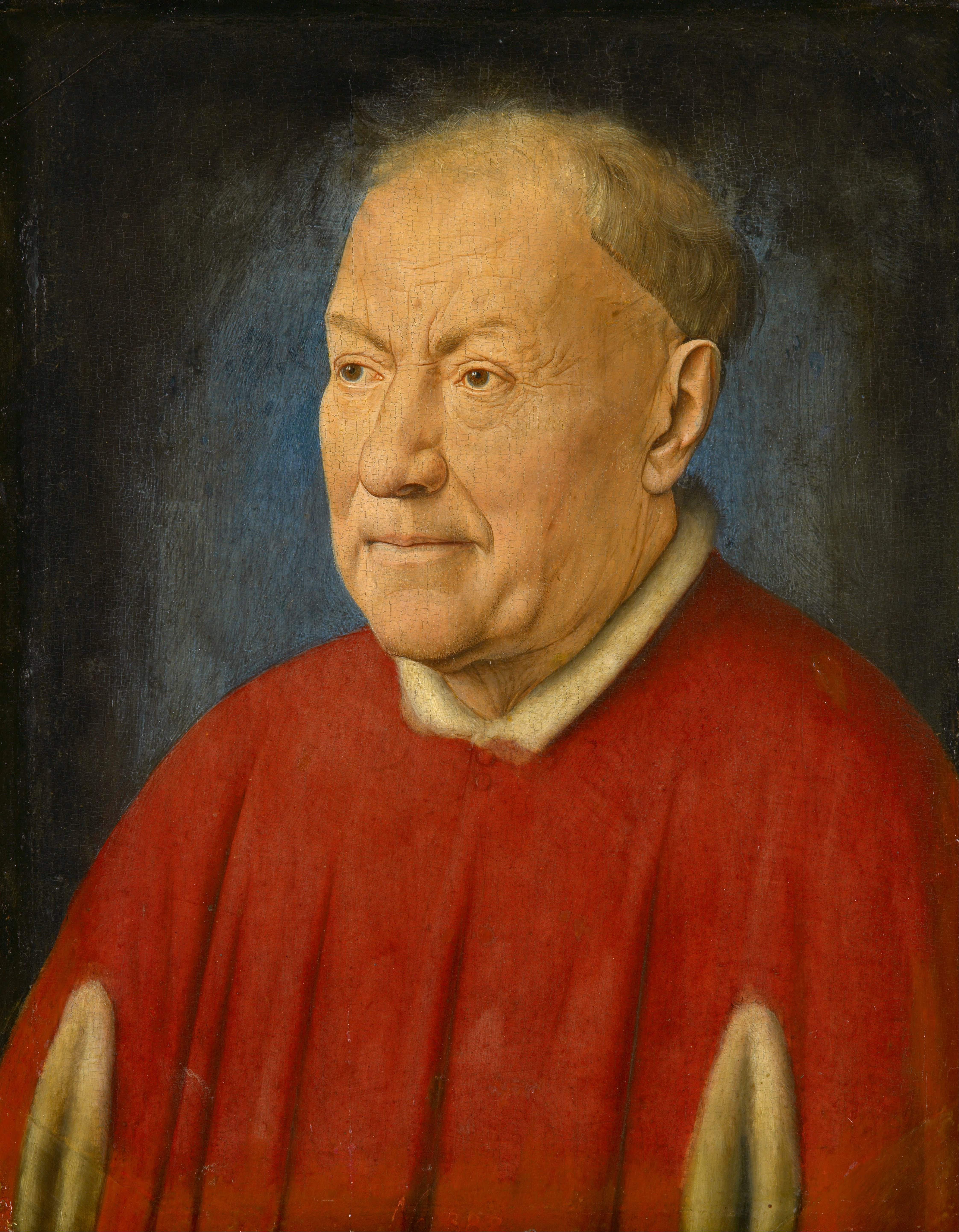
Annotated Details from Portrait of an Older Man, traditionally called Cardinal Albergati
The Vienna portrait can be compared with the Dresden study while keeping the sitter's name qualified. Match the numbered points to the details below.
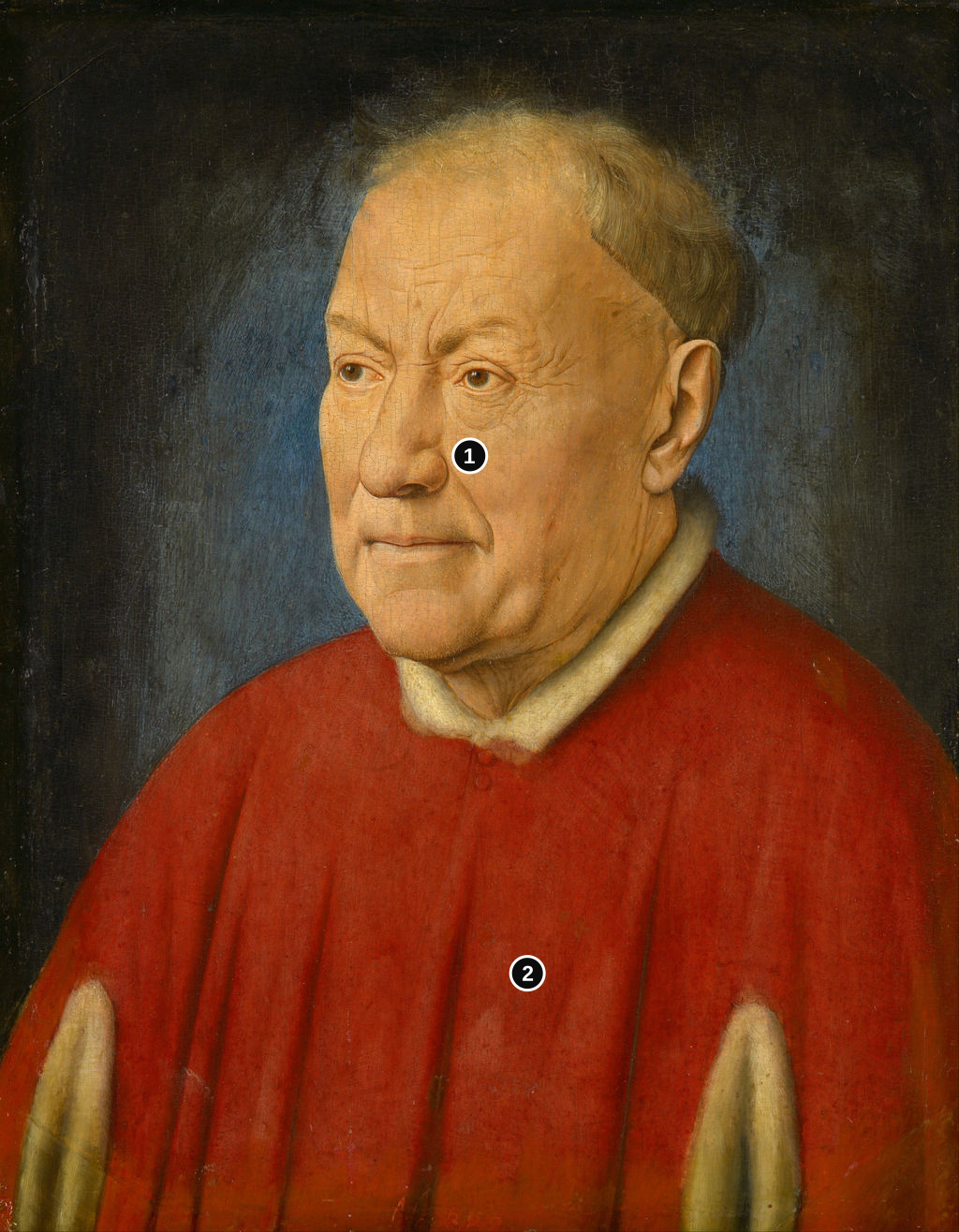
Details from PORTRAIT OF AN OLDER MAN, TRADITIONALLY CALLED CARDINAL ALBERGATI
Select a detail to enlarge it. Return to the numbered overview to find its position.
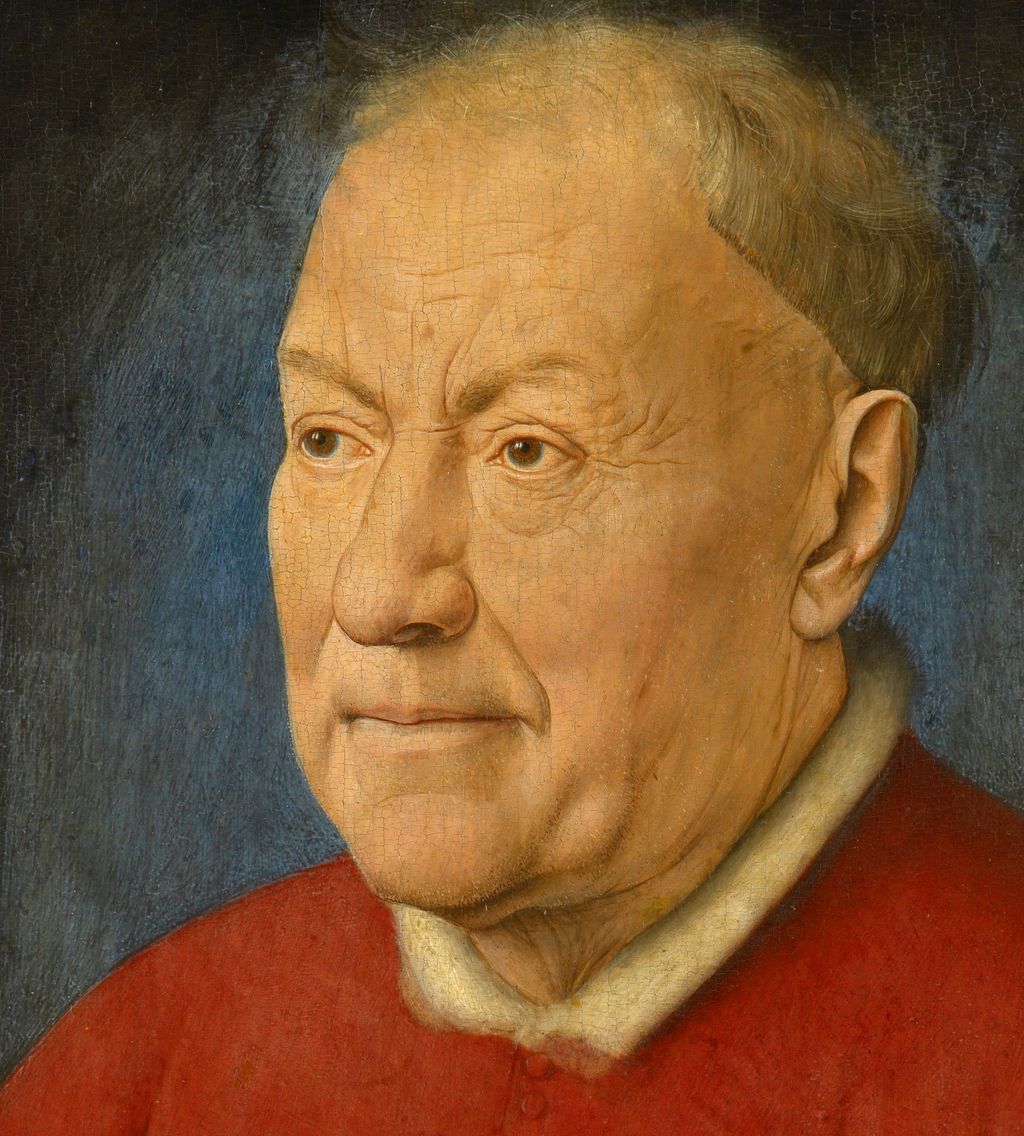
Face
Changes of tone across the face create a closely observed likeness. The identification as Cardinal Albergati remains qualified by the museum.
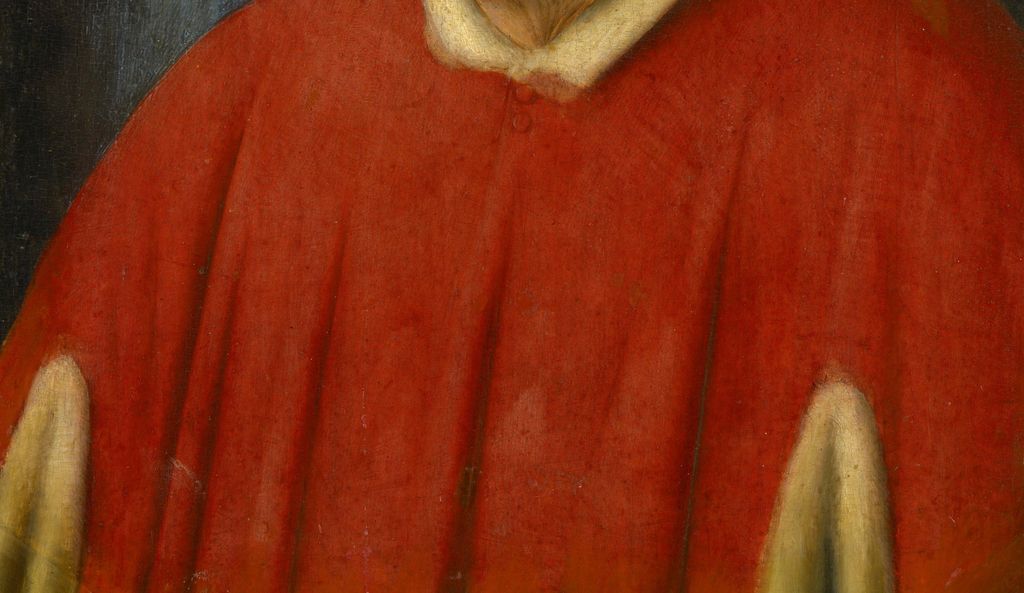
Red garment
Broad red clothing surrounds the face and shapes the sitter's imposing presence.
Looking at the face and the red robe
Begin with the contrast between the forehead and the garment. The forehead is a broad illuminated surface interrupted by short wrinkles and very fine changes of tone. Below it, the eyes, nose and mouth require a denser concentration of marks. Further down, the robe opens into long folds. The movement from minute facial detail to large areas of red prevents every part of the portrait from making the same demand on the eye. The cloth gives the head weight and support while the face supplies the individual likeness.
The pale edging is more than a decorative outline around the neck. Fur also appears in the tall openings near the lower corners, allowing the garment's construction to register without a complete view of the body. Hands remain out of sight. There is no ring, letter or book through which the sitter might declare a trade, learning or personal connection. The two small buttons beneath his chin are especially noticeable because so few accessories interrupt the clothing. Attention returns repeatedly to the head rather than following a chain of attributes.
The visible ear, on the viewer's right, anchors the turn of the head. Its projecting rim catches light while its interior contains a deeper shadow. Fine hair sweeps back above it, contrasting with the exposed forehead. Around the eyes, narrow creases branch outwards and the lower lids have a soft fullness. The closed mouth is comparatively economical: a small change in the line between the lips can alter whether we read the expression as patient, doubtful or faintly amused. Those responses belong to viewing the image, rather than to a recoverable account of the man's mood.
The background deserves a second look. In the reproduction it is not an equally black field throughout; a cooler, lighter zone appears beside the head and shoulders. That variation helps separate the silhouette without describing a room. The sitter occupies a concentrated painted space with no window, furniture or landscape. Small cracks visible across the surface belong to the ageing object, while the fine lines describing skin belong to its representation. At high magnification these two kinds of line can overlap, so an enlarged photograph needs to be read with care.
From a recorded head to a finished likeness
The related Dresden drawing makes this painting exceptional among surviving early Netherlandish portraits. The Morgan Library's exhibition with Dresden identifies that sheet as Van Eyck's sole universally accepted surviving autograph drawing. It records the same man's appearance in metalpoint on prepared paper, accompanied by written colour observations. The connection supplies unusually direct evidence that a painted portrait could grow from a portable record of a living sitter. It does not reveal the person who paid for the picture or the time between drawing and painting.[2]
Colour notes help bridge the difference between the two objects. A lightly drawn head can preserve contours and shading while leaving the painter without a reliable reminder of the complexion or grey beard. Leo van Puyvelde's Dutch study of the annotations discusses instructions for the lips, eyes and facial colouring, using Weale's earlier, incomplete transcription. Some letters were already difficult to read. These are practical observations in the painter's language, rather than a written identification of the man. Their specificity helps explain the painting's individual features without solving its title.[4]
A comparison should focus on the head before comparing the rectangular outlines. The drawing has its own margins and annotations, while the panel has been reshaped and enlarged at its sides. Measuring the full width of one reproduction against the full width of the other cannot establish an exact method of transfer. The significant evidence lies in how the facial parts correspond, where their proportions differ, and how paint turns a densely hatched study into a face that holds together at normal viewing distance.
Rachel Billinge and Lorne Campbell addressed those differences in the National Gallery's Technical Bulletin in 1995. In their discussion of the Arnolfini portraits, they observed that the Dresden head has a reduced cranium and enlarged features compared with the Vienna painting; those distortions are less pronounced in the painted version. Their comparison treats the transition as an adjustment, rather than an absolutely faithful enlargement. It also puts this pair alongside changes between underdrawing and finished faces in another Van Eyck work.[5]
That observation gives the viewer something concrete to test: compare the space above the eyes, the breadth of the cheek and the relation of mouth to lower face. The Vienna portrait is an organised likeness with its own proportions. A preparatory study did not relieve Van Eyck of making decisions in paint. Nor does a difference automatically identify a mistake in one object. A drawing made under the pressure of observation and a picture intended for sustained viewing could make different uses of the same face.
How the cardinal's name took hold
The identification has a longer history than a modern museum label suggests. In their 1912 catalogue, W. H. James Weale and Maurice Brockwell transcribed the description of a portrait of the Cardinal of the Holy Cross in Archduke Leopold Wilhelm's 1659 inventory. They connected that designation with Niccolò Albergati, whose titular church was Santa Croce in Gerusalemme. Their account placed the portrait firmly within the artist's career and presented Albergati's biography with considerable confidence. Modern questioned titles show that this confidence has not remained universal.[6]
The same catalogue preserves earlier uncertainty. In the Belvedere collection the panel had passed for an elderly Joos Vijd, donor of the Ghent Altarpiece. Weale and Brockwell noted that nineteenth-century writers compared the two faces and challenged that identification. They also discussed confusion over another cardinal, Domenico Capranica. This sequence matters because it separates what the picture depicts from what successive cataloguers thought it depicted. A face can remain recognisable while names attached to it change substantially.[6]
The early collector Peeter Stevens provides another important strand. A 2024 study by Bertrand Lefrère and Nicolas Kluger reports his seventeenth-century description of a Van Eyck portrait dated 1438 representing the Cardinal of the Holy Cross. That is evidence of how an owner described the object more than two centuries after its creation. It is not equivalent to reading a surviving date and sitter's name on the present panel. Whether the wording depended on a lost inscription, inherited information or interpretation needs to remain a separate question.[7]
This distinction explains why neither the date nor the title should be dismissed as a random modern guess. They have historical witnesses. But the witnesses are later than Van Eyck, and the painting no longer provides an intact original frame against which their information can be checked. The best introduction therefore retains “traditionally called Cardinal Albergati” while making the disputed identity immediately visible. Readers can find the familiar artwork without being asked to accept an identification as secure merely because it has appeared in books for generations.
Watch: Jan van Eyck in context
Choose a Smarthistory close reading of the Arnolfini Portrait or the closed and opened Ghent Altarpiece.
Jan van Eyck, The Arnolfini Portrait
Look closely at the room, mirror and gestures in the London double portrait.
Watch on YouTubeCostume, scholarship and the Beaufort proposal
Albergati's Carthusian identity creates a difficulty. The Morgan's account points to the man's hair and secular clothing as reasons for doubting that he represents the monk and papal diplomat. It proposes an otherwise unidentified scholar instead. The National Gallery's 2026 announcement likewise calls the panel Portrait of an Elderly Man (A Scholar?). These institutional descriptions agree that uncertainty needs to be expressed, while supplying no recovered personal name to replace Albergati.[2][3]
“Scholar” is a category proposed for the sitter, rather than an occupation demonstrated by a book in his hands. His red robe can convey distinction to a modern viewer, but colour alone cannot identify an ecclesiastical rank. The absence of an expected tonsure has also counted against the cardinal's name. Costume and hair are useful evidence because they test whether a proposed biography fits what is represented. They become less useful if every unusual feature is explained away simply to preserve a preferred identification.
Henry Beaufort, cardinal and bishop of Winchester, is another candidate discussed in the literature. Lefrère and Kluger revisit that possibility alongside Albergati in their 2024 paper, citing Malcolm Vale's 1990 historical study and John Hunter's 1993 discussion. Their own investigation centres on the crease visible across the sitter's earlobe and compares the portrait with historical accounts of the proposed men's health. They acknowledge that the exercise does not settle the identity. A painted anatomical feature supplies an interesting question, but cannot function here as a recovered name.[7]
The most useful outcome of these competing proposals is a clearer sense of what would count as stronger evidence. An independently documented commission, an identifying early inscription, or a securely connected contemporary description would answer a different kind of question from a resemblance or a plausible opportunity to meet. The surviving drawing establishes that the painter studied this face. It cannot select among historical biographies simply because one candidate travelled through the right region.
Bruges, Arras and the difficulty of dating a sitting
Older accounts often placed the drawing during Albergati's brief visit to Bruges in December 1431. Weale and Brockwell reconstructed an itinerary through Herne, Brussels, Ghent and Lille before Bruges. Their discussion included the civic preparations and gifts that marked a distinguished visitor's reception. These details establish a real diplomatic journey through the Low Countries; they help explain why an encounter with the Burgundian court painter seemed credible to earlier scholars.[6]
A revealing moment comes when their narrative moves from itinerary to commission. They suggested that one of the duke's letters probably asked Van Eyck to paint the cardinal. That “probably” matters: it marks a reconstruction rather than a quoted surviving order. Their further argument that a short stay required a drawing followed by a painting depends on the same identification and encounter. It should not be transformed into an established account of precisely how long the sitter posed or when the portrait was delivered.[6]
Arras in 1435 offers a different context. Till-Holger Borchert's account of Van Eyck's career places the artist's journey there within his continued service to Philip the Good, while treating the production of delegates' portraits as probable. The peace congress brought the painter into a diplomatic setting in northern France where Albergati was an important participant. That gives the proposed encounter historical substance, while the link between a particular face and a particular meeting still requires interpretation.[8]
French scholarship adds a useful distinction. In 1995 Albert Châtelet drew attention to Jacques Paviot's archival research, including a payment for Van Eyck's expenses travelling from Bruges to Arras in 1435. Châtelet used this to support dating the drawing to the congress and also mentioned the reported 1438 date for the painting. The journey payment supports the artist's presence in that setting; treating it as proof that this unidentified man sat there would make the document answer more than it actually records.[9]
The mid-to-late-1430s description allows these arguments to be understood without inventing a single exact chronology. A preparatory drawing can precede a painted portrait without both belonging to the same week or even the same year. The sitter's disputed name affects which meeting seems likely, while the historical dating of a meeting does not automatically resolve his name. Keeping those questions distinct makes the pair more informative, because the evidence for artistic process is considerably stronger than the evidence for a specific occasion.
Antwerp ownership and the move into a princely collection
The clearest later transfer took place in 1648, when the portrait passed from the Antwerp dealer and collector Peeter Stevens to Archduke Leopold Wilhelm. Karl Schütz's study of the archduke's collection gives 5 April 1648, citing Stevens's marginal note in his copy of Karel van Mander's Schilder-boeck. The date makes this a specific acquisition within the Antwerp art trade, rather than an unspecified movement into Habsburg ownership.[10]
Schütz places the purchase within a small, distinguished group of fifteenth-century Netherlandish paintings acquired by the archduke. The larger collection was assembled through several different channels and later became central to Vienna's Picture Gallery. For this portrait, the Stevens transaction matters more than a general account of princely collecting: it identifies a seller, buyer and recorded moment of exchange. The connection with Antwerp also helps explain why an early Netherlandish painting could enter an Austrian collection through the art market of the southern Low Countries.[10]
The 1659 inventory, discussed by Weale and Brockwell, then supplies a later written witness within the archduke's collection. Ownership and identification should still be distinguished. A seventeenth-century inventory can demonstrate that a picture was known and catalogued at that time, while retaining an inherited or mistaken name. The interval before Stevens remains a substantial gap: the directly consulted evidence does not establish the original patron, first destination or continuous ownership from Van Eyck's workshop.[6]
The oval panel and its later additions
Vienna's current record describes a striking physical change: the picture was oval in the eighteenth century and was subsequently supplemented. It records additions measuring one centimetre on the left and 1.1 centimetres on the right. The present rectangle therefore contains a history of alteration. Its framed dimensions, 42.5 × 35.5 × 3.5 centimetres, describe the object in its present surround, rather than an original fifteenth-century presentation.[1]
This is particularly consequential for a portrait whose background contains almost no setting. A change in outline alters the amount and shape of dark space around the head and the way the robe meets the lower corners. An oval would direct attention differently from the rectangle now reproduced. The recorded changes do not allow every previous stage to be reconstructed from the front photograph alone, but they explain why apparently minor edges deserve attention alongside the much more famous face.
The original frame is especially significant by comparison with Jan de Leeuw, Vienna's other accepted Van Eyck painting. Borchert draws attention to that portrait's original frame and its address to the viewer through an inscription. The older man's present image offers no equivalent surviving text. The comparison concerns the kinds of evidence each object retains: a named frame can answer questions that astonishingly precise facial observation, by itself, leaves open.[8]
Photographs, prints and continuing examination
Belgium's KIK-IRPA archive extends the object's documented afterlife. Its BALaT record, object 40004089, groups five photographs, including B107079, dated 1947. The record also associates the picture with exhibitions in 1947, 1951 and Bruges in 2002. These materials place the panel within a history of looking, lending and recording that is distinct from its fifteenth-century creation. BALaT's older inventory number and narrower dimensions should not silently replace Vienna's current overall measurement of the altered panel.[11]
The same archive links scientific-imaging file 2016.13094, assigned to the imaging department with Christina Currie named as responsible. The public description establishes that an examination file exists; it does not expose a complete technical report or justify inventing pigment identifications. Historical photographs and scientific images answer different questions. A dated photograph may document the appearance of a surface at one point, while an imaging study can investigate features unavailable to ordinary viewing. Neither should be described as a newly published conservation conclusion merely because its catalogue entry is online.[11]
A different form of access survives in Amsterdam. The Rijksmuseum holds William Unger's print after the painting, RP-P-OB-56.600, dated broadly 1861–1889. Its record names printer A. Pisani and Viennese publisher Hugo Othmar Miethke, and describes etching, plate tone and chine collé. This is a nineteenth-century reproductive object with its own makers and materials. It shows how the likeness circulated beyond Vienna before today's large digital images, while its traditional title cannot independently confirm whom Van Eyck painted.[12]
Research on the panel also continues at its owning museum. The Kunsthistorisches Museum's 2025 report describes interdisciplinary work preparing its restoration, with attention to original appearance, subsequent interventions and material structure. It connects that work with fresh consideration of the drawing and the sitter's identity. The report announces investigation and plans for presenting its results; it should not be read as a completed, detailed treatment account establishing new colours, an exact date or a named sitter.[13]
The portrait rewards returning from these records to the small painted object. Its pale collar, closed mouth and broad red garment remain immediate even when the familiar cardinal's biography is set aside. What makes the painting unusually valuable is the survival of several kinds of evidence together: a closely connected working drawing, a later collecting history, a visibly particular face and a support reshaped by subsequent taste. They offer a rich account of making and preserving a likeness while leaving the man himself unidentified.
Related reading


Discussion
What do you notice in Portrait of an Older Man, traditionally called Cardinal Albergati? Share a close observation or a source that adds useful context.
Join the Conversation
Keep observations specific and evidence clear.
References
- Kunsthistorisches Museum, Vienna, GG 975, “Cardinal Niccolò Albergati (?)”: current object record, support, dimensions, alterations, provenance and proposed Arras encounter. View Source
- Morgan Library & Museum with Staatliche Kunstsammlungen Dresden, “Jan van Eyck: Portrait of an Older Man”: drawing, colour annotations and disputed sitter. View Source
- National Gallery, London, “Van Eyck: The Portraits”: 2026 announcement, Vienna portrait as Portrait of an Elderly Man (A Scholar?), 1438(?). View Source
- Leo van Puyvelde, “De taal van Jan van Eyck,” 1955, especially pp. 217–220: Dutch discussion and partial transcription of the drawing's annotations. View Source
- Rachel Billinge and Lorne Campbell, “The Infra-red Reflectograms of Jan van Eyck's Portrait of Giovanni(?) Arnolfini and his Wife Giovanna Cenami(?),” National Gallery Technical Bulletin 16, 1995, p. 55: Dresden/Vienna proportions. View Source
- W. H. James Weale and Maurice W. Brockwell, The Van Eycks and Their Art, 1912, pp. 103–107: historical inventory, changing identifications and proposed 1431 chronology; treated as historical scholarship. View Source
- Bertrand Lefrère and Nicolas Kluger, “Iconodiagnosis as the key to establishing the identity of the so-called Niccolò Albergati portrait?”, Ethics, Medicine and Public Health 32, 2024, 100999, especially pp. 3–4; proposals remain unresolved. View Source
- Till-Holger Borchert, Masterpieces in Detail: Early Netherlandish Art from van Eyck to Bosch, publisher's preview, pp. 10–11: ducal service, Arras and Jan de Leeuw's frame. View Source
- Albert Châtelet, “Du nouveau sur Jan Van Eyck,” Bulletin Monumental 153/1, 1995, p. 80: discussion of Jacques Paviot's Arras travel-payment research, rather than direct consultation of the archival document. View Source
- Karl Schütz, “Die Sammlung Erzherzog Leopold Wilhelms,” in 1648: Krieg und Frieden in Europa, 1998, vol. 2, pp. 181–190: Stevens acquisition and collection history, online original text and note 41. View Source
- KIK-IRPA, Brussels, BALaT object 40004089: historical photographs, exhibition associations and linked scientific-imaging file 2016.13094; public metadata, not a full conservation report. View Source
- Rijksmuseum, Amsterdam, RP-P-OB-56.600, Portret van kardinaal Niccolò Albergati: William Unger after Van Eyck, 1861–1889. View Source
- KHM-Museumsverband, Jahres- und Geschäftsbericht 2025, pp. 36–37: research and preparation for restoration; relevant institutional indexed text consulted, direct download unavailable. View Source

 Jan van Eyck.jpg)
 Jan van Eyck.jpg)


