


 Buy Art Prints Now
from Amazon
* As an Amazon Associate, and partner with Google Adsense and Ezoic, I earn from qualifying purchases.
 by Tom Gurney
Tom Gurney BSc (Hons) is an art history expert with over 20 years experience
Page Created on June 19, 2020 / Page Updated on November 1, 2026
Email: tomgurney1@gmail.com / Phone: +44 7429 011000
The Cumaean Sibyl: prophecy, dress and restoration
The Cumaean Sibyl occupies the upper part of the narrow shutter above the washing alcove on the closed Ghent Altarpiece. Saint Bavo’s Cathedral identifies her as a pagan prophetess whose words were understood to anticipate a saviour. She belongs to the exterior completed in 1432, where the coming of Christ is announced before the opened wings reveal the heavenly assembly.[1]
Her bowed head, jewelled headdress and gathered green gown make a distinctive silhouette. One hand lies across the fabric at her breast; the other reaches down to gather its folds. Above her, a long written ribbon curls through the dark enclosure. Looking closely means following three different things: the painted woman, the words that establish her prophetic role, and a surface altered by centuries of treatment.
At a Glance
Details from The Cumaean Sibyl: prophecy, dress and restoration
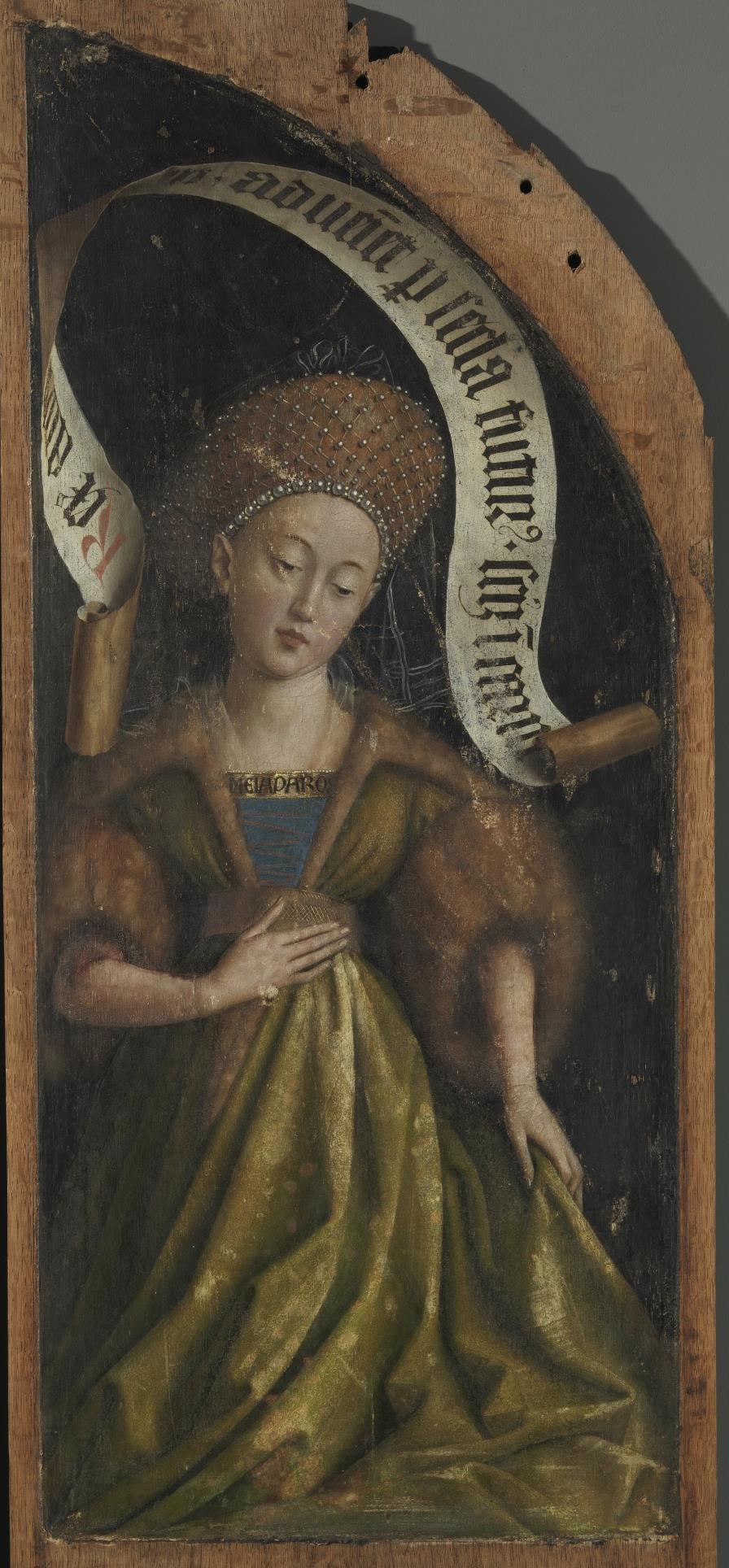
Inspect the Cumaean Sibyl during treatment
During treatment, after removal of local overpainting: earlier cleaning damage is visible in the green gown. KIK-IRPA treatment report (2016), p. 60, figure 25, © KIK-IRPA, Brussels. Unmodified publisher photograph; not the final state.
Finding the right sibyl
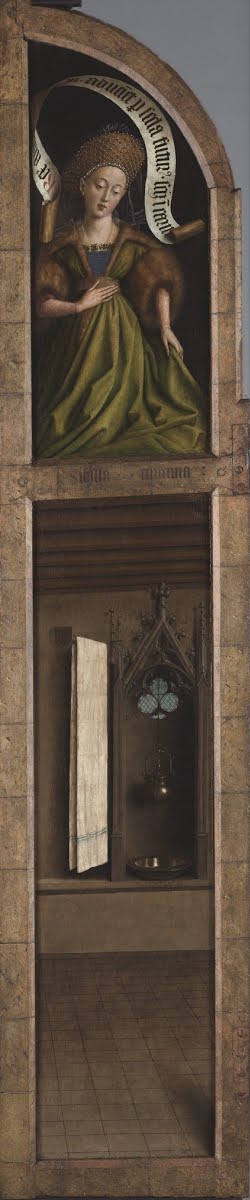
Read the upper figures from the viewer’s left: Zechariah, the Erythraean Sibyl, the Cumaean Sibyl and Micah. The Cumaean therefore stands between the other prophetess and Micah, immediately to the left of the shutter containing Mary. Below her are the water vessel, basin and hanging towel. The cathedral guide places these objects within the Annunciation interior; they do not illustrate an episode from the Sibyl’s ancient life.[1]
The complete shutter reproduced here makes that vertical arrangement visible. Lukas–Art in Flanders publishes it under the title Interior View and credits Hubert and Jan van Eyck together. Its architectural scene continues beneath the small prophetic compartment. This whole-panel record supplies the setting that a reproduction of the Sibyl alone necessarily leaves out; the institutional credit does not establish which brother painted her particular face.[2]
Notice how differently the two halves address the eye. The lower chamber has a long stretch of apparently vacant floor, a bright towel and a small, elaborate window. The upper compartment compresses a body, an oversized headdress and a ribbon into a pointed enclosure. Above, the picture is crowded with a prediction; below, everyday objects occupy a room awaiting the event announced across the neighbouring shutters. The change of scale makes the figure feel suspended above that domestic world.
Reading the clothes and gesture
Her headdress rises in a rounded, reddish form, covered with a network of tiny bright ornaments. Its curved lower edge follows the forehead. The pale veil is much less immediately legible: thin lines descend beside the face and shoulders against the dark ground. Enlarging the image helps distinguish those fine edges from the much more emphatic white banderole above them.
A blue inset shows at the chest, bordered with lettering and crossed by horizontal decorative lines. Brownish fur frames the opening of the outer garment. The contrast between that soft border and the tiny metallic-looking ornaments allows the painter to suggest different surfaces within a very small area. The dress gathers below the hand into a broad cascade; illuminated ridges and dark recesses give the lower body its volume.
W. H. James Weale’s 1912 account already drew attention to the fur-trimmed outer robe, blue underdress, elaborate head covering and veil. He also recorded the name on the frame and associated the prophecy with a Christmas Eve chant. His description is a useful earlier witness to how the figure was read, although it predates the recent conservation campaign. His directions also need care: the position should be checked against the complete closed altarpiece rather than inferred from a description of an isolated wing.[3]
The hands introduce an asymmetry that keeps the figure from becoming a static emblem. The hand held high closes the gown across the torso; the lower hand opens the gesture outward along the descending cloth. Her face tips towards the raised hand, while the dress spreads below in another direction. These visible movements support a reading of inward attention. They cannot, by themselves, reveal a sitter’s private feelings or identify a historical woman.
What the scroll actually says
The modern KIK-IRPA transcription records Sibilla cumana on the frame. On the scroll, Rex and the phrase about a king coming through future ages in the flesh survive alongside uncertain or missing letters. Its documentation connects the verse with Augustine’s City of God, XVIII.23. The other sibyl carries wording adapted from Virgil’s Aeneid VI, traditionally associated with the Cumaean seer. KIK cautions that transferred prophecies and early frame lettering prevent this apparent crossing from proving that later restorers simply exchanged the names.[4]
Augustine’s chapter explains the Christian use of such a witness. He discusses a Greek acrostic whose initial letters identify Jesus Christ as God’s Son and Saviour, and a poem that anticipates divine judgment. He explicitly leaves room for either an Erythraean or a Cumaean attribution. Because the verses oppose false gods, he considers their speaker potentially a member of the city of God. This is Augustine’s theological appropriation of sibylline authority, not independent evidence that a pagan woman historically predicted Jesus.[5]
Watch: Jan van Eyck in context
Choose a Smarthistory close reading of the Arnolfini Portrait or the closed and opened Ghent Altarpiece.
Van Eyck, Ghent Altarpiece (1 of 2)
Explore the Annunciation, donors and painted sculpture on the closed altarpiece.
Watch on YouTubeThat distinction changes how the ribbon is read. The painter gives the woman an authoritative written utterance rather than a speech balloon addressed to another person in her compartment. Its pale surface loops above her head and turns back towards the frame, allowing text to occupy the space surrounding her. The dark background makes the alternating black letters and light parchment conspicuous even when the smaller facial features are difficult to see.
A smooth modern sentence cannot reproduce every feature of that object. Some writing changes direction with the ribbon, some approaches a rolled end, and the surface includes wear. The painting makes prophecy highly visible while withholding easy, continuous reading. Its physical presentation therefore deserves attention alongside the recovered verbal meaning.
From classical seer to Christian witness
Virgil’s sixth book places the Sibyl at Cumae, where Aeneas consults her at Apollo’s sanctuary. The oracle’s inspiration transforms her appearance and voice; she prophesies conflict before Aeneas asks for guidance to the world of the dead. The scene, available in John Dryden’s translation through MIT’s Internet Classics Archive, provides a useful literary comparison. Van Eyck’s composed, richly dressed woman does not enact the poem’s violent prophetic possession. The comparison shows how selectively an inherited figure could be reshaped for a Christian altarpiece.[6]
The historical status of that classical figure also needs qualification. In his French-language study, the Louvain classicist Jacques Poucet argues that the evidence does not establish an actual prophetess practising at Cumae, despite the strength of ancient belief in her and Virgil’s influence. He also questions the famous identification of a monumental passage at Cumae as her cave. His argument concerns the formation of a tradition. For this painting, it discourages treating the Sibyl’s costume or surroundings as documentary reconstruction of an ancient person and her workplace.[7]
Later European images demonstrate the variety of that tradition. The Louvre catalogues a Florentine engraving of the Cumaean Sibyl, attributed to Baccio Baldini and dated about 1470. Its discussion connects the sibyl series with prophetic figures and Annunciation performances. This supplies a French institutional record of the wider Christian reception of sibylline voices. Since the print is later than the Ghent Altarpiece, it is a comparison for the continuing tradition, not a source from which Van Eyck could have borrowed.[8]
A different comparison survives in Amsterdam. The Rijksmuseum identifies Frans Huys’s engraving of 1546–62 as Sibylla Cumana, Nomine Amalthea, number seven in a series of ten sibyls. Its Dutch description specifies a seated woman holding a book, with a ruin behind her. The contrast is useful: neither the book nor the architectural ruin is required in the Ghent figure. Her identity depends on the particular combination of frame label, scroll and position, rather than a universally fixed set of accessories.[9]
A green gown with a complicated surface
The Dutch treatment report for 2012–16 describes nineteenth- and twentieth-century local overpainting intended to conceal damage in the green dress. Conservators removed these additions locally with an ethanol-based gel. The accompanying photograph shows the worn areas exposed during treatment. They also encountered a non-original green glaze in a loss. Because it closely resembled the original material and lacked an intervening varnish, it was retained: removal risked the already abraded original layer beneath. The report likewise found no clear overpainting in the questioned veil.[10]
The later scientific volume identifies altered folds introduced in the 1937 restoration through photographs and modern-element maps. Those interventions were removed. It also explains that the sleeves’ red glaze has browned, exposing pink beneath. Lead white compatible with the original period and traces in the underdrawing prevented a conclusive rejection of the veil. The fragmentary neck lettering remains a separate problem; it is not a secure personal name.[4]
The treatment photograph should consequently be read as an intermediate record. Its scattered pale abrasions show the condition encountered after later paint was removed; they are not a design of pale spots intended by the painter. Nor does the restored colour view mean that every later material could be eliminated. Comparing the labelled images helps separate the artist’s arrangement of folds from the conservation decisions required to preserve what survives.
Even without magnification, the condition affects the figure’s balance. The broad garment has to carry much of the composition’s weight, whereas the fine veil depends on lines almost lost against the background. A reproduction that darkens the head may make the veil disappear; one that exaggerates contrast may make worn green passages look like hard, deliberate highlights. Reading her expression independently of those changes can therefore be misleading.
The wooden wing behind the image
The technical research treats this surface as the reverse of the Eve wing, rather than an independent miniature panel.[4]
Pascale Fraiture’s 2013 dendrochronological report describes Eve’s support as two Baltic oak planks and identifies one as coming from the same tree as a plank in the Hermits panel. The report gives 1412 as the earliest possible manufacture date, while stressing that an unknown interval separated felling from use. Tree-ring evidence links the material to the larger ensemble; it cannot date the Sibyl’s painting precisely or assign it to one brother.[11]
That physical relationship brings two very different women into the same moving object. With the wings closed, the viewer meets the clothed prophetess and the washing alcove. When opened, Eve becomes visible on the other face. The change is achieved by turning a painted support, so the Sibyl’s location belongs to the altarpiece’s operation as well as to its iconographic arrangement.
Stéphane Lojkine’s French study of the altarpiece reads the closed registers as a sequence of incomplete revelation: donors, the Annunciation and prophetic anticipation precede the vision disclosed when the wings open. Within that interpretation, the sibyls give pagan prefiguration a place beside biblical prophecy. It is a modern account of the visual structure, not evidence that every fifteenth-century spectator followed precisely the same route through the imagery.[12]
Return finally to the complete shutter and follow the long ribbon down to the hand gathering the gown, then past the frame label to the washing alcove. That sequence keeps the Cumaean Sibyl’s words, body and position together. Her small painted compartment can then be read as an active part of the closed altarpiece’s announcement, with the surviving surface and its uncertainties still in view.
Related reading


Discussion
What do you notice in The Cumaean Sibyl: prophecy, dress and restoration? Share a close observation or a source that adds useful context.
Join the Conversation
Keep observations specific and evidence clear.
References
- Saint Bavo’s Cathedral, panel guide, closed exterior and general introduction. View Source
- Lukas–Art in Flanders, Interior View, complete shutter and joint attribution. View Source
- W. H. James Weale, The Van Eycks and Their Art (1912), pp. 53–54. View Source
- KIK-IRPA, The Ghent Altarpiece: Research and Conservation of the Exterior (2020), pp. 48, 94, 138, 299–300 and 373–75. View Source
- Augustine, City of God, XVIII.23, Marcus Dods translation. View Source
- Virgil, Aeneid VI, John Dryden translation, opening oracle episode. View Source
- Jacques Poucet, Les Tarquins, les Livres Sibyllins et la Sibylle de Cumes: entre Tradition, Histoire et Imaginaire (2008/2009), university presentation of the study. View Source
- Musée du Louvre, La Sibylle de Cumes, Baccio Baldini, about 1470, 3754 LR/Recto. View Source
- Rijksmuseum, Sibille van Cumae, genaamd Amalthea, Frans Huys, 1546–62, RP-P-1887-A-12291. View Source
- KIK-IRPA, Behandelingsverslag Lam Gods, Fase 1: 2012–2016, p. 60 and figure 25. View Source
- Pascale Fraiture, dendrochronological analysis of Adam and Eve (2013), conclusion, p. 25. View Source
- Stéphane Lojkine, Iconologie de la fable mystique (2016), closed-polyptych discussion. View Source
 Jan van Eyck.jpg)
 Jan van Eyck.jpg)


