


 Buy Art Prints Now
from Amazon
* As an Amazon Associate, and partner with Google Adsense and Ezoic, I earn from qualifying purchases.
 by Tom Gurney
Tom Gurney BSc (Hons) is an art history expert with over 20 years experience
Page Created on June 19, 2020 / Page Updated on November 1, 2026
Email: tomgurney1@gmail.com / Phone: +44 7429 011000
Interior View: the washing alcove in the Ghent Altarpiece
Between Gabriel and Mary on the closed Ghent Altarpiece, a towel hangs beside a Gothic recess containing a suspended vessel and a basin. Lukas–Art in Flanders catalogues this narrow section as Interior View, jointly crediting Hubert and Jan van Eyck. The title describes the inside of a painted room. It does not mean the colourful interior revealed when the wings open, or the whole exterior shown when they close.[1]
The cathedral’s guide identifies the washing alcove beneath the Cumaean sibyl. Together they occupy the narrow section immediately to the left of the Virgin Annunciate. The sibyl belongs to the prophetic figures above the room; the utensils belong to the setting of the angel’s message below. Their vertical association does not make the washing equipment the prophetess’s personal property. The completed ensemble dates to 1432, although this domestic passage carries no separate dated signature.[2]
At a Glance
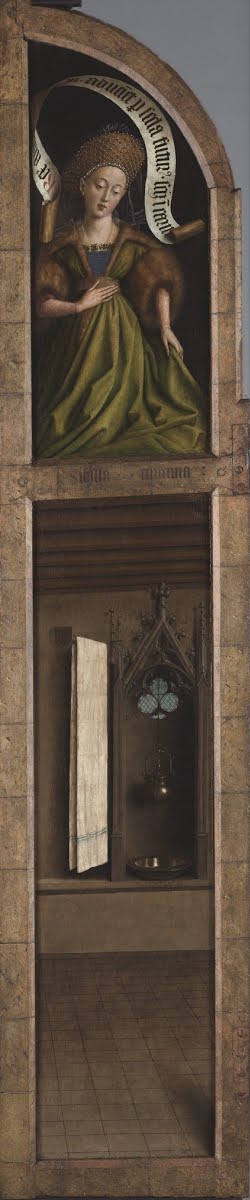
Details from Interior View: the washing alcove in the Ghent Altarpiece
Look closely: towel, vessel and basin
Published colour detail. MSK Ghent, French visitor guide (2020), p. 47. View publication. © Cathédrale Saint-Bavon, Gand / www.lukasweb.be–Art in Flanders vzw, photo Dominique Provost. Unmodified publisher image.
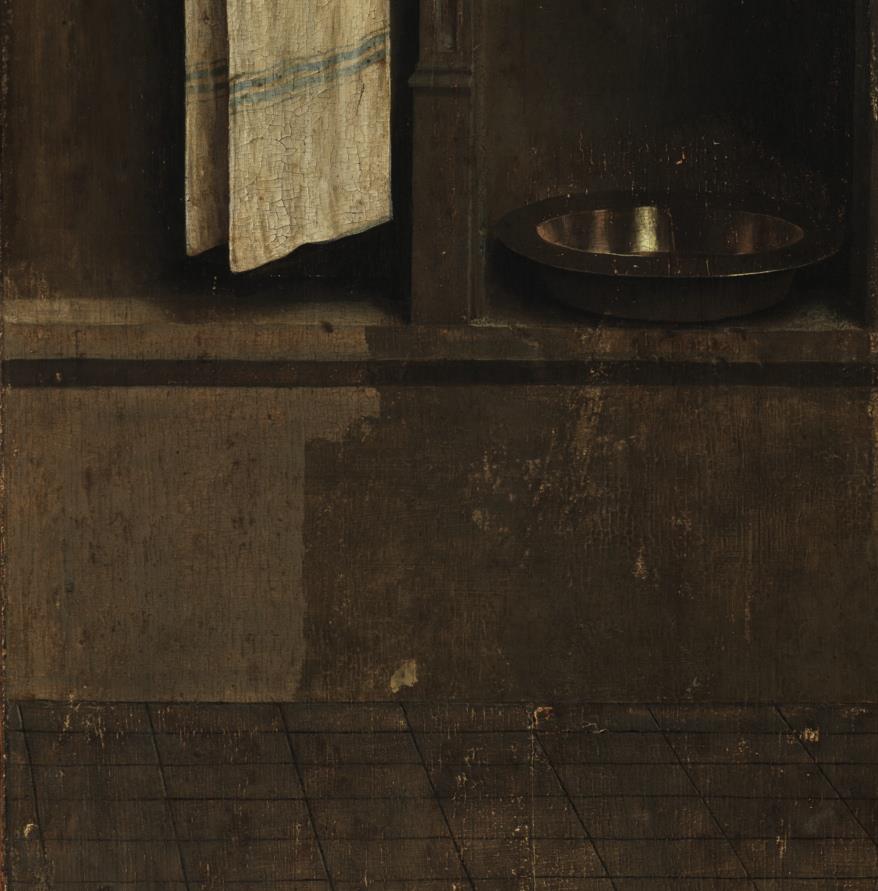
During treatment: the low wall
During overpaint removal; later paint remains at right. KIK-IRPA treatment report, p. 61, fig. 26. View publication. © KIK-IRPA. Unmodified publisher image.
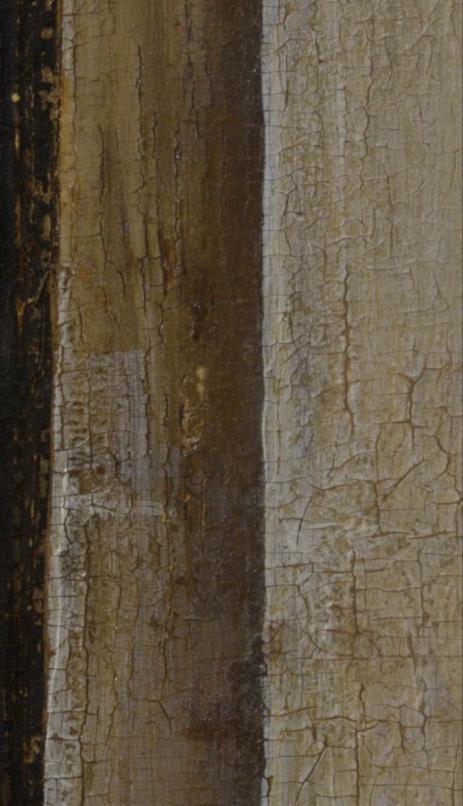
During treatment: the towel
During removal of old overpaint. KIK-IRPA treatment report, p. 61, fig. 27. View publication. © KIK-IRPA. Unmodified publisher image; not a final-state comparison.
Looking into the recess
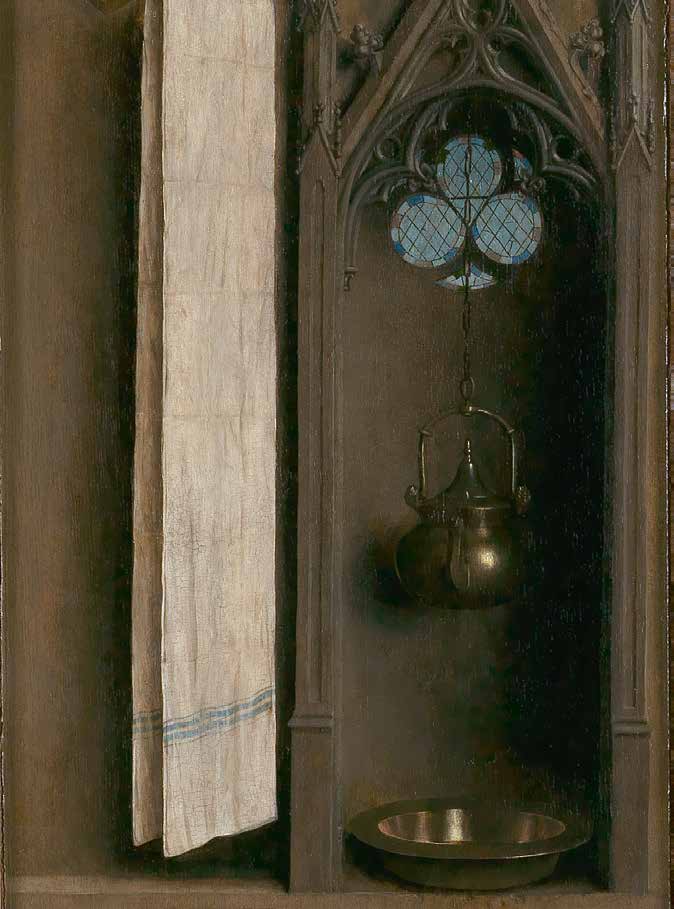
The published restored view shows a striking contrast between the towel’s broad pale surface and the dark cavity beside it. The cloth falls from a projecting support rather than lying flat against the rear wall. Its lower edge hangs above the ledge, and narrow blue bands cross near its foot. Long, uneven folds draw the eye downwards. Beside them, the basin’s curved rim interrupts the surrounding straight lines.
The vessel hangs above the basin on a chain. Its rounded body catches small bright accents, while much of its outline remains submerged in shadow. The basin below offers a wider surface to the light. These are different ways of describing reflective objects: a few glints make the hanging container legible; a broad illuminated band establishes the shallow receptacle. Neither needs a surrounding human figure to explain its apparent volume.
Higher in the niche, three rounded lights form a small glazed opening. Their tracery introduces a repeated, curving pattern beneath the pointed architectural decoration. The opening’s bluish colour gives the eye a cool accent above the warmer metal. It is important to look at the whole vertical arrangement: glazing, chain, vessel and basin form an axis, while the towel hangs to one side. The objects are distributed rather than piled together.
In the complete panel, the utensils occupy only part of a taller architectural field. Below the ledge, the tiled floor stretches towards the viewer. Above, the timber ceiling marks the room’s overhead limit. The patterned frame separates this domestic space from the sibyl’s compartment. A close-up brings the washing equipment forward, but the complete view restores its scale within a narrow shutter.
One room across four sections
Lukas’s restored-exterior feature explains that the four Annunciation panels form a single room. The two broad sections contain the angel and Mary; the narrow middle sections provide an outward view and an inward recess. The feature specifically identifies a towel, pot and basin in this second middle section. Those objects help the apparently unoccupied stretch of architecture register as a furnished home rather than an empty interval.[3]
The difference from the neighbouring street view is immediately visible in the published ensemble: one section opens towards buildings and activity beyond the room, while this one gathers attention around a dark wall recess. Looking moves outwards and then back towards domestic equipment before reaching Mary. The alcove gives that movement a pause. It also prevents the distance between the principal figures from becoming merely blank ground.
In the French visitor guide for the MSK’s 2020 exhibition, the copper vessel and basin exemplify objects that both reflect and absorb light. The guide connects such still-life passages with the illusion of space and describes painted frame shadows as if illumination also came from the spectator’s surroundings. Here the bright basin rim and the projecting towel make different demands on the eye: metal catches the light, while cloth displays it across a larger, folded surface.[4]
Convincing space, complicated viewpoints
Leen Huet’s Dutch account of the exhibition draws attention to the combination of viewpoints in the closed Annunciation. The room is seen from a relatively low position, while the outlook over the city is much higher. She treats the result as visually effective despite its geometric inconsistency. This is a useful distinction when examining the recess: the painting can persuade through light, overlap and familiar furnishings without providing a single architectural plan that could be built from its lines.[5]
An older observer responded differently. In 1912, W. H. James Weale compared the central room with the end compartments and noted discrepancies in walls, ceiling and street levels. He considered them evidence of different painters. His description also records the small traceried opening, suspended metal vessel, basin and long towel. The observations remain part of the work’s reception, while his attribution argument should be recognised as a historical conclusion rather than a settled identification of the hand that painted these objects.[6]
Watch: Jan van Eyck in context
Choose a Smarthistory close reading of the Arnolfini Portrait or the closed and opened Ghent Altarpiece.
Van Eyck, Ghent Altarpiece (1 of 2)
Explore the Annunciation, donors and painted sculpture on the closed altarpiece.
Watch on YouTubeThe cloth’s placement is especially effective in the close view. Its narrow top and wider visible face establish an angle against the wall, giving the viewer something to read obliquely. The dark interval behind it makes the light textile seem to stand away from the masonry. The basin’s ellipse supplies another cue to depth. Together they make the niche intelligible through objects and shadows, even before one follows the more demanding construction of the surrounding room.
Washing equipment and Marian meanings
Bernhard Ridderbos’s study of the Mérode Altarpiece explicitly compares its washing niche with the one at Ghent. He relates the laver and basin to Marian purity and discusses the older interpretation connecting such equipment with the fountain and living waters of the Song of Songs. He also notes that comparable niches existed in domestic and ecclesiastical settings. Their presence alone therefore does not establish that Mary occupies a literal church interior.[7]
Ridderbos cautions against assuming that every item in a religious picture must possess a hidden meaning. Applied to this comparison, that distinction allows the Ghent utensils to remain recognisable equipment while carrying devotional associations. A proposed meaning for washing does not require inventing an act of washing at the instant Gabriel speaks. Mary remains in the neighbouring section, and no hand reaches towards the basin.[7]
Carla Gottlieb’s 1970 article in the bulletin of Belgium’s Royal Museums offers a more elaborate interpretation. She reads the room through the Song of Songs and Christian church imagery, relating the central shutters’ opening to a sacred doorway. Her French summary connects the washing basin with baptism and the Baptist visible in the open ensemble. This differs from a simple identification of household furnishing. It is an argued symbolic reading, not an explanation preserved from the painters or patrons.[8]
French scholar Stéphane Lojkine likewise makes the two central openings important to his interpretation of the altarpiece as a threshold. His 2016 essay contrasts the urban outlook with the washing niche and its projecting towel, then relates their position to the physical opening of the wings. The approach directs attention to how the painted domestic view participates in an object that moves. It remains a modern interpretation: it does not establish that every fifteenth-century spectator read the towel through the same theoretical scheme.[9]
A comparison preserved in Rotterdam
Museum Boijmans Van Beuningen provides a particularly close later comparison: an anonymous panel of about 1470–1480 showing books, a washing vessel, a basin and a white towel within a niche. The museum identifies it as the reverse of a Marian image and explicitly compares its equipment with the Ghent Annunciation. Its catalogue connects the books with devotion and washing with purity, while noting the beginnings of later still-life interests.[10]
The Rotterdam object helps distinguish resemblance from identity. It is a small, later picture with its own reverse-side relationship to Mary, not a surviving detached component of the Ghent room. Its combination of meaningful furnishings and carefully observed objects demonstrates how productive such motifs could be beyond this commission. It does not prove that its anonymous maker copied the Ghent alcove directly or used precisely the same physical utensils.[10]
What examination changed
The 2020 conservation volume identifies the Interior View as the reverse of Eve, one of the two upper exterior units that escaped the nineteenth-century splitting carried out in Berlin. The domestic picture therefore remains part of a double-sided support. The same volume records changes to the position of the towel, rail and basin during the design process. Their convincing final arrangement was developed through revision rather than necessarily being fixed in the first drawing.[11]
The book also describes how removed overpaint had made the towel look stiff and heavily folded, whereas the uncovered fabric appeared more supple. These findings connect technical examination with an immediate visual issue: the difference between cloth that seems rigid and cloth that appears to hang. They do not settle which brother executed each stage. Support history, changes in design and later intervention are distinct kinds of evidence, even when they concern the same narrow passage.[11]
The Dutch treatment report supplies an important qualification. After overpaint was removed from the towel, another pigmented layer remained whose status could not be established conclusively, even after further investigation. Conservators left it in place. The report also records brown overpaint on the low wall and window edges, with brown stains visible on the original surface beneath. The published treatment photographs show stages in this investigation; they should not be mistaken for untouched originals or uniform final-state views.[12]
The wood behind the painted room
Pascale Fraiture’s 2013 tree-ring report examines the Adam and Eve supports, including the board carrying this exterior view. It identifies the left plank of Eve as coming from the same oak as the right plank of the Hermits. The connection links this narrow upper shutter materially with a different part of the altarpiece, without implying that their pictured subjects were painted together on one board.[13]
Fraiture proposes 1412 as the earliest possible manufacture date for the supports and explains why the interval between felling and use cannot be reconstructed precisely. A tree-ring result is consequently not an independent painting date for the towel or basin. The report’s Baltic timber evidence concerns the wooden object on which the room was made; the completed altarpiece’s 1432 date answers a different chronological question.[13]
Comparing the surviving records
Getty’s account of Closer to Van Eyck describes access to visible-light photographs, infrared reflectography and radiographs before, during and after conservation. Its project history distinguishes the first public release in 2012 from the expanded resource launched in 2017. For the alcove, the practical value is the ability to compare different witnesses rather than treating every reproduction as the same state of the painting. A treatment photograph documents an intervention; a complete colour view documents an appearance; a technical image answers another kind of question.[14]
The recess rewards attention at both scales. From a distance, a pale hanging shape and small flashes of metal enliven the gap beside Mary. Closer inspection reveals how the cloth turns, the vessel hangs and the basin catches the light. Restoring the full shutter then brings the sibyl, ceiling, ledge and floor back into view. The apparently modest household corner helps hold together an Annunciation whose principal figures remain separated across a broad painted room.
Related reading


Discussion
What do you notice in Interior View: the washing alcove in the Ghent Altarpiece? Share a close observation or a source that adds useful context.
Join the Conversation
Keep observations specific and evidence clear.
References
- Lukas–Art in Flanders, The Ghent Altarpiece: Interior View, object record and published colour image. View Source
- Saint Bavo’s Cathedral, English panel guide, closed exterior and washing alcove. View Source
- Lukas–Art in Flanders, The real Van Eyck revealed, Annunciation and interior details. View Source
- MSK Ghent, Van Eyck: Une Révolution optique, French exhibition visitor guide, 2020, p. 54; published detail p. 47. View Source
- Leen Huet, Van Eyck: De optische revolutie, Openbaar Kunstbezit Vlaanderen, 2020, p. 19. View Source
- W. H. James Weale, The Van Eycks and Their Art, 1912, pp. 51–52. View Source
- Bernhard Ridderbos, Choices and Intentions in the Mérode Altarpiece, Journal of Historians of Netherlandish Art 14, no. 1, 2022, Marian metaphors, symbolism and notes 57–58. View Source
- Carla Gottlieb, “En ipse stat post parietem nostrum”: The Symbolism of the Ghent “Annunciation”, Bulletin des Musées royaux des Beaux-Arts de Belgique, 1970, pp. 75–78 and French summary pp. 97–98. View Source
- Stéphane Lojkine, Iconologie de la fable mystique. Le retable de Gand à la lumière du De icona de Nicolas de Cues, Presses universitaires de Provence, 2016, section on the opening as a threshold; author’s university text. View Source
- Museum Boijmans Van Beuningen, Stilleven met boeken en wasbekken in een nis, anonymous, c. 1470–1480, inventory 2469 verso (OK), catalogue and curatorial response. View Source
- Bart Fransen and Cyriel Stroo, editors, The Ghent Altarpiece: Research and Conservation of the Exterior, KIK-IRPA, 2020, pp. 47–51, 138–139 and 216. View Source
- KIK-IRPA, Behandelingsverslag Lam Gods, Fase 1: 2012–2016, p. 61, figures 26–27 and towel treatment. View Source
- Pascale Fraiture, Report of Dendrochronological Analysis: Ghent Altarpiece, Adam and Eve, 21 October 2013, pp. 24–25. View Source
- Getty Foundation, Closer to Van Eyck, project account and imaging history. View Source


 Jan van Eyck.jpg)
 Jan van Eyck.jpg)


