


 Buy Art Prints Now
from Amazon
* As an Amazon Associate, and partner with Google Adsense and Ezoic, I earn from qualifying purchases.
 by Tom Gurney
Tom Gurney BSc (Hons) is an art history expert with over 20 years experience
Page Created on June 19, 2020 / Page Updated on November 1, 2026
Email: tomgurney1@gmail.com / Phone: +44 7429 011000
Virgin and Child with Saints Michael and Catherine: the Dresden Triptych
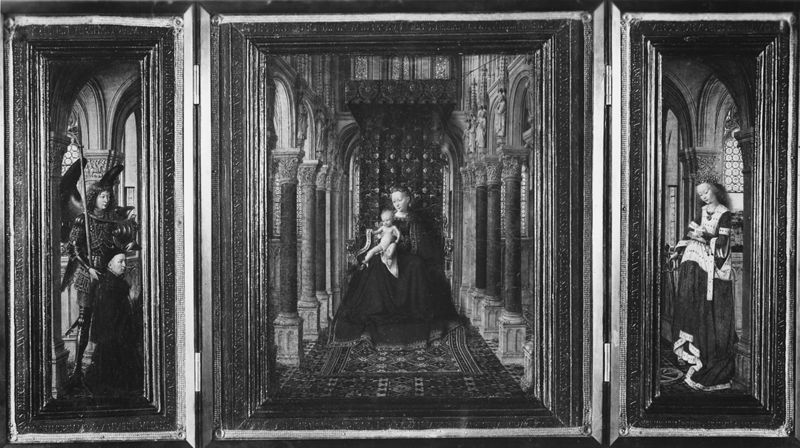
Jan van Eyck’s Dresden Triptych, completed in 1437, brings a kneeling patron into the presence of the Virgin and Child. Michael stands beside him on the left wing; Catherine reads on the right. Shut the wings and this coloured church interior disappears behind an Annunciation painted to resemble sculpture. The Dresden museum describes the unusually small work as an image for private devotion. Its two states give that devotion a physical action: opening the doors reveals the child whose coming the exterior announces.[1]
The painting belongs to the Gemäldegalerie Alte Meister, Dresden, inventory 799. Belgium’s KIK-IRPA records oil on oak, a height of 33.1 centimetres, a central width of 27.5 centimetres and wing widths of 13.6 centimetres. These measurements include more than the narrow painted openings familiar from cropped reproductions. The frame, with its prayers, heraldry and completion inscription, belongs to the evidence. Looking only at the figures leaves out much of what makes this particular object intelligible.[2]
At a Glance
Open and closed views

Compare the open triptych with its frames
A folding object with five painted faces
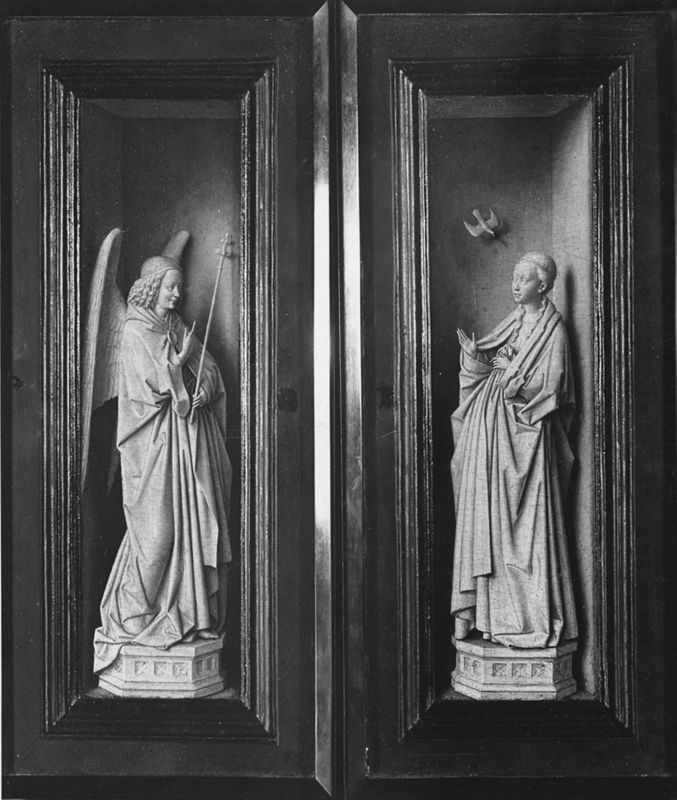
The word triptych describes three panels, but Dresden contains five painted faces: the centre, the two inner wings and their reverses. The exterior has its own complete subject. Gabriel occupies one niche and Mary the other, with the descending dove above her. Their pale bodies and folded garments suggest small sculpted figures. When the wings part, the two halves of that Annunciation turn away, and Michael and Catherine take their places around the enthroned mother and child. Both views were planned for the same object.[3]
There is a difference between seeing photographs of these surfaces and seeing the painting change. A photograph usually fixes the wings in a single position, flattening their relationship. The original hinges allow the object to occupy space, with one image gradually concealing another. The central panel remains stationary while the doors perform the transition. This makes the Virgin’s appearance inside particularly effective: colour, textiles and an inhabited church replace the quieter apparent sculpture on the outside. The revelation depends on joinery as well as on brushwork.[3]
Hélène Verougstraete’s technical study classifies the central frame as semi-integral: some mouldings are carved from the support itself, while others are separate pieces attached across it. Her diagram distinguishes this construction from a panel inserted into a fully separate grooved frame. Dresden also has a small outer ledge. The distinction explains why removing an original frame can mean altering the support, rather than simply changing a detachable accessory.[13]
Her measurements study observes that the closed triptych’s width lies near the historical Bruges foot. This is a relationship worth noticing, not proof of a rigid workshop standard controlling every dimension. The frame’s paint also imitates other materials: marble effects accompany a brown border carrying apparently raised lettering. Oak, carved moulding and painted illusion therefore cooperate in the object’s costly appearance.[13]
The format changes the relation between size and ambition. The centre can encompass a throne, several architectural bays and a carpet within a space little wider than an ordinary page. Each wing is narrower still. Van Eyck uses these limits to concentrate attention. Michael’s lance and Catherine’s sword fit the tall side openings; the seated Virgin and her spreading mantle occupy the broad centre. Their proportions respond to the wooden structure rather than being three interchangeable pictures placed in matching borders.[3][4]
A church made for close inspection
The opened triptych establishes a church interior with a central vessel and side aisles. Rounded arches and substantial columns give the space weight. Above them, smaller niches, carved figures and upper windows make it rise beyond the main company. William Henry James Weale’s detailed description records the combination of Gothic bases, Romanesque capitals and varied glazing. The mixture matters more than assigning the whole building a single architectural label. Van Eyck constructs a setting in which different kinds of stonework, ornament and light can be studied together.[3]
Follow the paving from the foreground towards the Virgin. Its small units establish a ground beneath the figures, while the columns lead the eye past them. The carpet introduces a second order of pattern over that floor. Behind Mary, the cloth of honour interrupts the recession and holds attention at the throne. The scene therefore offers two directions of looking: inward along the building, and directly towards the mother and child. The vertical cloth keeps the central pair from becoming simply another incident deep within a complicated interior.[3]
The architecture continues visually towards the wings, but the frames preserve distinct entrances into it. Michael and the donor occupy the left aisle; Catherine stands in the right. Their architectural surrounds establish kinship with the centre without erasing the real intervals between the panels. A column near a panel edge can belong to an imagined church while also reminding the viewer where one painted surface stops. The result is a carefully negotiated unity, with the physical divisions still visible.[3][4]
The view behind Catherine adds another scale. Beyond her window are buildings, fields, hills and more distant mountains. This landscape is a small opening within an already miniature painting. Its effect differs from the great panorama in the Rolin Madonna: here the outside world arrives as a glimpse beside the saint. It makes the church feel situated within a wider creation, even though the painting supplies no secure map reference. Identifying a town from this little prospect would require evidence beyond resemblance.[3]
Light helps articulate these spaces without making every visible window an exhaustive explanation of every highlight. Catherine’s pale face remains distinct against the darker architecture behind her; Michael’s metal catches a different range of reflections; Mary’s dress gathers deep shadows. Weale’s account even preserves an older critic’s concern that Catherine receives light despite standing before a window. Such observations reveal how actively the picture has invited scrutiny. Its convincing surfaces need not amount to a literal record of one building under one reproducible set of lighting conditions.[3]
Mary, the Child and the miniature throne
Mary wears a deep blue dress beneath her ample red mantle. Its ornamented edge travels through numerous folds before reaching the carpet. Her hair falls around her shoulders, held above the forehead by a jewelled band. Van Eyck distinguishes the softness of hair, the weight of cloth and the small bright accents of ornament. Mary’s body is seated and contained, but the mantle expands across the base of the composition, giving the central image a breadth the upright saints do not share.[3]
The naked Child rests on a light cloth across her lap. He holds a long scroll bearing words from Matthew 11:29, calling the reader to learn from his gentleness and humility. This is a teaching gesture addressed through writing. The little body and the extended band of text make different demands on the viewer: one is immediately recognisable, while the other requires proximity and reading. Mary supports him with both hands. The encounter is physically tender even as the throne and surrounding texts establish an elevated sacred presence.[3][4]
The throne is populated with very small figures of its own. Weale identifies Abraham’s sacrifice and David’s victory over Goliath among its narrative ornaments, with a pelican and phoenix below. These are not additional people attending the gathering at the same scale as Michael or Catherine. They belong to the represented furniture. Their miniature scale encourages the eye to shift between the main figures and the objects those figures inhabit, discovering another layer of narrative within an apparently practical seat.[3]
Read in Christian terms, Abraham and Isaac evoke the offering of a beloved son, while David’s victory offers a model of deliverance through an apparently unequal struggle. The pelican feeding its young and the phoenix returning to life similarly direct thought towards sacrifice and renewed life. These associations help explain why the throne is appropriate to Christ’s childhood here. Its imagery allows the small Child to be understood in relation to the later work of salvation, without inserting a large Crucifixion into the central panel.[3][11]
The brocade behind them contains foliage, fruit and animals. Weale recorded lions and unicorns among its repeating motifs. They reward close looking without overthrowing the clear central arrangement. From farther away the textile works as an emphatic dark, patterned backing; nearby it becomes a field of minute distinctions. A reproduction enlarged to fill a screen reverses this original experience. Details appear easy to inspect that would have required excellent eyesight in front of an object only about thirty-three centimetres high.[3]
Antoni Ziemba makes that effort of viewing central to his discussion of the triptych. The minute ornaments, distant town and small lettering require sustained scrutiny; following the frame sentences also involves an awareness of the object’s edges and orientation. His account helps restore the viewer’s bodily involvement to an image often encountered as a flat illustration. Reading the scroll and inspecting a throne ornament are different activities from recognising a Madonna. Van Eyck provides for all three within the same small space.[10]
Michael and the man he presents
Michael is a splendid armed protector, with multicoloured wings rising behind him. His lance establishes a strong vertical near the outer side of the left panel. A helmet rests against his arm; straps and armour introduce smaller divisions across his body. The metal is decorative and reflective, but it also belongs to the archangel’s martial identity. His bearing differs from the kneeling man’s. The standing heavenly figure makes the petitioner’s admission to the central presence feel mediated, rather than presenting the donor as an equal member of the holy company.[3]
The man wears a dark green, full-sleeved garment and a red head covering whose fabric extends down his shoulder. His small hands are held apart in prayer. Contemporary clothing makes him recognisably a person of Van Eyck’s own world, while his posture sets that worldly identity within a devotional act. A ring and fur trimming add to the specificity of his appearance. They suggest expense and social presentation, but neither a ring nor a fashionable collar supplies an individual name.[3][4]
The contrast between the two figures is especially effective at their shoulders. Michael’s armour opens into curves and bright highlights; the donor’s garment is subdued and more absorbent of light. Above the donor, a young, idealised protector rises in a costly suit of metal. Below him, an older human face looks towards the centre. The visual relationship makes protection legible before the viewer reads the frame’s praise of Michael. It also gives the patron a more active role than a little ownership emblem placed outside the sacred scene.[3]
Watch: Jan van Eyck in context
Choose a Smarthistory close reading of the Arnolfini Portrait or the closed and opened Ghent Altarpiece.
Jan van Eyck, The Arnolfini Portrait
Look closely at the room, mirror and gestures in the London double portrait.
Watch on YouTubeCalling him a donor remains useful even while his identity is unresolved. His portrait shows the human beneficiary of the prayer image and connects the object with an act of patronage. It does not tell us whether every stage of the transaction passed through his own hands. A family member or business intermediary could arrange a commission, and a portrait could commemorate someone other than the person who delivered payment. Those possibilities become relevant when documentary evidence names merchants without recording the purchase of a painting.[3]
Catherine’s book, sword and wheel
Catherine occupies her panel with a quieter kind of authority. She reads an open book while holding a sword whose point reaches the floor. The broken wheel beside her and the blade recall her martyrdom; the book identifies an intellectual and devotional activity rather than a military one. A crown, necklace and richly finished dress give the saint a royal appearance. Together, these attributes allow her to be recognised through several kinds of evidence: learning, rank and the instruments associated with her death.[3]
Her clothing provides one of the triptych’s most striking passages of colour. Blue fabric hangs in broad vertical folds, while the white ermine garment breaks that surface with small dark markings. Its edges and openings reveal further layers of blue. Long hanging sleeve elements give the costume its elaborate silhouette. The sword, by contrast, is slender and firm. Van Eyck balances a large area of cloth against a very thin object whose significance is disproportionate to the space it occupies.[3][4]
The reading figure also sets a different pace beside the donor’s prayer. He faces inward with his hands raised; Catherine lowers her attention to the pages. These activities can be held together within the opened work without becoming identical. A viewer may look towards the Virgin with the donor, inspect the words of the Child’s scroll, then encounter Catherine as another image of attentive reading. The book is therefore part of the painting’s account of devotion as well as an identifying attribute.[3]
Weale once inferred that Catherine’s presence might imply a learned donor, perhaps an orator or philosopher. That is a historical suggestion, not an established biography. The saint’s intellectual associations do not prove the sitter’s occupation, any more than Michael proves his first name. Catherine’s place could reflect several forms of attachment or patronal choice. Her panel remains fully intelligible as the representation of a reading royal martyr even where the specific reason for choosing her is lost.[3]
What the frame asks its reader to remember
The central frame praises Mary through biblical language of brightness, purity and fruitfulness. Weale’s transcription traces its phrases to Wisdom 7:26 and 7:29 and Ecclesiasticus 24, also known as Sirach. The passage moves from comparison with the sun and stars to the image of an immaculate mirror, then to vine and fruitful flowers. These are several linked sources, rather than one continuous quotation from a single biblical verse. Their arrangement gives the central image a verbal setting as elaborate as its painted church.[3][4]
The mirror here is a metaphor in the inscription. It need not be confused with a represented household mirror or used to turn every reflective highlight into the same symbol. The text directs an educated reader towards Mary’s relation to divine splendour; the painted jewels, textile and luminous flesh make a material counterpart to that praise. Image and writing approach their subject through different means. One shows the bodily presence of mother and child, while the other supplies a language for the status of the enthroned woman.[3][4]
Michael’s frame celebrates his leadership among the angelic hosts and his advocacy for human souls. Catherine’s text describes a prudent virgin aspiring to a heavenly seat, separating valuable grain from chaff and following Christ after relinquishing worldly honours. Such words make the inscriptions more than identifying labels. Michael’s protective role is expressed as something beneficial to people, and Catherine’s royal appearance is accompanied by a text about spiritual renunciation. Reading introduces ideas that clothing alone cannot communicate.[3][4]
The Catherine hymn also widens the geographical context. Weale located it in medieval office books used in the diocese of Liège and in a Tournai breviary printed in Paris in 1497. These witnesses show the text’s circulation across the southern Netherlands and France. They do not establish that a book printed sixty years after the painting was Van Eyck’s source. The later printed breviary is evidence for a continuing liturgical tradition, not an item that could have lain in his workshop in 1437.[3][4]
The lower central inscription names Jan and states that he made and completed the work in 1437. His device ALC IXH XAN, commonly rendered “as well as I can,” accompanies that claim.[5]
The painted lettering imitates raised inscription rather than treating the frame as a plain sheet of writing. Highlights make the words seem materially present in the mouldings. This introduces another distinction between reality and representation: the wooden border is real, but the apparent precious lettering is an effect achieved in paint. The viewer meets an object that advertises skill at its very edges. Omitting those edges from a reproduction removes part of the relationship between sacred praise, costly appearance and the painter’s own work.[3]
The Annunciation behind the open doors
On the exterior, Gabriel and Mary stand on individual polygonal bases in shallow niches. The restricted palette imitates carved bodies, and the folds appear harder than the coloured cloth inside. Gabriel’s raised hand and Mary’s answering gesture carry their exchange across the central division. The dove provides another indication of the subject. This is an announcement made through two apparently separate statues, with the division between the wings turned into a meaningful interval between speaker and respondent.[3][4]
The niches are not merely empty dark backgrounds. Their sides and the projecting bases create small, measurable spaces around the figures. Hélène Verougstraete and Wim Verbaal have drawn attention to the oblique geometry of Dresden’s exterior: the recesses and bases read as though the doors were slightly ajar. They interpret these small directional cues as invitations towards opening. This is a study of how perspective can guide a viewer’s action, rather than evidence for a rule requiring the owner to stop at one prescribed hinge angle.[9]
The separate Annunciation Diptych in Madrid offers a useful comparison, but it is a different surviving object. The Thyssen-Bornemisza museum likewise discusses sculptural illusion, fictive framing and the separation of Gabriel from Mary, and explicitly compares its panels with Dresden’s exterior. Its current dating remains approximate. Dresden’s signed completion year should not be used to give that undated diptych an equally certain year, or to imply that the Madrid panels once served as these wings.[12]
The difference between exterior and interior makes sense without describing the first as spiritually empty and the second as alive. Both are painted sacred representations. The exterior’s Annunciation is the beginning of the event the interior embodies in Mary’s motherhood. Its sculpture-like figures can sustain attention while the object is closed. Opening adds colour, the donor’s portrait and a more expansive church, but it does not replace a meaningless cover with the only significant image.[3][4]
Heraldry and the unresolved donor
An eagle above a three-towered castle on the donor’s frame connects the object with the Genoese Giustiniani. The companion shield on Catherine’s side remains unidentified. In his 2019 study, Till-Holger Borchert reports technical confirmation of the arms’ authenticity and improvement through careful restoration. That gives the heraldry firmer standing than an account that leaves it as a possibly unrelated late addition. Nevertheless, original arms identify an affiliation more readily than an individual face. Borchert keeps the donor question open and stresses the possible importance of the second shield.[6]
The best-known earlier proposal was Michele Giustiniani. A modern archival alternative comes from Noëlle Streeton’s study of the 1438 Borromei ledger: Raffaello Giustiniani is described as being of Bruges and appears in transactions involving Middelburg and Antwerp. This places a family representative in the relevant commercial world near the triptych’s completion. Streeton considers a patron or intermediary role; the entries contain no identified payment for this picture. The evidence cannot convert Raffaello’s documented banking activity into a securely named portrait.[5]
Borchert adds a useful caution: surviving accounts represent only part of the commercial community, and the Giustiniani name covered a wider Genoese association of families. A candidate’s appearance in one surviving ledger need not make him the only possible commissioner. Nor does the presence of Michael alone settle the question in favour of someone named Michele. The material and written clues narrow the context while leaving room for relationships that the surviving records do not describe.[6]
Changes beneath the finished surface
The triptych’s polished appearance should not be mistaken for a design executed without revision. In her review of the Dresden exhibition catalogue, Sue Jones discusses its account of alternative positions for the donor’s hands beneath the paint: an initial prayer gesture and a more widely separated arrangement precede the final result. She questions a simple one-way derivation from the hands of Saint Francis in the related Eyckian paintings. Similarity can reveal a shared problem of pose without establishing which composition supplied the first solution.[7]
Further examination continued after those findings. Uta Neidhardt’s 2012 conference abstract reports that infrared reflectography undertaken in 2011 revealed significant underdrawing in the Virgin-and-Child group. Her announcement emphasises how improved examination repeatedly altered the understanding of Van Eyck’s working process. It supports the existence of substantial planning changes; the abstract alone does not provide enough information to reconstruct every discarded arrangement. A diagram purporting to show an exact earlier position would require the published technical images and their detailed interpretation.[8]
KIK-IRPA’s record also lists an intervention file from 2016 under scientific imaging. The listing documents continuing investigation; it does not publish the file’s results. Together, these records show that a signed and dated painting can still pose questions about execution. Dating, identification of a patron and reconstruction of a working sequence require different evidence. Certainty about 1437 does not make every earlier drawn line, painted shield or archival name equally certain.[2]
Collecting, restoration and rediscovery
The later history includes a probable Gonzaga identification, an English royal phase marked on a wing, and eventual Saxon ownership. Streeton relates the work to a 1597 Gonzaga shipment and records Charles I’s collector’s mark. These later traces do not bridge the missing history from its first owner. The important 1959 removal of covering paint exposed Jan’s name, motto and completion date, changing the basis of attribution and chronology.[5]
French collecting supplies another witness. Weale records the triptych as number 266 in the inventory of Everard Jabach, drawn up on 17 July 1696, where it was assigned to Hubert van Eyck. His historical bibliography then tracks changing Dresden catalogue labels: Dürer in 1765, an unknown German master in 1817, Hubert in 1840 and Jan in 1846. These are records of changing descriptions, not a claim that all labels had equal merit. The surviving painting was repeatedly reinterpreted as information and judgments changed.[3][4]
Weale himself, writing in 1908, believed that the original frame bore neither Jan’s name nor his motto. He consequently entertained Hubert’s authorship and possible later completion by Jan. The statement is especially revealing because the frame now supplies precisely the evidence he thought absent. What had been covered could not contribute to his argument. Reading his careful descriptions remains valuable, provided his attribution theory is understood as a stage before the inscription’s rediscovery rather than a current alternative established by documentation.[3]
The painting’s reputation also travelled through reproduction. The Mills College Art Museum holds a nineteenth-century engraving after it by Hugo Bürkner. Maggie Freeman’s catalogue study notes his HB 1888 monogram added at the column base near the donor and discusses the translation of coloured surfaces into line and shadow. The mark belongs to the printmaker’s later interpretation, not to Van Eyck’s painted architecture. Reproductive images can preserve valuable details while also introducing their maker’s own claims and conventions.[11]
Seeing the whole triptych
Begin with the closed Annunciation, then compare its niches with the church inside. Look from the donor’s raised hands towards the Child’s scroll, and from Catherine’s open book towards the words on her frame. The objects and gestures establish connections that a list of symbols cannot fully convey. Across the five painted faces, learning, prayer, protection and revelation take several different forms. The small scale makes these connections intimate, while the architecture and throne enlarge their spiritual setting.[3][4]
The name of the painter and the completed year are secure; the kneeling patron’s personal identity remains unresolved. That balance is part of the triptych’s continuing interest. Its most important evidence survives in more places than the painted faces: on the frames, in the working changes, in a collector’s mark and in records that sometimes describe what later generations could no longer see. Read together, those traces reveal an unusually rich devotional object whose size conceals the extent of its invention.[2][3]
Related reading
 Jan van Eyck.jpg)


Discussion
What do you notice in Virgin and Child with Saints Michael and Catherine: the Dresden Triptych? Share a close observation or a source that adds useful context.
Join the Conversation
Keep observations specific and evidence clear.
References
- Gemäldegalerie Alte Meister, Dresden, Triptych of Mary and Child, St. Michael, and the Catherine, museum presentation on Google Arts & Culture; private devotion and 1437 attribution. View Source
- KIK-IRPA, Brussels, BALaT, Vierge dans l’Église, object 40004068, Dresden inventory 799; materials, dimensions and intervention-file listing. View Source
- W. H. James Weale, Hubert and John Van Eyck: Their Life and Work (1908), pp. 125–130 and 199–200; full object description, liturgical transcriptions and historical reception. Attribution conclusions predate the 1959 discovery. View Source
- W. H. James Weale and Maurice W. Brockwell, The Van Eycks and Their Art (1912), pp. 82–87; inscriptions, object description and earlier catalogue labels, with superseded attribution and donor proposals distinguished. View Source
- Noëlle L. W. Streeton, “Jan van Eyck’s Dresden Triptych: New Evidence for the Giustiniani of Genoa in the Borromei Ledger for Bruges,” JHNA 3:1 (2011), including notes and figures. View Source
- Till-Holger Borchert, “The Impact of Jan van Eyck’s Lost Lomellini Triptych and His Genoese Patrons,” Colnaghi Studies Journal 4 (2019), especially pp. 32–36 and corresponding notes; RKD-hosted publication. View Source
- Sue Jones, review of Das Geheimnis des Jan van Eyck, HNA Reviews; original critical discussion of the donor/Saint Francis comparison, reporting the 2005 catalogue’s underdrawing findings. View Source
- Uta Neidhardt, “News Concerning the Development Process of the Dresden Triptych,” Van Eyck Studies conference abstracts (Brussels, 2012), p. 52; abstract consulted, not the full 2017 chapter. View Source
- Hélène Verougstraete and Wim Verbaal, The Ghent Altarpiece and the Inscription on the Cloths of Honour behind Mary and John the Baptist, pp. 30–32, fig. 33; Dresden exterior perspective comparison. View Source
- Antoni Ziemba, The Agency of Art Objects in Northern Europe, 1380–1520 (2021), pp. 572–574, fig. 482; close viewing and physical handling, Library of Congress public copy. View Source
- Maggie Freeman, “Hugo Bürkner’s Print after Jan van Eyck’s Dresden Triptych,” Saints and Sinners, Mills College Art Museum exhibition catalogue, pp. 26–33; later print, HB 1888 mark and throne imagery. View Source
- Mar Borobia, The Annunciation Diptych, Museo Nacional Thyssen-Bornemisza; current dating and comparison with Dresden’s outer wings. View Source
- Hélène Verougstraete, Frames and Supports in 15th- and 16th-Century Southern Netherlandish Painting (KIK-IRPA, Brussels, 2015), pp. 101–102, 167–168 and 236–243, especially fig. 120; construction, proportions, profiles, polychromy and inscriptions. View Source

 Jan van Eyck.jpg)


