


 by Tom Gurney
Tom Gurney BSc (Hons) is an art history expert with over 20 years experience
Published on June 19, 2020 / Updated on November 6, 2026
Email: tomgurney1@gmail.com / Phone: +44 7429 011000
The Sixty-nine Stations of the Kiso Kaidō
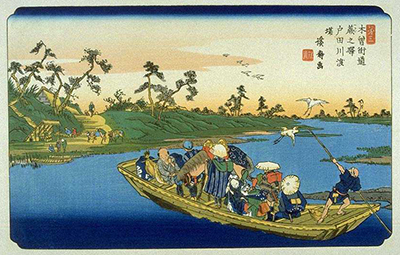
The Sixty-nine Stations of the Kiso Kaidō is a landscape-print series associated with two designers, Keisai Eisen and Utagawa Hiroshige. Its subject is the inland road between Edo, now Tokyo, and Kyoto: a route of mountain passes, rivers, settlements and stopping places. The series turns that extended journey into a sequence of individual encounters. Travellers work their way through weather and darkness while the landscape changes around them.
The familiar title can conceal two distinctions. These are colour woodblock prints, rather than a single painting, and Hiroshige did not design the entire series alone. Museum Wales identifies Eisen as the designer of twenty-four sheets, with Hiroshige responsible for the remainder. The individual print, its designer and its particular impression must therefore be identified before details from one sheet are applied to another. [1]
At a Glance
- ProjectColour woodblock print series
- DesignersKeisai Eisen and Utagawa Hiroshige
- SubjectThe inland road between Edo and Kyoto
Contents
An inland road and its stations
The Kiso road is associated with the Nakasendō, one of the major highways connecting the political and cultural centres of Edo-period Japan. A station was a practical place within that transport system, offering services and accommodation. In the prints, however, a station name can introduce much more than a view of an inn or a busy street. It can stand for a stretch of river, a bridge, a wooded slope or the atmosphere of approaching a settlement at night.
That relationship between place name and selected view is central to the series. The image is not a modern route diagram. It gives a locality a memorable visual identity. A traveller might know the road through physical effort and successive stopping places; a print buyer could assemble a different journey through recognisable designs.
The Cleveland Museum of Art describes the mountainous road and the appeal of viewing its scenery without undertaking the inconveniences of travel. This helps explain why the images can be both informative and imaginative. They offer access to distant places while also choosing the season, viewpoint and weather through which those places will be remembered. [2]
Eisen and Hiroshige
The joint authorship makes the series particularly rewarding to compare. Eisen's contribution belongs within the same publishing enterprise as Hiroshige's, but the designers should not become interchangeable names. Museum records for individual sheets preserve the distinction. An exhibition list from the Hiroshige Museum, for example, identifies Eisen's Fukaya Station and Nojiri: Distant View of the Ina River Bridge separately from Hiroshige's Matsuida and Nakatsugawa. [3]
Authorship is only one part of a print's identity. Publishers, block cutters and printers also contributed to its physical production. The designer's drawing supplied a composition that had to be translated into a system of carved blocks and printed colours. The resulting sheet is evidence of that collaboration as well as of one artist's conception.
This matters when comparing impressions. The same design may appear lighter or darker, with stronger or weaker gradations, in sheets printed at different times or preserved under different conditions. Those differences need not establish a new composition. Equally, a shared station name does not guarantee that two designs are the same image.
Nagakubo and the experience of moonlight
Hiroshige's Nagakubo provides a clear example of how the series transforms a stopping place into an atmospheric event. A bridge carries small figures across water, while trees and foreground travellers establish a nearer scale. The moon does not illuminate every surface equally. Instead, its presence encourages the viewer to read contrasting areas of light and dark as a nocturnal landscape.
The bridge performs several tasks at once. It is a structure through which the road continues, a stage for figures seen at a distance and a horizontal element that stabilises the composition. Its repeated uprights and moving silhouettes introduce a rhythm that differs from the irregular contours of the trees.
The foreground offers another tempo. A person, animal or roadside structure can be recognised as belonging to ordinary travel, while the distant figures are reduced almost to signs. The image therefore joins two experiences: the practical business of moving along a road and the broader sensation of looking into a moonlit setting. Neither cancels the other.
Dating a series and dating a sheet
Dates should be read at the appropriate scale. The National Gallery of Victoria places the series within 1834–42 and dates its Nagakubo impression approximately to 1834. Cleveland dates its example 1835 or 1836. These institutional descriptions show why a date attached to one museum sheet should not automatically become the production date of every impression or the whole series. [2] [4]
A general guide can locate the project in the 1830s and early 1840s while keeping individual catalogue dates with their records. This is more useful than presenting one precise year as though every station design and printing campaign appeared simultaneously.
The same principle applies to measurements. A museum may give image dimensions, sheet dimensions or both. A trimmed impression can have a smaller sheet without representing a different design. When comparing records, first establish what has actually been measured.
Landscape through economy
The prints can suggest extensive space through relatively few elements. A mountain profile, a band of mist, a bridge and a group of figures may be enough to establish a complicated relationship between foreground and distance. Areas without dense description are active parts of that relationship. They allow the eye to move between more concentrated passages.
This economy is particularly visible in water and sky. Rather than describing every ripple or cloud, a design can organise broad colour zones and a few decisive lines. A dark bank beside a light river creates a sense of depth; a small figure crossing the boundary supplies a measure of scale.
The effect should not be mistaken for a lack of observation. Selection is one of the skills of the series. The designer needs to decide which forms are essential to a place's pictorial identity and which would distract from the larger arrangement. The apparent simplicity is the result of that decision.
Reading the sequence
An individual sheet can stand alone, but a sequence changes how it is understood. A snowy road gains another meaning beside an image of heat or rain. An open view of water feels different after a confined passage through a town. The series repeatedly varies the relationship between human movement and the conditions through which it passes.
Viewers need not pretend to reconstruct an uninterrupted documentary journey. Instead, compare the alternatives that the prints offer: looking down from a height, approaching a bridge, seeing travellers from behind or discovering a settlement beyond a foreground obstruction. Each arrangement positions the spectator differently.
The lasting achievement of the Kiso road series lies in this combination of continuity and variation. The road supplies a shared structure. Eisen, Hiroshige and the makers of the printed sheets give particular places their own visual character. The journey remains recognisable, but the experience of travelling never becomes uniform.
Artworks and records
Selected documented works and records relevant to this article; this is not a complete catalogue.
| Name | Date | Record |
|---|---|---|
| Nagakubo | 1830s | |
| Itahana | 1830s | |
| Fukaya Station — Eisen | about 1835 |
Discussion
Share a reading of the figures, materials or relationships discussed in this article.
Reader Insights
Which detail most affects your reading?
Which comparison would you like to explore further?
Join the Conversation
Share a detail, comparison or question about The Sixty-nine Stations of the Kiso Kaidō below.
References
- Museum Wales, Sixty-Nine Stages of the Kisokaido: Itahana. View source.
- Cleveland Museum of Art, Nagakubo, 1942.144. View source.
- Shizuoka City Tokaido Hiroshige Museum of Art, 2024 exhibition list. View source.
- National Gallery of Victoria, Nagakubo, 524-2. View source.