


 by Tom Gurney
Tom Gurney BSc (Hons) is an art history expert with over 20 years experience
Page Created: 30 August 2026 / Page Updated: November 6, 2026
Email: tomgurney1@gmail.com / Phone: +44 7429 011000
Gustave Moreau: Introduction
In Oedipus and the Sphinx, the picture with which Gustave Moreau returned to the Paris Salon in 1864, two bodies are locked in a bare, unnerving contest of sight. Three decades later, Jupiter and Semele crowds a monumental throne with gods, victims, emblems, architecture and pulses of colour. The first work made Moreau's public reputation; the second, completed in 1895, gathers the ambitions of his late career into an almost overwhelming private vision. Together they show why this Parisian history painter cannot be reduced to ornament or fantasy. He used ancient and biblical narratives to ask how painting might embody thought, desire, danger and spiritual aspiration in a modern age.[1][2]
At a Glance
- Lived1826–1898; born and died in Paris
- Known forimaginative history paintings drawn from classical mythology, scripture and literature
- TrainingFrançois-Édouard Picot's studio and the École des Beaux-Arts, followed by close study of Théodore Chassériau and the old masters
- Key turning pointsan intensive Italian journey in 1857–59, the Salon comeback of 1864, the celebrated Salon group of 1876 and his appointment as a professor in 1892
- Working rangeoils, watercolours and an immense graphic practice, from rapid studies to full-size cartoons
- Essential legacya formative place in the history of Symbolism, an influential teaching studio and the house-museum he planned around his own work
Gustave Moreau in context
Neoclassical contexts
c. 1780–1850Romanticism
c. 1800–1850Symbolism
c. 1880–1910J.-A.-D. Ingres
1780–1867Eugène Delacroix
1798–1863Théodore Chassériau
1819–1856Gustave Moreau
1826–1898Edgar Degas
1834–1917Henri Matisse
1869–1954Orpheus
1865The Apparition
1876Galatea
c. 1880Saint George and the Dragon
1889–90Jupiter and Semele
1894–95Contents
- Introduction
- Why Gustave Moreau Matters
- Paris, Picot and the Example of Chassériau
- Italy as a Working Archive
- The Salon Return and a Selective Public Career
- Public Pictures and the Private Studio
- Myth, Scripture and the Salomé Problem
- Drawing and Watercolour: The Engine of Invention
- Eight Works as Different Ways In
- The Teacher, 1892–1898
Why Gustave Moreau Matters
Moreau inherited the institutions and procedures of French history painting: formal training, ambitious narrative subjects and the Salon as a testing ground. Yet he redirected that tradition away from straightforward public instruction. His protagonists face riddles, visions, forbidden knowledge and destructive revelation. Setting and costume may be assembled from many visual sources, but the result is rarely an archaeological reconstruction. Moreau made the old story into a charged mental event.
That choice matters because it cut across the dominant story of later nineteenth-century French art. While painters of modern life turned to streets, cafés and changing light, Moreau continued to work with Oedipus, Orpheus, Salomé, Galatea and Jupiter. The National Gallery describes his project as maintaining religious and mythological painting during the rise of Naturalism.[3] He did not merely preserve the genre, however. He stretched its surfaces, slowed its narratives and made ambiguity productive.
His importance also lies in the range hidden behind the familiar ornate paintings. Drawing structured his compositions from the first search for a pose through tracing and enlargement. Watercolour gave him another tempo: sometimes controlled and minutely worked, sometimes comparatively loose. Late canvases could remain open, provisional or repeatedly transformed. To see Moreau clearly, it helps to move between the finished public image and the much larger studio process preserved in Paris.
Paris, Picot and the Example of Chassériau
Moreau grew up in a cultivated Parisian household. His father, the architect Louis Moreau, encouraged a classical education, while the young artist drew persistently. From 1844 to 1846 he worked in the private studio of François-Édouard Picot, a Neoclassical painter whose pupils prepared for the demanding entrance competition to the École des Beaux-Arts. Moreau entered the school in 1846 but left in 1849 after twice failing to win the Prix de Rome. He then copied in the Louvre and obtained some state commissions.[4]
Academic formation gave him more than a style. It established habits of preparation, figure study and comparison with earlier art that remained central even when his imagery became difficult to classify. A decisive personal example came from Théodore Chassériau. Moreau befriended him in 1851 and took a studio nearby. Chassériau's combination of Ingres-like line with Romantic colour and drama offered a model for crossing categories that official art culture often kept apart. His death in 1856 left Moreau without that close point of reference, shortly before the younger painter undertook a far more systematic encounter with Italian art.[4]
The results should not be understood as passive eclecticism. The Musée Gustave Moreau explains that prototypes associated with Michelangelo or Leonardo, precise linear models and the sinuous movement found in miniature painting could be brought into a new synthesis.[5] What distinguishes Moreau is not the absence of borrowing but the pressure he put upon heterogeneous material until it entered his own pictorial grammar.
Italy as a Working Archive
Moreau left for Italy in October 1857 and returned to Paris in September 1859. Rome, Florence, Milan, Venice and Naples became stages in a planned programme of research rather than stops on a leisurely tour. He copied Renaissance paintings and frescoes, studied antiquities and anatomy, filled sketchbooks and made landscapes. In Rome he worked after Michelangelo, Raphael and Sodoma; in Florence he studied artists from early Tuscan painting to the Mannerists; in Venice, Carpaccio's narrative cycles proved especially important. He also met Edgar Degas during the journey.[5][6]
Copying allowed Moreau to analyse how another artist organised a body, a procession, a colour interval or a storytelling sequence. These studies became a repertoire that he could revisit, not a set of finished answers. His encounter with Carpaccio, for example, would remain relevant when he reworked the legend of Saint George decades later. Italian art gave him a deeper historical vocabulary, but it also sharpened his determination to renew history painting rather than imitate its monuments.
This distinction helps explain the strangeness of his mature work. Architecture may recall a church, palace or stage without becoming one identifiable building. A figure can carry the poise of Renaissance art while inhabiting a space that obeys dreamlike rather than naturalistic logic. The journey supplied visual material; Moreau's subsequent invention changed its function.
The Salon Return and a Selective Public Career
When Moreau returned to the Salon with Oedipus and the Sphinx in 1864, he presented a deliberately severe encounter. The winged monster grips Oedipus's body and stares directly into his face; fragments of earlier victims remain below. The Metropolitan Museum records that the work made Moreau's mark at the exhibition, where its unusual concentration turned a familiar myth into a struggle with an existential riddle.[1] It established that a traditional subject could still feel psychologically immediate.
The next years brought public success and frustration. Orpheus, dated 1865 and shown at the 1866 Salon, replaces violence with an ambiguous act of contemplation: a young Thracian woman holds the dead poet's head on his lyre. The state purchased the painting in 1866.[7] In 1869 Moreau exhibited Prometheus and The Abduction of Europa, won a medal and endured hostile criticism. He then stayed away from the Salon until 1876.[4]
That return was exceptionally concentrated. The group included Hercules and the Lernaean Hydra, Salomé Dancing Before Herod, Saint Sebastian and the watercolour The Apparition. The Art Institute of Chicago's Hercules turns combat into a poised confrontation between the hero and the many-headed creature.[8] The Hammer's Salomé makes performance itself the dangerous centre of the story, while the Orsay/Louvre Apparition suspends the Baptist's severed head before the dancer in a separate, visionary invention.[9][10] These are not two titles for the same object or scene. One shows the dance before Herod; the other materialises its terrible consequence.
Moreau showed six paintings at the 1878 Universal Exhibition and made his last Salon appearance in 1880 with Helen and Galatea. The latter, now at the Musée d'Orsay, recasts the Ovidian story of the sea nymph desired by the Cyclops Polyphemus.[11] His public appearances were therefore intermittent, but they were strategically important. He could still test a major picture before a broad audience while conducting much of his experimentation away from it.
Public Pictures and the Private Studio
The difference between public and private work is not a simple divide between finished paintings and casual sketches. Moreau prepared Salon pictures through extensive sequences of studies, tracings and cartoons. He also returned to compositions over long periods, enlarged canvases and made new versions of recurring subjects. Current museum records are essential here because identical or similar titles can conceal distinct materials, dates and owners.[12]
His house at 14 rue de La Rochefoucauld became the physical centre of this practice. A reception room retained Italian copies, landscapes, watercolours and works connected with friends and admired artists.[13] Elsewhere, albums, drawings, studies and completed pictures accumulated alongside canvases that were repeatedly reconsidered. The surviving arrangement lets viewers encounter process next to outcome, rather than only the works selected for exhibition or sale.
This helps correct two opposing myths: that every Moreau painting sprang fully formed from private fantasy, or that every elaborate surface merely disguises academic calculation. His work depended on calculation and revision, but those methods enabled invention. He could establish a composition through line, search for attributes in prints or photographs, then alter emphasis through colour, texture and the density of marks.
Myth, Scripture and the Salomé Problem
Moreau treated myth and scripture as living structures, not fixed codes to be decoded once. A traditional narrative supplied relationships—hero and monster, poet and witness, mortal and god—but a painting could hold several emotional or moral possibilities at the same time. In Orpheus, mourning, poetic survival and the strange resemblance between the living bearer and severed head coexist. In Galatea, beauty and desire are inseparable from the unseen threat of Polyphemus. In Jupiter and Semele, revelation is at once fulfilment and annihilation.[2][7][11]
The Salomé pictures demonstrate why one universal formula fails. In the Hammer painting, the dancer commands a ceremonial interior as Herod watches. The museum notes that Moreau developed the work through more than eighty preparatory sketches and combined decorative references from a specifically varied group of sources, including Indian, Persian, Turkish, Egyptian, Moorish, Roman, Greek and Etruscan material.[9] Those references should be named carefully, not collapsed into a vague idea of an undifferentiated East. Nor do they make the picture an objective record of any one culture.
In The Apparition, watercolour, gouache-like opacity, line and luminous detail support a different conception. The head appears before Salomé as a suspended vision, but the image refuses to settle whether the event is external, remembered or inwardly experienced. The official record identifies the active work as the 1876 watercolour RF 2130, under the responsibility of the Musée d'Orsay and kept in the Louvre's Department of Graphic Arts.[10] It must not be confused with Moreau's oil versions of the subject.
Drawing and Watercolour: The Engine of Invention
Moreau's graphic work is fundamental rather than supplementary. The house-museum's holdings show how a first notation might lead through figure studies, compositional experiments, tracings and a full-size cartoon. The museum's visitor trail describes an immense collection presented across the former home and studios, while carefully avoiding the claim that any online selection is a complete record of the oeuvre.[14]
His tools included graphite, black chalk, charcoal, red chalk, pen and ink, tracing paper and squared transfer. He studied animals from life and consulted engravings, photographs, Renaissance prints, Indian and Persian miniatures and Japanese prints.[5] Such research does not reduce an image to a checklist of quotations. It reveals a method of collecting visual possibilities before deciding how they should interact.
Watercolour could loosen that procedure. Moreau recognised that the medium sometimes allowed effects that remained elusive in an elaborate oil. A small sheet might move quickly between a colour atmosphere and a suggested figure; another could be worked with gold, dense bodycolour and exact line. The 1879 commission for sixty-four illustrations to La Fontaine's Fables demonstrates that watercolour was also capable of sustained narrative ambition.[4]
The studios preserve another side of this freedom. Some large paintings were enlarged or reworked for years, while others remained closer to an initial painted state. The museum points to this coexistence of long revision and rapid execution, cautioning against treating “unfinished” as one uniform category.[15] Explore Moreau's paintings alongside his drawings and watercolours to see how line, transfer, colour and surface move across media.
Eight Works as Different Ways In
The best introduction to Moreau is not a single ranked masterpiece but a sequence of changing problems.
Begin with confrontation. Oedipus and the Sphinx asks what happens when a hero's intellectual confidence meets a creature that can destroy him. Hercules and the Lernaean Hydra turns a more physical combat into an equally suspended test, with neither opponent yet released into action.[1][8]
Then follow poetry after violence. Orpheus focuses on a young woman who retrieves the poet's head. The quiet meeting of faces, lyre and landscape introduces Moreau's ability to transform a brutal ending into an image about memory, art and survival.[7]
Separate two Salomés. Salomé Dancing Before Herod uses gesture, audience and accumulated decoration to hold the fatal request just beyond the visible moment. The Apparition turns consequence into a radiant, terrifying vision. Reading them together reveals repetition as reinvention, not duplication.[9][10]
Look at desire under pressure. Galatea places the pale sea nymph within a dense marine setting while the Cyclops watches. Its compact panel offers an especially clear encounter with Moreau's layered finish and his transformation of an Ovidian source.[11]
End with late synthesis. Saint George and the Dragon condenses years of reworking and sources that include Renaissance, Byzantine, Indian and Persian art. The National Gallery stresses both the painting's long development and its spiritualised young warrior.[16] Jupiter and Semele expands the problem of divine revelation into a crowded cosmology. Its first sketch dates from 1889; the commissioned work was delivered in 1895.[2]
These works also lead into the wider question of Moreau's Symbolism, mythology and religion. The route matters because the same visual device can change meaning from one story to another. A halo, jewel, flower or monster is not a permanent token with one definition across the oeuvre.
The Teacher, 1892–1898
Moreau succeeded Élie Delaunay as professor at the École des Beaux-Arts in 1892 and taught there at the end of his life. His pupils included Georges Rouault, Henri Matisse, Albert Marquet, Henri Manguin and Charles Camoin. The consequential point is not that he “invented Fauvism”. Rather, the Musée Gustave Moreau emphasises the freedom he gave students to develop distinct personalities, his encouragement to study in the Louvre and his insistence on imagination and colour.[17]
That approach is striking because it did not demand imitation of his own mythological vocabulary. Moreau could transmit seriousness about artistic tradition without prescribing a single outward style. Some pupils later participated in the 1905 Salon d'Automne associated with Fauvism, but their divergent work is evidence of an enabling pedagogy, not a Moreau formula passed down intact.
His classroom therefore extends the central tension of his art. The old masters were resources rather than limits; discipline was meant to strengthen, not replace, an artist's individual vision. This is a more useful legacy than a straight genealogical claim that converts one teacher into the author of everything his pupils later did.
The Artist-Designed Museum
Moreau's most unusual late project was not one painting but the future of his house and its contents. In 1895 he asked the architect Albert Lafon to transform 14 rue de La Rochefoucauld. Large, north-lit studios replaced upper domestic floors, while rooms below were arranged around family memories and the belongings of Alexandrine Dureux.[18] The apartment was therefore not preserved as an untouched record of everyday life; Moreau deliberately composed it as a memorial environment.
The house-museum was also a way of keeping relationships between works visible. Moreau classified drawings and paintings, revisited some canvases and planned how the collection might outlast him. His 1897 will bequeathed the property, collection and everything kept there to the French state, stipulating that the ensemble retain its integrity. The museum opened in 1903, with Henri Rupp carrying out the artist's instructions.[19][14]
This setting changes how Moreau can be studied. A conventional museum often isolates a selected masterpiece; here, large Salon pictures coexist with sketches, repetitions, watercolours, furniture and an enormous paper archive. The result is not a neutral time capsule, because the artist actively shaped it. It is a final act of authorship: an argument that his work would be understood better as a connected field than as a handful of detached finished objects.
Symbolist Reputation and Later Reception
Calling Moreau a Symbolist is useful if chronology remains visible. The literary movement received its defining manifesto from Jean Moréas in 1886. The Metropolitan Museum places Moreau among the older artists who laid groundwork for pictorial Symbolism in the 1870s through imaginary settings, subjective meaning and biblical or mythological figures.[20] Moreau had already painted Oedipus in 1864 and Orpheus in 1865; those works should not be backdated into membership of a movement that did not yet formally exist.
His influence and reputation have also shifted. Symbolist writers and painters found precedents in his suggestive narratives. His pupils responded to his teaching. Later Surrealists admired the liberty of his imagination, while twentieth-century viewers became newly interested in late sketches whose open colour and uncertain imagery looked very different from his finished Salon works. A major 1999 retrospective presented paintings, watercolours, drawings and preparatory studies across fifty years, underscoring the distance between the ornate stereotype and the full practice.[21]
Earlier exhibitions had already helped frame that reassessment. A 1961–62 Museum of Modern Art catalogue considered Moreau alongside Odilon Redon and Rodolphe Bresdin, a historical grouping that shows how museums were testing broader genealogies of dream, print culture and Symbolist imagination.[22] No one comparison contains him. Moreau remains compelling because academic discipline, private experiment, intense looking at older art and a refusal of contemporary Naturalism all meet without resolving into a single label.
Follow Gustave Moreau's career through four stages
Paris, Picot and the example of Chassériau
Moreau grew up in Paris, entered François-Édouard Picot's studio and studied at the École des Beaux-Arts. Early Salon ambitions developed alongside sustained attention to Théodore Chassériau and to older art.
Copying, travel and a decisive Salon re-entry
An extended Italian journey made copying into a working method. Back in Paris, Oedipus and the Sphinx and Orpheus announced a deliberately individual renewal of history painting.
Myth, scripture and a selective public career
Moreau developed richly worked oils and watercolours around heroes, poets, saints and fatal encounters. Salon successes coexisted with a guarded studio practice and long processes of revision.
The École des Beaux-Arts and an artist-designed legacy
As a professor, Moreau encouraged students to find individual means of expression. He also transformed his family house and studios into the museum that would preserve works, studies and working relationships together.
Essential works
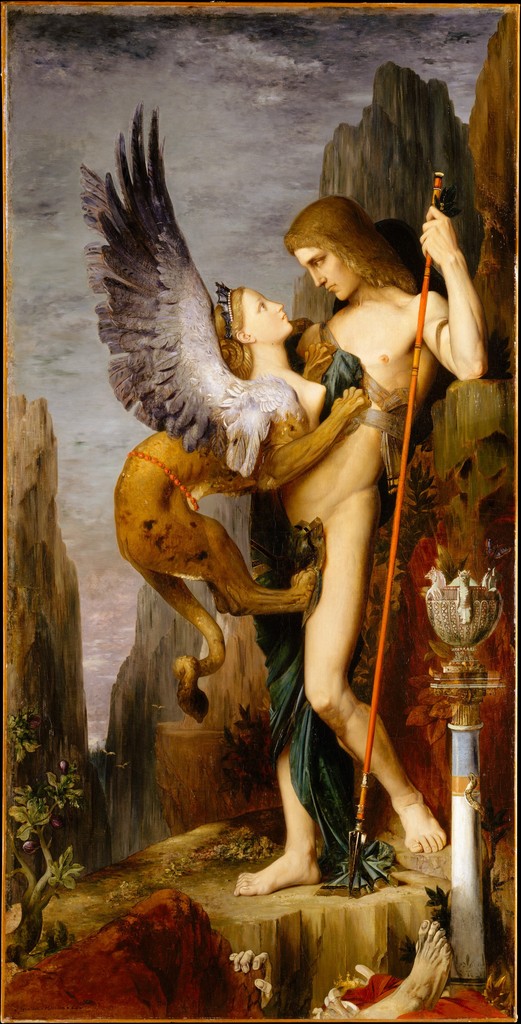
Oedipus and the Sphinx
1864 · An unnervingly close contest of gazes made Moreau's return to the Salon both public and unmistakably individual.
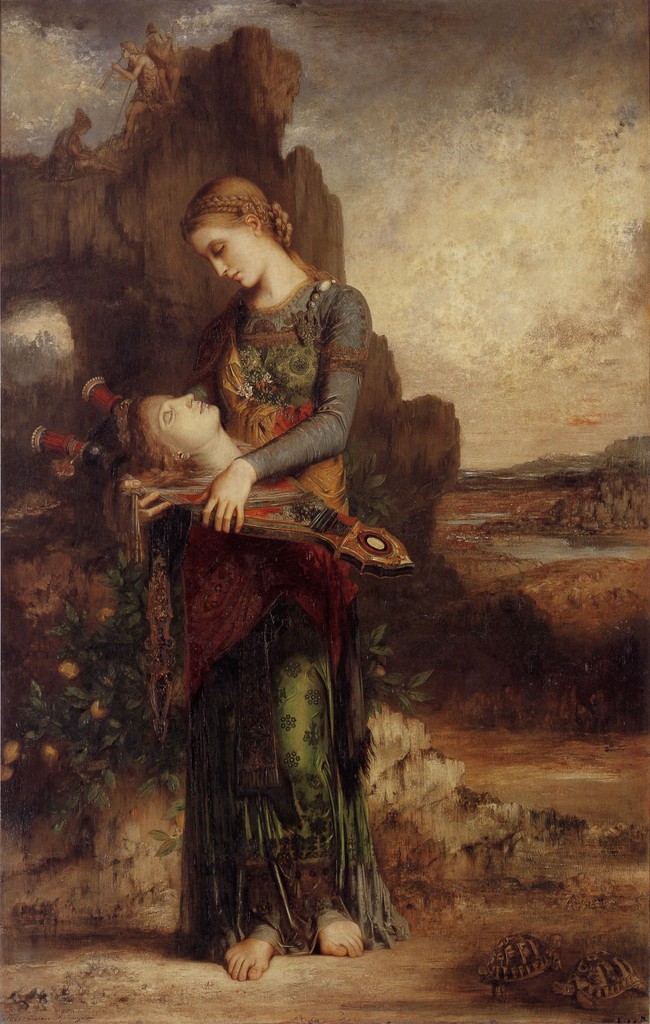
Orpheus
1865 · A Thracian girl carries the poet's severed head and lyre through a silent, meticulously balanced landscape.
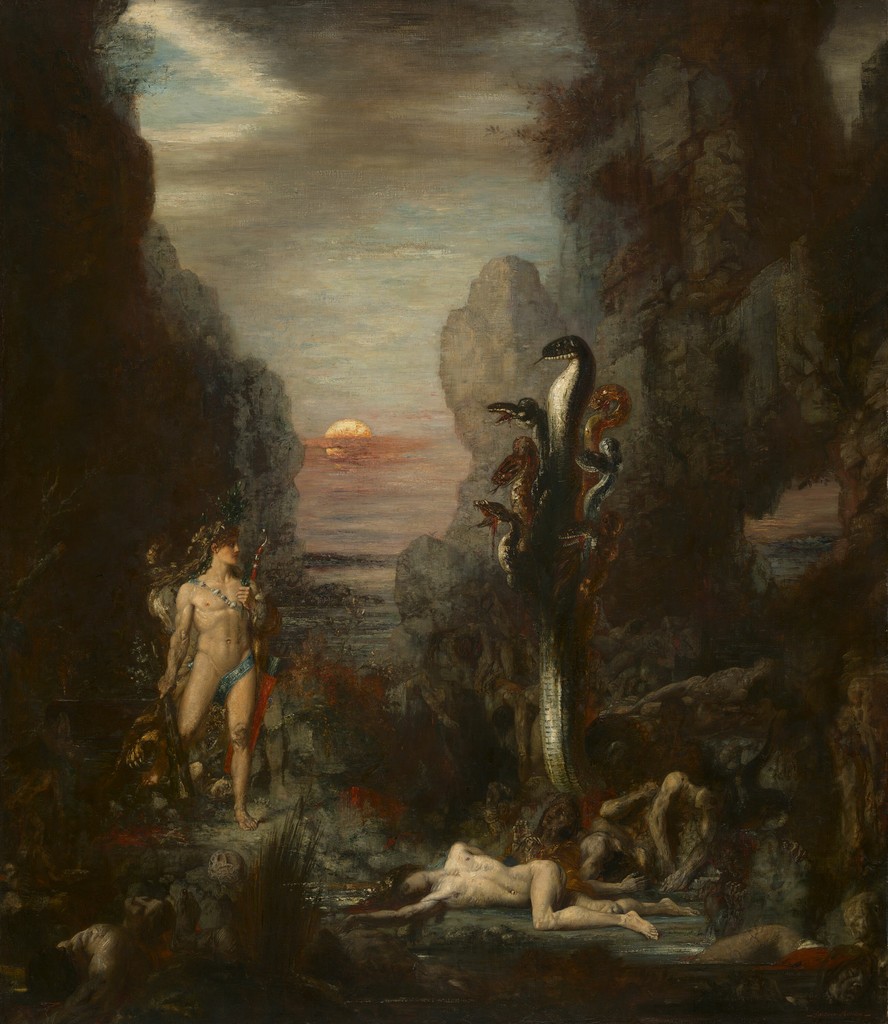
Hercules and the Lernaean Hydra
1875–76 · Hero and monster confront one another across a compressed field where stillness makes the coming struggle more severe.
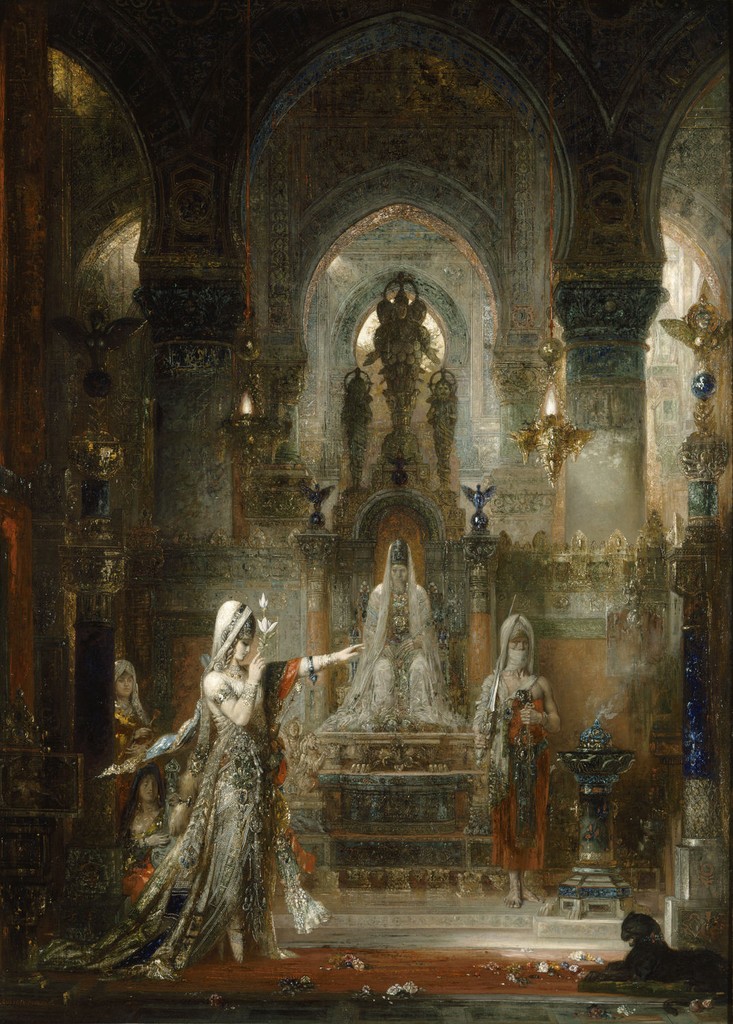
Salomé Dancing Before Herod
1876 · Architecture, costume and suspended gesture turn a biblical episode into a jewel-like and deeply uneasy spectacle.
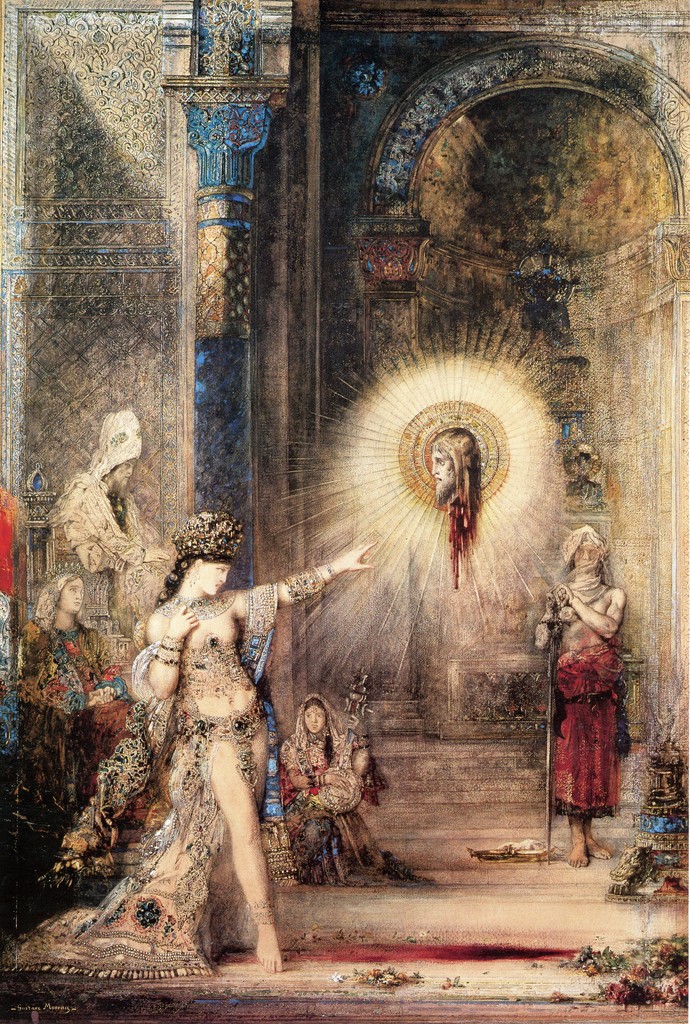
The Apparition
1876 · The radiant head of John the Baptist faces Salomé in a watercolour whose material brilliance intensifies its ambiguity.
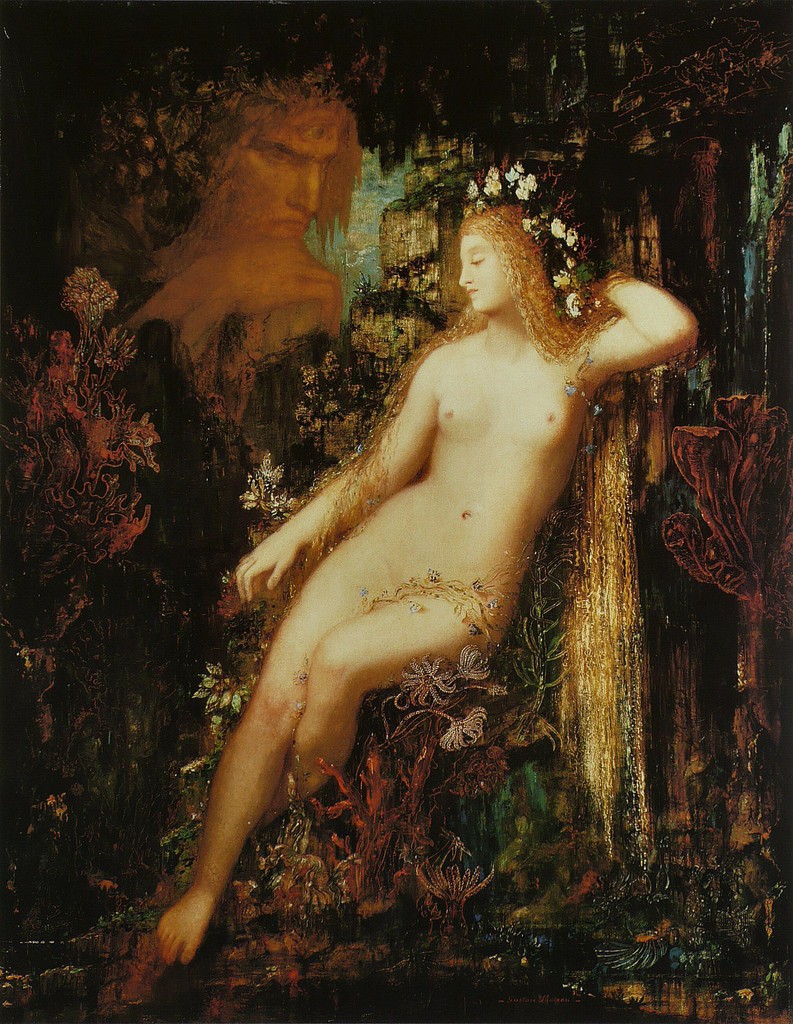
Galatea
c. 1880 · Galatea's pale body and Polyphemus's hidden gaze stage desire through colour, concealment and decorative density.
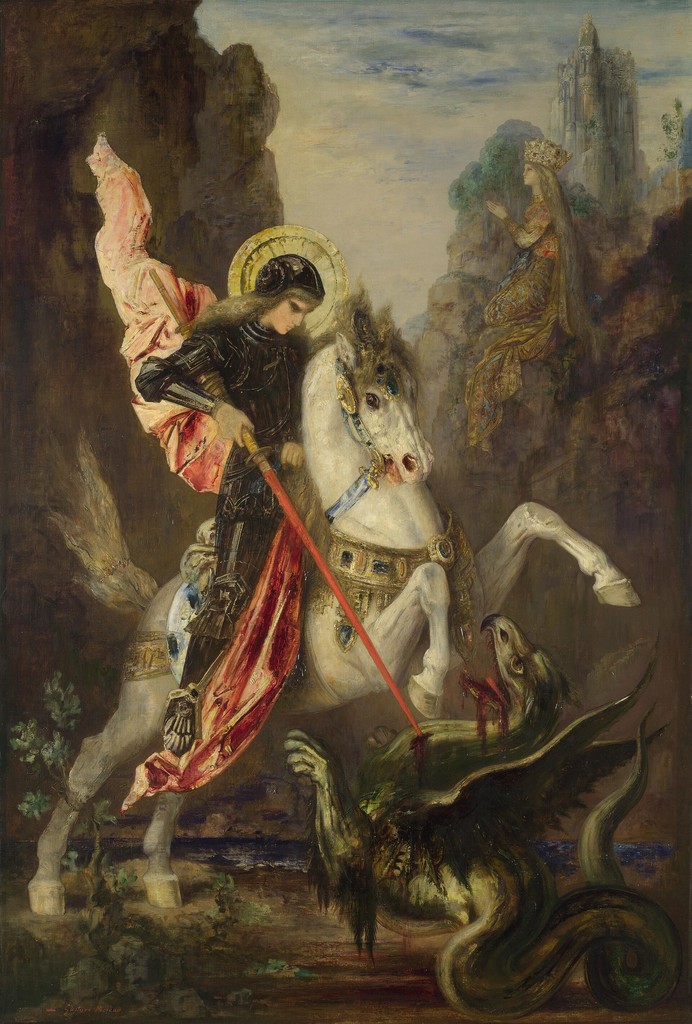
Saint George and the Dragon
1889–90 · A vertical, gold-flecked encounter recasts the saint's combat as a concentrated test of spiritual purpose.
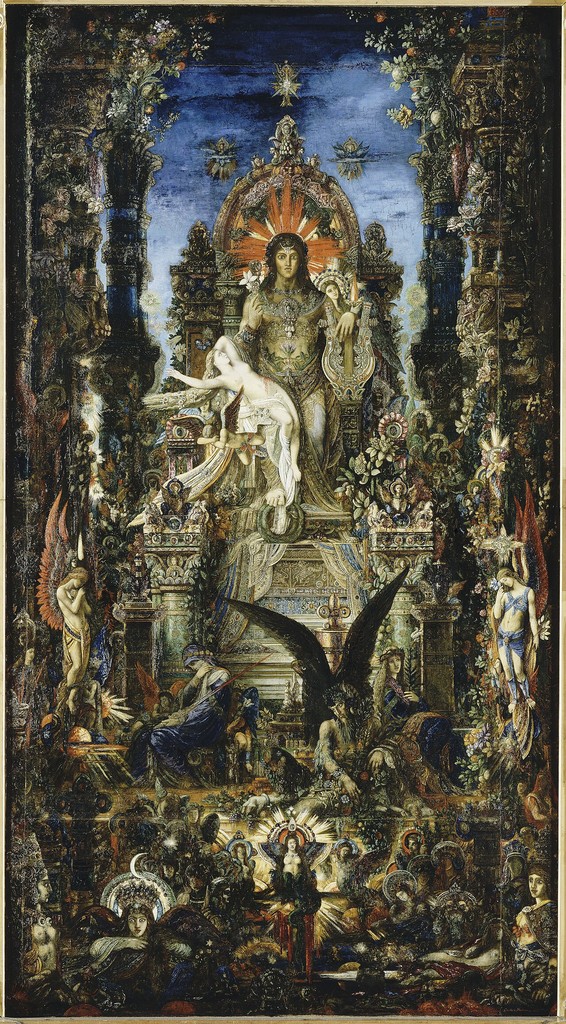
Jupiter and Semele
1894–95 · Moreau's vast late synthesis gathers divine revelation, death and regeneration into an elaborate vertical cosmos.
Researched works directory
This searchable evidence census was assembled from public museum records and a reproducible Wikidata snapshot. It is not a catalogue raisonné, a claim to complete oeuvre coverage, or a substitute for Pierre-Louis Mathieu's printed catalogue, which was not consulted for this directory.
| Name | Date | Medium |
|---|---|---|
| Abstract Study | 1850 | Painting |
| Abstract Study | 1875 | Painting |
| Abstract Study | 1890 | Painting |
| Academic Study of a Man | 1847 | Painting |
| Achilles the Centaur Chiron | 1859 | Painting |
| Andromeda | 1867 | Painting |
| Andromeda | Date unknown | Painting |
| Angels Following the Magi | 1860 | Painting |
| Angels following the Three Magi | 1898 | Painting |
| Angels Throwing Flowers on the Vatican | 1850 | Painting |
| Aphrodite, 1871 | Date unknown | Painting |
| Apollo and Daphne | 1852 | Painting |
| Apollo and The Nine Muses | 1856 | Painting |
| Apollo and the Satyrs | 1850 | Painting |
| Apollo Victorious over Python | 1885 | Painting |
| Apollon and Marsyas | 1858 | Painting |
| Ariadne and Theseus | 1875 | Painting |
| Arion | 1891 | Painting |
| Athenians being Delivered to the Minotaur in the Cretan Labyrinth | 1855 | Painting |
| Autumn | 1885 | Painting |
| Bacchanal | 1850 | Painting |
| Bacchus on the Panther -cart. | Date unknown | Painting |
| Bathsheba | 1875 | Painting |
| Beheading of John the Baptist | 1872 | Painting |
| Bertrand and Raton | 1879 | Painting |
| Binding of Isaac | 1850 | Painting |
| Birth of Venus | 1870 | Painting |
| Briseis Departure | 1859 | Painting |
| centaur | Date unknown | Painting |
| Centaurs | 1850 | Painting |
| Chimera | 1850 | Painting |
| Chimeras | 1875 | Painting |
| Christ and the Two Thieves | 1870 | Painting |
| Christ at Gethsemane | 1850 | Painting |
| Christ at Gethsemane | 1875 | Painting |
| Christ at Lake Tiberias | 1850 | Painting |
| Christ at the Column | 1850 | Painting |
| Christ Blessing Hist Mother | 1850 | Painting |
| Christ Reliever | 1850 | Painting |
| Circe | 1850 | Painting |
| Cleopatra | 1850 | Painting |
| Cleopatra | 1887 | Painting |
| Danaé | 1858 | Painting |
| Darius, Fleeing after the battle of Arbela, Stops, Exhausted, to Drink from a Pond | 1853 | Painting |
| Darius Flight | 1850 | Painting |
| Dead Orpheus | 1850 | Painting |
| Dead Orpheus | 1890 | Painting |
| Dead Poet Carried by a Centaur | 1890 | Painting |
| Death Giving Laurels to the Winner of the Tournament | 1859 | Painting |
| Death of a Young Crusader | 1870 | Painting |
| Death of Moses | 1850 | Painting |
| Death of Sapho | 1850 | Painting |
| Death of Sapho | 1872 | Painting |
| Debauchery | 1850 | Painting |
| Dejanira (Autumn) | 1872 | Painting |
| Delilah | 1850 | Painting |
| Delilah | 1890 | Painting |
| Delilah | 1896 | Painting |
| Descent from the Cross | 1850 | Painting |
| Diana bathing | 1900 | Painting |
| Diomede devoured by his horses | 1865 | Painting |
| Diomedes Devoured by His Horses | 1865 | Painting |
| Diomedes Devoured by His Own Horses | 1870 | Painting |
| Œdipus the Wayfarer | 1888 | Painting |
| Draft for Sapho | 1850 | Painting |
| Eleonora Gonzaga, Duchess of Urbino | 1858 | Painting |
| Endymion | 1850 | Painting |
| Erigone | 1865 | Painting |
| Eve | 1850 | Painting |
| Eve | 1875 | Painting |
| Fairy in a Cave | 1850 | Painting |
| Fairy with Griffins | 1870 | Painting |
| Fairy with Griffins | 1876 | Painting |
| Fée aux griffons | 1876 | Drawing |
| Femme et licorne | 1890 | Painting |
| Francesco Maria della Rovere, Duke of Urbino | 1858 | Painting |
| Françoise de Rimini | 1850 | Painting |
| Galatea | c. 1880 | Painting |
| Galathea | 1896 | Painting |
| Galathea | Date unknown | Painting |
| Ganymede | 1886 | Painting |
| Gardian Angel of the City | 1850 | Painting |
| Genius of Evil | 1850 | Painting |
| Genius of Evil | 1875 | Painting |
| Golgotha | 1870 | Painting |
| Hamlet | 1850 | Painting |
| Hamlet Giving Poison to the King | 1850 | Painting |
| Helen | 1850 | Painting |
| Helen | 1880 | Painting |
| Helen at the Scaean Gate | 1888 | Painting |
| Helen Glorified | 1893 | Painting |
| Helen on the Walls of Troy | 1850 | Painting |
| Helen on the Walls of Troy | 1875 | Painting |
| Helene | Date unknown | Painting |
| Hercule et les oiseaux du lac de Stymphale | Date unknown | Painting |
| Hercules and Omphale | 1856 | Painting |
| Hercules and the Ceryneian Hind | 1871 | Painting |
| Hercules and the Daughters of Thespius | 1850 | Painting |
| Hercules and the Lernaean Hydra | 1875–1876 | Painting |
| Hercules and the Nemean Lion | 1850 | Painting |
| Hercules and the Stymphalian Birds | 1872 | Painting |
| Hercules and Thespius Daughters | 1850 | Painting |
| Hercules at Lake Stymphalia | 1875 | Painting |
| Hercules between Vice and Virtue | 1850 | Painting |
| Hesiod and the Muse | 1870 | Painting |
| Hesiod and the Muse | 1875 | Painting |
| Hesiod and the Muse | 1891 | Painting |
| Hesiod and the Muses | 1860 | Painting |
| Hesiod and the Muses | 1882 | Painting |
| Hésiode enfant | 1860 | Painting |
| Horse Rider | 1854 | Painting |
| Horse Rider | 1870 | Painting |
| Horse Rider and Amazon | 1869 | Painting |
| Horse Riders and Horses | 1854 | Painting |
| Indian Women Poets | 1890 | Painting |
| Interior, Draft | 1850 | Painting |
| Jacob and the Angel | 1876 | Painting |
| Jacob and the Angel | 1878 | Painting |
| Jacob et l'Ange | 1878 | Painting |
| Jason | 1865 | Painting |
| Jason et Éros | 1891 | Painting |
| Judith | 1850 | Painting |
| Jupiter and Semele | 1889–1895 | Painting |
| King Canute and His Courtesans | 1850 | Painting |
| King David | 1878 | Painting |
| L'enlèvement d'Europe | 1872 | Painting |
| La Fée | Date unknown | Painting |
| La mort de Sapho | 1872 | Painting |
| La mort de Sapho | 1876 | Painting |
| La Villa Borghèse | Date unknown | Painting |
| Landscape | 1850 | Painting |
| Landscape, Draft | 1850 | Painting |
| Landscape (Neighborhood of Étampes) | 1850 | Painting |
| Le Bon Samaritain | 1865 | Painting |
| Le Cantique des cantiques | 1853 | Painting |
| Le Christ et Madeleine (Noli me Tangere) | 1889 | Painting |
| Le Grand Pan contemple les Sphères Célestes | 1897 | Drawing |
| Le Poète et la Sirène | 1893 | Painting |
| Le Soir | 1887 | Painting |
| Le Sphinx | 1886 | Painting |
| Leda | 1846 | Painting |
| Leda | 1850 | Painting |
| Leda | 1870 | Painting |
| Les Chimères | 1884 | Painting |
| Les Plaintes du poète | 1882 | Painting |
| Life of Humanity | 1875 | Painting |
| Life of Humanity | 1886 | Painting |
| Life of Humanity: Salvator Mundi | 1886 | Painting |
| Life of Humanity: The Golden Age, Adam - Evening - Sleep | 1879 | Painting |
| Life of Humanity: The Golden Age, Adam - Morning - Prayer | 1879 | Painting |
| Life of Humanity: The Golden Age, Adam - Noon - Extasy | 1879 | Painting |
| Life of Humanity: The Iron Age, Cain - Evening - Death | 1879 | Painting |
| Life of Humanity: The Iron Age, Cain - Morning - Work | 1879 | Painting |
| Life of Humanity: The Iron Age, Cain - Noon - Rest | 1879 | Painting |
| Life of Humanity: The Silver Age, Hesiod and Orpheus, Hesiod - Evening - Tears | 1879 | Painting |
| Life of Humanity: The Silver Age, Hesiod and Orpheus, Hesiod - Morning - Inspiration | 1879 | Painting |
| Life of Humanity: The Silver Age, Hesiod and Orpheus, Orpheus - Noon - Song | 1879 | Painting |
| Love Victorious over Death | 1850 | Painting |
| Lucretia and Tarquin | 1850 | Painting |
| Magdalene on Golgotha | 1850 | Painting |
| Magdalene on Golgotha | 1875 | Painting |
| Magdalene on Golgotha | 1880 | Painting |
| Magnolia | 1864 | Painting |
| Martyrdrom | 1850 | Painting |
| Messalina | 1850 | Painting |
| Messalina | 1874 | Painting |
| Messaline | 1874 | Painting |
| Mort de Sapho | 1900 | Painting |
| Moses Exposed | 1875 | Painting |
| Moses Exposed on the Nile | 1875 | Painting |
| Moses, in Sight of the Promised Land, Takes His Sandals Off | 1854 | Painting |
| Moses Rescued from the Nile | 1893 | Painting |
| Mystic Flower | 1890 | Painting |
| Narcissus | 1850 | Painting |
| Narcissus | 1885 | Painting |
| Narcissus | 1890 | Painting |
| Noces d’Alexandre et de Roxane | Date unknown | Drawing |
| Nude Study | 1850 | Painting |
| Nyx, Night Goddess | 1880 | Painting |
| Oedipus and the Sphinx | 1864 | Painting |
| Orestes | 1850 | Painting |
| Orestes | 1875 | Painting |
| Orestes and the Erinyes | 1875 | Painting |
| Orphés | 1865 | Painting |
| Orpheus | 1865 | Painting |
| Orpheus Head | 1850 | Painting |
| Orpheus on Eurydice's Tomb | 1890 | Painting |
| Pasiphaë | 1850 | Painting |
| Pasiphaë | 1880 | Painting |
| Pasiphaë, Grisaille | 1850 | Painting |
| Pauline Moreau as the Virgin | 1848 | Painting |
| Perseus and Andromeda | 1870 | Painting |
| Persian Poet | 1875 | Painting |
| Petrarch After the Triumph | 1850 | Painting |
| Phaéton | 1878 | Painting |
| Phoebus and Boreas | 1879 | Painting |
| Pietà | 1867 | Painting |
| Pietà | 1875 | Painting |
| Pietà | 1876 | Painting |
| Pietà | Date unknown | Painting |
| Pittacus the Tyrant in War Costume | 1883 | Drawing |
| Polyphemus | 1880 | Painting |
| Poney | 1870 | Painting |
| Portrait of Gustave Moreau by Himself | 1850 | Painting |
| Portrait of Gustave Moreau by Himself | 1890 | Painting |
| Postman and Horses | 1854 | Painting |
| Prometheus | 1868 | Painting |
| Prometheus | 1869 | Painting |
| Prometheus Thunderstruck | 1870 | Painting |
| Prometheus, Variant | 1870 | Painting |
| Rape of Deianira | 1850 | Painting |
| Rape of Deianira | 1872 | Painting |
| Return of the Argonauts | 1890 | Painting |
| Ruines de Rome : le Colisée vu des jardins de l'Angélicum des dominicains | 1858 | Painting |
| Saint Cecilia and the Angels of Music | 1850 | Painting |
| Saint Francis Kissing a Leper | 1850 | Painting |
| Saint George and the Dragon | 1889–1890 | Painting |
| Saint Jerome | 1850 | Painting |
| Saint Sebastian | 1850 | Painting |
| Saint Sebastian | 1870 | Painting |
| Saint Sebastian and the Angel | 1876 | Painting |
| Saint Sebastian and the Angels | 1850 | Painting |
| Saint Sebastian Succoured | 1885 | Painting |
| Saint Sebastian with Archers | 1875 | Painting |
| Saint-Sébastien et l'ange | 1876 | Painting |
| Saint Sébastien soigné par les saintes femmes | 1869 | Painting |
| Sainte Cecilia | 1850 | Painting |
| Salome | 1850 | Painting |
| Salome | 1872 | Painting |
| Salome | 1874 | Painting |
| Salome at the Prison | 1873 | Painting |
| Salomé au Jardin | 1878 | Painting |
| Salome Dancing | 1872 | Painting |
| Salomé Dancing Before Herod | 1876 | Painting |
| Salome Dancing in front of Herod | 1876 | Painting |
| Salome with the Head of John the Baptist | 1876 | Painting |
| Santa Cecilia (Moreau) | Date unknown | Painting |
| Sappho falling into the Abyss | 1867 | Painting |
| Semele | 1889 | Painting |
| Semele, Draft | 1889 | Painting |
| Singing Centaurs | 1850 | Painting |
| Slaves Thrown to the Morays | 1850 | Painting |
| Song of Songs (Cantique des Cantiques) | 1893 | Painting |
| Spanish Conversation | 1850 | Painting |
| Spring | 1850 | Painting |
| St. Sebastian | Date unknown | Painting |
| Study | 1850 | Painting |
| Study | 1874 | Painting |
| Study | 1875 | Painting |
| Study for Jupiter and Semele | 1889 | Painting |
| Study for Moses Taking Off His Sandals | 1854 | Painting |
| Study for Saint Cecilia | 1850 | Painting |
| Study for Salome | 1874 | Painting |
| Study for The Triumph of Alexander the Great | 1885 | Painting |
| Study from Nature | 1850 | Painting |
| Study of a red ibis | 1900 | Painting |
| Sultan | 1850 | Painting |
| Suzanne et les vieillards | 1895 | Painting |
| swinging girl | Date unknown | Painting |
| Tea Rose | 1850 | Painting |
| Temptation | 1890 | Painting |
| Tempting Demon | 1875 | Painting |
| The Angels of Sodome | 1872 | Painting |
| The Apparition | 1876 | Drawing |
| The Argonauts | 1885 | Painting |
| The Bad Rich | 1850 | Painting |
| The calvary | 1867 | Painting |
| The childhood of Sixtus V. | 1853 | Painting |
| The Chimera | 1867 | Painting |
| The chimera | Date unknown | Painting |
| The Chimeras | 1850 | Painting |
| The Crowning with Thorns | 1846 | Painting |
| The Daughters of Thespius | 1853 | Painting |
| The Dead Lyres | 1897 | Painting |
| The Decameron | 1850 | Painting |
| The Disciples in Emmaus | 1850 | Painting |
| The Dream Haunting the Mogul | 1881 | Painting |
| The Entombment | 1867 | Painting |
| The Good Samaritan | 1850 | Painting |
| The Infant Moses | 1877 | Painting |
| The Magi | 1860 | Painting |
| The Martyred Saint Sebastian | 1869 | Painting |
| The Mermaid and the Poet | 1895 | Painting |
| The Muses Leaving Their Father Apollo to Go and Light the World | 1868 | Painting |
| The Parca and the Angel of Death | 1890 | Painting |
| The Parcae | 1850 | Painting |
| The Pieridae | 1875 | Painting |
| The Pieridae | 1880 | Painting |
| The Pietà | 1867 | Painting |
| The Plague in Florence | 1870 | Painting |
| The Poet and the Siren | 1894 | Painting |
| The Prodigal Son | 1850 | Painting |
| The Prodigal Son | 1890 | Painting |
| The Rape of Europe | 1868 | Painting |
| The Rape of Europe | 1869 | Painting |
| The Shulamite | 1853 | Painting |
| The Sirens | 1850 | Painting |
| The Sirens | 1875 | Painting |
| The Sirens | 1882 | Painting |
| The Springs | 1856 | Painting |
| The Suitors | 1862 | Painting |
| The Toilette | 1887 | Painting |
| The Travelling Angels | 1875 | Painting |
| The Travelling Poet | 1890 | Painting |
| The Unicorn | 1885 | Painting |
| The Unicorns | 1888 | Painting |
| The Voices | 1867 | Painting |
| The Wandering Jew | 1870 | Painting |
| The Young Man and Death | 1856–1865 | Painting |
| Tomyris and Cyrus | 1850 | Painting |
| Triumph of Alexander the Great | 1873 | Painting |
| Triumphing Church | 1870 | Painting |
| Tyrtaeus | 1850 | Painting |
| Tyrtaeus Singing While Fighting | 1860 | Painting |
| Un Saint au désert | 1879 | Painting |
| Untitled | 1866 | Painting |
| Venice | 1850 | Painting |
| Venice | 1885 | Painting |
| Venus Rising from the Sea | 1866 | Painting |
| Victim | 1850 | Painting |
| Vue de Florence | 1858 | Painting |
| Walk in a Park | 1865 | Painting |
| Water Fairy | 1850 | Painting |
| Womand and Chimera | 1875 | Painting |
| Young Thracian Woman Holding Orpheus' Head | 1866 | Painting |
Frequently Asked Questions
Gustave Moreau was a French painter, draughtsman, watercolourist and teacher, born in Paris in 1826 and active there until his death in 1898. Trained through the academic system, he devoted his mature career to imaginative history painting and later designed his home and studios as the museum that preserves much of his work.[4][19]
He is famous for densely imagined paintings of mythological and biblical subjects, especially Oedipus, Orpheus, Salomé and Jupiter. He is also important for the drawings and watercolours behind those works, for the freedom of his late experiments, and for his influence as a teacher.[5][17]
Yes, Moreau is widely regarded as a leading or foundational figure for pictorial Symbolism. The qualification is chronological: several key works preceded the organised literary movement and its 1886 manifesto. His emphasis on imagination, subjective meaning and suggestive myth helped prepare the ground on which later Symbolists worked.[3][20]
Yes. Henri Matisse and Georges Rouault were among the artists in Moreau's École des Beaux-Arts studio during his professorship from 1892. His significance as a teacher lies in encouraging individual development, museum study and imaginative uses of colour, not in making every student paint like him.[17]
Start with Oedipus and the Sphinx for his public breakthrough, then compare Salomé Dancing Before Herod with The Apparition to see how he reinvented one narrative across oil and watercolour. Add Orpheus for poetic stillness and finish with Jupiter and Semele for the scale and density of his late synthesis.[1][2][7][9][10]
Discussion
Use this evidence-led guide as a starting point for close looking rather than a final verdict.
Share an observation about Gustave Moreau or a source that adds useful context.
Reader Insights
Which work most clearly complicates the familiar image of Moreau as a painter of finished, jewel-like visions?
Where do Paris, Italian study, literary networks or older art most productively alter your reading?
Which source or surviving object would you investigate next?
Join the Conversation
Add your reading below, keeping observations specific and evidence clear.
References
- Metropolitan Museum of Art, “Oedipus and the Sphinx”:, accessed 30 August 2026.
- Musée Gustave Moreau, “Jupiter and Semele [Jupiter et Sémélé]”:, accessed 30 August 2026.
- National Gallery, London, “Gustave Moreau”:, accessed 30 August 2026.
- Musée Gustave Moreau, “Biography of Gustave Moreau”:, accessed 30 August 2026.
- Musée Gustave Moreau, “The Art of Gustave Moreau”:, accessed 30 August 2026.
- Musée Gustave Moreau, “Gustave Moreau in Italy”:, accessed 30 August 2026.
- Musée d'Orsay, “Orphée”:, accessed 30 August 2026.
- Art Institute of Chicago, “Hercules and the Lernaean Hydra”:, accessed 30 August 2026.
- Hammer Museum, “Salomé Dancing Before Herod”:, accessed 30 August 2026.
- Musée d'Orsay, “L'Apparition”:, accessed 30 August 2026.
- Musée d'Orsay, “Galatée”:, accessed 30 August 2026.
- Musée Gustave Moreau, “Artworks on the move”:, accessed 30 August 2026.
- Musée Gustave Moreau, “The Cabinet de Réception”:, accessed 30 August 2026.
- Musée Gustave Moreau, “Visitor trail”:, accessed 30 August 2026.
- Musée Gustave Moreau, “The Studios”:, accessed 30 August 2026.
- National Gallery, London, “Saint George and the Dragon”:, accessed 30 August 2026.
- Musée Gustave Moreau, “Gustave Moreau and Fauvism”:, accessed 30 August 2026.
- Musée Gustave Moreau, “Gustave Moreau's Apartment”:, accessed 30 August 2026.
- Musée Gustave Moreau, “English press kit 2023”:, accessed 30 August 2026.
- Metropolitan Museum of Art, “Symbolism”:, accessed 30 August 2026.
- Metropolitan Museum of Art, “Gustave Moreau: Between Epic and Dream”:, accessed 30 August 2026.
- Museum of Modern Art, Odilon Redon – Gustave Moreau – Rodolphe Bresdin:, accessed 30 August 2026.