 by Tom Gurney
Tom Gurney BSc (Hons) is an art history expert with over 20 years experience
Published on June 19, 2020 / Updated on October 16, 2026
Email: tomgurney1@gmail.com / Phone: +44 7429 011000
The Deluge and Doré's Bible Series
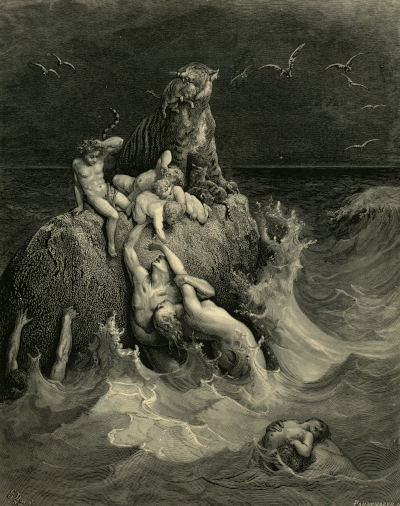
The Deluge is one of Gustave Doré's most devastating Bible illustrations. It shows the flood not as a distant emblem of punishment, but as a physical crisis unfolding around bodies, water, rock and panic. The ark belongs to the story, but Doré does not make safety the emotional centre of the image. He turns instead toward those left outside: people and animals clinging to the last exposed ground as the flood rises around them.[1]
That choice gives the image its force. Many flood pictures show the ark as a sign of deliverance. Doré shows the catastrophe from below, from the side of vulnerability. A child reaches, bodies crowd together, animals press into the same desperate space, and the surrounding water makes every foothold temporary. The viewer understands the story through pressure: too little land, too much water, too little time.[2]
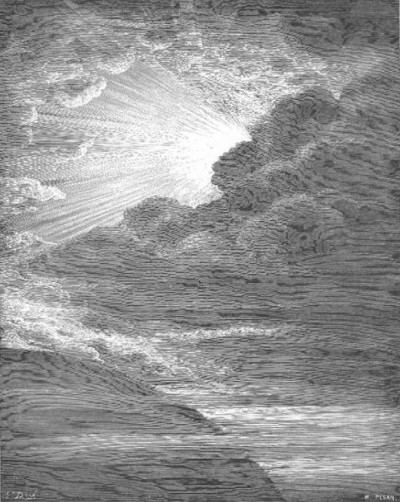
The Deluge belongs near the front of Doré's Bible corridor. The Creation of Light imagines the beginning of visibility and order. The Deluge shows the world overwhelmed after human history has already begun. Together, the two images establish the range of Doré's Genesis imagination: creation as cosmic emergence, and flood as total collapse.
At a Glance
- SubjectThe Genesis flood, with people and animals outside the ark [1]
- ArtistGustave Doré
- Engraver noteAdolphe François Pannemaker is identified with the engraving [1][2]
- Publication routeLa sainte Bible, Tours, Alfred Mame et Fils, 1866 [2][3]
- Companion pagesCreation of Light, Illustrations, Engravings
Contents
- Doré's Flood Scene
- Genesis and the Rising Waters
- How to Read the Image
- The Ark in the Distance
- Drawing, Wood Engraving and Pannemaker
- Place in Doré's Bible Cycle
- Publication, Reception and Reproduction
Doré's Flood Scene
The Deluge is not a calm illustration of a known story. It is a close view of disaster. The image concentrates on the last exposed places where life can gather: rock, broken ground, branches and any height that remains above the water. People and animals are pushed into one shared emergency. The distinction between human command and animal instinct has almost disappeared because both are reduced to the same need to survive.
That compression is one of Doré's great strengths. He often builds drama by placing small, vulnerable bodies against immense natural or supernatural force. In The Deluge, the force is water. It surrounds the figures, erases stable ground and turns the whole landscape into a field of danger. The image is crowded, but the crowd does not feel orderly. It feels packed by fear.
The Old Book Illustrations description is useful because it points to the ark as a distant silhouette and to groups of people and animals seeking refuge on rocks, mounds and breaking trees. Doré's emotional focus falls on the foreground struggle, while the ark remains far away. The viewer can understand the flood narrative without needing the ark to dominate the design. Safety exists, but it is not where the eye first settles.[2]
Genesis and the Rising Waters
The flood narrative in Genesis gives Doré a subject built around excess: rain, depth, destruction, survival and covenant. The Pitts Theology Library record anchors this image to Genesis 7, while the French caption recorded by Old Book Illustrations gives Genesis VII, 1-6. The safest way to read the image is therefore as Doré's visual response to the opening crisis of the flood, when entry into the ark and rising waters separate the saved from those exposed to destruction.[1][2]
Doré does not illustrate the flood by summarising the whole story. He chooses one dramatic condition: people and animals outside the ark as the waters rise. That choice narrows the text into a single visual problem. How can the printed page make the viewer feel the disappearance of land? How can it show that ordinary space has become unusable?
The answer lies in vertical pressure. The composition drives the eye upward from the water toward the remaining rock and bodies, but that upward movement brings no confidence. The refuge is crowded and precarious. The higher ground does not promise lasting safety. It only delays the next wave.
How to Read the Image
Start with the structure of the scene before looking at individual faces or bodies. The composition is built on a severe opposition between rising water and shrinking refuge. Water occupies the world around the figures. Rock and trees offer temporary height, but they are visually under siege. The viewer reads the danger before reading the details.
Then look at the crowding. Doré presses humans and animals into the same compressed space. That creates emotional intensity, but it also gives the image a wider meaning. The flood does not only threaten a single family or group. It threatens the living world. Animals in the scene are not background accessories; they help make the flood feel universal.
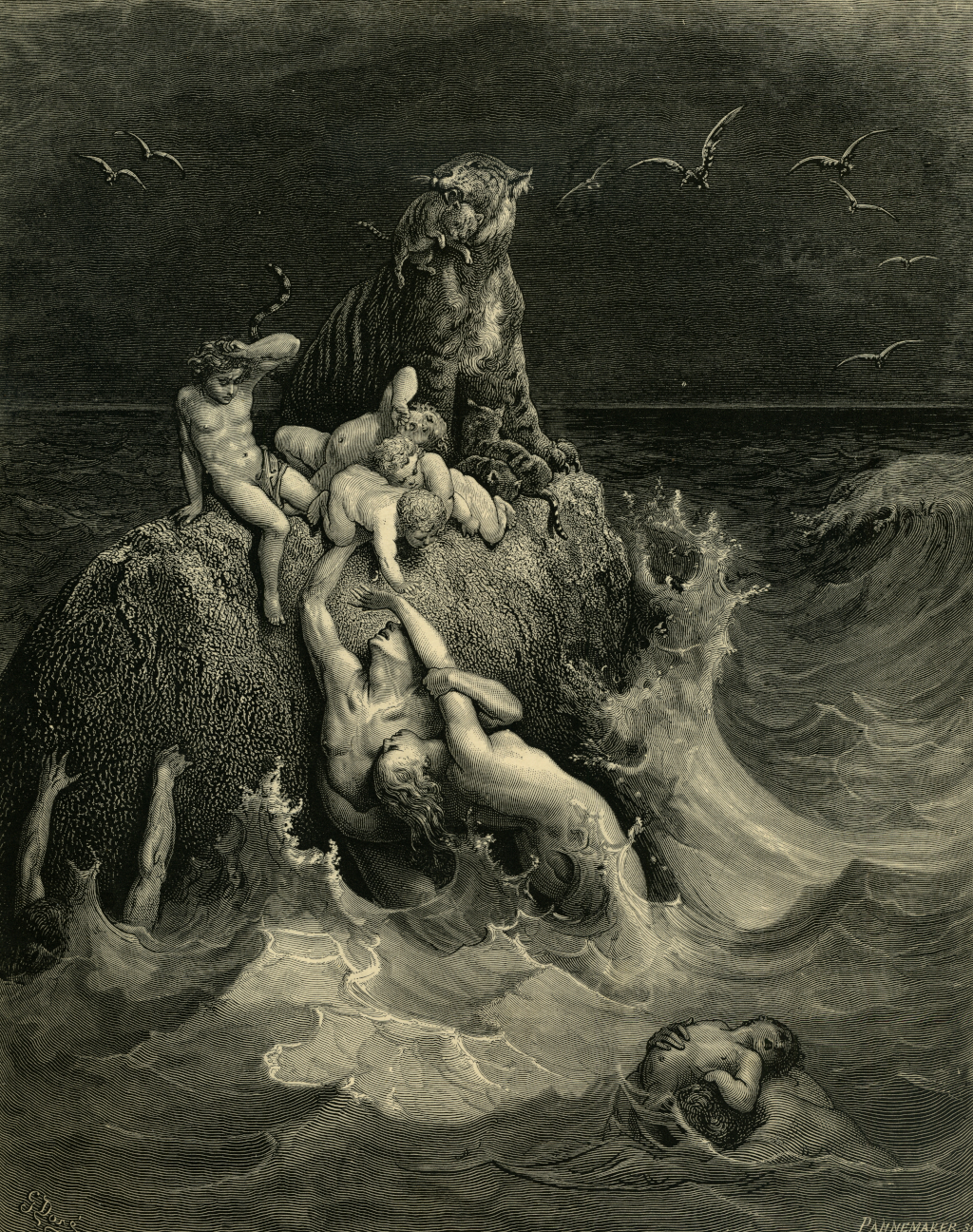
The direction of movement matters too. Arms reach, bodies lean and figures cling. These gestures tell the viewer that the disaster is ongoing. Nothing has settled. Doré's flood is not a completed ruin, but an event still happening. The eye senses movement from water to rock, from lower bodies to higher bodies, from present survival to likely loss.
The Ark in the Distance
The ark is one of the most important details in The Deluge precisely because it is not the largest form in the image. Doré understands that the story does not need the ark to be monumental in order to be present. Its distance gives the scene a harsher emotional structure. The object of survival exists, but it cannot be reached by the figures in the foreground.
That distance also creates a strong narrative split. The ark belongs to divine instruction, obedience and preservation. The foreground belongs to exposure, delay and terror. Doré holds those two meanings in the same composition. He does not need to explain the flood through a long sequence of events because the relationship between ark and stranded bodies already tells the viewer where the moral and physical division has fallen.
The animals intensify that division. They remind the viewer that the flood story concerns the fate of living creatures, not only human society. In the ark narrative, animals are preserved by pairs; in the foreground of Doré's image, animals share the same dangerous ground as people. The contrast makes the image feel more total.
Drawing, Wood Engraving and Pannemaker
The Deluge also belongs to Doré's engraving story. The Pitts Theology Library record identifies Adolphe François Pannemaker's engraver signature at the lower right of the woodcut. Old Book Illustrations likewise names Pannemaker as engraver and identifies the technique as wood engraving. The Morgan Library's record for La sainte Bible notes that plates were engraved from Doré's drawings by H. Pisan and others, while the wider Bible project depended on collaborative printmaking.[1][2][3]
That process matters especially for The Deluge. The image depends on tonal pressure: dark water, pale bodies, broken highlights, dense shadow and the textured movement of floodwater. Doré's design had to be translated into a surface that could be printed in black and white. The engraver's work gave the water its force, the rocks their roughness and the figures their visibility amid the storm.
Wood engraving was particularly suited to Doré's book world because it could carry detailed images into printed publication. The Utpictura18 account explains that this form of engraving allowed fine detail and integration with typographic production, while Doré's Holy Bible used full-page illustrations. In a flood scene, that capacity for detail is crucial. The drama needs many small elements to remain readable: limbs, animal forms, rock edges, foam, sky and distance.[6]
Place in Doré's Bible Cycle
Within the Bible cycle, The Deluge follows a different emotional register from The Creation of Light. Creation is almost figureless and atmospheric. The Deluge is crowded and bodily. Creation depends on the separation of light and darkness. The Deluge depends on the disappearance of safe space. One image begins the world; the other nearly erases it.
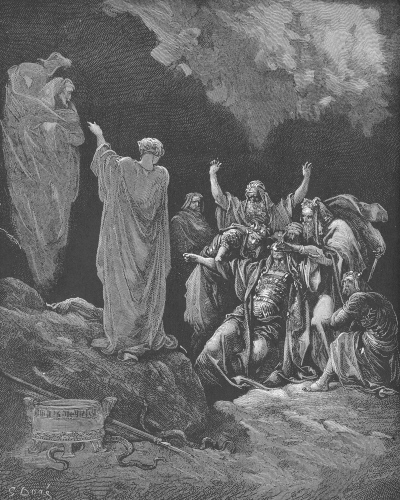
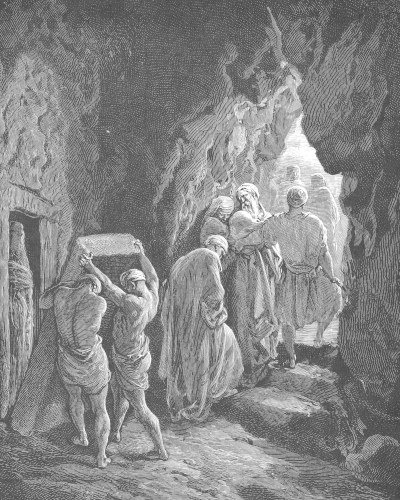
That contrast is useful for this Doré guide because the Bible route works as a series rather than a set of isolated famous pictures. Doré's Bible images build power through variation. He does not use the same dramatic formula for every subject. A quiet Genesis beginning, a flood catastrophe, a supernatural consultation in Saul and the Witch of Endor and the grieving stillness of The Burial of Sarah each ask for a different visual rhythm.
The Deluge is one of the strongest links in that rhythm because it combines spectacle with close human vulnerability. The viewer sees a world-scale event through the bodies of those caught in it. That is Doré's larger Bible method at its best: the image feels immense, but it remains legible through gesture and composition.
Publication, Reception and Reproduction
Doré's Bible illustrations circulated through major nineteenth-century publishing networks. The Morgan Library record identifies La sainte Bible as a two-volume work published in Tours by Alfred Mame et Fils in 1866, with drawings by Doré and text ornamentation by Hector Giacomelli. The Metropolitan Museum of Art likewise records La Sainte Bible, volumes 1 and 2, with Doré as illustrator, Mame as publisher and printer, and the date 1866.[3][4]
The Library of Congress copy of The Doré Bible Gallery gives a later American route into the same visual tradition. It was published in Philadelphia by H. Altemus around 1890 and presents a selected gallery of Bible illustrations. The Library of Congress catalogue records Doré as creator and Bible illustrations as the subject, and its digitized book collection is public domain and free to use and reuse.[5]
Those later editions matter because they help explain why The Deluge became familiar beyond its first publication setting. Doré's Bible images were not confined to one French book. They travelled through English, American and other editions, and through later galleries and reproductions. Musée d'Orsay's exhibition account notes that Doré's Bible and Dante illustrations were deeply embedded in collective memory and disseminated widely in Europe and the United States.[7]
Why The Deluge Still Matters
The Deluge remains one of Doré's essential Bible images because it shows his ability to make catastrophe immediate. The subject is ancient, but the image feels physically present. Water rises. Bodies cling. Animals press toward the same fragile refuge. The ark is part of the story, but the emotional scene is where survival has almost run out.
That immediacy is the reason the image works as more than a Bible illustration. It is also an artwork about scale, vulnerability and the collapse of ordinary space. Doré's black-and-white design makes the world feel unstable without requiring colour or theatrical props. He uses crowding, contrast and movement to create a scene that feels both narrative and symbolic.
For readers moving through Doré's Bible pages, The Deluge follows The Creation of Light as the first great catastrophe in the sequence. It turns the beginning of Genesis into a visual arc: light appears, the world takes form, and then the world is drowned. Later pages can extend the route into burial, prophecy, rebellion and judgement, but The Deluge gives the Bible corridor its first overwhelming crisis.
Related Bible Pages
Use these pages as the next steps through Doré's Bible corridor. They keep The Deluge in sequence rather than treating it as a single isolated image.
FAQ
Discussion
How does Doré make the flood feel immediate rather than remote?
Reader Insights
Notice how the ark remains visible but emotionally distant from the crowded foreground.
Look at how people and animals are forced into the same fragile refuge as the waters rise.
Think about how Pannemaker's engraved linework carries water, rock, bodies and shadow in black and white.
Join the Conversation
Share your reading of The Deluge below.
References
- Pitts Theology Library, Emory University, The Deluge, accessed 27 July 2026.
- Old Book Illustrations, The Deluge, accessed 27 July 2026.
- The Morgan Library & Museum, La sainte Bible, accessed 27 July 2026.
- The Metropolitan Museum of Art, La Sainte Bible (vol. 1 and 2), accessed 27 July 2026.
- Library of Congress, The Doré Bible Gallery, accessed 27 July 2026.
- Utpictura18, Serge Ceruti, Gustave Doré and the Bible, accessed 27 July 2026.
- Musée d'Orsay, Gustave Doré (1832-1883): Master of Imagination, accessed 27 July 2026.