

 by Tom Gurney
Tom Gurney BSc (Hons) is an art history expert with over 20 years experience
Published on June 19, 2020 / Updated on September 6, 2026
Email: tomgurney1@gmail.com / Phone: +44 7429 011000
David and Goliath by Artemisia Gentileschi
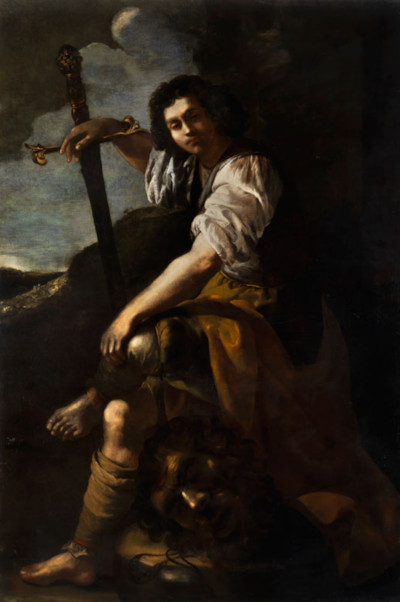
The David with the head of Goliath treated here is an attribution-sensitive Artemisia Gentileschi picture documented through Dorotheum's 2019 Old Master Paintings sale. Dorotheum presented the work as Artemisia Gentileschi, oil on canvas, 203.5 x 152 cm, with a private European collection route and a probable historical trail back through Naples and the Giustiniani collection. [1]
That opening caution matters. This page is not about Orazio Gentileschi's David with the Head of Goliath in the Galleria Spada, Rome. [3] It is also not a general page for every David and Goliath connected with the Gentileschi family. It follows the Dorotheum/private-collection object route and keeps its attribution, provenance and image status carefully bounded.
The subject is stark: David has killed Goliath and holds the giant's severed head. Yet the painting's interest, if the attribution is accepted, is not only in victory. It turns the aftermath into a dark encounter with the viewer: a young figure, a terrible trophy, a body staged between triumph, threat and display.
Image reference: Dorotheum lot record and image route.
At a Glance
- Attribution routeArtemisia Gentileschi, following Dorotheum. [1]
- TitleDavid with the head of Goliath. [1]
- Mediumoil on canvas. [1]
- Dimensions203.5 x 152 cm, framed. [1]
- Sale contextDorotheum, Old Master Paintings I, lot 56, 22 October 2019. [1]
- Collection routeprivate European collection at the time of sale. [1]
- Historical routeprobably Naples studio, 1631, and Giustiniani inventories. [1]
- SubjectDavid after killing Goliath.
- Version cautionnot Orazio Gentileschi's Galleria Spada painting. [3]
- Image statussource-matched to Dorotheum route; permission remains Amber. [1]
Contents
- Which David and Goliath Is This?
- The Story After the Battle
- Looking at the Painting
- Attribution, Documentation and Caution
- Not Orazio's Galleria Spada David
- David Beside Artemisia's Heroic Figures
- Naples, Collectors and Lost Works
- Where to Go Next
Which David and Goliath Is This?
The safest way to read this page is to begin with the auction record, not with the title alone. Dorotheum identifies its lot as David with the head of Goliath by Artemisia Gentileschi, gives the medium and dimensions, and records the painting as coming from a private European collection. [1] It also sets out a probable chain of earlier references: a work seen in Artemisia's studio in Naples in 1631, then a painting of the subject in Giustiniani family inventories.
The word "probably" is doing important work. The source route is not the same as a museum collection record with a settled accession number, nor is it a reason to pretend every historical reference is beyond dispute. The article can still be useful if it tells readers exactly what kind of evidence is being used: a sale catalogue attribution, documentary comparisons, later scholarship and a private-collection object.
The Galleria Spada painting provides the clearest warning against confusion. Spada's official page identifies its David with the Head of Goliath as Orazio Gentileschi, probably painted between 1611 and 1616, oil on canvas, 173 x 142 cm. [3] That is a different object and a different attribution. It should not supply facts for this Artemisia page.
There is another modern complication too. The Art Newspaper reported in 2020 on a newly attributed Artemisia David and Goliath restored in London, with a faint Artemisia signature reported along the sword. [2] That report is useful evidence that David and Goliath attributions around Artemisia remain active and closely studied, but it should not be folded into the Dorotheum object as if every fact belonged to one painting.
The Story After the Battle
The story comes from the First Book of Samuel. Goliath, the Philistine champion, challenges the Israelites. David, young and lightly armed, defeats him with a sling stone, then uses Goliath's own sword to cut off his head. The episode has long been read as a victory of faith, courage and divine favour over brute force.
Painters were drawn to the moment after the killing because it lets the story become physical. David's youth is set against Goliath's massive head. The sling or sword can stand for the improbable victory. The severed head becomes proof: the giant was real, the danger was real, and David's triumph is not merely symbolic.
In Artemisia's world, the subject also belonged to a larger culture of dramatic biblical and heroic images. David is not Judith, Jael or Lucretia, but he shares their pictorial world: violent action turned into a charged aftermath, a body presented to the viewer, and moral force carried through light, gesture and physical evidence.
Looking at the Painting
Dorotheum describes David as a dark-haired youth who looks outward while displaying Goliath's severed head. He is placed near a column, with the sling beneath the giant's head, and is set in a dark atmosphere shaped by strong light and shade. [1] Those details give the painting its public voice.
David is not shown in the rush of combat. The battle has ended. What remains is the display of victory and the psychological pressure of being looked at by the victor. A young figure holds a monstrous head; the viewer becomes part of the exchange. The image asks not simply what happened, but what victory looks like when the violence is still present.
The scale matters. At more than two metres high, the painting is not a small devotional or cabinet subject. It gives David a near-life-size presence. That size makes the severed head feel heavier, the gesture more deliberate, and the dark space around him more theatrical.
Attribution, Documentation and Caution
The strongest reason to keep the page is that the Dorotheum route gives a coherent Artemisia attribution with documentary support. The catalogue connects the picture probably with a David described in Artemisia's Naples studio in 1631, and probably with later Giustiniani inventories that describe a full-length David holding Goliath's head by Artemisia. [1]
That evidence is significant, but it must be handled with discipline. The page should not turn probability into certainty. It should not imply that the painting is in a public museum. It should not treat all David and Goliath references as one object. It can say that Dorotheum presented the work as Artemisia and explain the supporting route, while keeping the language open where the source itself is open.
For readers, the lesson is not that every attribution is unstable. It is that careful art history names its evidence. A museum label, a sale catalogue, a seventeenth-century inventory, a conservation report and a modern article do not all carry the same weight. This page is strongest when it lets readers see that hierarchy.
Not Orazio's Galleria Spada David
Orazio Gentileschi's David with the Head of Goliath in the Galleria Spada is an important painting, but it is not this page's object. Spada identifies its work as Orazio's, probably from 1611 to 1616, and describes it as oil on canvas measuring 173 x 142 cm. [3]
The risk is easy to understand. Both artists share the Gentileschi name. Both are connected to Caravaggio's legacy. Both have David and Goliath subjects attached to their names. But the family connection cannot be allowed to erase object identity.
Orazio's art can remain part of Artemisia's background because he trained her and because their works moved through overlapping seventeenth-century worlds. [4] But this article should not borrow his Spada painting's date, collection, measurements or interpretation.
David Beside Artemisia's Heroic Figures
David is a male hero, which makes this painting different from the works for which Artemisia is most famous. Her Judiths, Jael, Lucretia, Susanna and Bathsheba pages place women at the centre of danger, moral pressure or action. David stands in another tradition: the young biblical victor who defeats a giant.
Even so, the painting belongs naturally beside Artemisia's heroic subjects because it is about aftermath. In the Florence and Naples Judith Slaying Holofernes pages, the violence is happening before the viewer's eyes. In Judith and Her Maidservant, the deed is done and the women listen into the dark. In Jael and Sisera, a quiet interior becomes the site of lethal decision.
The Dorotheum David shares that interest in the moment after force has been used. David's victory is complete, but the painting does not let the viewer pass quickly to celebration. Goliath's head remains present. The body has become evidence. The hero's gaze makes the viewer feel addressed by the result.
Naples, Collectors and Lost Works
Dorotheum's documentation places the possible early history of the painting in Naples and the Giustiniani orbit. [1] The National Gallery records that Artemisia settled in Naples from 1630 and ran a successful studio there. [4] That context makes a 1631 studio reference plausible as part of her mature professional world, though the wording should remain careful.
Naples was not a retreat. It was a major artistic centre where Artemisia could work for demanding patrons, manage a studio and participate in a crowded visual market. A large David and Goliath would fit that world: ambitious, dramatic, and capable of attracting collectors interested in biblical subjects and Caravaggesque force.
The Giustiniani connection, if accepted, also matters. The family was associated with major collecting in Rome, including works linked to Caravaggio and his circle. A David by Artemisia moving into that kind of collection would show the level at which her work could circulate. But again, the evidence remains a probable route rather than a settled museum provenance.
Where to Go Next
For Artemisia's broader life and career, start with the biography and paintings hub. For her most famous treatments of violent biblical action, read the Florence and Naples Judith Slaying Holofernes pages. For an aftermath scene with tense listening rather than display, read Judith and Her Maidservant. For another biblical killing scene, read Jael and Sisera; for a tragic Roman heroine, read Lucretia.
Those routes help place this David with the Head of Goliath in a wider field of bodies, decisions and consequences. The painting remains attribution-sensitive, but it is worth treating carefully because it opens a different door into Artemisia's art: not only women under pressure, but the Baroque imagination of victory after violence.
Related Pages
- Artemisia Gentileschi
- Artemisia Gentileschi Biography
- Artemisia Gentileschi Paintings
- Judith Slaying Holofernes, Florence
- Judith Slaying Holofernes, Naples
- Judith and Her Maidservant
- Jael and Sisera
- Lucretia
Frequently Asked Questions
Discussion
How should readers approach an attribution-sensitive Artemisia Gentileschi painting?
Reader Insights
Which details keep the Dorotheum painting distinct from Orazio Gentileschi's Galleria Spada work?
How does David's stillness change the way the violence is felt?
Where does the page use probability carefully rather than turning it into certainty?
Join the Conversation
Share your reading of this painting below.
References
- Dorotheum, Artemisia Gentileschi, Old Master Paintings I, lot 56. Primary source for the Dorotheum/private-collection object route, title, attribution framing, medium, dimensions, sale context, probable provenance and visual description. The visible page image was checked against Dorotheum's image route artemisia-gentileschi-6416805.jpg, which returned HTTP 200 as an image/jpeg during this local HTML gate; reuse rights remain Amber.
- The Art Newspaper, newly attributed Artemisia Gentileschi painting of David and Goliath revealed in London. Used only for modern attribution/reception context, not as Dorotheum-object metadata.
- Galleria Spada, Gentileschi - David with the Head of Goliath. Used as a cautionary comparator for the separate Orazio Gentileschi object.
- National Gallery, London, Artemisia Gentileschi artist biography. Used for broad career, training and Naples context.
 Artemisia Gentileschi.jpg)
 Artemisia Gentileschi.jpg)