by Tom Gurney
Tom Gurney BSc (Hons) is an art history expert with over 20 years experience
Published on June 19, 2020 / Updated on November 6, 2026
Email: tomgurney1@gmail.com / Phone: +44 7429 011000
Saint Bartholomew and Saint Sebastian: Sebastiano's Organ Shutters
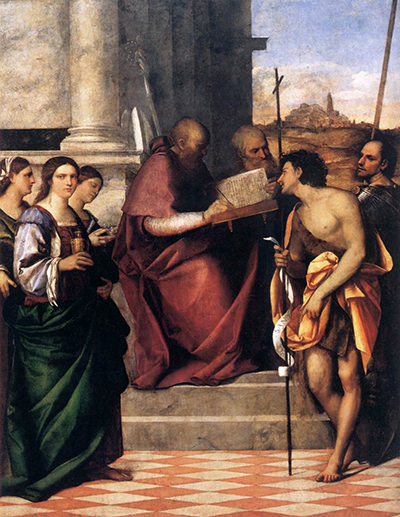
Sebastiano del Piombo's images of Saint Bartholomew and Saint Sebastian belong to a group of organ shutters made for the Venetian church of San Bartolomeo. They are not an independent devotional scene of the two saints meeting. Their original function required painted figures to operate within a movable architectural furnishing, viewed in relation to an organ, a church interior and the changing position of the shutters.
The Gallerie dell'Accademia identifies the group as San Bartolomeo, San Sebastiano, San Ludovico da Tolosa, San Sinibaldo. The four names preserve the full ensemble, even when a reproduction isolates Bartholomew and Sebastian. The paintings belong to Sebastiano's early Venetian career, before the Roman commissions that increasingly shaped his reputation. [1]
At a Glance
- Original functionOrgan shutters for San Bartolomeo, Venice
- EnsembleBartholomew, Sebastian, Louis of Toulouse and Sebaldus
- ContextSebastiano’s early Venetian work
Works in context
Contents
Paintings that opened and closed
An organ shutter differs from a panel conceived solely to hang on a wall. Its image has to make sense as part of a furnishing that changes state. Opening and closing can alter which figures are visible and how their positions relate to the surrounding architecture.
This function should influence how the paintings are described. A modern photograph may flatten the ensemble into a single arrangement, while a museum display can make the surviving parts appear more independent than they originally were. Neither presentation completely reproduces the experience of looking towards an organ in use.
The figures also had to remain legible within a substantial interior. A clear silhouette, a recognisable attribute and a convincing bodily stance could matter more than a profusion of small narrative details. The format invites attention to how a standing body occupies a tall painted field and addresses a viewer at some distance.
Bartholomew and his attribute
Bartholomew is one of the apostles. In Christian art, the knife associated with his martyrdom is a principal means of identifying him. Such an attribute condenses an extensive religious tradition into a comparatively small object that a viewer can recognise.
The knife also creates a relationship between identity and material form. It has an edge, a grip and a position in relation to the saint's hand. Its effectiveness depends on being both a sign and a believable thing within the painting. If it were treated only as a label, the figure would lose some of its physical coherence.
The saint's pose must then connect that attribute with the larger body. A turn of the head or a change in the position of an arm can give the standing figure an internal rhythm. These relatively restrained movements are especially significant in a narrow architectural field, where a broad gesture might be difficult to accommodate.
Sebastian and the exposed body
Sebastian introduces a different problem. His traditional imagery involves a body subjected to martyrdom, frequently shown with arrows. The exposed figure makes anatomy and the turning of flesh central to the painting's effect, while the saint's identity remains tied to the religious narrative.
The contrast with a clothed companion is important. Drapery organises the body through folds, overlapping edges and larger areas of colour. An exposed torso requires the painter to make weight and movement intelligible through modelling, contour and the relation of limbs. Placing such figures within one ensemble allows different kinds of bodily presence to be compared.
Sebastian should not be reduced to an anatomical demonstration. His suffering and endurance belong to the intended religious meaning. The painter's skill gives that meaning a visible form, rather than replacing it with a purely technical exercise.
The other two saints
Louis of Toulouse and Sebaldus of Nuremberg complete the named group. Their inclusion helps restore the ensemble's identity when attention has been limited to the better-known Bartholomew and Sebastian. A pair of familiar figures can dominate reproductions without representing the full commission.
The Vanderbilt photographic archive preserves separate records of Saint Sebastian and Saint Sebaldus within the organ-shutter series. These archival descriptions are useful evidence for the organisation and naming of the surviving images, though a photograph remains a record of an object rather than the object itself. [2]
Different saints could address different traditions of devotion within a church. To establish a precise connection with a particular patron or community, however, the presence of a name must be joined to documentary evidence. The group invites that historical investigation without justifying an invented story about every original worshipper.
Venetian colour and architectural space
The Gallerie dell'Accademia presents Sebastiano's early work within the artistic world transformed by Giorgione. That context is useful because the organ shutters require colour and light to give a standing figure a persuasive presence. They belong to a period in which Venetian painters were finding new ways to make bodies and atmosphere inhabit the same pictorial space. [1]
Painted architecture contributes to the effect. A niche, support or enclosing field can provide a measure against which the body is read. The figure appears to stand somewhere rather than merely being placed on a coloured surface. At the same time, the architecture remains part of the image's design and must fit the actual furnishing around it.
The relationship between painted and real architecture is especially important for shutters. A figure could seem to occupy an imagined recess while the panel itself moved within a real frame. The work brings together an illusion of stability and the physical mobility of its support.
The familiar name del Piombo belongs to Sebastiano’s later papal office, rather than to the original setting of the Venetian shutters. Using the conventional name to identify the painter is reasonable, but it should not lead to the assumption that this early church furnishing was made after he entered papal service. The distinction helps keep a career narrative in order: the Venetian commission is evidence of the painter’s formation before the institutional role that supplied his lasting epithet.
Before the Roman career
Sebastiano's later partnership with Michelangelo can make the early Venetian works seem like a preliminary chapter. The shutters deserve a fuller assessment. They already pose demanding questions about scale, bodily weight, expressive restraint and the integration of figures within a larger setting.
Vasari's account of Sebastiano's career preserves the importance of his Venetian formation, though its biographical anecdotes should be read as a sixteenth-century interpretation rather than as unqualified documentary fact. The surviving works offer more direct evidence of the young painter's ambitions than a simple narrative of influence can provide. [3]
The ensemble is most revealing when reconstructed in the mind as a functioning object. Consider the saints individually, then return them to the group of four. Finally, imagine the shift between a museum wall and the organ in a church. Each stage changes how the figures are encountered. Sebastiano's achievement lies in making individual bodies remain compelling within that complex relationship of painting, movement, architecture and devotion.
Artworks and records
Selected documented works and records relevant to this article; this is not a complete catalogue.
| Name | Date | Record |
|---|---|---|
| Holy Family with Catherine, Sebastian and a Donor | Sixteenth century | Painting |
| Madonna and Child with Saints and a Donor | 1517 | Painting |
| Martyrdom of Saint Agatha | 1520 | Painting |
| Portrait of a Lady with the Attributes of Saint Agatha | Early 1530s | Painting |
| Visitation | about 1519 | Painting |
Discussion
Share a reading of the figures, materials or relationships discussed in this article.
Reader Insights
Which detail most affects your reading?
Which comparison would you like to explore further?
Join the Conversation
Share a detail, comparison or question about Saint Bartholomew and Saint Sebastian: Sebastiano's Organ Shutters below.
References
- Gallerie dell'Accademia, Venice, Sala VIII, Sebastiano's four saints and the early Venetian context. View source.
- Vanderbilt University, Contini-Volterra Photographic Archive, Sebastiano del Piombo records, including Saint Sebastian and Saint Sebaldus from the organ shutters. View source.
- Giorgio Vasari, Life of Sebastiano del Piombo, historical career account. View source.