


 by Tom Gurney
Tom Gurney BSc (Hons) is an art history expert with over 20 years experience
Published on June 19, 2020 / Updated on August 9, 2026
Email: tomgurney1@gmail.com / Phone: +44 7429 011000
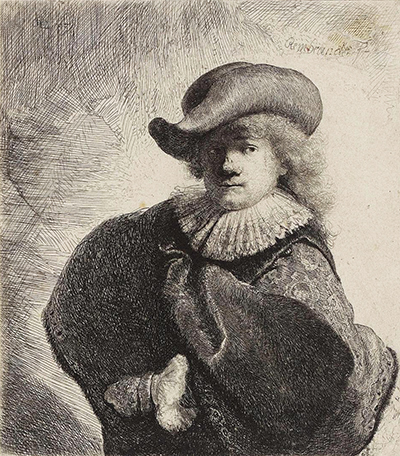
This is undoubtably one of Rembrandt's finest self portrait etchings, and follows the culmination of several years' obsession with this medium. The piece arrived in 1631 and is now to be found in the Europe, Prints and Drawings department of the Museum of Fine Arts in Boston, USA.
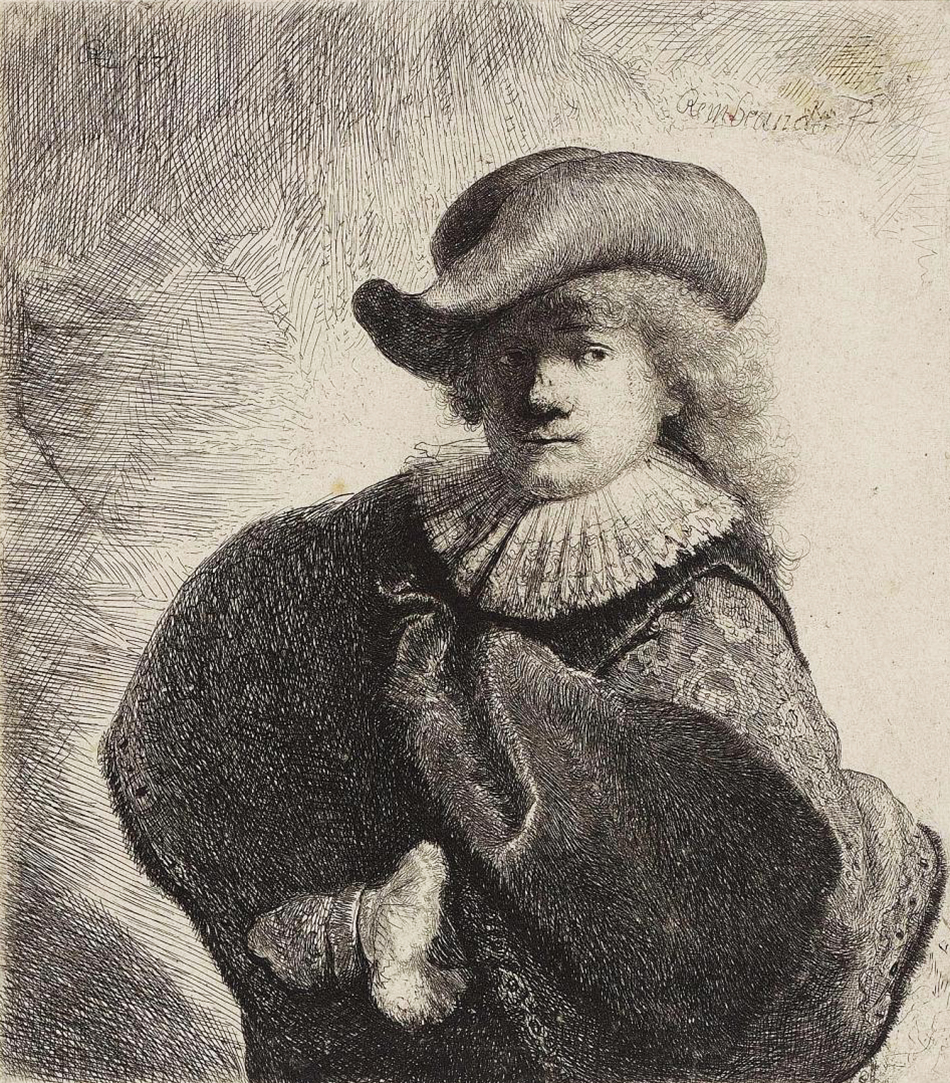
Within this engraved print we find a dashing young Rembrandt who has not only spent time on his hair in this example, but gone even further with some delightful clothing. Many of his other self portraits from recent years had left him looking almost homeless in appearance as he looked deeply into the negative emotions within his character. He he charms us with a beautiful soft hat which juts out enthusiastically, with his frilled collar also giving off a confident, positive vibe. His hair is tamed in this example, mainly covered by the hat, with the rest drifting down his left shoulder. Rembrandt's expression is fairly neutral, as he looks off to our right. Several examples from the career of Rubens feature a similar pose, and we know that Rembrandt was a keen admirer of the earlier master. The rest of Rembrandt's outfit is beautifully patterned, giving the appearance of a successful city gentleman in 17th century Netherlands.
Lines are produced within this etching in a variety of different directions. He uses cross hatching for the less significant areas, to almost create whole solid blocks of colour. We find that in the background, as well as in elements of his coat, particularly on his right hand side. He then works differently on his left sleeve, in order to create the realistic image of fur. He then uses opposing lines for elements of his hat in order to create the image of light bouncing off his hat, and his hair is typically curly, with looser, more informal lines which produce this feeling of thick hair. Shadowing is relatively simple here, mainly only used on the right side of his face, meaning that the light source is from our right hand side. Those considerations would be key when working in etching, as no colour palette would be available for other contrasting techniques.
The artist proudly signs this piece in the top right corner, with his signature being slightly larger than normal. This piece itself has so much to offer, and it is no surprise that several art historians have recently pinpointed it as being amongst his best within this medium. It is the fusing of several different techniques together as well as the proud, smart appearance of this young artist which make it so truly memorable and it may well convince some to follow the medium of etching with a greater interest than they perhaps had done so before. He himself has reinvented this medium during his lifetime, giving it more respect from academics and historians and underlining the flexibility that it offered which many did not previously realise.
Object Notes and Research Context
The Rijksmuseum records this 1631 print as Self-portrait in a Soft Hat and Patterned Cloak and notes that Rembrandt's etchings rarely came into being in a single session. He began with the head, then added torso and background, making the object a clear example of state-by-state development.
The British Museum's early-state material adds a useful caution around the old title: the so-called embroidered cloak is not necessarily embroidered in the way earlier writers assumed. Both titles remain useful, but the current patterned-cloak wording is more precise. This is one of the best legacy pages for teaching readers what a print state is.
The state history is the richest part of this page. Rijksmuseum material makes clear that Rembrandt built the print in phases, beginning with the head and then adding body and background. That helps readers understand printmaking as a process of revision, not simply the production of a single fixed image.
The old embroidered-cloak title should remain for search value but be explained against current patterned-cloak wording. This is a good example of how art history titles shift when scholars look again at costume, print states and earlier assumptions. The print is also a useful example for terms such as state and etching.
Further Rembrandt Context
This shorter legacy page remains part of the Rembrandt archive. For fuller context, use the refreshed Rembrandt pages below, which explain the artist's biography, media, technique, attribution issues and major works in greater depth.
For secure object data, attribution and collection history, compare Self Portrait in a Soft Hat and Embroidered Cloak with the relevant museum or catalogue record before treating older page text as final.
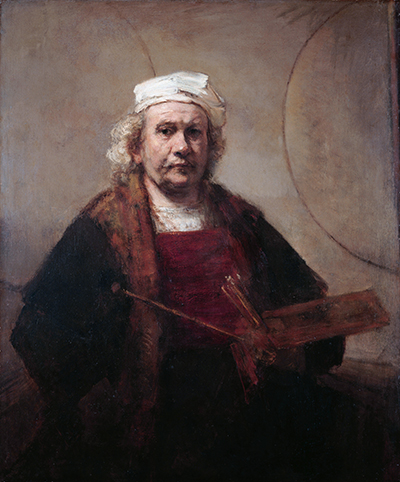
 Rembrandt.jpg)
Discussion
What feels most useful when looking at Self Portrait in a Soft Hat and Embroidered Cloak: the subject, the handling of light, the medium, the attribution history, or its place within Rembrandt's wider etching or print output?
Reader Insights
Set this page beside the refreshed Rembrandt hubs before relying on older summaries alone.
Rembrandt pages often need museum records, catalogue history and attribution caution, especially where older sources use broader labels.
Which detail would you most want clarified next: date, medium, collection, attribution, subject, condition or comparison with another Rembrandt work?
Join the Conversation
Have a thought or observation about Self Portrait in a Soft Hat and Embroidered Cloak? Share it below. Thoughtful responses may be added as the Rembrandt archive continues to be reviewed.