


 by Tom Gurney
Tom Gurney BSc (Hons) is an art history expert with over 20 years experience
Published on June 19, 2020 / Updated on August 9, 2026
Email: tomgurney1@gmail.com / Phone: +44 7429 011000
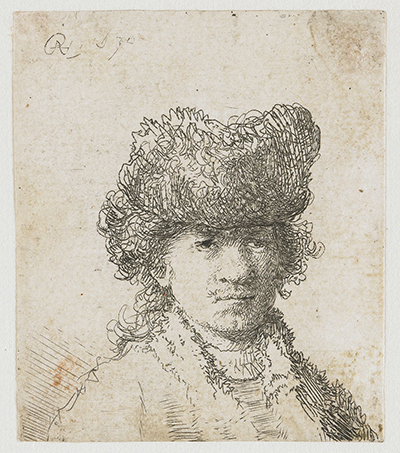
Rembrandt van Rijn loved to dress up for his self portraits, enjoying the creative side to choosing different arrangements of garments and jewellery. He would sport several different hats within his self portraits, in this case being a felt cap.
He would also take this further by posing as figures from classical literature in order to allow himself a greater variety of outfits. These would become amongst his best known works, such as Self-Portrait as the Apostle Paul in which he wears a simple cloth over his forehead in a relatively subdued piece. Within the etching displayed here, with is dated at 1630, it is likely that he was looking for new ideas having produced several portraits in recent years. The felt cap is given a great prominence, with the tall hat covering a good amount of the vertical space of this etching. It also covers his curly hair, leaving us to focus on other parts of his face that we might otherwise have been distracted away from. His own hair was often so untidy that we would marvel at the loose brushstrokes used by the artist to capture it accurately. He did, however, often take more case over his moustache though, at that is present here.
Usually, he would put the light from our right hand side, but here he chooses to bring it in from the left which leaves a small amount of shadowing on the opposing side of his face. The etching and printing process would reverse everything, so it would have been the other way around when he constructed the original engraving. The cap itself would also produce a further shadow that covered his entire forehead, and this places an increased importance onto his dark, piercing eyes. His nose was naturally prominent, not the ideal shape though for modelling, but this was Rembrandt being himself, and he did not care about societal norms. He signed this etching in the top left corner, having shortened his signature a few years earlier. The print found here looks in fairly good condition, despite the years that have passed since the early 17th century, but it is likely that more versions of the print exist elsewhere. Individual prints can fetch several thousands of pounds, but are far more affordable than his original oil paintings.
Rembrandt clearly liked this particular artwork because the cap would appear again in many other self portraits throughout the 17th century. He loved the ability to work without any planning or intention, and he could work from his studio with self portraiture all year round. His more elaborate paintings would take months, if not years, of preparation and in some cases could become a burden after a certain period, when inspiration would start to run dry. These etchings were quick and enjoyable, but still also able to produce extra funds for his expensive lifestyle as well. They also helped his own personal brand, building him up as a sort of artistic celebrity, at least within the major Dutch towns and cities of this period. No-one has ever really impacted Dutch life in quite the same way as Rembrandt, even though they have produced so many artistic stars.
Object Notes and Research Context
Rijksmuseum records date Self-portrait in a Fur Cap to around 1629 and connect it with Rembrandt's experiments in casting his own face into shadow. The print follows an unusual painted self-portrait where the face is largely obscured, showing how quickly he moved ideas between painting and etching.
The print is as much about difficulty as result. The museum notes that the shadowed face was not easy to make legible, and that Rembrandt only solved the problem fully in a later attempt. That makes the print ideal for explaining trial, state and revision without forcing it into a heroic self-image.
Further Rembrandt Context
This shorter legacy page remains part of the Rembrandt archive. For fuller context, use the refreshed Rembrandt pages below, which explain the artist's biography, media, technique, attribution issues and major works in greater depth.
For secure object data, attribution and collection history, compare Self Portrait in a Fur Cap with the relevant museum or catalogue record before treating older page text as final.
 Rembrandt.jpg)
Discussion
What feels most useful when looking at Self Portrait in a Fur Cap: the subject, the handling of light, the medium, the attribution history, or its place within Rembrandt's wider etching or print output?
Reader Insights
Set this page beside the refreshed Rembrandt hubs before relying on older summaries alone.
Rembrandt pages often need museum records, catalogue history and attribution caution, especially where older sources use broader labels.
Which detail would you most want clarified next: date, medium, collection, attribution, subject, condition or comparison with another Rembrandt work?
Join the Conversation
Have a thought or observation about Self Portrait in a Fur Cap? Share it below. Thoughtful responses may be added as the Rembrandt archive continues to be reviewed.