


 by Tom Gurney
Tom Gurney BSc (Hons) is an art history expert with over 20 years experience
Published on June 19, 2020 / Updated on August 9, 2026
Email: tomgurney1@gmail.com / Phone: +44 7429 011000
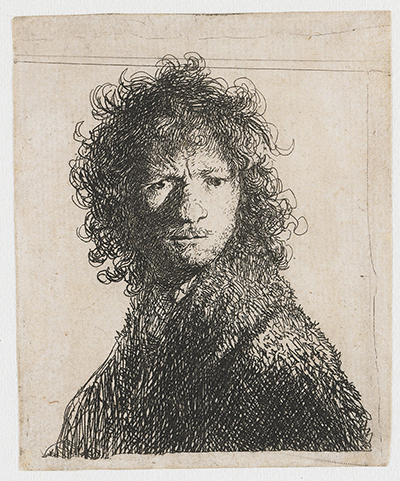
Rembrandt van Rijn produced a series of self portrait etchings in the late 1620s and early 1630s. The prints from them were widely dispersed at the time in order to finance the artist's growing art collection.
This was an artist who did not worry about making himself look beautiful within his artworks. He loved to be honest and open in his work, as well as getting in touch with the different human emotions that we all experience in our own lives, both the positive and negative ones. He would often concentrate on intense facial expressions within his portraits, with a good example being The Raising of Lazarus, where we find ourselves studying the emotions on the faces of every figure in the scene, rather than just the main figure. You will also notice from the etching in front of us that the titles would often be constructed around these expressions, with this 1630 design featuring a frowning portrayal of the artist.
Rembrandt's hair was often a cause for inspection, with loose curls allowing him to work freely. The thicker areas would be much darker, and often use alternative techniques, such as cross hatching, before he then moved on to the individual hairs that would reach out in a seemingly random, untidy fashion. It was this lack of care of his own appearance which made his decision to portray himself as a beggar in later years entirely believable. In fact it would predict his own demise, as he later fell into bankruptcy. For many years it would actually be his self portraits that kept his financial head above water, mainly with the paintings, but these etchings had the advantage of allowing repeated series of prints that could also be sold at lower prices, bringing him a new audience of prospective customers.
We do know that the National Gallery of Art own a print from this etching but it is unclear as to where the remaining items from this series now lie (the etching may lie within their ownership as well). The artist would have been around 24 years of age at the time of this artwork, as shown in his youthful looks. It is incredible to see just how quickly his rate of progress could be, as it was only around his late teens that he was starting to produce impressive paintings, and the etching techniques would normally take decades to master. He would take advice from other, more experienced engravers and there would have been many around at that time, as it was a highly regarded medium within Northern European art during the 17th century.
Object Notes and Research Context
Rijksmuseum records date Self-portrait, Frowning to 1630 and connect it with the artistic practice of studying states of mind in the mirror. This is not a vanity image in the modern sense, but an exercise in expression, light and facial contraction.
The small etched head belongs to a remarkable group in which Rembrandt used his own face as available laboratory material. Anger, surprise, laughter and shadow could be tried quickly, then reused in history paintings where convincing emotion mattered. Link this page to the self-portraits hub and to the style-and-technique discussion of facial expression.
This sheet is one of the clearest examples of expression study. The frown compresses brow, eyes and mouth into a small but readable emotional signal. Rembrandt could then transfer that kind of knowledge to figures in narrative paintings, where anger, fear or surprise had to be understood quickly by the viewer.
Such small etchings matter within Rembrandt's wider career. They show practice, not just finished fame. The same artist who made Night Watch and the late self-portraits also used tiny plates to study the mechanics of expression. That makes the page a useful support for technique and self-portrait navigation.
Further Rembrandt Context
This shorter legacy page remains part of the Rembrandt archive. For fuller context, use the refreshed Rembrandt pages below, which explain the artist's biography, media, technique, attribution issues and major works in greater depth.
For secure object data, attribution and collection history, compare Self Portrait, Frowning with the relevant museum or catalogue record before treating older page text as final.
 Rembrandt.jpg)
Discussion
What feels most useful when looking at Self Portrait, Frowning: the subject, the handling of light, the medium, the attribution history, or its place within Rembrandt's wider etching or print output?
Reader Insights
Set this page beside the refreshed Rembrandt hubs before relying on older summaries alone.
Rembrandt pages often need museum records, catalogue history and attribution caution, especially where older sources use broader labels.
Which detail would you most want clarified next: date, medium, collection, attribution, subject, condition or comparison with another Rembrandt work?
Join the Conversation
Have a thought or observation about Self Portrait, Frowning? Share it below. Thoughtful responses may be added as the Rembrandt archive continues to be reviewed.