


 by Tom Gurney
Tom Gurney BSc (Hons) is an art history expert with over 20 years experience
Published on June 19, 2020 / Updated on August 9, 2026
Email: tomgurney1@gmail.com / Phone: +44 7429 011000
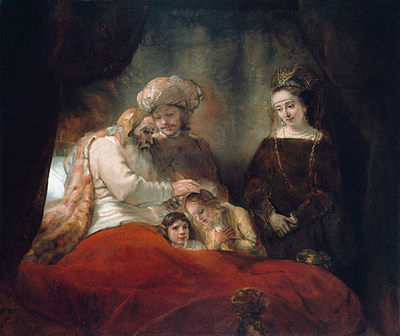
Jacob Blessing the Sons of Joseph is a major 1656 late biblical painting in Kassel
There is a charming atmosphere to this very personal portraits which is now on display in the Gemäldegalerie Alte Meister in Kassel, Germany. This large canvas stands at 173 cm × 209 cm (68 in × 82 in) and was completed in 1656, when the artist was around 50 years old.
A charming aspect of this painting is that Rembrandt displays his use of light and shadow (Chiaroscuro) across multiple figures, suggesting that his feeling of family is significant here. Normally he would focus the eye on one or two figures and leave the rest darkened.
The precise tale covered in this painting is a visit to dying father Jacob by Manasseh and Ephraim, his two sons. With their father in such a bad way, it was necessary for them to visit him before he potentially may have passed away. Their sadness is combated with a comfortating touch, hopefully aiding these young boys in a harrowing experience. The younger son is seen here being blessed, partially against the wishes of Jacob who had himself brought them with him on this visit.
The Schloss Wilhelmshöhe is a Neoclassical palace in central Germany. Its Gemäldegalerie Alte Meister contains work by the likes of Nicolas Poussin, Albrecht Altdorfer, Anthony van Dyck and Albrecht Durer. This insitution also holds an antiquities collection and the Graphic Arts Collection and is amongst the finest art gallery or museum in this region of Germany.
Object Notes and Research Context
The Kassel Gemaldegalerie Alte Meister records the painting as Jakob segnet Ephraim und Manasse, signed and dated 1656, oil on canvas, 173 by 209 cm, inventory GK 249. The subject comes from Genesis 48, where the aged Jacob blesses Joseph's sons and deliberately crosses the expected order by favouring the younger Ephraim.
The Rembrandt Database notes that Kassel has shared extensive technical documentation, including material related to the painting's damage by an acid attack in 1977 and later treatment. That conservation history is not a side note: it helps explain why major museum records for Rembrandt paintings often include scientific and restoration evidence alongside iconography and provenance.
For readers, the strongest interpretive route is family, touch and reversal. Joseph tries to guide the blessing according to seniority, but Jacob's crossed hands make divine preference visible. The subject connects to Rembrandt's family-and-household themes and to his late biblical paintings, where small gestures often carry the entire narrative burden.
The Kassel painting also has a major compositional strength that deserves explanation. Rembrandt places the crucial theological reversal in the hands: Jacob crosses his arms so that the younger Ephraim receives the greater blessing, while Joseph attempts to correct him. The scene is quiet, domestic and almost tender, but its meaning turns on lineage, election and the deliberate overturning of expected order.
Because the canvas suffered a modern acid attack, conservation history needs careful handling. The attack is not a sensational detail to lead with, but it explains why the Kassel documentation route matters and why technical records are part of the painting's present history. It also supports a wider Rembrandt theme: many famous works survive through damage, treatment, copies, documents and changing scholarly interpretation.
A caption or short paragraph should identify Ephraim and Manasseh by role rather than assuming readers know Genesis. Joseph brings his sons to the dying Jacob for blessing; the drama begins when Jacob crosses the expected order. That simple explanation makes the painting much easier to read.
This page can also usefully link to Rembrandt's family biography material. The painting is not about Rembrandt's own household, but its emotional force depends on fathers, sons, inheritance and touch, themes that make it easy for users to connect narrative painting with life context.
Further Rembrandt Context
This shorter legacy page remains part of the Rembrandt archive. For fuller context, use the refreshed Rembrandt pages below, which explain the artist's biography, media, technique, attribution issues and major works in greater depth.
For secure object data, attribution and collection history, compare Jacob Blessing the Sons of Joseph with the relevant museum or catalogue record before treating older page text as final.
 Rembrandt.jpg)
Discussion
What feels most useful when looking at Jacob Blessing the Sons of Joseph: the subject, the handling of light, the medium, the attribution history, or its place within Rembrandt's wider painting output?
Reader Insights
Set this page beside the refreshed Rembrandt hubs before relying on older summaries alone.
Rembrandt pages often need museum records, catalogue history and attribution caution, especially where older sources use broader labels.
Which detail would you most want clarified next: date, medium, collection, attribution, subject, condition or comparison with another Rembrandt work?
Join the Conversation
Have a thought or observation about Jacob Blessing the Sons of Joseph? Share it below. Thoughtful responses may be added as the Rembrandt archive continues to be reviewed.