


 by Tom Gurney
Tom Gurney BSc (Hons) is an art history expert with over 20 years experience
Published on June 19, 2020 / Updated on August 9, 2026
Email: tomgurney1@gmail.com / Phone: +44 7429 011000
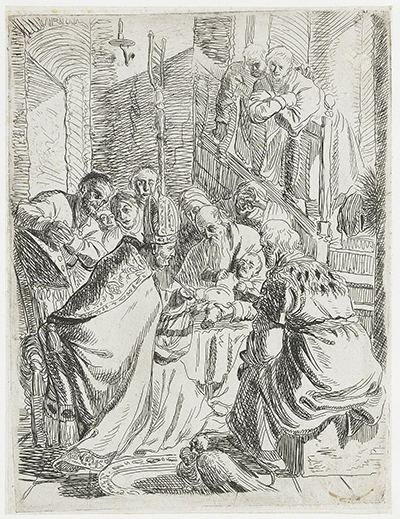
This etching was produced in 1626 and is one of many Rembrandt artworks which focused on the Circumcision of Christ. Religious themes would, of course, dominate much of this artist's work, but there were also many exceptional portraits and self portraits as well.
Here we find an example of Rembrandt trying out the medium of etching for the very first time. As such, this piece can be considered somewhat crude in comparison to the later work that he produced, but it still holds a great significance in helping us to track his progress over time. He is known to have consulted Jan Pietersz Berendrecht initially and visited his workshop in order to learn more about the challenging techniques involved in etching and printmaking. He had only just finished his own apprenticeship at this stage, which underlines the ambitious nature of Rembrandt who was always looking for new ways of expressing his creativity as well as widening his oeuvre.
Rembrandt would use a needle to create his design into the film and is known to have worked fairly quickly, even in these early days. The artist quickly saw some incredible opportunities from working in this way and would use prints as a means to increase his income and also spread his signature across wider boundaries, which in turn would increase the number of commissioned paintings that he would receive. Indeed, during his own lifetime it was actually his etchings that contributed to his success more than his paintings, and it was only after his passing that historians placed a greater importance on the latter.
One of the prints produced from the etching can be found in the collection of the Minneapolis Institute of Art, whose website features a little more information on the artwork itself, as well as a back story around Rembrandt's work with etching more generally. The greater affordability of his printed etchings has enabled a wider audience to acquire items from Rembrandt's career, where his original paintings would simply have been too expensive. Indeed, you will find further copies of this particular design in other collections, some of which may have been from the same series, and some not. Rembrandt liked to review his prints at each stage, and then amend the etching accordingly for future proofs as the artwork evolved over time. The different stages would then vary in value too, and would normally be signified with notes on the back, written by the artist himself.
Object Notes and Research Context
The Rijksmuseum identifies The Circumcision, around 1625, as Rembrandt's first print, a surprisingly ambitious large-format composition for a beginner in etching. It was published by Johannes Pietersz. Berendrecht in Haarlem, which also makes the page useful for explaining that Rembrandt's earliest prints did not yet follow the later pattern of the artist issuing and revising plates himself.
The subject returned in later Rembrandt prints, including The Circumcision in the Stable of 1654. That comparison anchors the subject: the early print is crowded, experimental and still awkward in depth, while the late print shows a more economical command of darkness, intimacy and drypoint. The comparison leads naturally to Rembrandt's prints and technique.
The early print is important because it shows ambition before mastery. Rembrandt attempts a dense biblical interior with multiple figures, ritual action and spatial depth at a point when his etched technique was still developing. That mix of daring and awkwardness is exactly why the print should not be treated as disposable.
The later Circumcision in the Stable provides the cleanest comparison. By 1654 Rembrandt could create mystery through shadow and simplification rather than crowding the plate with explanation. A short section comparing the early and late treatments would help readers see development across three decades of printmaking.
This early print can also introduce the idea of published prints. Berendrecht's role matters because it reminds readers that Rembrandt's print career was commercial and collaborative from the beginning. Later he became closely associated with issuing and revising his own plates, but the earliest sheet already sits inside a publishing network.
Further Rembrandt Context
This shorter legacy page remains part of the Rembrandt archive. For fuller context, use the refreshed Rembrandt pages below, which explain the artist's biography, media, technique, attribution issues and major works in greater depth.
For secure object data, attribution and collection history, compare The Circumcision with the relevant museum or catalogue record before treating older page text as final.
 Rembrandt.jpg)
Discussion
What feels most useful when looking at The Circumcision: the subject, the handling of light, the medium, the attribution history, or its place within Rembrandt's wider etching or print output?
Reader Insights
Set this page beside the refreshed Rembrandt hubs before relying on older summaries alone.
Rembrandt pages often need museum records, catalogue history and attribution caution, especially where older sources use broader labels.
Which detail would you most want clarified next: date, medium, collection, attribution, subject, condition or comparison with another Rembrandt work?
Join the Conversation
Have a thought or observation about The Circumcision? Share it below. Thoughtful responses may be added as the Rembrandt archive continues to be reviewed.