


 Buy Art Prints Now
from Amazon
* As an Amazon Associate, and partner with Google Adsense and Ezoic, I earn from qualifying purchases.
 by Tom Gurney
Tom Gurney BSc (Hons) is an art history expert with over 20 years experience
Page Created on June 19, 2020 / Page Updated on November 1, 2026
Email: tomgurney1@gmail.com / Phone: +44 7429 011000
The Three Marys at the Tomb: discovery, light and a disputed Van Eyck attribution
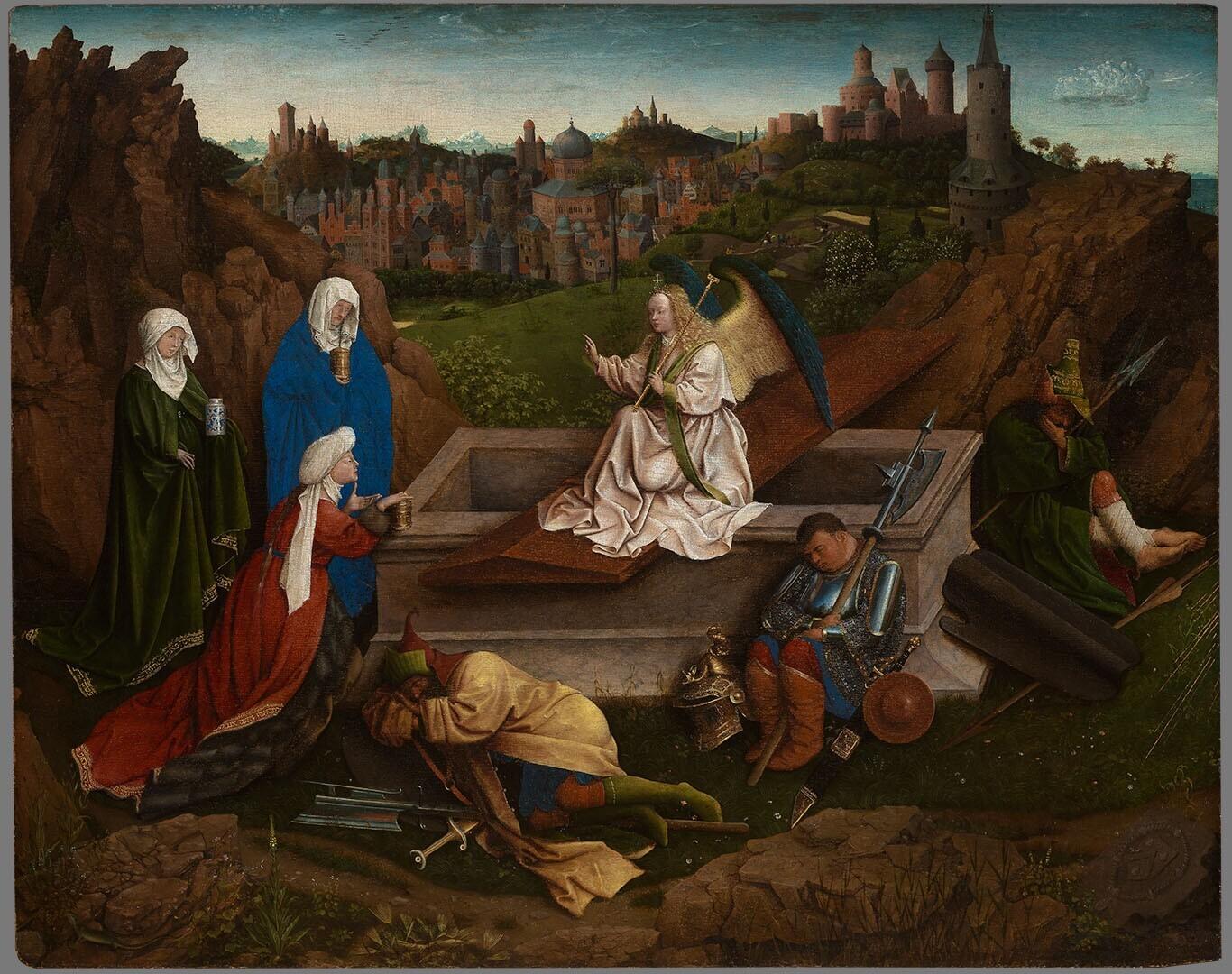
An opened tomb stretches across the middle of the painting. Three women have brought vessels for anointing Christ’s body; an angel tells them that he has risen. The guards remain asleep, their weapons and armour useless beside the opened grave. The Three Marys at the Tomb gives the discovery a spacious setting, with a winding road and a densely built city beyond the immediate encounter.
Museum Boijmans Van Beuningen in Rotterdam catalogues the work as attributed to Jan van Eyck, 1425–35. Its oil-painted panel measures 71.5 × 90 centimetres, accession 2449 (OK). Those details identify the surviving object, whose authorship and original extent remain disputed. Recent conservation and scholarship have made it more interesting, while leaving the museum’s qualified attribution open to challenge.[1]
At a Glance
How the painting tells the Resurrection story
The National Gallery’s account of the Three Maries, or Holy Women, relates the subject to all four Gospel narratives. Mary Magdalene is usually recognisable, while the other women cannot always be distinguished individually. The familiar title therefore names a devotional subject rather than guaranteeing a single roster shared by every written account. The Rotterdam picture gathers the women, angel, tomb and guards into one landscape in which the consequence of the Resurrection becomes visible.[2]
Magdalene kneels in a red mantle at the near end of the tomb. Her eyes turn towards the angel, while her hands remain close to the vessel and the stone. The arrangement brings two forms of evidence together: the messenger speaks, and the opening reveals an absence. Her companions stand behind her, holding their own containers. Boijmans identifies Mary Salome, but leaves the blue-clothed woman’s identity uncertain between Christ’s mother and Mary Cleophas.[1]
The women’s postures make their shared arrival look uneven in time. Magdalene has already dropped to her knees, while the standing pair retain the upright bearing of people who have approached along a path. Their vessels belong to an action that can no longer take place. The women have reached the correct grave with the correct materials, only to discover that the purpose of the visit has changed. The objects give their astonishment a practical basis.
The angel occupies the displaced lid rather than hovering outside the scene. A raised hand addresses the women; the staff and broad wings distinguish the speaker from the human visitors. White cloth folds over the stone, creating a light centre between the darker opening and the bodies in the foreground. The figure’s seated position also makes the disturbed tomb seem newly usable as a place of announcement. What sealed a grave now supports its interpreter.
The lid cuts diagonally through the composition, while the sarcophagus stretches more horizontally behind it. These two strong directions prevent the women and angel from forming a static row. The dark interior is accessible to the eye but cannot offer the body the visitors expect. Across that gap, hands, faces and folds carry the exchange. The story is made legible through the relation between physical things, without showing the actual instant when Christ rose.
Sleeping bodies, glittering armour
The guards create a second group of three. One lies across the foreground wrapped in yellowish cloth, another sleeps upright against the tomb, and a third sits farther right. Their weapons establish their task, yet their postures cancel its effectiveness. They take up much of the space closest to the viewer without contributing to the conversation. The women’s attention and the guards’ unconsciousness become competing ways of inhabiting the same morning.
The yellow-clothed sleeper is especially emphatic because his body crosses the ground almost sideways. Bent legs, a folded arm and the low sweep of his garment produce a shape very different from the tall mantles behind him. His head is turned away from the empty grave. In the seated armoured figure, the head falls forward while the equipment remains conspicuously elaborate. The painter gives metal a brilliance its owner cannot presently appreciate.
Look at the contrast between the polished breastplate and the darker mesh beside it. The breastplate collects broad blue and pale reflections; the mail breaks into many small light marks. A helmet rests separately on the ground, its elaborate crest rising beside the soldier’s legs. A circular shield and long weapon shafts further divide the foreground. Hard, shining surfaces surround vulnerable sleeping faces and hands, joining painstaking observation to the narrative of failed vigilance.
The reflections are also a way of connecting the soldier with his surroundings. Colour on the breastplate belongs to the same world as sky, grass and clothing elsewhere in the panel. The armour does not simply have a local metallic colour; it changes according to what it faces. Beside the still heads and slack bodies, that responsive surface creates a small paradox. The equipment seems to register the world more actively than the people wearing it.
A sacred city and a difficult route into the distance
Rock rises on either side of the foreground, opening towards a green middle distance and the city. The landscape is not a continuous empty corridor. It alternates between steep faces, grass, roads, walls and towers, so that the eye repeatedly has to change scale. The little travellers help bridge that difference: their bodies are small enough to belong to the distant route but recognisable enough to connect it with the people beside the tomb.
The city gathers pointed roofs, round towers, walls and a conspicuous dome into a compressed skyline. Its red and brown buildings stand out against paler mountains. A handful of birds crosses the sky, and cloud fragments interrupt the blue. The breadth of the setting gives the women’s encounter a world beyond it. Nothing in the scene suggests that the entire city has awakened to what has happened at the grave.
Writing in 1908, W. H. James Weale described the snow-topped mountains, winding road, riders and pedestrians, and a flight of wild geese. He admired the light striking some towers while the city’s centre remained dark. His description is valuable as a record of looking before modern treatment, but his attempt to explain the foreground illumination as possible moonlight is an interpretation. The painting’s different kinds of light have long demanded explanation.[3]
Weale also recorded a debate over whether the background came from an on-site drawing of Jerusalem. He favoured a composition assembled from accounts of the Holy Places rather than a direct view. That old disagreement remains a useful warning about the difference between a persuasive sacred city and a documented journey. Recognisable-looking buildings can be combined with imagination, inherited models or travellers’ descriptions. A skyline cannot, by itself, prove that Jan or Hubert visited Palestine.[3]
Near the viewer, the foreground plants and broken rock interrupt the broad architectural prospect. Weale singled out several plants by name, including teasel and flag-lily. Those identifications belong to his historical description rather than a new botanical examination here. The visible point is the change in attention: distant walls require a small, economical mark, while a nearby leaf can receive its own edge and highlight. The landscape makes close scrutiny and expansive viewing part of one experience.[3]
The Syrian jar and the women’s preparations
The blue-and-white vessel held by the green-clothed woman has a history beyond its role in the Gospel subject. Boijmans curator Alexandra van Dongen identified the depicted apothecary jar as based on pottery from Damascus, whose makers drew on imported Chinese porcelain. The museum presented the research in Remix Rotterdam, relating the object to connections between Damascus, Venice and Bruges. A painted container thus opens the devotional scene onto a history of exchange.[4]
This identification concerns an object type and its decoration. It does not recover a bill of sale for the painter’s model or establish the itinerary of one particular pot. Nor does an imported vessel require its painter to have travelled to its place of manufacture. Such distinctions make the finding stronger: an object can carry knowledge of distant craft traditions into a workshop through trade, collecting or the circulation of images.[4]
Within the composition, the jar remains part of the women’s intended work. Its pale surface and dark pattern contrast with the neighbouring folds of green cloth, making it easy to find once one knows where to look. The vessel’s position close to the woman’s chest also differs from Magdalene’s container near the tomb. Each woman has carried something to the same destination, but their hands now hold supplies for a task overtaken by the angel’s news.
Watch: Jan van Eyck in context
Choose a Smarthistory close reading of the Arnolfini Portrait or the closed and opened Ghent Altarpiece.
Jan van Eyck, The Arnolfini Portrait
Look closely at the room, mirror and gestures in the London double portrait.
Watch on YouTubeThe cut right edge and the missing Christ
Boijmans’s conservation account reports that more than ten centimetres were removed from the right side and that a figure of Christ disappeared with the lost section. It also identifies the gilded rays as original. These findings change the narrative possibilities of the panel. The surviving angel and empty tomb may once have shared the composition with the risen Christ himself.[5]
The rays reach towards a boundary that no longer preserves the complete design. They make the loss consequential rather than merely a reduction in width. A missing figure could alter the direction in which a viewer reads the women’s attention and the balance between announcement and appearance. The present rectangle may feel coherent, but visual coherence does not prove physical completeness.
A separate curatorial answer cautions that too little information survives for a reliable reconstruction of the whole. It remains uncertain whether the work extended farther at other edges and what those portions contained. The specific right-hand loss should therefore not become a confident drawing of an entire original altarpiece. We can describe the museum’s finding without inventing Christ’s precise pose, costume, gesture or relationship to an original frame.[1][5]
What conservation found beneath the varnish
The 2012 treatment prepared the panel for The Road to Van Eyck. In the museum’s assessment, testing and cleaning supported an origin in the Van Eyck workshop. Its account makes an additional judgement that the original golden rays must be by the master. The two statements have different scopes: evidence that gilding belongs to the original structure does not, on its own, identify the individual who applied it.[5]
The conservators’ 2012 Van Eyck Studies abstract gives a more precise account of the difficult surface. Annetje Boersma, Eva van Zuien, Annelies van Loon and Katrien Keune reported an old yellowed oil-resin layer beneath later varnish. Because gilding lay above it in places, they considered whether it could be an original varnish or part of the painting procedure. Their wording is exploratory, and should not become a claim that a complete original coating has been conclusively identified.[6]
The same report addresses the unusually flat-looking blue robe. An X-radiograph still showed modelling that the present surface no longer clearly reveals. Examination of a cross-section suggested deterioration within the ultramarine paint through pigment–binder interaction. The robe’s current appearance therefore cannot simply be read as the painter’s intended treatment of folds. Some apparent differences in quality or modelling may belong to the object’s later material history.[6]
Colour built in layers, tested through reconstruction
In 2025, Maartje Stols-Witlox and Elmer Kolfin used this panel to explain painting over a white ground. Their study illustrates Indra Kneepkens’s reconstruction, from drawing and base colours through translucent glazes. Red, blue and yellow areas receive different sequences of layers rather than one uniform method. This helps explain why the coloured garments appear so distinct from one another. The article also acknowledges the recent challenge to the painting’s attribution and date.[7]
A reconstruction is useful because it turns an apparently effortless surface into a series of decisions. An opaque layer can hide drawing that a painter still needs; a glaze can deepen a shadow but requires time to dry. Different colours may demand different solutions even within one small garment. These practical questions draw attention to the care behind the result without allowing us to watch the original painter at work.[7]
Kneepkens’s 2021 University of Amsterdam thesis examines the panel much more closely. She distinguishes the original four-board support from her smaller reconstructed section, and describes fine drawing alongside broader wet lines. Her experiments with the soldier’s mail and reflected highlights favour paint that keeps tiny brush marks sharp. These are practical interpretations informed by technical images, not chemical identification of every original binding medium.[8]
Her discussion of zinc is similarly careful. Elemental maps help recover the blue robe’s lost modelling, but zinc associated with copper may occur naturally within azurite. A stronger signal is not automatic proof that zinc sulphate was deliberately added as a drying agent. Evidence from individual paint particles offers further possibilities. The distinction matters because a scientific image records a material distribution, which still needs interpretation before it can become a recipe.[8]
Why the name of the painter remains disputed
The history of attribution predates scientific imaging. Weale’s 1908 survey records scholars choosing Jan, Hubert, an early work, or something later than the accepted Van Eyck paintings. The same similarities could support different arguments. Resemblance to the Ghent Altarpiece might indicate common authorship, dependence on a shared workshop language, or a later painter’s admiration. Disagreement was already embedded in the panel’s modern reception.[3]
The Louvre curator Georges Lafenestre offered a particularly vivid French response to its appearance at Bruges in 1902, reprinted in his 1904 book. He treated it as a Hubert painting and connected the figures with Italian frescoes, while praising the sleeping soldiers and elaborate landscape as evidence of close observation. His proposed date of 1410 and suggestion of execution in Padua are historical interpretations, not facts established by the present museum record. They show how readily a persuasive comparison could grow into a biography.[9]
A very different French-language argument appeared in 1959. Jean Squilbeck examined the guards’ polearms, swords, armour and detached helmet. He compared their construction with later objects and images, concluding that the picture might belong around 1485–1525. Particularly important to him was the possibility that the elaborate helmet combined features unsuited to actual combat. He also considered the sarcophagus and the heraldic addition. This was a published challenge to the accepted date, not a newly discovered consensus.[10]
Squilbeck’s reasoning makes the weapons more than decorative detail. If a securely identified type was invented after a proposed painting date, it could create a chronological difficulty. Yet a fanciful painted weapon is not necessarily identical to a surviving museum specimen. The debate requires both knowledge of military equipment and an assessment of the painter’s freedom to combine forms. Its importance lies in the questions it makes visible, rather than a single date that all later scholars accepted.[10]
In 2025, Frans Nies renewed the challenge in Oud Holland. His published abstract argues that Eyckian drawing and technique do not justify a firm Jan attribution, and proposes a date after 1455 on iconographic grounds, compatible with the wood analysis. He allows an anonymous follower, possibly someone formerly employed in the workshop. Only the abstract was available for consultation here; the full iconographic argument cannot be independently evaluated from that summary. Boijmans continues to catalogue the picture under its qualified Jan attribution.[11][1]
These positions should not be collapsed into one alternative. Squilbeck’s proposed period is considerably later than Nies’s lower boundary. A workshop attribution can imply production during Jan’s life, while a follower might have worked after his death. A panel made in the Eyckian tradition need not have been made by either brother. For this reason the paintings guide includes the Rotterdam work with its uncertainty visible, while the page follows the owning museum’s current wording.
Ownership, heraldry and the journey to Rotterdam
A coat of arms in the lower corner encouraged an early connection with Philippe de Commynes. Weale identified it through the chevron, shells and collar of the French Order of Saint Michael. He used that association to place the painting in Commynes’s possession before 1472. Squilbeck later questioned the assumptions behind the heraldic argument. The painted arms are evidence of a claim to ownership or association; they do not automatically identify the original commissioner or establish a fifteenth-century chain of possession.[3][10]
Weale’s later provenance traces the picture through the Bauwens collection, William Middleton, the dealer Johnson, Sir John Charles Robinson and the Cook collection at Richmond. His record also connects it with the 1826 Bauwens sale and the 1872 Middleton sale. These are reported historical links, rather than auction documents newly examined for this page. The earlier proposed identification with an eighteenth-century collection deserves particular caution, since a matching subject or remembered title is weaker evidence than a securely documented transfer.[3]
The public exhibitions in Weale’s account help explain why the painting became familiar to British and continental scholars. It appeared at London’s Burlington House in 1873, the Burlington Fine Arts Club in 1892, the New Gallery in 1899, Bruges in 1902, and London’s Guildhall in 1906. Each display gave critics another opportunity to compare it with paintings attributed to the brothers. Its changing labels belong to that history of repeated public judgement.[3]
The museum’s research into collecting supplies a more precise modern landmark. Albert Elen’s account dates Daniël George van Beuningen’s purchase from the Cook collection to 30 April 1940, at 2.2 million guilders. It records the painting’s arrival before the German attack on Rotterdam and its survival of the air raid. This is the history of the panel’s own purchase, distinct from the Koenigs drawings discussed elsewhere in the same document.[12]
Boijmans’s 2020 news account gives the London purchase price as £250,000, describing it as Van Beuningen’s most expensive acquisition. The panel entered the museum with his collection in 1958. After its 2012 treatment, the museum made an exceptional loan to the 2020 Van Eyck exhibition in Ghent. Its current online object record lists it as in storage, so an old exhibition photograph should not be taken as a promise that it is permanently on display.[13][1]
The painting rewards a return to its central exchange after all these questions. The women have arrived prepared to tend the dead, the guards have failed to attend, and the angel makes an empty place intelligible. Changes to the panel’s edges and surface complicate that encounter, while its uncertain maker keeps the image within an active history of research. The surviving picture remains forceful because the story is organised through bodies, objects, space and light that still invite close looking.
Related reading


 Jan van Eyck.jpg)
Discussion
What do you notice in The Three Marys at the Tomb: discovery, light and a disputed Van Eyck attribution? Share a close observation or a source that adds useful context.
Join the Conversation
Keep observations specific and evidence clear.
References
- Museum Boijmans Van Beuningen, The Three Marys at the Tomb, 2449 (OK), current English and Dutch object record, specifications and curatorial answers. View Source
- National Gallery, London, “Three Maries,” glossary; the Gospel witnesses and uncertain individual identities. View Source
- W. H. James Weale, Hubert and John Van Eyck: Their Life and Work (1908), pp. 153–157, catalogue 28; historical description, provenance, exhibitions and attribution debate. Historical claims distinguished from current conclusions. View Source
- Museum Boijmans Van Beuningen, Remix Rotterdam. Boijmans x Wereldmuseum, “Trade encounters”; Alexandra van Dongen’s research on the Damascus-type jar. View Source
- Museum Boijmans Van Beuningen, “‘The Three Marys at the Tomb’ Attributed to Van Eyck”; 2012 treatment, original rays, missing right-hand section and workshop interpretation. View Source
- Annetje Boersma, Eva van Zuien, Annelies van Loon and Katrien Keune, “New Findings on The Three Marys at the Tomb by Van Eyck in the Museum Boijmans Van Beuningen,” Van Eyck Studies colloquium abstract (2012), p. 30. Complete indexed abstract consulted; direct PDF access unavailable. View Source
- Maartje Stols-Witlox and Elmer Kolfin, “The Hidden Revolution of Colored Grounds: An Introduction,” Journal of Historians of Netherlandish Art 17:2 (2025), sections on Three Marys, figures 14–19 and note 10. View Source
- Indra Kneepkens, Masterful Mixtures (University of Amsterdam, 2021), chapter 9, pp. 201–220, and relevant chapter 8 passages, pp. 176–178, 197; original technical evidence distinguished from experimental reconstruction. View Source
- Georges Lafenestre, Les Primitifs à Bruges et à Paris, 1900–1902–1904, second edition (Paris, 1904), pp. 100–102; French account of the 1902 exhibition, consulted as historical reception. View Source
- Jean Squilbeck, “Une œuvre énigmatique, ‘les Trois Marie au Tombeau’ du Musée Boymans à Rotterdam,” Revue belge d’archéologie et d’histoire de l’art 28 (1959), pp. 53–77; actual printed pagination, rather than the museum bibliography’s pp. 3–27. Full article consulted. View Source
- Frans Nies, “The attribution of Jan van Eyck’s Three Marys at the tomb reconsidered,” Oud Holland (2025), DOI 10.1163/18750176-12340232; complete published abstract consulted through ResearchGate, full paper unavailable. View Source
- Albert Elen, The Koenigs Collection, Museum Boijmans Van Beuningen, updated March 2017, p. 13; separate purchase of Three Marys in April 1940. View Source
- Museum Boijmans Van Beuningen, “Van Eyck painting on loan for first time,” 29 January 2020; purchase price, 2012 conservation and exceptional Ghent loan. View Source
 Jan van Eyck.jpg)


