



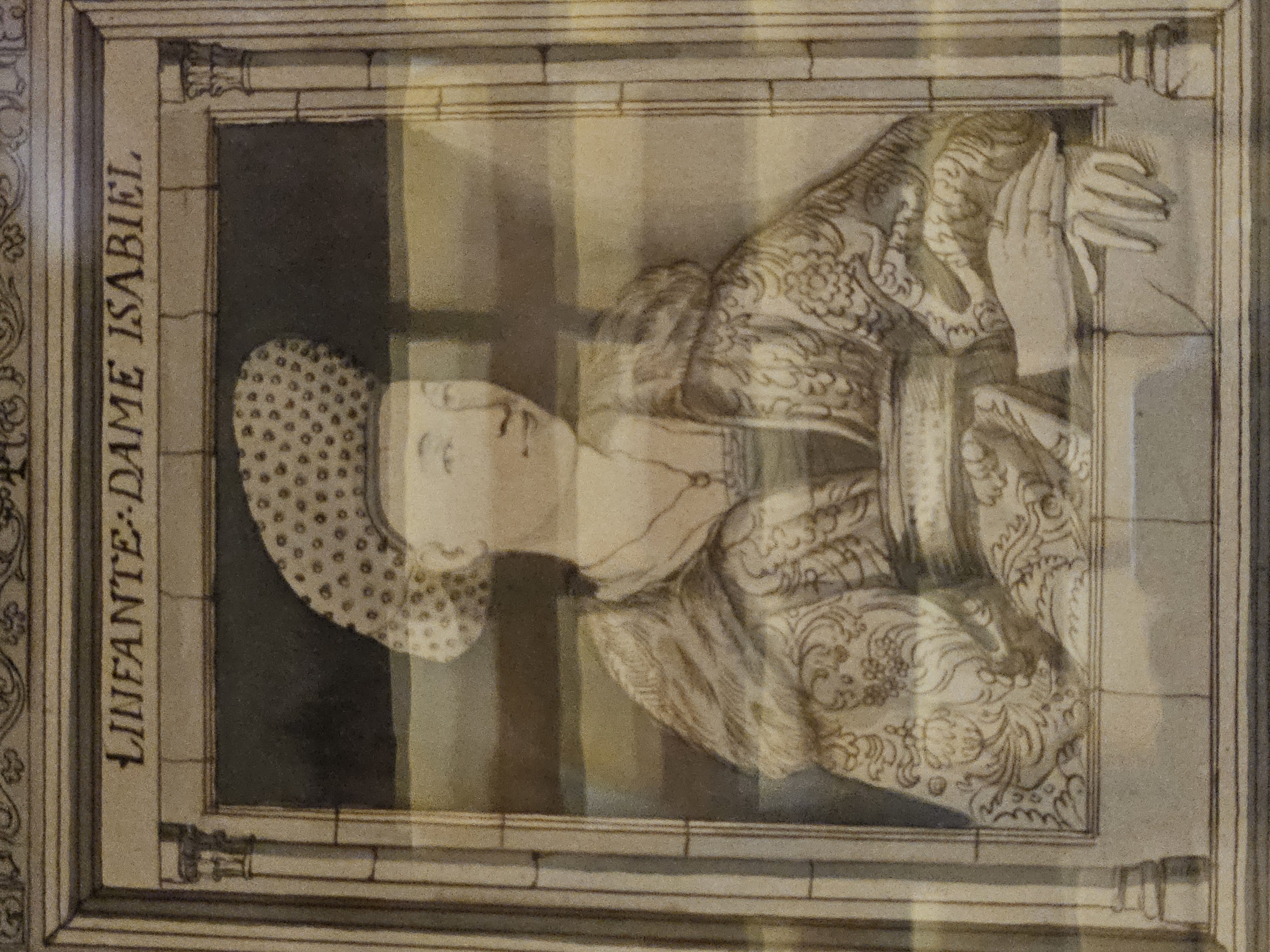
Later drawn witness traditionally linked to Van Eyck’s lost portrait of Isabella; this is not his original painting.
Buy Art Prints Nowfrom Amazon
* As an Amazon Associate, and partner with Google Adsense and Ezoic, I earn from qualifying purchases.
 by Tom Gurney
Tom Gurney BSc (Hons) is an art history expert with over 20 years experience
Page Created on June 19, 2020 / Page Updated on November 1, 2026
Email: tomgurney1@gmail.com / Phone: +44 7429 011000
The lost portrait of Isabella of Portugal
Jan van Eyck painted Isabella of Portugal in 1429 for Philip the Good, the Burgundian duke considering her as his third wife. The original is lost. A much later drawing in Lisbon preserves a proposed reflection of its design: the princess appears behind a stone sill, beneath her name, with one hand reaching into the viewer's space. It offers a compelling image of an encounter between painter and prospective duchess, although its distance from the missing work matters.[1][3][6]
The evidence comes in several distinct forms. An embassy account records the making and dispatch of a likeness; the Lisbon copy supplies a composition; other drawings and paintings preserve competing traditions of Isabella's appearance. They do not all reproduce the same original. Research in Belgian, French, Dutch, British, American and Portuguese collections helps separate those objects and explains why a familiar caption can conceal a complicated attribution history.
At a Glance
The embassy and the portrait from life
The mission reached Avis on 12 January 1429 and met King John I the following day. Negotiations continued with his sons. The surviving French account says that the ambassadors had Jan paint the infanta from life while they investigated her reputation and character. Written information and visual likeness were complementary parts of the marriage enquiry: the portrait was not the entire basis of the negotiations.[3]
Around 12 February they dispatched four messengers, two travelling by sea and two overland. Each carried a written report, and the account also mentions sending the painted likeness. These details distinguish arrival, audience, negotiations and dispatch; they do not establish a sitting on one precisely known January day. Nor do they name the portrait's pigments or support. The journey was organised around diplomatic business, and the surviving description is interested in what the envoys accomplished rather than how the painter built his picture.[3]
The National Gallery places the Portuguese journey within Van Eyck's employment by Philip, whose service began in 1425. A court appointment could require travel as well as pictures. The lost likeness therefore documents an important part of his professional practice that his surviving devotional paintings cannot show directly: making an image for an employer who needed to see someone living at another court. His access to Isabella depended on an organised embassy and royal reception, rather than a private visitor's opportunity to sketch.[4]
Were there two portraits?
The frequently repeated account of two Van Eyck portraits, one sent by each route, goes beyond the wording of the mission record. Stephan Kemperdick's re-examination stresses that four reports are described but the portrait remains singular. This does not prove that Van Eyck could never have made another version. It means that the dispatch account cannot establish the familiar pair, and no surviving originals allow us to compare two supposedly identical pictures.[2][3]
A different second image has emerged from French research. In 2025 Philippe Lorentz drew attention to a chronicle in the Bibliothèque nationale de France recording a portrait brought to Philip at Amiens by Portuguese envoys in 1424. He proposes that its maker was Portuguese; the work has disappeared. Those earlier marriage discussions failed. The chronicle reference supplies evidence for a previous use of Isabella's likeness in negotiations, five years before Van Eyck's portrait.[5]
The distinction changes the story. Two portraits associated with separate negotiations in 1424 and 1429 are not two versions made by Jan during one embassy. Lorentz suggests that Philip could compare the earlier image with the new one, but the absent pictures cannot be used to demonstrate which was more flattering or technically accomplished. His further suggestion that the earlier likeness made little impression is interpretation, not a recorded response from the duke. The new evidence enriches the diplomatic context without recovering either painted surface.[5]
The Lisbon drawing and its inscriptions
Portugal's national archive identifies its object as a watercolour reproduction of the portrait made at Avis. It is filed as PT/TT/CF/201, within Códices e documentos de proveniência desconhecida. The archive description notes that the reproduction includes the surrounds, explanatory inscription, paired initials and the flint-and-steel emblems associated with the Order of the Golden Fleece. Its public viewer provides the image together with two further files.[1]
The long French inscription describes a likeness sent to Philip, identifies Isabella through her father and his Portuguese titles, and says that she subsequently became the duke's wife. That retrospective wording is a clue to how the image was remembered. It tells a viewer the outcome of the negotiations, something a picture first sent to a prospective husband could not yet announce as an accomplished marriage. The inscription's historical information must therefore be distinguished from the moment it describes.[1]
Kemperdick dates the pen-and-brush copy probably to the seventeenth century. He distinguishes its painted architecture from an additional surround reproduced outside it, proposing that the latter was added in the fifteenth century after the marriage. The inner inscription names Isabella as the infanta, preserving her unmarried rank. These different elements need not all reproduce Jan's initial design.[2]
Looking at the princess in the niche
The archive's complete image makes the central portrait surprisingly small within the written and ornamental surrounds. Narrow columns rise beside the sitter, while the sill cuts across her lower body. The head turns slightly, allowing the nearer cheek and more distant side of the face to be seen together. Her patterned head covering swells above a much narrower face. Below it, the plain areas of skin interrupt a dense accumulation of textile patterns, fur-like edges and jewellery.[1]
Watch: Jan van Eyck in context
Choose a Smarthistory close reading of the Arnolfini Portrait or the closed and opened Ghent Altarpiece.
Jan van Eyck, The Arnolfini Portrait
Look closely at the room, mirror and gestures in the London double portrait.
Watch on YouTubeThe photograph provided here shows the portrait and its architectural opening at a larger scale. Broad sleeves spread across the lower corners, a belt gathers the robe, and a pendant descends towards the neckline. Most strikingly, the two hands occupy different positions in relation to the sill: one rests across the forearm, while the other extends its fingers downward over the stone. This is an observation of the later copy, not proof of the exact hand positions in the missing painting.[6]
The forward hand gives the copied figure a different relationship to the opening from the hat and shoulders, which remain enclosed behind it. Following that movement makes the imagined boundary between her space and ours unusually tangible. The drawing also distinguishes a dark upper recess from a brighter area beside the face. These relationships help explain the design's appeal even when its original colour is unavailable. Reflections across the modern photograph belong to the display glass and should not be mistaken for depicted architecture or historical paint loss.[6]
Van Eyck's surviving portrait of his wife Margaret offers an independently accessible example of how dress, face and a surrounding inscription can work together. It does not supply Isabella's missing colours. Looking between the two is most useful as a comparison of presentation: one is a surviving painted object, the other a composition transmitted through a later hand. Differences in finish may belong to the act of copying as much as to the original painter's choices.
Size, medium and what cannot be reconstructed
Kemperdick's estimate of a 26.5 × 20-centimetre painted field assumes that the drawing copies its model at actual size. His suggestion of tempera on parchment or fine canvas addresses the difficulty of dispatching wet oil paint. Both are hypotheses; neither follows from physical examination of the lost original. His proposed preliminary drawing is likewise a reconstruction of Jan's working process.[2]
Barbara von Barghahn's 2013 study records the drawing's publication by Louis Dimier in the early 1920s and a Paris sale from the Parsons collection in 1925. That modern collecting history concerns the drawn witness, not a rediscovery of Jan's painting. Her description of the sitter's ornate dress is useful for the copy's reception, but her repetition of the two-portrait dispatch narrative needs to be read against the primary account and Kemperdick's later correction. Repetition in a substantial book does not turn an inference into an additional document.[7]
A separate copy in Brussels
Another line of evidence leads to Anthonio de Succa's drawings in Belgium. Weale's 1912 account records a sheet copied from portraits belonging to Denis de Villers at Tournai on 5 December 1601. Isabella appears with other members of the Burgundian and Netherlandish dynastic circle. The certificate dates Succa's copying activity; it does not date every lost painting he encountered.[8]
This Isabella wears a broad-sleeved robe and a kerchief over her headdress, with her hands concealed within the sleeves. Her presentation differs from the Lisbon figure's projecting fingers. Weale thought the source might have been a Portuguese-embassy portrait, but that was his conjecture. His discussion also predates the publication of the now familiar Lisbon drawing, an important chronological limit when following his argument.[8]
The Royal Institute for Cultural Heritage retains the qualification in its Friedländer database: Succa's drawing is described as after a Van Eyck original with a question mark. The institute explains that an artist's database group includes assistants, followers and copies as well as autograph works. The Brussels location thus identifies a surviving research object. It does not establish that Succa drew from the picture Philip received, or that the two later drawings document two originals made in Portugal.[9]
Dijon, Paris and Versailles: names that changed
A painted portrait in Dijon adds another caution. France's Joconde record describes a presumed Isabella of Portugal, made around 1500 or in the early sixteenth century after an earlier model, and gives Isabella of Bourbon as an alternative identification. Its discussion places the costume around 1450–60, substantially later than the Portuguese embassy. The 30 × 22-centimetre wooden panel is a Louvre deposit, INV 2139, held in Dijon since 1951.[10]
The Louvre's own record for the same inventory number preserves a broader fifteenth-century date and a title referring to Isabella of Portugal around 1430. The two institutional descriptions do not express an identical chronology. The Louvre also transcribes an old label identifying Isabella of Bavaria, yet another woman. Such labels document successive opinions about the object; they do not amount to evidence that the sitter changed identity or that the painting can securely reconstruct Jan's lost commission.[11]
A nineteenth-century copy extended this French tradition. Versailles records Laure Houssaye de Léoménil's portrait, commissioned in 1836 for Louis-Philippe's historical museum, as a copy after INV 2139. Its own inventory number is MV 4004. The work demonstrates how an uncertain earlier identification could become part of a national historical display. It remains an 1836 painting after the Dijon model, not a newly surviving link to the 1429 sitting.[12]
Rogier's tradition and later transformations
The Getty portrait belongs to a different mid-century tradition, assigned to Rogier van der Weyden's workshop. Campbell and Szafran's technical study found a green gown beneath the current red-and-gold costume, crimson beneath the pale collar and cuffs, and a light belt beneath the green one. They dated the panel's construction in or after 1451 and related its earlier appearance to an inventory description in Margaret of Austria's collection. Those findings concern the Getty painting alone.[13]
The authors also explain the later inscription naming the Persian Sibyl. The picture's identity and costume were therefore altered after its first execution; its current appearance cannot be treated as an untouched record of Isabella in 1429. Equally, the proposed connection with a lost Rogier altarpiece at Batalha points towards another model and another stage of her life. The technical evidence reveals a complicated history of representation, rather than supplying Van Eyck's palette by proxy.[13]
The Netherlands preserves evidence of another attribution change. The Rijksmuseum owns an albumen photograph by Alexandre, dated approximately 1878–83, in a Nieuwenhuys sale catalogue. Its record associates the painting with Rogier but transcribes the historical inscription “Eyck (Jean Van).” The tiny photographic print, only 130 × 102 millimetres, records how an Isabella portrait circulated under Jan's name in the nineteenth century. It is a document of collecting and attribution, rather than another copy of the Portuguese picture.[14]
New York's Metropolitan Museum keeps the uncertainty visible in its title Portrait of a Noblewoman, Probably Isabella of Portugal. It dates that oil-on-wood painting to the early sixteenth century and assigns it to a Netherlandish painter. This is another specific object with its own dimensions and attribution, rather than the lost portrait resurfacing in America. Together, these witnesses make Isabella's portrait history richer while leaving the physical character of Jan's diplomatic commission unresolved.[15]
Related reading


Discussion
What do you notice in The lost portrait of Isabella of Portugal? Share a close observation or a source that adds useful context.
Join the Conversation
Keep observations specific and evidence clear.
References
- Arquivo Nacional da Torre do Tombo, “Retrato da infanta D. Isabel de Portugal,” PT/TT/CF/201; complete description and image viewer. View Source
- Stephan Kemperdick, “Early Texts on Some Portraits by Jan van Eyck,” Van Eyck Studies (2017), pp. 311–313. View Source
- Burgundian embassy account, reproduced in W. H. James Weale, Hubert and John Van Eyck: Their Life and Work (1908), pp. lviii–lx. View Source
- National Gallery, London, “Jan van Eyck,” artist biography. View Source
- Philippe Lorentz, “Histoire de l'art du Moyen Âge occidental,” Annuaire de l'EPHE 156 (2025), pp. 343–344; BnF, Français 23018, ff. 446v–447, quoted in note 6. View Source
- GualdimG, photograph of the Lisbon copy's portrait and architectural opening, 10 May 2025; 3,000 × 4,000 pixels, CC BY-SA 4.0. View Source
- Barbara von Barghahn, Jan van Eyck and Portugal's “Illustrious Generation”, vol. 1 (2013), pp. 53–54 and notes 10–11; publisher preview. View Source
- W. H. James Weale and Maurice Brockwell, The Van Eycks and Their Art (1912), pp. 212–214, Succa sheet and Tournai certificate. View Source
- KIK-IRPA, Friedländer database, “Portrait of Isabella of Portugal,” Succa copy, ENP I, 61a. View Source
- Ministère de la Culture, Joconde record 01370005168, presumed Isabella of Portugal / Isabella of Bourbon, Dijon. View Source
- Musée du Louvre, INV 2139, portrait deposited in Dijon; current title, dating and historical labels. View Source
- Ministère de la Culture, Joconde record 000PE007546, Laure Houssaye de Léoménil, 1836 copy, Versailles MV 4004. View Source
- Lorne Campbell and Yvonne Szafran, “The Portrait of Isabella of Portugal, Duchess of Burgundy, in the J. Paul Getty Museum,” The Burlington Magazine 146 (March 2004), pp. 148–157, especially 153–155. View Source
- Rijksmuseum, Alexandre, photographic reproduction of an Isabella portrait, RP-F-2001-7-1718-2. View Source
- Metropolitan Museum of Art, Portrait of a Noblewoman, Probably Isabella of Portugal, 50.145.15. View Source
 Jan van Eyck.jpg)
 Jan van Eyck.jpg)


