 Buy Art Prints Now
from Amazon
* As an Amazon Associate, and partner with Google Adsense and Ezoic, I earn from qualifying purchases.
 by Tom Gurney
Tom Gurney BSc (Hons) is an art history expert with over 20 years experience
Page Created on June 19, 2020 / Page Updated on November 1, 2026
Email: tomgurney1@gmail.com / Phone: +44 7429 011000
The Ince Hall Madonna: a follower of Jan van Eyck
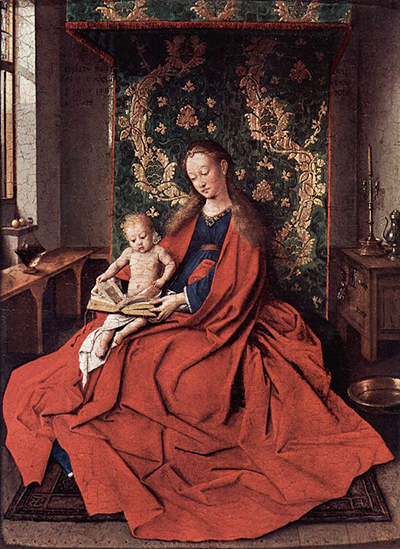
The Ince Hall Madonna carries a remarkably confident claim: an inscription says that Johannes de Eyc completed it in Bruges in 1433. The National Gallery of Victoria, Melbourne, nevertheless catalogues this small Virgin and Child under Flanders, dating it to the middle or later fifteenth century. Its conservator Carl Villis argues for a later follower of Jan van Eyck. The painted name and date are evidence to investigate, rather than an independent certificate of authorship.[1][2]
The oil painting measures 26.3 by 19.4 centimetres, accession 1275-3. Its familiar nickname comes from the Weld-Blundell family's English residence, where it was kept before its acquisition for Melbourne. That identifies a later collecting context, not the home of a known fifteenth-century patron. The panel matters because its admired Eyckian imagery, unusually controversial inscription and extensive technical examination allow us to follow how an attribution is made, challenged and revised.[1][2]
At a Glance
A sacred encounter in a furnished room
Mary sits beneath a canopy and cloth of honour, with the Christ Child on her lap. Their attention gathers around an open book. Her red mantle spreads broadly across the carpet, giving the figures a stable, almost pyramidal silhouette inside the narrow room. A window, vessels, bench and cupboard provide small discoveries around this quiet centre. The book establishes shared reading; the owning museum's record does not supply a secure transcription that would justify naming its precise passage.[1][2]
The domestic furnishings make the scene approachable, while the expensive textiles and canopy distinguish Mary's presence within it. Her low position and the broad drapery bring her close to the viewer. At this small scale, looking becomes an intimate activity: the spectator can move between the child's limbs, the book, glittering threads and objects near the window without confronting a life-sized public image. A personal devotional use is plausible, although the surviving evidence does not identify its first owner or commission.[2][3]
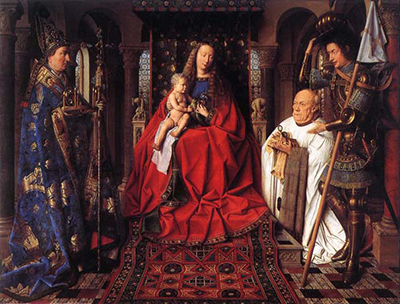
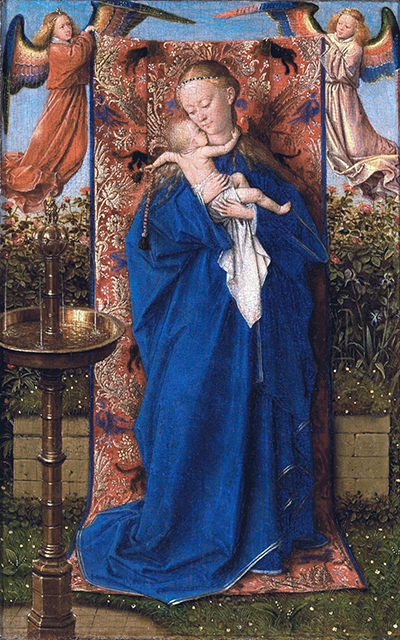
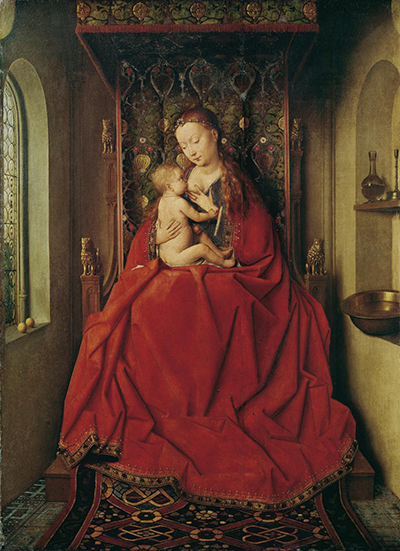
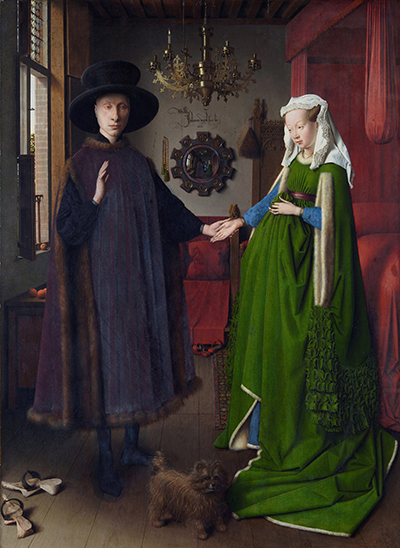
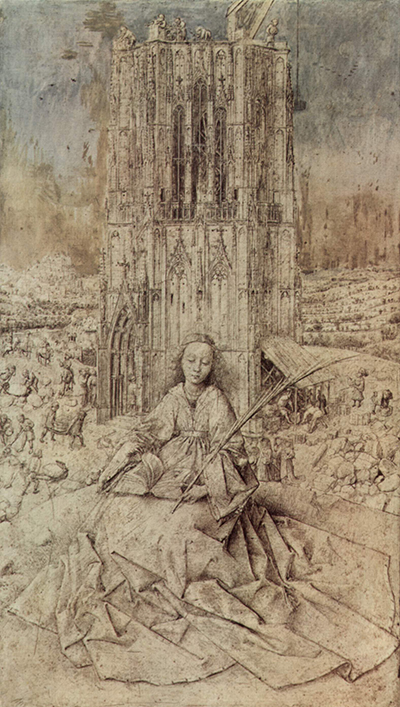
The setting recalls the Lucca Madonna, including its canopy, carpet, candelabrum, brass vessel and glass bottle. Villis connects the cropped window and wooden floor with the Arnolfini Portrait, and the mantle's expansiveness with Saint Barbara. He compares different parts of the child with the Dresden triptych and Van der Paele Madonna, and Mary's face with the Madonna at the Fountain. Such correspondences identify a shared vocabulary; they do not establish that the painter inspected every original.[2]
What does the inscription actually establish?
Black lettering at upper left gives the completion statement, date, maker's name and Bruges. At upper right appears a version of Jan's motto, usually translated as “As I can.” The writing belongs inside the painted room, beside the hanging. Its relationship to the image therefore differs from the independently surviving original frame of the Antwerp Madonna. The present Melbourne surround supplies no comparable fifteenth-century frame evidence.[1][2]
The inscriptions are old, but their relationship to the painting's first execution remains disputed. One historical explanation proposed that wording had been transferred from a lost original frame. That is a hypothesis, not a recorded operation. Hudson also questions claims that solvent tests established the lettering as contemporary with the surrounding paint: two old paint layers can resist cleaning similarly without having been applied together. Conversely, a failure to demonstrate later addition cannot prove originality. The tests leave a narrower conclusion than an unqualified signature attribution suggests.[2][3]
Lettering has its own interpretive problems. The surname lacks the familiar final K, while the inclusion of Bruges is unusual among Jan's accepted signatures. Hudson counters some objections by comparing Jan's variable Latin abbreviations and dates. Cleaning the Dresden triptych frame revealed a date in Roman numerals, weakening the argument that Melbourne's Roman numerals must be incompatible with Jan. These comparisons prevent easy dismissal of individual forms; they do not authenticate the whole inscription or overturn Melbourne's current classification.[2][3]
Condition complicates the reading further. Hudson compares photographs before and after the 1957–58 treatment and reports that a horizontal stroke affecting a letter in the motto disappeared during cleaning. He interprets it as earlier retouching. Some alleged errors may therefore concern an altered inscription rather than its first appearance. The responsible distinction is between what the words claim, how their damaged letters have been read, and whether the claim identifies the painter.[3]
How the attribution changed
The panel was purchased as a van Eyck in 1922, through Frank Rinder's work as the Felton Bequest's London adviser, and carries the NGV's 1923 acquisition credit. Its former owners had possessed it since the early nineteenth century. The apparent signature helped it enter accounts of Jan's development: Panofsky used the supposed 1433 date to position it early among the Marian paintings. If that date is unreliable, however, a chronology constructed around it cannot independently validate it.[1][2]
Examination involving Brussels specialists and the National Gallery, London, followed by Albert Philippot's conservation in 1957–58, changed the assessment. The work came to be regarded as a follower's copy of a lost original. Later research challenged that technical case. Hudson's detailed 2009 study argues that the materials and working methods remain compatible with Jan or his studio; early twenty-first-century exhibitions in Madrid and Bruges entertained an assistant attribution. Villis acknowledges these arguments but judges the accumulated stylistic and compositional differences too substantial for either Jan or his workshop.[2][3]
Belgian records preserve that disagreement. KIK-IRPA's BALaT catalogue places the work in Jan's workshop, with a 1433–1450 range. A Musea Brugge research page captions it as a workshop painting around 1435–40. These differ from the owning museum's current date and Villis's later-follower interpretation. They should remain attributed opinions, rather than being combined into a falsely precise consensus date. Nor does the older scientific investigation reduce to a single test that identified another named painter.[1][2][4][5]
The documentation itself has layers. BALaT indexes photographs from 1956, 1959 and 1972, together with intervention file 1956.01854. Those records establish a substantial history of examination, but the public index is not the complete laboratory dossier. Hudson goes further by comparing successive reports and their revisions. Distinguishing an observation from the interpretation subsequently attached to it is essential here: a photograph, pigment sample or damaged edge does not carry its own attribution.[3][4]
Watch: Jan van Eyck in context
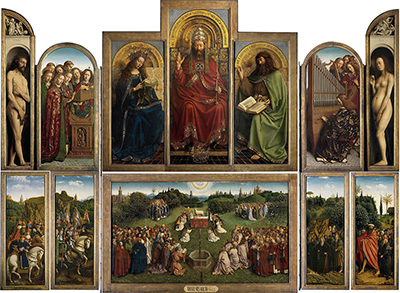
Choose a Smarthistory close reading of the Arnolfini Portrait or the closed and opened Ghent Altarpiece.
Jan van Eyck, The Arnolfini Portrait
Look closely at the room, mirror and gestures in the London double portrait.
Watch on YouTubeWhat lies beneath the visible painting?
Infrared reflectography revealed a particularly consequential change beneath the canopy. The painter initially included two bundled curtains, one at either front corner, before suppressing them with the surrounding wall paint. Hudson explains how this opened the encounter between spectator and sacred figures. Green paint found beneath the brownish background, previously interpreted as careless application, could instead record this deliberate revision. The change gives a reason to examine the sequence of making, rather than judging every underlying mark against the final image.[2][3]
Other adjustments concerned the window, drapery and child. Hudson describes an earlier upper boundary of the window subsequently extended beyond the picture's top, changes to the child's fingers and foot, and revisions around Mary's mantle. These are not all equally certain or equally extensive, but together they show development during execution. Villis accepts the significance of the alterations. They weigh against a completely literal transfer of one finished model, while remaining possible in a follower's independently adapted imitation.[2][3]
The wooden support supplies a firm limit. Peter Klein's 1999 dendrochronological examination could not match its growth rings to a dated reference sequence. It therefore yielded no useful felling date. Hudson questions an earlier geographical description of the oak, since the evidence did not securely establish where the tree grew. Neither an unsuccessful ring match nor a resemblance in size to Jan's small portraits establishes when this panel was painted.[2][3]
Preparation and pigments require similar care. Analysis confirmed a chalk ground; Villis records SEM/EDS examination by Deborah Lau in 2000. Hudson's reassessment discusses lead-tin yellow and combinations of vermilion, red lake, black and blue in the paint. He disputes earlier assumptions that particular shadow mixtures were alien to Netherlandish practice, citing comparable mixtures in accepted works. His argument challenges exclusions based on an overly restrictive technical model. A historically compatible palette, however, was available to more than one painter and cannot identify Jan by itself.[2][3]
For example, Hudson follows the old objection to black in the shadows of the red mantle. He identifies differences between samples and notes comparable use of black or blue to deepen red in accepted Netherlandish paintings. His discussion of lead-tin yellow also challenges historical suggestions of much later manufacture. These points concern the credibility of particular exclusions; they leave a wide interval of possible old paintings. They should not be turned into a scientific result pinpointing either 1433 or a named workshop.[3]
Panel edges also entered the debate. Earlier investigators questioned the absence of an unpainted margin and a barbe, the ridge formed where preparation or paint meets a frame already attached during execution. Hudson argues that trimming and surviving edge traces undermine a categorical exclusion based on those features. His interpretation is a counterargument about how the object was made and subsequently altered. The present edges do not reconstruct a lost frame, and acceptance of his criticism would still leave the painting's visual authorship to be assessed.[3]
Space, illumination and uneven handling
For Villis, the room is among the strongest reasons for rejecting Jan's hand. The floorboards, carpet, bench, window and canopy suggest depth individually, but their recession does not produce an intelligible shared plan. The canopy's relationship to the window is particularly elusive. This concerns the coordination of a whole setting, rather than compliance with mathematical perspective: Jan's accepted interiors can be constructed empirically while making their figures and furniture seem spatially connected.[2]
Light raises a related difficulty. The window lies behind the figures, yet does not fully explain their frontal illumination or the darkness distributed around the hanging. Villis compares the Melbourne window's heavy highlights with the subtler gradations, textures and reflections of the Arnolfini interior. He acknowledges their different scales, then points to the similarly small Dresden and Antwerp paintings as additional comparisons. His case therefore depends on more than asking a tiny panel to match the finish of a much larger one.[2]
The distinction is not between universally poor work and uniformly perfect work. Villis praises passages in Mary's mantle and the gold threads, while finding the window and carpet comparatively coarse. The carpet's ornament is scratched into its brown-red paint in a sketchy manner. Hudson offers a comparison with scratched detail in the Arnolfini brush, which Villis does not find persuasive. This disagreement shows how scholars can recognise the same technique yet judge differently whether its use resembles Jan's handling.[2][3]
Textiles, shutters and a bottle
The patterned hanging has a broad, asymmetrical pomegranate-vine design. Textile specialist Lisa Monnas, whose observations Villis reports, did not consider the material impossible for the 1430s or 1440s. She questioned how its pattern repeats and fabric width were represented. Villis also stresses the flat surface and absence of fold creases, contrasting Jan's more convincing woven structures. Broad, swirling patterns have closer parallels in later fifteenth-century pictures. These are comparative clues, not a laboratory date for the cloth or panel.[2]
Outward-opening shutters and a biconical glass bottle complicate the Netherlandish setting. Villis relates the shutters to later Westphalian examples. He reports information from Rotterdam curator H. E. Henkes identifying the bottle as a German type. That correspondence is evidence mediated through the published essay, not an independently dated object found with the painting. Neither detail alone proves German manufacture. Together with other departures, they help Villis consider a later imitator with access to Eyckian designs and knowledge of neighbouring traditions.[2]
Condition, copies and continuing value
Abrasion affects the red glaze of Mary's mantle, with losses and repairs around the lower edges and floorboards. Retouching includes small facial details and cupboard keys. Villis nevertheless considers the design essentially intact: damage cannot explain every irregularity of the room or carpet. Hudson is more critical of aspects of the earlier examination and restoration. The differing assessments make condition part of the argument, while giving no basis for imagining that an unaltered, securely autograph masterpiece can simply be recovered beneath all disputed passages.[2][3]
The support has its own conservation history. Hudson records earlier reports of warping, including examination in Detroit in 1941 and subsequent treatment in Melbourne. He also distinguishes the remaining slight curvature from claims about the panel's original quality. Present thickness, edges and flatness have therefore passed through later interventions. A rough-looking reverse or altered outline needs historical explanation before it can safely be treated as the maker's untouched procedure.[3]
A related Madonna at Covarrubias has prompted a proposed shared, lost Eyckian model, perhaps transmitted through a compositional drawing. Villis reports Susan Jones's view that such a drawing could preserve the arrangement while leaving a later painter to invent details. Musea Brugge studies another related interior and compares it with Melbourne and Covarrubias. Its dendrochronology and underdrawing results belong to the separate Bruges painting; importing them into the Ince Hall panel would create evidence this object does not possess.[2][5]
The proposed lost model and the surviving revisions can coexist. An artist could begin with an inherited arrangement, alter curtains and figures, and supply furnishings from other sources. The alternatives are therefore more varied than autograph original or exact copy. This distinction explains why Villis can recognise invention within the Melbourne panel while rejecting it from Jan's accepted works. It also prevents the hypothetical prototype from being described as a recoverable composition whose every original detail is known.[2][3]
The modern frame is another distinct historical layer. Frederick Pollak made the gilded surround in London in 1954, replacing a Gothic Revival frame that the NGV says has not been recovered. The museum describes gilding on fabric deliberately distressed to suggest age. This is documented twentieth-century presentation, not concealed evidence for a medieval date. The useful encounter is with the whole complicated survivor: an intimate devotional image, a sustained response to Jan's inventions, and an unusually revealing case in which inscription, material compatibility and visual judgement answer different questions.[1][2][3]
Related reading
Discussion
What do you notice in The Ince Hall Madonna: a follower of Jan van Eyck? Share a close observation or a source that adds useful context.
Join the Conversation
Keep observations specific and evidence clear.
References
- National Gallery of Victoria, The Virgin and Child, accession 1275-3: current classification, measurements, inscriptions, acquisition credit and Frederick Pollak frame. View Source
- Carl Villis, “The National Gallery of Victoria's Virgin and Child, by a follower of Jan van Eyck: a continuing reassessment,” Art Journal 52 (2014): attribution history, technical findings, comparisons and reported specialist correspondence. View Source
- Hugh Hudson, Jan van Eyck, The Ince Hall Virgin and Child, and the Scientific Examination of Early Netherlandish Paintings (2009), particularly pp. 76–81, 87–90, 96–98, 114–116, 128 and 147–152: technical reassessment and inscription debate; digitised by RKD. View Source
- KIK-IRPA, BALaT, Vierge et Enfant (Ince-Hall Madonna), object 40004087: workshop attribution, date range and photographic/conservation documentation index. View Source
- Musea Brugge, “Vierge à l'Enfant dans une pièce intérieure, disciple de Jan van Eyck”: research on a separate Bruges panel and comparative caption for the Melbourne painting. View Source
 Jan van Eyck.jpg)
 Jan van Eyck.jpg)