

 by Tom Gurney
Tom Gurney BSc (Hons) is an art history expert with over 20 years experience
Published on June 19, 2020 / Updated on December 18, 2025
Email: tomgurney1@gmail.com / Phone: +44 7429 011000
Portrait of Jeanne Hebuterne in a Large Hat is a famous painting by Amedeo Modigliani, created in 1917-1918.
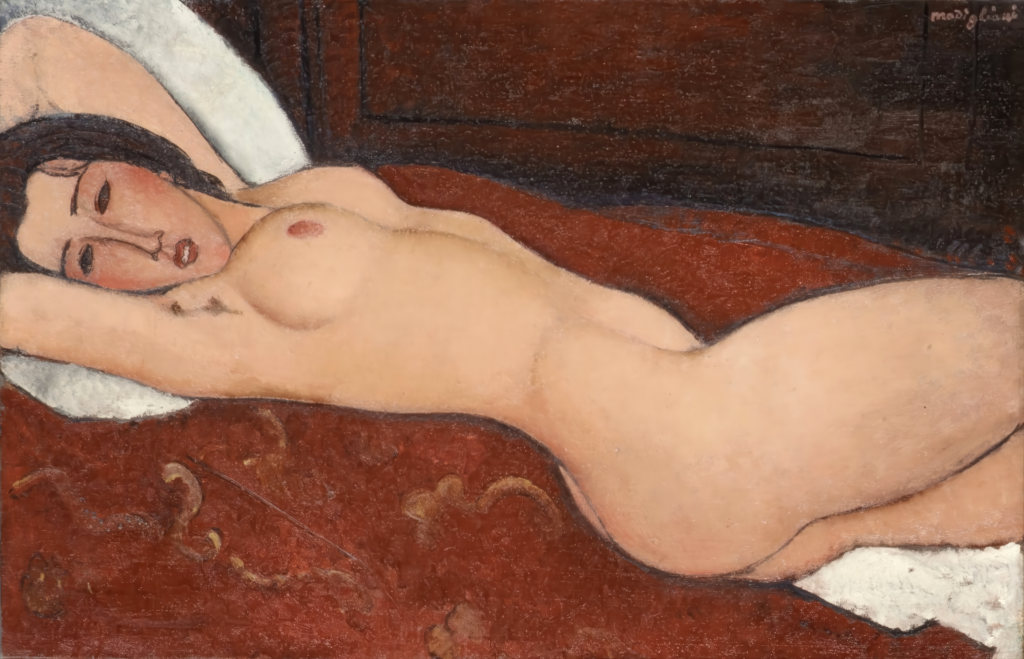
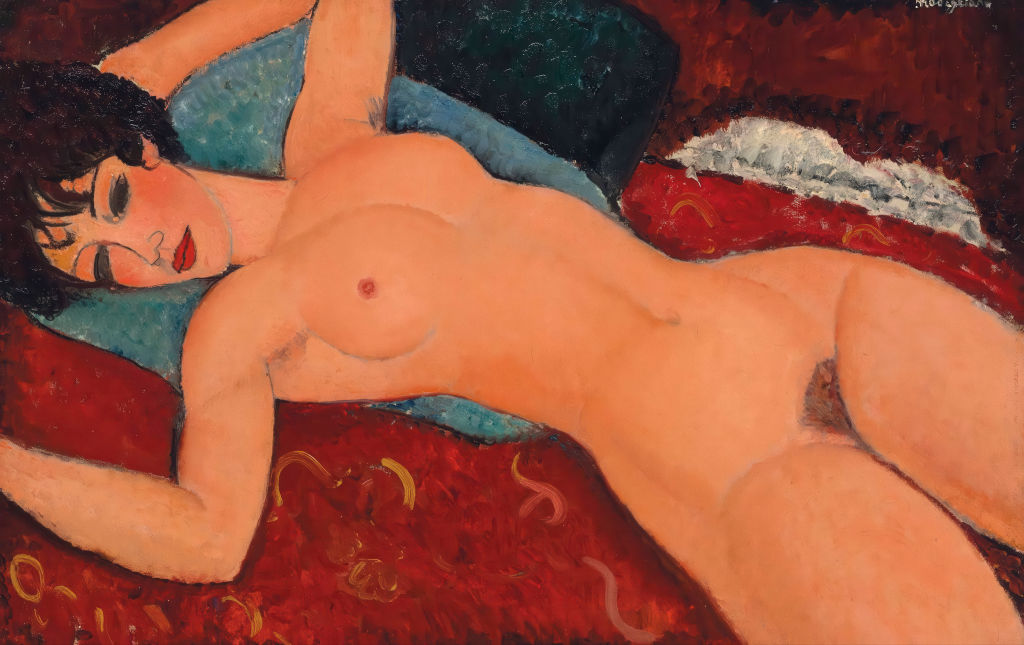
This quietly haunting image features the artist's partner in a reflective mood. She would appear in a number of his works at around this period and we learn much about their relationship through these portraits. They offer a calmer, more thoughtful artist in comparison to his more famous Nu Couché.
Modigliani was an Italian artist who moved to Paris in 1906. There he became known for his Bohemian lifestyle, which fuelled his distinctive, innovative art. This page examines this portrait painting in detail, covering its meaning, composition and its position within the artist's wider series of portraits devoted to his closest companion.
- Artist: Amedeo Modigliani
- Title: Portrait of Jeanne Hébuterne in a Large Hat
- Date: 1918-1919
- Medium: Oil on canvas
- Art Movement: Modern Art (Modernism, Cubism, African and Oceanic sculpture and Fauvism)
- Subject: Jeanne Hébuterne
- Period: Late Period
The Painting: Portrait of Jeanne Hébuterne in a Large Hat
This portrait shows the artist's partner, Jeanne Hebuterne. She is often referred to as his wife, but the couple never married. Hebuterne was an artist herself, but the day after Modigliani died from tuberculosis as the age of 35, she committed suicide by jumping from a balcony.
There is much to celebrate from their lives, but they also suffered at times too. In this painting, Jeanne is given a subdued personality, choosing not to give to much away to us. The colour tones are also muted, creating a totally alternative atmosphere when compared to Modigliani's nudes. Jeanne is seated in front of us, with her neck being noticeably elongated. Her hat is carefully positioned to sit partially behind her head, reaching down to below her chin level.
Her fingers are also stretched beyond a realistic length, with her shoulders disappearing completely, leaving a triangular-shaped torso. This was modern art, and a new form of portrait composition. We understand from photos of his partner just how much is amended from reality as Modigliani welcomes Jeanne into his alternative dimension.
Who was Jeanne Hébuterne?
Jeanne Hébuterne was much, much more than just Amedeo's muse. She studied painting at the Académie Colarossi in Paris and developed into an artist in her own right. This is how she came to meet Modigliani, and eventually they would start dating in around 1917. As fellow artists, their relationship would inevitably turbulent, but passionate, and they would come to mean a lot to each other.
Having been born in 1898, Jeanne was only in her late teens when she met Amedeo. She produced portraits of him within her own career, and whilst her own artistic style was also Modernist, she did diverge from her lover's approach. Sadly, they left behind a daughter, Jeanne Modigliani, who was forced to grow up without her famous parents - it was only in her later life that she became aware of the significance of her birth parents.
Our Modigliani biography covers more of their lives and their relationships. It is worth noting how the artist portrays his muse in this painting - one would never realise their closeness in real life, because of the subdued, distant nature of this portrait.
Description
This portrait of Jeanne Hebuterne shows her wearing a hat with a wide brim. She has a pensive expression, with one hand raised in front of her with two fingers resting on her chin.
The hat is black on top, with the underside of the brim painted in an earthy brown shade. Her skin tone is a similar shade, but slightly paler. The almond-shaped eyes in the portrait are bright blue.
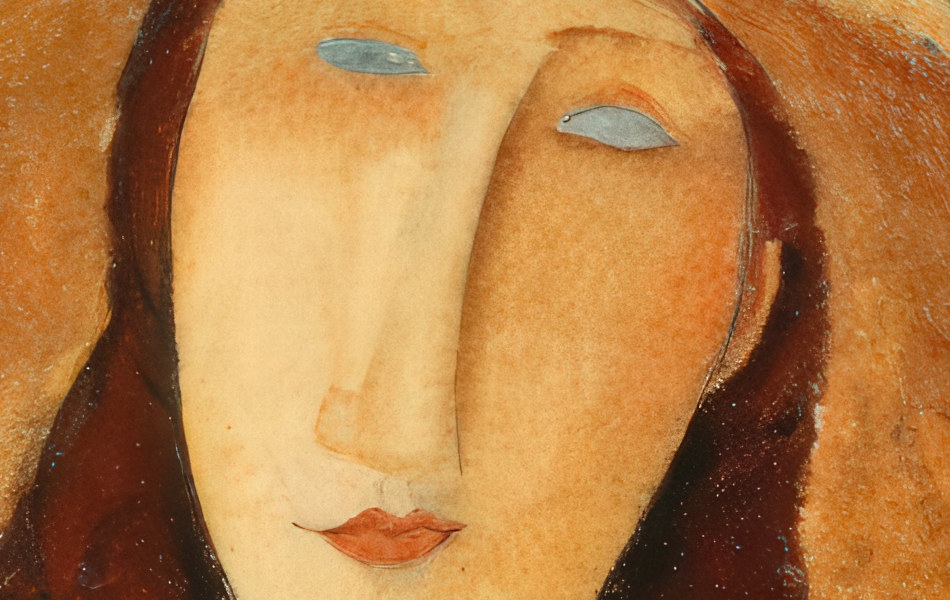
Face in Detail, Jeanne Hebuterne
They are blank-looking, rather than lifelike, and are given very little definition, with no eyelashes or pupils. Hebuterne's neck and shoulders are bare, with sloping shoulders.
Her round-necked dress is the same black as the crown of her hat, merging with the black couch that she sits upon. The painting's background is not clearly defined, showing a bare wall in a shade of brown slightly darker than the inside of the hat. The earthy background tones make the creamier face and body stand out in contrast.
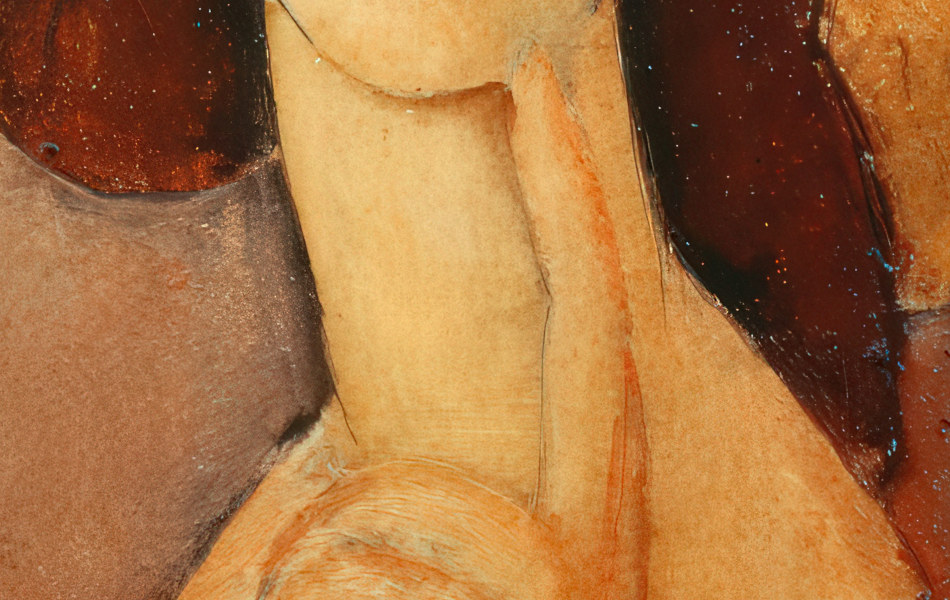
Elongated Neck of Jeanne Hebuterne
Style
We can see Modigliani's signature distortion and exaggeration, with a long, oval face and long nose. He uses curving, twisting lines. He was strongly influenced by African art, which is reflected in the mask-like face.
He produced a style which makes his work instantly recognisable, quite a feat considering the amount of portrait painters to have appeared over the last few centuries. He combined elements of Cubism, Expressionism and influences from African and Oceanic sculpture to turn his models into a new form.
His nudes were bolder, more impactful, meaning this simpler portraits, with reduced palettes of colour, would need to impress in other ways - and that, they do. He deliberately separates viewer and model, creating a different atmosphere, one of mystery. There is no realism here, but a new dimension.
Meaning and Symbolism
There are also echoes of the Renaissance art that was also a huge influence on the painter, with the large hat referencing a halo around Hebuterne's face, almost akin to a Giotto painting. Her expression echoes the beatific, calm faces seen on the statues of saints in Catholic churches, while the position of her raised hand, with its two extended fingers touching her face, echoes a pose which is often seen in Christian art.
Modigliani's late style, in a short career, made use of elongation in his portraits. This came from his interest in African masks, which also connected to his preference for sculpture over painting. Her hat, is surrounding as a halo, also fills much of the background and this helps to focus our attention purely on the model. Artists have attempted to capture emotions such as melancholy within their work, and here Modigliani does something similar.
The Jeanne Hébuterne Portrait Series (1918-1919)
The couple started dating in 1917 and would soon start to produce portraits of each other. These offer an insight into their feelings towards each other, though are not as giving in that regard as they might have been. Amedeo Modigliani indicated all that he had learnt in his career leading up to this point, and so his series of Jeanne Hébuterne portraits is polished and consistent.
Amedeo varied the compositional features in each iteration of this series, experimenting with clothing, posture, expression and mood. What remained constant, though, was his use of elongation, the quiet, modest atmosphere and also the appropriate choice of colour scheme. The series has risen in significance in recent years as more attention has been afforded to Jeanne by academics.
List of Jeanne Hébuterne Portraits by Amedeo Modigliani
- 1917 - Jeanne Hebuterne with Necklace
- 1917 - Jeanne Hebuterne with Hat
- 1917 - Jeanne Hebuterne with Large Hat
- 1918 - Jeanne Looking Front
- 1918 - Jeanne Half Turned to the Right
- 1918 - Jeanne in Profile
- 1918 - Jeanne Seated in an Armchair
- 1918 - Jeanne Seated in Profile with Dark Dress
- 1918 - Jeanne Seated with the Arm Resting in the Back of the Chair
- 1918 - Jeanne Hebuterne Head
- 1918 - Jeanne Seated in Profile with White Dress
- 1918 - Jeanne Seated Looking Front
- 1918 - Jeanne with a Yellow Sweater
- 1919 - Jeanne Seated, Yellow Jumper
- 1919 - Jeanne, Hand on Shoulder
- 1919 - Jeanne at a Sofa
- 1919 - Jeanne Head
- 1919 - Jeanne with Hat
- 1919 - Jeanne Seated in Bed
- 1919 - Jeanne Loose Hair
- 1919 - Jeanne in Shirt
- 1919 - Jeanne Arm Back of Chair
- 1919 - Jeanne with Hat
- 1919 - Jeanne with Foulard
- 1919 - Jeanne Seated in Front of Door
Provenance and Ownership
It is an oil on canvas painting that is 15" wide and 21.75" high (38 cm by 55 cm). It currently hangs in a private collection.
The present owner (believed to reside in Japan) of Portrait of Jeanne Hebuterne in a Large Hat won the painting at auction, purchasing the piece for $8,250,000. It was Lot 29 at the Christie's Impressionist and Modern Paintings and Sculpture auction in New York, 1990.
Prior to this high profile auction sale, the painting changed hands several times in the 1930s and 1950s, always moving between private collections. The painting was then inherited by Robert Owen Lehman and lent to the Metropolitan Museum, New York up to its sale date in 1990.
The painting has been exhibited on multiple occasions, as early as 1933 and as recently as 2008. These appearances have included cities such as Brussels, Basel, New York, Zurich, Paris and Tokyo.
Summary
Modigliani's portraits of Jeanne Hébuterne are an important part of his oeuvre, capturing, as they do, a key figure in his life. There is emotion and atmosphere within these works, even though they are more subtle than his other bolder figurative works. Jeanne Hebuterne in a Large Hat features a refined palette and reduced detail in line with his plethora of artistic influences, including African and Oceanic sculpture.
Whilst struggling for acceptance in his own lifetime, Modigliani's portraits, such as this one, helped to re-shape modern portraiture. They also shone a light on the important figures in his exciting, but turbulent life.
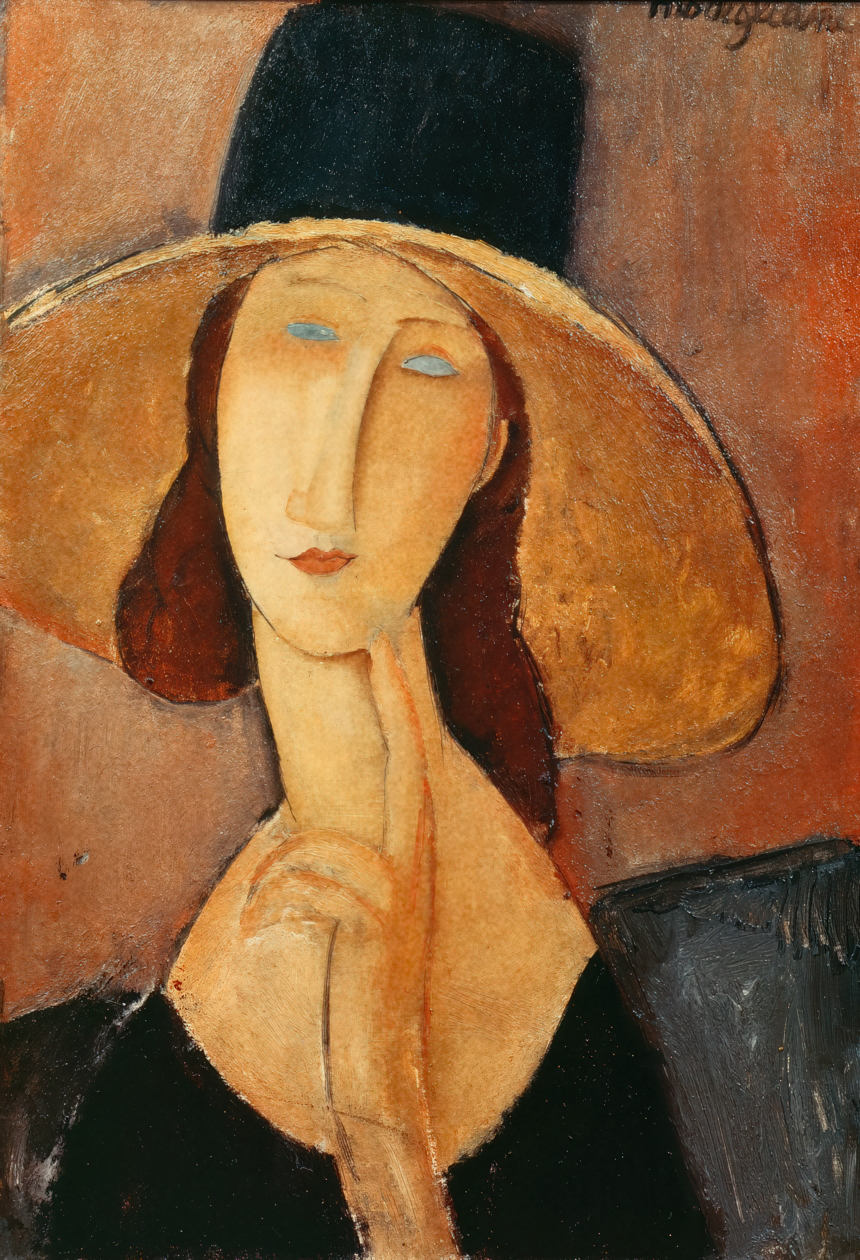
Portrait of Jeanne Hebuterne in a Large Hat, Amedeo Modigliani, 1917-1918
References
- Doris Krystof, Amedeo Modigliani, Taschen, 2015, PP81
- Werner Schmalenbach, Modigliani, Prestel, 2018
- Mason Klein, Modigliani Unmasked, Yale University Press, 2017