

 by Tom Gurney
Tom Gurney BSc (Hons) is an art history expert with over 20 years experience
Published on June 19, 2020 / Updated on December 29, 2025
Email: tomgurney1@gmail.com / Phone: +44 7429 011000
Amedeo Modigliani's Portrait of Maude Abrantes (circa 1908) is an evocative modernist portrait that distills the sitter's psychological essence into a rhythm of elongated line, controlled form and serene presence.
Painted during Modigliani's Paris period, this work stands as one of his most compelling feminine portraits — blending sculptural structure with inner distance and offers us a clue as to the stylistic route his work would take in the years that followed.
Modigliani was relatively new to Parisian life in 1908 and was very much evolving his artistic style at this point. This particular portrait offers elements of his early and late work, and is therefore quite an intriguing piece within his oeuvre. We have, for instance, the elongated neck and still, somber face which later became his signature style, but there is also more detail in the subject's clothing and face than we would typically find a decade later.
Amedeo was known to have relationships with some of his female subjects, which added to the turbulence and scandal of his career, but it is not known if this was the case with Maude Abrantes.
Who Was Maude Abrantes?
Maude Abrantes was an American artist, socialite and muse. Her birth name was Leontine Phipps. Maude was heavily involved in bohemian art circles and suffered from a serious morphine addiction, bringing her into the world of Modigliani, who himself had a turbulent social life. She is known to have left Paris for New York in 1908, helping us to date this painting accurately, though there is still some discussion about whether it was produced in 1907 or 1908.
Early on in his career, Modigliani would put more detail in his portraits, including the eyes - here it allows us to understand the complex personality of this troubled but charismatic woman. The psychological balance of this piece is more important to the artist than the precise accuracy of what we see. She is known to have accompanied Amedeo to various Paris events, and so he knew her well enough to portray her personality within this portrait.
Why did Maude Abrantes leave Paris after this Painting?
As a painter herself, Paris offered Leontine Phipps plenty of artistic opportunities - perhaps she changed her name to Maude Abrantes in order to fit into this new community more smoothly. After a turbulent period in Paris she is believed to have become pregnant and chosen to head to New York in November, 1908. This would not have been long after the portrait was finished, and perhaps she was hoping to bring the child up in a more stable environment.
Rare Double-Sided Painting
Modigliani painted the portrait, which has puzzled experts for over a century, on a canvas he previously used for a nude figure with a hat.
During the time of that Modigliani painted this portrait many painters had limited means and it was usual to paint on both sides of a canvas.
However, what was unusual is that not only did he turn the canvas over, but he also turned it so that it was upside down. Despite this being an unusual thing to do by an artist, experts have not given much attention to this strange act, until now.
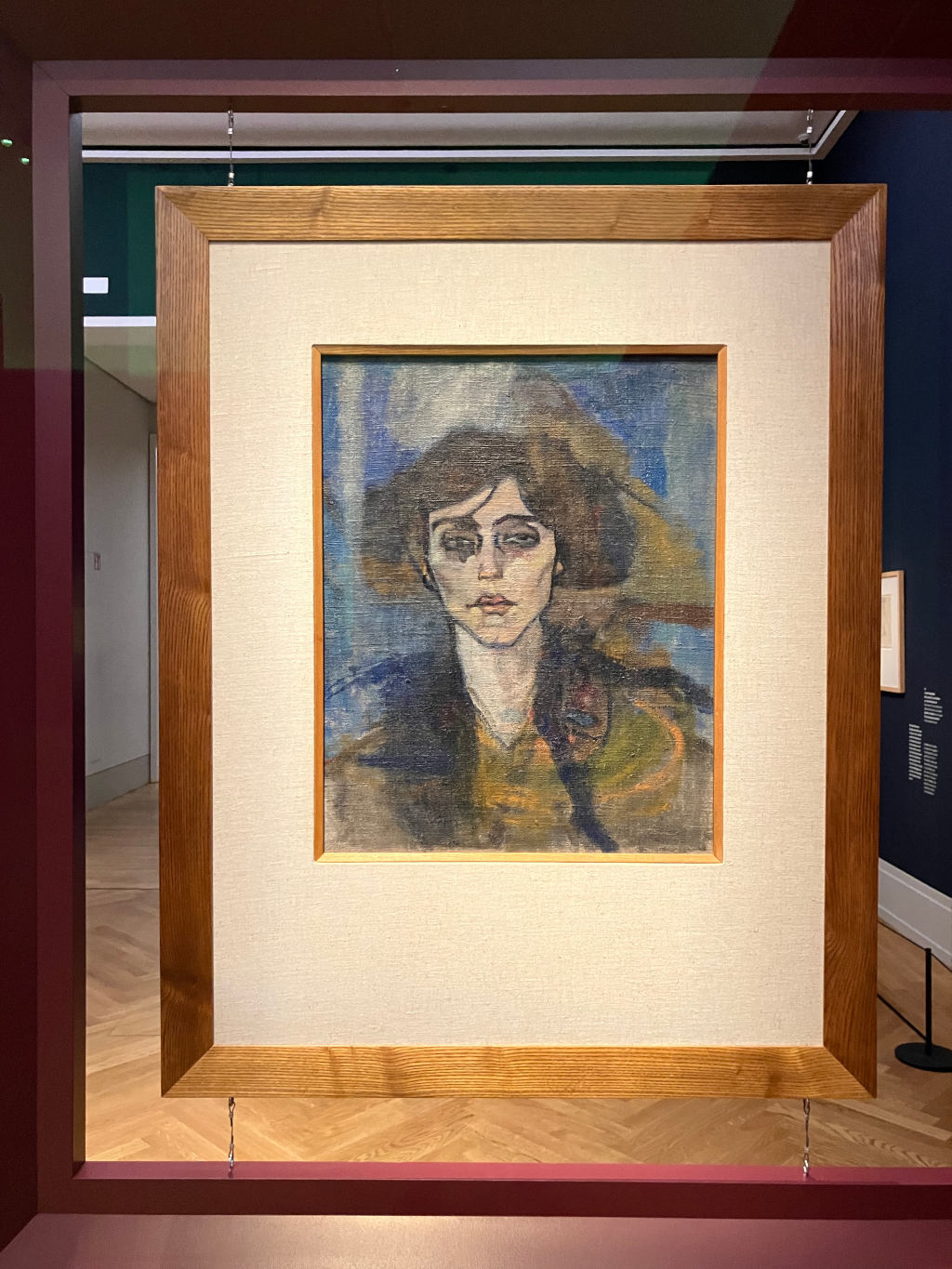
Portrait of Maude Abrantes, Hanging at the Reuben and Edith Hecht Museum, Haifa, Israel, image courtesy of Wikimedia Commons
- Artist:Amedeo Modigliani
- Title:Portrait of Maude Abrantes
- Date:circa 1908
- Medium:Oil on canvas
- Size:81.3 x 53.3 cm
- Movement:Modernism
- Current Location:Hecht Museum, University of Haifa, Haifa, Israel
The Painting Itself: Composition, Mood and Presence
This portrait is perfectly restrained, leaving room for our own imagination. The subject is placed front-on, looking directly at us. Modigliani avoids putting too much of the rest of her body in this composition, leaving the focus almost exclusively on her face, and her gaze. We see her long neck, a trait of his work later on in his career, and this helps balance the layout. Her would focus on sculpture by around 1909/1910 and we can already predict that in how he composes this piece.
The tones of this piece intersect and fuse together, with blues and browns merging her clothing with the background - the clear contrast is between these and her face, which is in bright white paint. There are then lines of black, or dark grey paint which outline her lips and fill in her eye brows. The artist carefully controls our attention, pushing towards the deep gaze of this complex personality.
Meaning and Artistic Intent
This portrait of Maude Abrantes produces a feeling of curiosity in our minds - the subject appears full of emotion, but more questions than answers are raised by artist Modigliani. There is a strong balance to the painting, helped by the model's naturally long, narrow neck. The intention, or meaning, of this painting is not to focus on replication, but instead create an atmosphere around the subject, by connecting with her soul.
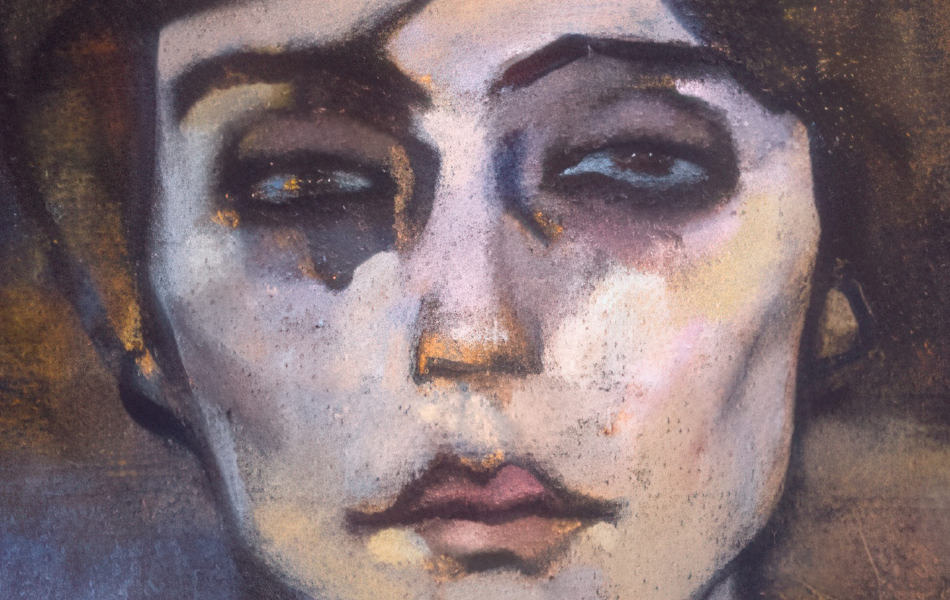
Detail, Portrait of Maude Abrantes
Artist Background
Modigliani was a Jewish-Italian painter and sculpture who mainly worked for most of his career in France. Modigliani is particularly famous for his portrait work, particularly of nudes in a modern style of painting.
Much of his work has unique characteristics which includes particular elongation of the subjects that he paints. Much of his portraiture work was not well liked at the time, although his work has now been accepted.
The artist was educated in Italy, where he gained much knowledge of Renaissance art. It was in 1906 that he then moved to Paris, and it was here that he painted the portrait of Maude Abrantes.
Where is the Painting today?
The Hecht Museum now houses Portrait of Maude Abrantes by Amedeo Modigliani. Curators have adapted their display to allow the canvas to be viewed from both sides, so that both artworks are visible.
It was hung for a century until one day, a museum guide was discussing the painting with a group of visitors. She suddenly saw another, mysterious painting in the background.
In came to light that the reason that Modigliani turned the painting around was not because he was frustrating visitors that were trying to view the painting, but instead, he was not happy with the original image on that side of the canvas and simply turned it around to create a third.
Address
Reuben and Edith Hecht Museum,
University of Haifa,
Abba Khoushy Ave 199,
Haifa,
Israel
Large Image of the Painting
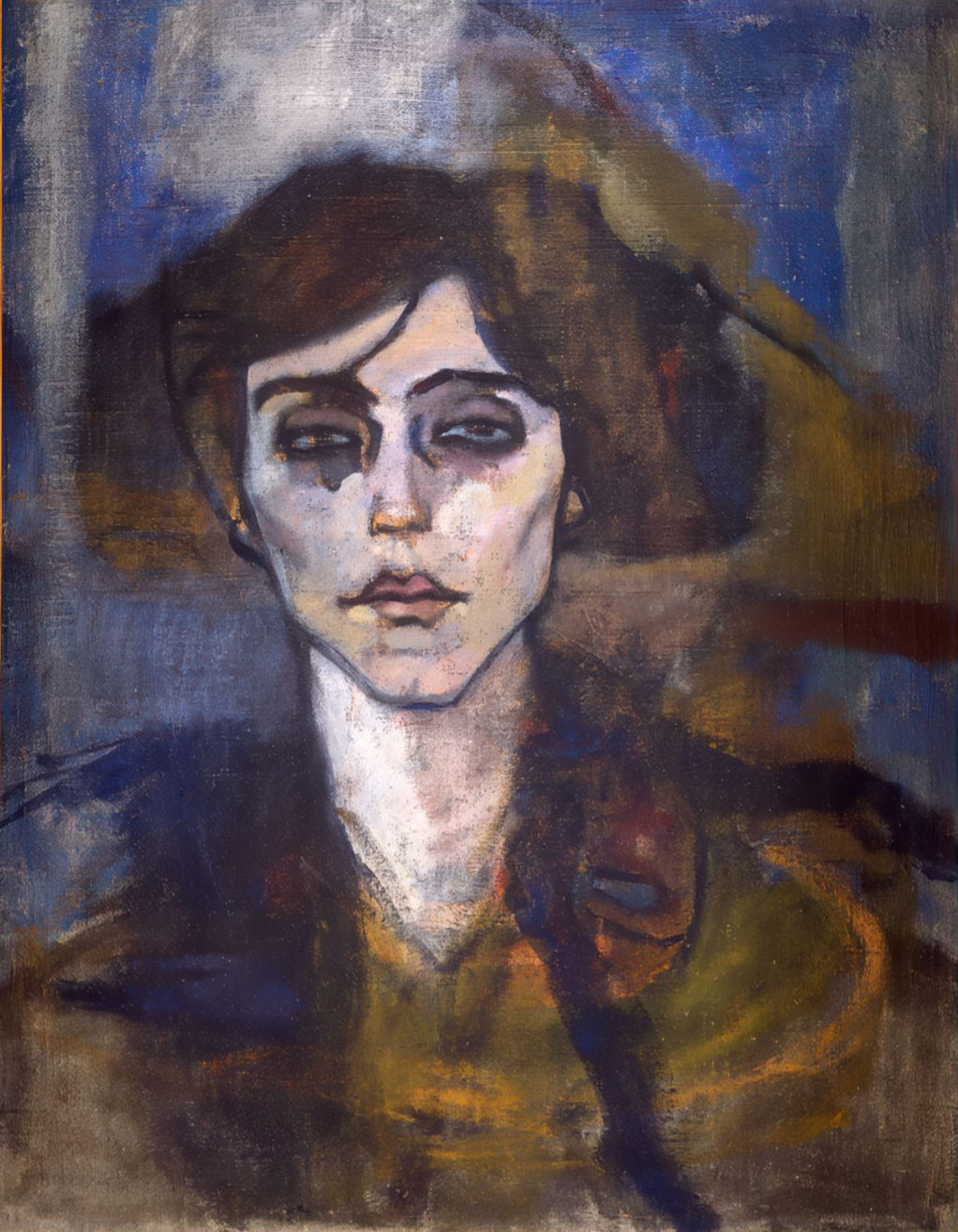
Portrait of Maude Abrantes, circa 1908, Amedeo Modigliani