


 by Tom Gurney
Tom Gurney BSc (Hons) is an art history expert with over 20 years experience
Published on June 19, 2020 / Updated on August 9, 2026
Email: tomgurney1@gmail.com / Phone: +44 7429 011000
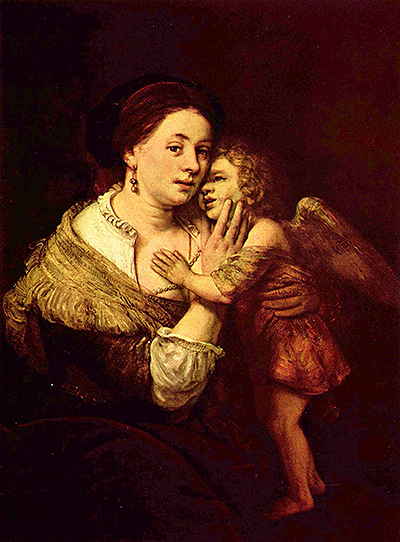
Venus and Cupid is a Louvre work after Rembrandt, linked to late Rembrandt mythological prototypes
Venus and Cupid is likely to have been one element of a series of three paintings, recently labelled as a classical trinity of goddesses, alongside Juno and Pallas Athene. The commission for all three possibly came from rich collector, Herman Becker, who would prove a useful partner to Rembrandt who was constantly struggling with his own financial health.
It was A Corpus of Rembrandt Paintings who published this theory and there is considerable evidence to back this claim up. The same collector held a series of three prints from an earlier artist which contained precisely the same three goddesses, albeit in very different depictions.
The likely explanation, therefore, is that the rich Becker requested Rembrandt to produce paintings alongside the same themes of these prints from a decade earlier, only with the master's own artistic licence and invention added on top.
There is little known specifically about this individual painting, other than that it has been cropped on each side. It is a touching scene with the main figure leaning to the right. In Pallas Athene you will see the figure leaning to the left, which then leaves these paintings to be placed on either side of the front-on Juno. Rembrandt did not cover these figures at any other time in his career, so the connection to the prints of Wenzel Hollar simply cannot be a pure coincidence.
Venus herself is a mythological figure used by countless artists over the many centuries of art history, be it the Renaissance and Baroque periods or all that has occurred since. Some of the most notable contributions have included Titian's Venus and Cupid, Giorgione's Sleeping Venus, Venus, Cupid, Baccchus and Ceres by Peter Paul Rubens and Sandro Botticelli's Birth of Venus.
Object Notes and Research Context
The Louvre records Venus and Cupid as Vénus et l'Amour, after Rembrandt, INV 1743 / MR 949, oil on canvas, after 1660, now displayed at the Louvre-Lens. That catalogue status means the page needs a visible correction to older wording that treated it as simply completed by Rembrandt in 1657.
The Louvre's note explains that the painting was once called Hendrickje Stoffels as Venus, but treats that identification as speculative. It also connects the work to the possibility of a lost Rembrandt Venus and Cupid from the 1660s, including references to the Harmen Becker estate and the Pieter Six sale. The safest public phrasing is therefore that the picture may preserve a Rembrandt-related invention without itself being accepted as an autograph.
Within Rembrandt's wider orbit, the work has value mainly as a workshop, attribution and reception case. It belongs beside Pallas Athene, Juno, workshop and attribution, and the corpus discussion, while the warning helps readers distinguish a follower work from secure late mythological paintings.
The Louvre's catalogue status makes this one of the clearest attribution-warning cases in the legacy set. The painting is after Rembrandt, but it remains relevant because it may reflect a Rembrandt-related composition, it has an important older reception history, and it helps readers understand how follower works entered the Rembrandt orbit.
The former identification of the figure as Hendrickje Stoffels should also be handled cautiously. Such identifications are tempting because they connect mythological painting to biography, but the Louvre treats that route as speculative. A better page keeps biography secondary and focuses on subject, workshop, collection history and the difference between autograph, pupil and follower.
The work supports Rembrandt mythology and attribution context, but it should not be treated like a secure masterpiece. The warning block gives readers that context before they reach any older title wording or inherited image captions.
Further Rembrandt Context
This shorter legacy page remains part of the Rembrandt archive. For fuller context, use the refreshed Rembrandt pages below, which explain the artist's biography, media, technique, attribution issues and major works in greater depth.
For secure object data, attribution and collection history, compare Venus and Cupid with the relevant museum or catalogue record before treating older page text as final.
 Rembrandt.jpg)
Discussion
What feels most useful when looking at Venus and Cupid: the subject, the handling of light, the medium, the attribution history, or its place within Rembrandt's wider painting output?
Reader Insights
Set this page beside the refreshed Rembrandt hubs before relying on older summaries alone.
Rembrandt pages often need museum records, catalogue history and attribution caution, especially where older sources use broader labels.
Which detail would you most want clarified next: date, medium, collection, attribution, subject, condition or comparison with another Rembrandt work?
Join the Conversation
Have a thought or observation about Venus and Cupid? Share it below. Thoughtful responses may be added as the Rembrandt archive continues to be reviewed.