


 by Tom Gurney
Tom Gurney BSc (Hons) is an art history expert with over 20 years experience
Published on June 19, 2020 / Updated on August 9, 2026
Email: tomgurney1@gmail.com / Phone: +44 7429 011000
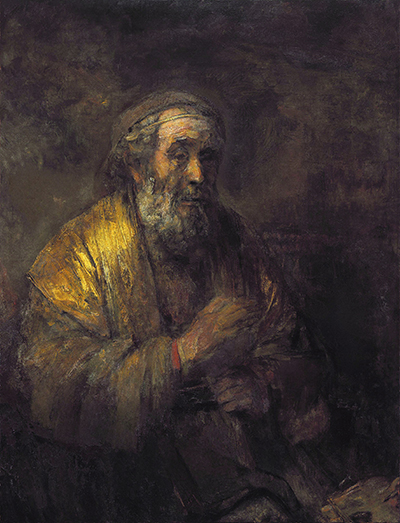
Homer is Rembrandt's damaged late commission for Antonio Ruffo, now in the Mauritshuis
This particular painting was also close to destruction after fire damage from an earthquake whilst being displayed at the palace of Antonio Ruffo in Messina, Italy in 1783. Thankfully after some cropping of the outer edges and some restoration, it survived to the present day.
Rembrandt van Rijn is amongst the most researched artists in history, with a dedicated research team being set up in the 1960s and still running today. Their most notable output includes the Corpus Survey his his life's paintings, which includes Homer Dictating his Verses within it.
An original element of the painting which was one of the parts removed after fire damage was a scribe who would write down the dictations given by Homer, who was himself blind. There are still just the slightest clue to this with several fingers remaining in the lower right hand side of the picture. The light creeps across from the left hand side of the painting to bring out golden colour from Homer's coat. His elderly facial features are also accurately captured by this master of light.
This original painting remains at the Mauritshuis, an art museum in The Hague, Netherlands, though does occasionally get loaned out for related exhibitions elsewhere. This respected museum contains work by many famous names besides just Rembrandt, including Jan Steen, Frans Hals, Johannes Vermeer, Jacob van Ruisdael and Hans Holbein the Younger.
Object Notes and Research Context
The Mauritshuis records Homer as an oil on canvas of 1663, inventory 584, commissioned by the Sicilian nobleman Antonio Ruffo. It was originally larger: the scribe to whom the blind poet dictated was mostly lost, leaving only small traces at the lower right. That damaged state is central to the work's meaning today because the viewer now encounters Homer as an isolated figure suspended in brown shadow and golden light.
Scientific research has made this page richer than a basic object summary. Studies of the painting's degraded smalt explain why parts of the garment and background now read as nearly monochrome brown. The best preserved passages are the thickly painted face, hand and yellow robe, where Rembrandt's late material handling still carries the figure's authority.
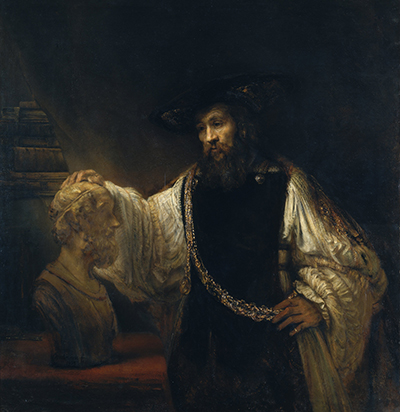
Homer belongs with Aristotle with a Bust of Homer and the lost Alexander commission for Ruffo. Together they show Rembrandt addressing ancient fame, poetic memory and patronage far beyond Amsterdam.
The Ruffo commission context deserves space because it shows Rembrandt working for an international patron late in life. Antonio Ruffo owned and commissioned ambitious paintings by major artists, and Rembrandt's Homer formed part of a learned series around ancient exemplars. The damaged canvas should therefore be read not as an isolated fragment but as a remnant of a larger intellectual commission involving poetry, rulership and fame.
Scientific smalt research gives the painting a modern conservation context. Smalt, a cobalt-containing blue glass pigment, can lose colour as it degrades, changing the balance of a painting dramatically. In Homer, that alteration helps explain why the present surface appears so brown and shadowed. The point also connects the work to pigment, conservation and impasto.
The lost scribe should be made clear in image captions or object notes. Without that information, the title Homer Dictating his Verses can seem confusing because the dictation partner is mostly missing. The damaged state is therefore essential to understanding both the composition and the modern viewing experience.
Damage can also change a painting's apparent subject balance. With most of the scribe lost and smalt altered, modern viewers encounter a more solitary Homer than Ruffo first commissioned. That makes conservation history central, not peripheral.
That point also helps explain why reproductions can make the work seem more obscure than the commission originally was.
Further Rembrandt Context
This shorter legacy page remains part of the Rembrandt archive. For fuller context, use the refreshed Rembrandt pages below, which explain the artist's biography, media, technique, attribution issues and major works in greater depth.
For secure object data, attribution and collection history, compare Homer Dictating his Verses with the relevant museum or catalogue record before treating older page text as final.
 Rembrandt.jpg)
Discussion
What feels most useful when looking at Homer Dictating his Verses: the subject, the handling of light, the medium, the attribution history, or its place within Rembrandt's wider painting output?
Reader Insights
Set this page beside the refreshed Rembrandt hubs before relying on older summaries alone.
Rembrandt pages often need museum records, catalogue history and attribution caution, especially where older sources use broader labels.
Which detail would you most want clarified next: date, medium, collection, attribution, subject, condition or comparison with another Rembrandt work?
Join the Conversation
Have a thought or observation about Homer Dictating his Verses? Share it below. Thoughtful responses may be added as the Rembrandt archive continues to be reviewed.